



By Matthew B. Harrison
TALKERS, VP/Associate Publisher
Harrison Legal Group, Senior Partner
Goodphone Communications, Executive Producer
Radio once measured the audience… now digital platforms use the audience to decide what happens next
Radio programmers have always watched the audience. The difference for programmers today is that the audience can now watch back, respond instantly, influence the show, and determine whether the next person ever receives it.
That is the practical meaning of an algorithm for a broadcaster. It is not a mysterious robot hiding inside the black box of an enigmatic social platform. It is a set of instructions used to make decisions. On YouTube, Facebook, TikTok, Spotify, Twitch, and other services, those instructions help determine which content gets shown, to whom, in what order, and under what circumstances.
Radio has used simpler forms of algorithmic thinking for decades. A music clock is a set of instructions. So is a rule prohibiting two songs by the same artist within a specified period. Or two female vocals in a row. A programmer who schedules news at the top of the hour, traffic twice an hour, and the strongest feature before a commercial break has created a decision system.
Digital algorithms do something more consequential. They do not merely organize the program. They organize the audience around each individual piece of content.
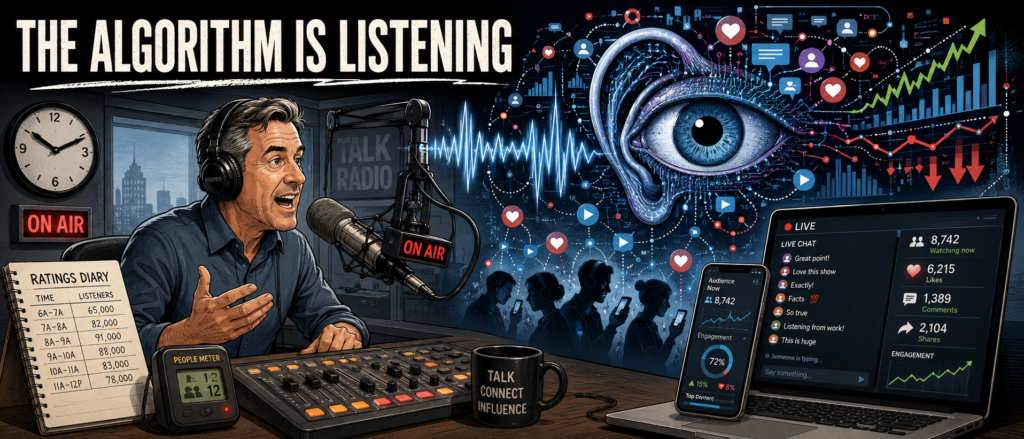
From diaries to PPM
The traditional radio diary asked selected listeners to record what they heard and when they heard it. Nielsen defines the diary as a measurement method in which respondents manually record their listening habits. Those reported habits are then used to estimate listening across a larger market.
The system was necessarily crude. A diary could show that someone reported listening to a station during morning drive. It could not reliably establish whether that person loved the program, ignored it, hated it, stayed because the station was playing in a waiting room, or simply remembered the call letters incorrectly.
Still, the diary produced an enormously valuable number. Ratings influenced advertising rates, station formats, talent contracts, syndication opportunities, and management decisions. The ratings service measured the audience, but the station still controlled the programming and the transmitter.
The Portable People Meter changed the speed and granularity of that feedback. PPM panelists carry a small device that detects inaudible identification codes embedded in participating broadcasts. Instead of relying entirely on a listener’s memory and written entry, the meter passively detects exposure to encoded audio.
That gave programmers something closer to immediate feedback. They could study audience movement within smaller portions of a show, identify apparent tune-out points, compare features, evaluate commercial breaks, and make changes much more quickly.
PPM therefore became the bridge between traditional ratings and algorithmic distribution. The diary remembered the audience. PPM observed the audience more closely. Both still produced information for human beings to interpret.
A programmer could see a decline and decide to shorten a segment. The meter did not shorten it. A consultant could conclude that a feature hurt retention. The PPM system did not prevent tomorrow’s listeners from hearing it.
The algorithm closes that gap.
The scorecard becomes the program director
A digital platform does not merely measure whether content attracted an audience. It uses audience behavior to decide how much additional distribution the content should receive.
YouTube says its recommendation systems examine whether viewers choose to watch, ignore, or reject a recommended video. They also consider viewing duration, percentage watched, likes, survey responses, and other signals intended to predict whether a particular viewer will enjoy the content. Its recommendations are personalized according to the habits and context of each user.
Meta describes a similarly layered process. Its ranking systems evaluate thousands of possible signals and narrow a large pool of candidate posts into the relatively small number that appear in an individual user’s feed. The system is not one universal algorithm producing the same answer for everyone. It consists of multiple models and ranking decisions designed to predict relevance for each user.
That produces a fundamental change.
Ratings told the broadcaster how the show performed – the algorithm uses performance to decide whether the show receives another audience
Imagine a station where every listener receives a different program log. One person hears more legal analysis because that person stayed through the last legal segment. Another receives confrontational political clips because those clips generated repeated viewing. A third hears interviews but rarely monologues because previous behavior suggests that interviews hold attention longer.
The station would no longer broadcast one program to the market. It would continuously assemble a different station for every listener. The necessary mental and physical bandwidth would be overwhelming.
That is roughly what a personalized feed does.
Per platform and per person
There is no single algorithm governing digital media. Each platform develops systems based upon its own content formats, business objectives, safety policies, available data, and desired user behavior.
YouTube may value a combination of selection, viewing duration, satisfaction, and continued viewing. Facebook may rank content according to predicted relevance, previous interactions, direct feedback, and the characteristics of the post. Spotify uses listening behavior and other signals to create recommendations that differ from one listener to another. Spotify has described its personalization as a combination of human editorial judgment, many signals, and multiple systems.
The answer is therefore both per platform and per user.
Two people can follow the same host and still see different clips. One may receive the host’s morning monologue because that person regularly watches political commentary. Another may receive only interviews because the system predicts that interviews are more likely to hold that person’s attention.
Following a creator does not guarantee delivery of everything that creator produces. It usually makes the content eligible for consideration. The platform still ranks it against other material.
That distinction can bewilder broadcasters. A radio station does not normally decide that one regular listener should receive Tuesday’s second hour while another should never know that hour existed. A personalized platform can make exactly that kind of decision at enormous scale and speed.
Shadow banning, down-ranking and ordinary failure
This helps explain why a particular broadcast, podcast episode, or clip may appear to vanish.
Creators often call this shadow banning. Sometimes a platform has imposed an actual restriction, applied a policy, removed content from a recommendation surface, or reduced distribution in a particular category. Platforms can and do change the weight assigned to different content and engagement signals. Meta, for example, has publicly described reducing the distribution of certain political content and changing the importance of comments and shares in ranking that material.
Other times, no formal penalty exists. A clip may receive fewer impressions because the first group of viewers did not choose it, did not remain, or appeared less satisfied than viewers who received competing content. Interest in the subject may have declined. The title may have failed. The platform may have found a different audience segment, or none at all.
From the creator’s side, those explanations can look identical. Reach collapsed. The platform offers incomplete information. The host knows that yesterday’s clip traveled and today’s did not, but cannot see every ranking decision that produced the difference.
That opacity separates algorithms from traditional ratings. Broadcasters could challenge diary methodology or complain about a PPM panel, but they understood that the measurement company was generating an estimate. The ratings company did not simultaneously control the transmitter.
Digital platforms frequently measure the behavior, rank the content, control the distribution environment, sell the advertising, and decide how much information the creator receives about the process.
Who won then, and who wins now?
When a radio station earned strong ratings, the station owner generally won first.
The sales department could charge more for commercial inventory. Management gained bargaining power. A successful host could receive a raise, a stronger time slot, more freedom, or national distribution. Advertisers benefited from access to a desirable audience, but the station assembled and controlled that audience.
The ratings company profited from measuring the marketplace. It did not own the station’s listener relationship.
Under algorithmic distribution, the platform usually wins first.
Strong engagement keeps users on the service, creates additional advertising opportunities, and gives the platform more behavioral information. Every click, pause, replay, skip, search, comment, and return visit improves the platform’s understanding of what may hold attention next.
The creator can also win. A successful program may receive greater distribution, advertising revenue, subscriptions, sponsorships, paid memberships, or direct audience support. But that success remains conditional because the creator rarely controls the next impression.
The platform owns the recommendation environment. The creator supplies the program.
That arrangement does not make the platform an enemy. A platform that distributes a broadcaster’s work, finds new listeners, sells advertising, and shares revenue provides real value. Broadcasters should want those companies to make money because profitable distribution systems continue to invest in distribution.
The concern arises when creators mistake access to a platform for ownership of an audience.
When radio could make a record
Music radio once held extraordinary power over attention.
A station could place a record into rotation and introduce it repeatedly to an entire market. Airplay created familiarity. Familiarity encouraged record sales, requests, concert attendance, press coverage, and additional airplay. A major station did not merely report which songs had become popular. It could help make them popular.
That power came from scarcity. A market had a limited number of significant stations and a limited number of available music positions. The programmer decided which records entered rotation. The listener chose among a comparatively small number of common offerings.
Radio therefore programmed for the market and, at its best, for the culture.
Streaming platforms program at a different scale. Spotify, Apple Music, Amazon Music, and similar services can compare individual listening behavior with patterns generated by millions of other users. Spotify says its personalized systems consider signals including what users hear, when they hear it, and which songs they add to playlists. Newer tools even allow users to inspect or influence the taste profile used for personalization.
A local music director might understand the preferences of a city, format, or demographic. A global platform can identify thousands of smaller behavioral groups inside that market and program differently for each of them.
The platform may therefore program more accurately for the individual.
Radio programmed more powerfully for the culture.
Radio could make a large audience hear the same song. A streaming platform can make millions of people hear different songs selected for each of them. One concentrates attention. The other personalizes it.
The long tail
Broadcast content was once temporary. A segment aired and disappeared unless the station repeated it or someone recorded it. Most interviews, jokes, arguments, calls, and performances went out through the transmitter and were effectively lost to the cosmos.
Digital content can remain available indefinitely. A podcast episode may attract little attention during its first week and become relevant three years later. An old interview may resurface after a news event. A forgotten music performance may reach a new audience because another clip, search, or recommendation leads people back to it.
The archive has become part of the active program.
This long tail creates enormous opportunity, but availability does not guarantee discovery. The platform still decides which part of the archive to place before a user. An old segment may live forever while remaining functionally invisible.
Radio once exercised power by deciding what entered rotation. Platforms exercise power by deciding what emerges from an almost limitless catalog.
The old gatekeeper controlled the present. The new gatekeeper can also revive the past.
The audience enters the show
Livestreaming adds another step to this evolution.
The diary recorded what listeners remembered. PPM detected exposure. The algorithm reacts to behavior. A livestream audience can influence the content while it is still being created.
This is common in gaming (video games, not gambling). Viewers comment, vote, suggest strategies, send paid messages, subscribe, or use platform tools to attract the streamer’s attention. Twitch offers qualifying creators monetization through subscriptions, Bits, and advertising. It also permits simulcasting under its current guidelines, allowing the same live program to appear on Twitch and other services at the same time.
Radio already understands the basic idea. A caller can redirect an interview, challenge the host, introduce a fact, or become the strongest part of the hour.
The difference is scale and visibility.
A caller usually reaches the air after passing through a producer or screener. A livestream chat may produce hundreds or thousands of simultaneous reactions visible to the host, producer, audience, sponsors, and platform.
The producer becomes more than a call screener. The producer becomes an audience editor who watches several streams of participation and decides which contributions improve the program.
Radio first or Twitch first?
A talk-radio program could stream on Twitch while also airing on radio. The technical order matters less than the editorial order.
In a radio-first simulcast, the terrestrial show remains the primary product. Cameras allow Twitch users to watch, comment, subscribe, send questions, and contribute financially. The host occasionally incorporates the digital audience, much as the host incorporates callers.
This model preserves the radio clock, station obligations, and established program structure. Its weakness is that online viewers may feel they are watching a security camera pointed at a radio studio. A successful livestream must acknowledge the chat and give viewers a reason to participate.
A radio-first approach can be successful.
In a Twitch-first program, the livestream audience may influence the topic, pace, questions, and direction of the show more continuously. The radio station then simulcasts or carries that program.
That can also work, but the host must translate the visual and interactive elements. A radio listener should not repeatedly hear, “The chat says we should move on,” without knowing what the chat said or why it matters.
The strongest approach may treat radio and Twitch as two entrances into the same program. Callers contribute by voice. Livestream viewers contribute through chat, polls, paid messages, subscriptions, or questions selected by the producer.
Neither audience should feel secondary. Radio audiences should always feel primary.
One practical warning applies. A talk show made from material the broadcaster owns or licenses is far easier to simulcast than a music-intensive station. Terrestrial music rights do not automatically provide every right required for an audiovisual Twitch stream or archived video. Twitch warns that unauthorized music can produce copyright enforcement, muted material, or other consequences.
Do not let the dashboard host the show
The goal is not to serve the algorithm.
The goal is to make a good show and distribute it profitably through every appropriate channel: terrestrial radio, streaming audio, livestreaming video, podcasts, clips, social feeds, archives, subscriptions, and advertising.
Algorithms can help identify what attracts attention. Livestream chats can reveal confusion or enthusiasm. PPM can show apparent tune-out. Podcast statistics can show completion and return listening.
None of those measurements can fully explain why the work matters.
A host should study audience behavior without surrendering the console to it. The loudest 10 people in a chat do not necessarily represent the thousand people quietly watching. Callers never represented every radio listener. PPM movement does not always identify the cause of movement. A highly engaged audience can still reward anger, repetition, spectacle, or conflict that weakens the program over time.
Immediate information creates the temptation to make immediate changes. Radio learned that lesson with PPM. Digital creators now face the same temptation at greater speed.
A good broadcaster listens to the audience, learns from the audience, and occasionally allows the audience to change the show. A good broadcaster also knows when to finish the thought.
The progression is now clear:
The diary remembered the audience. PPM observed the audience. The algorithm is distributed according to the audience. Livestreaming allows the audience to enter the program itself.
The technology changed. The central obligation did not.
Make something worth hearing. Then understand the systems that determine whether anyone else gets the chance.
Matthew B. Harrison is a media and intellectual property attorney who advises radio hosts, content creators, and creative entrepreneurs. He has written extensively on fair use, AI law, and the future of digital rights. Reach him at Matthew@HarrisonLegalGroup.com or read more at TALKERS.com.