By Matthew B. Harrison
TALKERS, VP/Associate Publisher
Harrison Legal Group, Senior Partner
Goodphone Communications, Executive Producer
 In radio and podcasting, editing isn’t just technical – it shapes narratives and influences audiences. Whether trimming dead air, tightening a guest’s comment, or pulling a clip for social media, every cut leaves an impression.
But here’s the legal reality: editing also creates risk.
For FCC-regulated broadcasters, that risk isn’t about content violations. The FCC polices indecency, licensing, and political fairness – not whether your edit changes a guest’s meaning.
For podcasters and online creators, the misconception is even riskier. Just because you’re not on terrestrial radio doesn’t mean you’re free from scrutiny. Defamation, false light, and misrepresentation laws apply to everyone — whether you broadcast on a 50,000-watt signal or a free podcast platform.
At the end of the day, it’s not the FCC that will hold you accountable for your edits. It’s a judge.
1. Alex Jones and the $1 Billion Lesson
Alex Jones became infamous for promoting conspiracy theories on Infowars, especially his repeated claim that the Sandy Hook shooting was a hoax – supported by selectively aired clips and distorted facts.
The result? Nearly $1 billion in defamation verdicts after lawsuits from victims’ families.
Takeaway: You can’t hide behind “just asking questions” or “it was my guest’s opinion.” If your platform publishes it – over the airwaves or online – you’re legally responsible for the content, including how it’s edited or framed.
2. Katie Couric and the Gun Rights Group Edit
In “Under the Gun,” filmmakers inserted an eight-second pause after Katie Couric asked a tough question, making it seem like a gun rights group was stumped. In reality, they had answered immediately.
The group sued for defamation. The case was dismissed, but reputations took a hit.
Takeaway: Even subtle edits – like manufactured pauses – can distort meaning and expose creators to risk.
3. FOX News and the Dominion Settlement
FOX News paid $787 million to Dominion Voting Systems after airing content suggesting election fraud – often based on selectively edited interviews and unsupported claims.
Though FOX is (among other things) a cable network, the impact shook the media world. Broadcasters reassessed risks, host contracts, and editorial practices.
Takeaway: Major networks aren’t the only ones at risk. Radio hosts and podcasters who echo misleading narratives may face similar legal consequences.
4. The Serial Podcast and the Power of Editing
“Serial” captivated millions by exploring Adnan Syed’s murder conviction. While no lawsuit followed, critics argued the producers presented facts selectively to build a certain narrative.
Takeaway: Even without a lawsuit, editing shapes public perception. Misleading edits may not land you in court but can damage trust and invite scrutiny.
Whether you’re behind a radio microphone or a podcast mic, your editing decisions carry weight – and legal consequence.
The FCC might care if you drop an indecent word on air, but they won’t be the ones suing you when a guest claims you twisted their words. That’s civil law, where defamation, false light, and misrepresentation have no broadcast exemption.
There’s one set of rules for editing that every content creator lives by – and they’re written in the civil courts, not the FCC code.
Edit with care.
Matthew B. Harrison is a media and intellectual property attorney who advises radio hosts, content creators, and creative entrepreneurs. He has written extensively on fair use, AI law, and the future of digital rights. Reach him at Matthew@HarrisonLegalGroup.com or read more at TALKERS.com.


 The “Pareto Principle” is a rule-of-thumb that roughly 80% of revenue comes from about 20% of customers, in many industries. Including radio, where so-called “First Preference” or “P1” listeners – those who listen to your station most – contribute most of your Time Spent Listening.
 Hubbard says, “Gamut’s revenue has grown 47% over the past two years, and the network now spans more than 250 national and local shows, including flagship franchises ‘American Nightmares’ and ‘Professor of Rock,’ plus local sports networks SKOR North in Minneapolis-St. Paul and 312 Sports in Chicago. Hubbard CEO Ginny Hubbard adds. “John has been leading Gamut since the day he walked in the door, and we’ve watched him turn it into something everyone at Hubbard is proud of. He understands this business from the creator’s side and the sales side, and he genuinely cares about the people making these shows. Naming him president is our way of recognizing that, and of letting the industry know how much we believe in where Gamut is headed under John’s leadership.”
 The Wall Street Journal recently described what it calls, “The Trillion Dollar Race to Automate Our Entire Lives.” Artificial Intelligence is rapidly evolving from something that answers questions into something that does things – researching, writing, analyzing, organizing and creating. WSJ describes a coming world of personal AI concierges capable of everything from executive presentations to filling out March Madness brackets. For podcasters, there’s opportunity here. And a warning.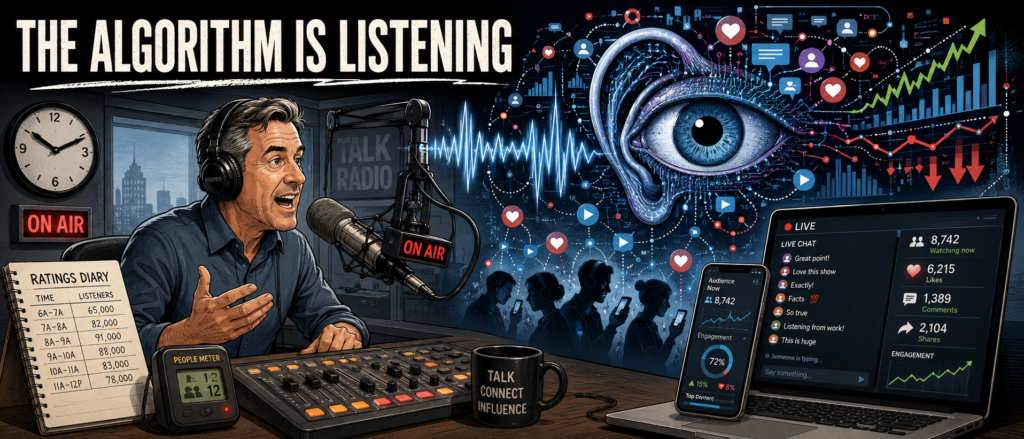

 If you work in radio, you’ve heard every flavor of AI anxiety. Some fear it will wipe out jobs. Others treat it like a super shortcut – cranking-out spots, promos, and proposals faster and cheaper. Kate O’Neill’s
  provides important benchmark measures for usage and behavior around streaming audio, podcasting, radio, smart audio, social media, and debuting this year, never-before-seen data on AI usage. Annual results and trending data from The Infinite Dial are relied upon by its audience of content producers, media companies, agencies, and the financial community.” The webinar will feature Edison vice president of research Megan Lazovick with special guest James Cridland, editor of Podnews.
 TALKERS magazine, the leading trade publication serving America’s professional broadcast talk radio and associated digital communities since 1990, is pleased to participate as the presenting sponsor of the Intercollegiate Broadcasting System (IBS) conference for the second consecutive year. The conference is currently underway in New York.
 radio industry (and its related fields) seeks to connect with and develop a next generation of professional practitioners as well as engaged audiences. TALKERS is honored to again provide financial support, encouragement, experience, and advice to the dedicated organizers of this very special event.
 dashboards and API access that support automated reporting and portfolio-level insights. The collaboration will also support select broadcast attribution initiatives within Audacy’s radio portfolio, complementing existing measurement partners. Audacy president of digital sales Michael Biemolt says, “Audacy consistently strives to deliver measurable results for advertisers, and our partnership with Podscribe further strengthens that promise. With enhanced attribution and transparency across our portfolio, we’re giving clients even greater confidence in how Audacy drives performance at scale.”
 morning radio show with co-hosts DJ Envy, Jess Hilarious and Loren LoRosa. Charlamagne Tha God comments, “When it comes to iHeartMedia, gratitude will always be my attitude. They’ve created space for me to grow not just as talent, but as an executive and true partner through The Black Effect Podcast Network. To say that I’m thankful is an understatement. iHeart is the biggest and best audio company on the planet and audio is the foundation on which the whole media conglomerate will be built. Podcasting, live events, TV/film and documentaries, the sky is the limit for where we are going; and radio will always be at the core of it. Here’s to a new era of growth, impact, and prosperity.”
 The Cumulus Media | Westwood One Audio Active Group unveils an audio planning guide based on data from Edison Research and Nielsen data. Saying that there are incorrect assumptions among strategists and media planners about which audio media have the most listeners, chief insights officer Pierre Bouvard underscores that AM/FM radio is still the dominant ad-supported audio platform with a 66% share. Podcasting is second with a 20% share and this is true across all demographics. For those who are all-in on digital audio only, Bouvard says they are missing 70% of the potential audience as ad-supported Spotify, Pandora and podcasts reach only 30% of the U.S. in a typical day. Further, Bouvard says the data suggests an optimal allocation of audio ad spend: “The ideal allocation for a 25-54 audio plan is 62% AM/FM radio, 24% podcasts, 12% music streaming (Pandora, Spotify, Amazon Music, and YouTube Music), and 2% SiriusXM satellite radio.”
  “Longtimers” and notes that 77% of “First-Years” are consuming podcasts while actually watching the video compared to 69% of “Longtimers” doing the same. Edison says that most new consumers and established podcast fans are actively watching while listening to video podcasts but that video is even more important for engaging with new audiences. While “Longtimers” currently have an affinity for audio only podcasts, that may change over time. Edison concludes that although podcasting is an audio-first platform, “many creators and marketers are likely missing an audience acquisition and engagement opportunity by not considering how to fit video content and video platforms into their strategic planning.”
 last 11 years, the study has been reprised annually to track buy-side podcast advertising consideration and intention. The latest Advertiser Perceptions study, conducted in June 2025 with 302 marketers and media agencies, reveals advertiser/agency podcasting usage and interest has reached an 11-year high.” Some of the notable takeaways from this study include: 1) Nine out of 10 marketers and media agencies say they have discussed podcast advertising for potential investment; 2) Podcast advertising consideration surges to an eleven-year high: 74% of brands and agencies say they are likely to consider advertising in podcasts; 3) Podcast spending intention jumps to 69%, an eleven-year record; and 4) 78% of agencies and advertisers currently advertise in podcasts, a 5X increase since the first IAB podcast upfront in 2015.
 Remember how Larry King would interrupt rambling callers to ask, “What’s your question?” It could sound gruff, but it was really a courtesy, to viewers or listeners. Larry feared TV clickers and dashboard radio buttons. He kept-it-moving to keep viewers and listeners from wandering.
 Radio is an intimate, one-to-one medium; so “you” and “your” – speaking to one person – will resonate more than addressing “all of you.” There’s only one of me.
 Francisco. iHM region president AJ Punjabi says, “Alan’s deep experience in both traditional broadcast and digital audio innovation makes him the ideal leader to drive our business forward. His results-driven approach and commitment to client success will strengthen our market leadership across platforms.” Hirschbein comments, “I’m energized to join iHeartMedia’s tremendous leadership team as vice president of sales. As the enduring leader in broadcast radio, iHeartMedia has also transformed itself into a dynamic force in podcasting and digital audio, standing at the forefront of audio innovation. I’m eager to contribute to this continued evolution and help our partners harness the unmatched reach and engagement that only iHeartMedia can deliver.”

 was $22.3 million, up 7% over Q2 of 2023. Audacy also breaks out revenue by radio format categories and while Sports radio revenue was $71.1 million (up 8.3% over last year), News/Talk revenue was $43 million (a decline of 2.3% from the same period a year ago). Audacy chairman, president and CEO David J. Field comments, “Audacy continued to deliver strong 2024 financial performance with Q2 Adjusted EBITDA more than doubling, up 116% vs. prior year. For the first six months of 2024, Adjusted EBITDA is up 128%. Our accelerating financial performance reflects our significant revenue share gains, low-teen growth in digital advertising, high single-digit growth in network radio, and prudent expense reductions, offsetting continued weakness in traditional ad markets. Notably, our transformational, strategic investments are emerging as a critical driver in our accelerating performance. Recent improvements in our streaming and podcasting platforms, along with further enhancements to our digital monetization and programmatic capabilities are increasing their impact on our top-line and bottom-line results. As previously announced, we received court approval of our consensual pre-packaged Plan of Reorganization in February and are awaiting FCC approval to complete the process. We continue to expect final approval and emergence to occur during the current quarter. The third quarter is currently pacing up low-single digits, and we expect another quarter of significant Adjusted EBITDA growth.”
 43% of spoken word listening, and podcasts 36%. Keep in mind that for Edison’s purposes spoken word content includes news, sports talk and play-by-play, audiobooks, talk shows, and “personalities.” Edison states, “Podcasting’s share of spoken word will almost surely surpass that of AM/FM within a few more years. There is one more thing to note – the advantage for AM/FM is coming entirely from those age 65 and older. Among those ages 13-64, podcasting has already passed AM/FM listening by, 41% to 39%. Meanwhile, among the oldest Americans age 65+, AM/FM radio continues to dominate, with a 66%-13% advantage. Curiously, that 66%-13% difference among the oldest Americans is the exact same difference we recorded for all Americans 13+ in 2017.”
 Because you can? Because you aren’t doing AM/FM radio? Because you are on radio, but can’t-do-there what you can-do podcasting? Because you are making money podcasting?

 proceedings in the United States Bankruptcy Court for the Southern District of Texas and has filed a proposed Plan of Reorganization that incorporates the terms of the RSA and is subject to approval by the Court. Under the terms of the RSA, a supermajority of debtholders committed to vote in favor of the Plan, which, when approved, will reduce Audacy’s funded debt from approximately $1.9 billion to approximately $350 million. Audacy’s debtholders will receive equity in reorganized Audacy. Audacy expects that the Court will hold a hearing to consider the approval of the Plan in February and to emerge from bankruptcy once regulatory approval is obtained from the Federal Communications Commission. Audacy has filed with the Court a series of customary “First Day Motions” to obtain Court authority for the Company to continue operating its business in the ordinary course without disruption to its advertisers, vendors, partners or employees. Audacy expects to operate normally during this restructuring process under its current leadership team.