



The Algorithm is Listening

By Matthew B. Harrison
TALKERS, VP/Associate Publisher
Harrison Legal Group, Senior Partner
Goodphone Communications, Executive Producer
Radio once measured the audience… now digital platforms use the audience to decide what happens next
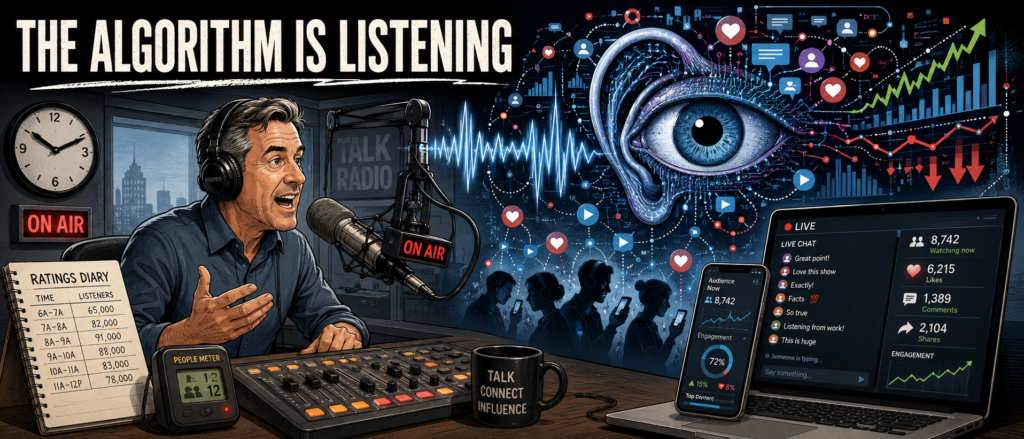
Radio programmers have always watched the audience. The difference for programmers today is that the audience can now watch back, respond instantly, influence the show, and determine whether the next person ever receives it.
That is the practical meaning of an algorithm for a broadcaster. It is not a mysterious robot hiding inside the black box of an enigmatic social platform. It is a set of instructions used to make decisions. On YouTube, Facebook, TikTok, Spotify, Twitch, and other services, those instructions help determine which content gets shown, to whom, in what order, and under what circumstances.
Radio has used simpler forms of algorithmic thinking for decades. A music clock is a set of instructions. So is a rule prohibiting two songs by the same artist within a specified period. Or two female vocals in a row. A programmer who schedules news at the top of the hour, traffic twice an hour, and the strongest feature before a commercial break has created a decision system.
Digital algorithms do something more consequential. They do not merely organize the program. They organize the audience around each individual piece of content.
From diaries to PPM
The traditional radio diary asked selected listeners to record what they heard and when they heard it. Nielsen defines the diary as a measurement method in which respondents manually record their listening habits. Those reported habits are then used to estimate listening across a larger market.
The system was necessarily crude. A diary could show that someone reported listening to a station during morning drive. It could not reliably establish whether that person loved the program, ignored it, hated it, stayed because the station was playing in a waiting room, or simply remembered the call letters incorrectly.
Still, the diary produced an enormously valuable number. Ratings influenced advertising rates, station formats, talent contracts, syndication opportunities, and management decisions. The ratings service measured the audience, but the station still controlled the programming and the transmitter.
The Portable People Meter changed the speed and granularity of that feedback. PPM panelists carry a small device that detects inaudible identification codes embedded in participating broadcasts. Instead of relying entirely on a listener’s memory and written entry, the meter passively detects exposure to encoded audio.
That gave programmers something closer to immediate feedback. They could study audience movement within smaller portions of a show, identify apparent tune-out points, compare features, evaluate commercial breaks, and make changes much more quickly.
PPM therefore became the bridge between traditional ratings and algorithmic distribution. The diary remembered the audience. PPM observed the audience more closely. Both still produced information for human beings to interpret.
A programmer could see a decline and decide to shorten a segment. The meter did not shorten it. A consultant could conclude that a feature hurt retention. The PPM system did not prevent tomorrow’s listeners from hearing it.
The algorithm closes that gap.