



The Algorithm is Listening

By Matthew B. Harrison
TALKERS, VP/Associate Publisher
Harrison Legal Group, Senior Partner
Goodphone Communications, Executive Producer
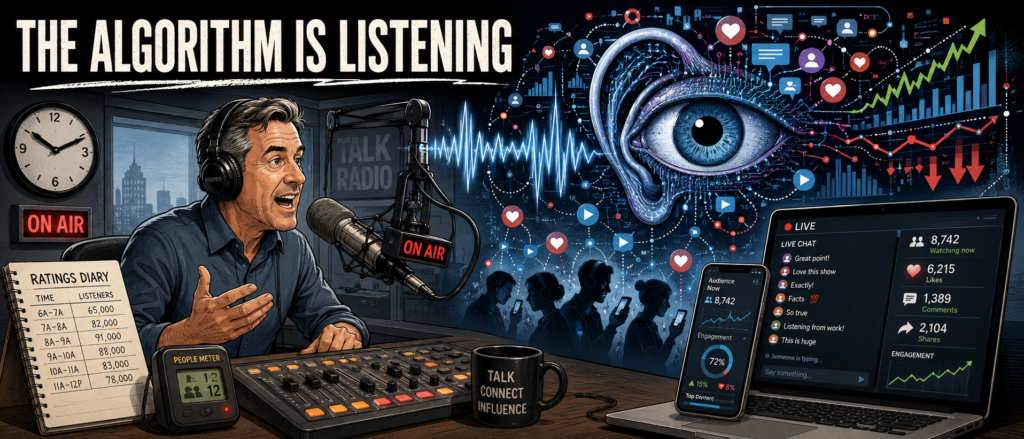
Radio once measured the audience… now digital platforms use the audience to decide what happens next
Radio programmers have always watched the audience. The difference for programmers today is that the audience can now watch back, respond instantly, influence the show, and determine whether the next person ever receives it.
That is the practical meaning of an algorithm for a broadcaster. It is not a mysterious robot hiding inside the black box of an enigmatic social platform. It is a set of instructions used to make decisions. On YouTube, Facebook, TikTok, Spotify, Twitch, and other services, those instructions help determine which content gets shown, to whom, in what order, and under what circumstances.
Radio has used simpler forms of algorithmic thinking for decades. A music clock is a set of instructions. So is a rule prohibiting two songs by the same artist within a specified period. Or two female vocals in a row. A programmer who schedules news at the top of the hour, traffic twice an hour, and the strongest feature before a commercial break has created a decision system.
Digital algorithms do something more consequential. They do not merely organize the program. They organize the audience around each individual piece of content.
From diaries to PPM
The traditional radio diary asked selected listeners to record what they heard and when they heard it. Nielsen defines the diary as a measurement method in which respondents manually record their listening habits. Those reported habits are then used to estimate listening across a larger market.
The system was necessarily crude. A diary could show that someone reported listening to a station during morning drive. It could not reliably establish whether that person loved the program, ignored it, hated it, stayed because the station was playing in a waiting room, or simply remembered the call letters incorrectly.
Still, the diary produced an enormously valuable number. Ratings influenced advertising rates, station formats, talent contracts, syndication opportunities, and management decisions. The ratings service measured the audience, but the station still controlled the programming and the transmitter.
The Portable People Meter changed the speed and granularity of that feedback. PPM panelists carry a small device that detects inaudible identification codes embedded in participating broadcasts. Instead of relying entirely on a listener’s memory and written entry, the meter passively detects exposure to encoded audio.
That gave programmers something closer to immediate feedback. They could study audience movement within smaller portions of a show, identify apparent tune-out points, compare features, evaluate commercial breaks, and make changes much more quickly.
PPM therefore became the bridge between traditional ratings and algorithmic distribution. The diary remembered the audience. PPM observed the audience more closely. Both still produced information for human beings to interpret.
A programmer could see a decline and decide to shorten a segment. The meter did not shorten it. A consultant could conclude that a feature hurt retention. The PPM system did not prevent tomorrow’s listeners from hearing it.
The algorithm closes that gap.
 …I’m sharing promo copy now airing on my client stations, which addresses listeners’ – and advertisers’ — 2026 apprehensions:
 provide CMLI with opportunities to engage with students and the campus community through WHPC and select college events. The college will also make available WHPC-produced public affairs programming, as well as student-produced content for potential use across CMLI’s stations. Connoisseur Media regional SVP Kristin Okesson says, “We’re excited to partner with Nassau Community College to help inspire and develop the next generation of radio and media talent. Partnerships like these create a direct pipeline for passionate students to gain real-world experience, build important industry connections, and ultimately become the future superstars of our business. We appreciate Shawn Novatt and the NCC team for their commitment to creating these opportunities, and we look forward to working together to support students as they begin their careers in broadcasting and media.”
 1940s, when broadcast dominated mass communications in the U.S. Since then, the media marketplace has changed drastically – from widespread deployment of cable and satellite television networks to the rise of social media, podcasts, and streaming. Local broadcasters compete directly with Big Tech, streaming services, and social media platforms in the marketplace of consumer content. Yet, unlike their competitors such as YouTube and Facebook, broadcasters are limited by the ownership rules in how many households and consumers they can reach. This is an inherent disadvantage.” The letter adds, “By eliminating the national television cap, local TV duopoly restrictions, and local radio ownership caps, broadcasters can better achieve the scale and efficiencies necessary to compete – and to attract vital investment – in a fragmented and rapidly evolving information market.”
  political sales for their Katz Digital Video division. The promotions are effective immediately. The company says these leadership moves reflect Katz’s continued
  investment in delivering strategic, results-driven solutions for political advertisers through both linear and digital media. Katz Media Group CEO Mark Gray states, “Katz has built the most experienced and trusted political sales team in the industry. With deep-rooted expertise across both broadcast and digital, our team delivers unmatched scale, strategy, and results for political advertisers. As the landscape continues to evolve, Katz remains the go-to partner for campaigns looking to connect with voters in meaningful and measurable ways.”
 digital content programming, production, and broadcasting processes while creating stickier listener environments and more opportunities for advertisers to engage with them.” Audacy chief technology officer Sarah Foss says, “As the nation’s second-largest radio broadcaster, we’re always integrating cutting-edge technologies into our stack to deliver the best experiences for our 200 million monthly listeners and more efficiencies to our business. This partnership underscores our commitment to building the future of digital audio, and we’re thrilled to see it start coming to fruition.”
 Broadcast revenue decreased 5.3% to $49.7 million from $52.5 million; Station Operating Income decreased 43.5% to $6.2 million from $10.9 million; Same Station net broadcast revenue decreased 5.8% to $49.4 million from $52.4 million; and Same Station operating income decreased 37.7% to $6.8 million from $10.9 million. Digital Media revenue increased 0.5% to $10.9 million from $10.8 million, and Publishing revenue decreased 3.5% to $5.2 million from $5.4 million. Salem reports that as of June 30, 2023, the company was not in compliance with its fixed charge coverage ratio. On August 7, 2023 it signed a forbearance whereby the bank agreed not to exercise remedies on the default during the month of August. Additionally, the notional amount of the revolver was reduced from $30 million to $25 million with a minimum availability of $1 million. The interest rate associated with the revolver increased by two percentage points effective July 1, 2023 through the date of the forbearance amendment.
 a proven track record of driving success for digital clients across broad spectrum of media, including broadcast television, newspaper, and radio. He brings with him a
  passion for developing digital strategy that delivers results for local businesses.” Tyler Toti comes to Tulsa from CMG San Antonio to serve as digital client performance manager. CMG Tulsa VP and market manager Mark Shecterle comments, “Ben and Tyler have an impressive history of working collaboratively to develop successful digital media strategies for their client partners. Their expertise, coupled with CMG’s vast array of topline digital products, will create a powerful resource for Tulsa businesses. I’m thrilled to have them join our veteran team of market-leading media consultants.” CMG Tulsa operates news/talk KRMG-FM and three music-formatted stations.
 increased 17.4% to $67.7 million leading to an operating loss of $4.2 million as compared to operating income of $5 million posted in Q1 of 2022. Salem reports a net loss of $5.2 million, compared to Q1 2022’s net income of $1.7 million. Salem reports in three segments – Broadcast, Digital Media, and Publishing. Broadcast revenue for the quarter was $48.3 million (down 0.2%), Digital Media was $10.5 million (up 2%), and Publishing revenue was $4.6 million (up 19.7%). Looking ahead, the company is projecting total revenue to decline between 5% and 7% from the second quarter 2022 total revenue of $68.7 million and expects operating expenses to increase between 3% and 6% compared to Q2 of 2022.
  2023 who carry a computer – a smartphone – with them all the time. Other findings from this year’s edition of the study include: 1) 75% of Americans 12+ have listened to online audio in the last month; 2) Among U.S. adults age 18+ who have ridden in a car in the last month, 37% are listening to online audio in the car, up from 32% last year; 3) 42% of Americans 12+ have listened to a podcast in the last month, a new all-time high and up from 38% in 2022; and 4) 38% of U.S. adults age 18+ who have ridden in a car in the last month say they listen to podcasts in the car, up from 32% in 2022. Edison Research VP Megan Lazovick says, “After two previous annual studies that showed clear effects from the COVID-19 disruptions, the trends in audio and social media habits seem to be back on pattern. The growth of online audio and podcasting to record high levels is exciting to reveal.”
  own. It remains competitive with podcasts and DSPs (Digital Streaming Providers, such as Spotify, Apple Music, Pandora, and others) when consumers are in vehicles or public transit during the early morning and late afternoon commutes, and on weekends.” Respondents were asked to select a top preference from a list of audio entertainment choices and their top choices were (for morning commuters), broadcast FM/AM radio with 19% of the sample, followed closely by podcasts, with streaming coming in at third. The study indicates the competition is closer during the late afternoon commute, where podcasts and streaming barely eclipse radio as the top choice among commuters at 15% vs. 14% of the sample, respectively. And radio remains competitive as an audio entertainment favorite among listeners on the go during the weekend, sharing the top spot with DSP’s and eking ahead of podcasts.
  study illuminate how Black Americans consume podcasts, discover podcasts, why they listen, and more. The study is a follow-up to the original
  programming and individual achievement by, for and about women in television, radio/audio and digital media. Submissions from all facets of media are encouraged. A full list of the categories can be found