


Industry Views

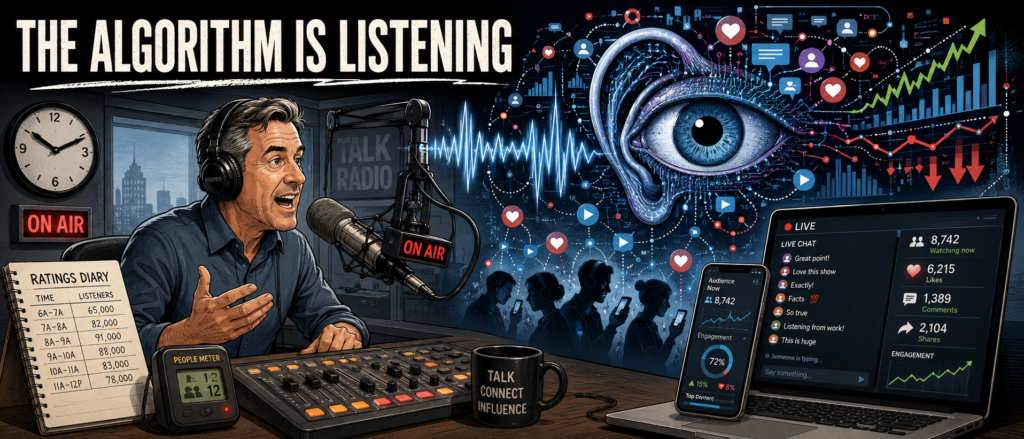
The Algorithm is Listening
1527a63f d481 4de5 8636 2bcf88a23c44

img

By Matthew B. Harrison
TALKERS, VP/Associate Publisher
Harrison Legal Group, Senior Partner
Goodphone Communications, Executive Producer

Radio once measured the audience… now digital platforms use the audience to decide what happens next

Radio programmers have always watched the audience. The difference for programmers today is that the audience can now watch back, respond instantly, influence the show, and determine whether the next person ever receives it.

That is the practical meaning of an algorithm for a broadcaster. It is not a mysterious robot hiding inside the black box of an enigmatic social platform. It is a set of instructions used to make decisions. On YouTube, Facebook, TikTok, Spotify, Twitch, and other services, those instructions help determine which content gets shown, to whom, in what order, and under what circumstances.

Radio has used simpler forms of algorithmic thinking for decades. A music clock is a set of instructions. So is a rule prohibiting two songs by the same artist within a specified period. Or two female vocals in a row. A programmer who schedules news at the top of the hour, traffic twice an hour, and the strongest feature before a commercial break has created a decision system.

Digital algorithms do something more consequential. They do not merely organize the program. They organize the audience around each individual piece of content.

From diaries to PPM

The traditional radio diary asked selected listeners to record what they heard and when they heard it. Nielsen defines the diary as a measurement method in which respondents manually record their listening habits. Those reported habits are then used to estimate listening across a larger market.

The system was necessarily crude. A diary could show that someone reported listening to a station during morning drive. It could not reliably establish whether that person loved the program, ignored it, hated it, stayed because the station was playing in a waiting room, or simply remembered the call letters incorrectly.

Still, the diary produced an enormously valuable number. Ratings influenced advertising rates, station formats, talent contracts, syndication opportunities, and management decisions. The ratings service measured the audience, but the station still controlled the programming and the transmitter.

The Portable People Meter changed the speed and granularity of that feedback. PPM panelists carry a small device that detects inaudible identification codes embedded in participating broadcasts. Instead of relying entirely on a listener’s memory and written entry, the meter passively detects exposure to encoded audio.

That gave programmers something closer to immediate feedback. They could study audience movement within smaller portions of a show, identify apparent tune-out points, compare features, evaluate commercial breaks, and make changes much more quickly.

PPM therefore became the bridge between traditional ratings and algorithmic distribution. The diary remembered the audience. PPM observed the audience more closely. Both still produced information for human beings to interpret.

A programmer could see a decline and decide to shorten a segment. The meter did not shorten it. A consultant could conclude that a feature hurt retention. The PPM system did not prevent tomorrow’s listeners from hearing it.

The algorithm closes that gap.

(more…)

Front Page News Industry News

Monday, January 31, 2022

Monday Memo: Talk Radio 101 – LISTEN. “Streaming has music radio on its heels, because,” in consultant Holland Cooke’s view, “The Sentence Never Spoken is ‘Alexa, please play six commercials.’” Yet Cooke warns that “talkers should avoid taking false comfort that we’re less vulnerable to digital competitors, because people are using social media to talk to each other without us.” In this week’s column, HC details techniques to engage callers. Read it here.


Pending Business: It’s a Matter of Trust. Radio sales pro Steve Lapa says that it’s not unusual for news/talk radio sellers to unwittingly overlook the importance of the trust and credibility that their station’s hosts have engendered with their listeners. Too often, this important quality that’s not easy to match is left out of proposals for one reason or another. Read his column here.

Adriana Rizzo Named SVP of Consumer Marketing for Audacy. Marketing pro Adriana Rizzo joins Audacy as SVP of consumer marketing, effective January 31. In this role, Rizzo will lead the company’s audience growth initiatives across brand strategy, creative, messaging, media planning and attribution, while also managing the company’s Alchemy function, focused on the strategic integration of exclusive content and programming to Audacy’s over 200 million listeners. Audacy chief marketing officer Paul Suchman says, “We’re thrilled to have Adriana join our growing team. Her hire underscores our commitment to world-class marketing and our vision to become the audio platform of choice for consumers. The timing of Adriana’s hire is well aligned with our deep investments in technology and our future-proofed digital platform. Adriana will be a key partner to our business lines and to our marketing leads across broadcast, digital, sports betting and podcasting.” Rizzo was most recently with Discovery and launched streaming service Discovery+. She’s also served with ESPN. She comments, “I’m very excited to be joining Audacy at such an important and strategic time for the company and the industry. I look forward to working closely with this talented team and helping Audacy achieve new heights.”

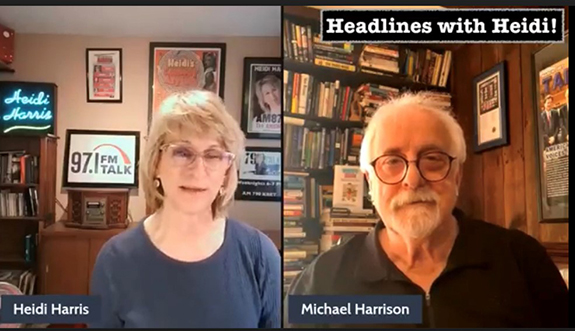
After YouTube Snub, Heidi Harris Launches Vimeo Show. Twenty-four-year veteran Las Vegas-based radio talk show host Heidi Harris, currently heard at “97.1 FM Talk St. Louis” (KFTK-FM), is another conservative commentator recently banned from YouTube because of political content that the mega-platform says doesn’t meet its standards. In response, she has launched a new channel on Vimeo which will feature her daily “Headlines with Heidi” program. TALKERS founder Michael Harrison served as her first guest. Harris and Harrison discussed the current Big Tech censorship controversy as well as a number of “behind-the-scenes” talk media issues. To see the program, please click here.

2022 iHeartRadio Podcast Awards Take Place Virtually on Thursday. A number of celebrities will make guest appearances on this Thursday’s 2022 iHeartRadio Podcast Awards. The program was originally to take place live at the iHeartRadio Theater in Los Angeles but will now happen virtually at 9:00 pm ET on February 3 streaming on iHeartRadio’s YouTube channel and Facebook page as well as broadcast across select iHeartMedia radio stations nationwide. iHeartMedia says stars appearing include: Jason Bateman, Sean Hayes and Will Arnett, Martha Stewart, Matt Rogers and Bowen Yang, Paris Hilton, Shonda Rhimes, Will Ferrell, Wilmer Valderrama, and many more. While winners from most categories will be decided by a panel of industry leaders and creatives, the Podcast of the Year award is decided by social voting on Twitter. The nominees for Podcast of the Year are: “Code Switch,” “Conan O’Brien Needs a Friend,” “Crime Junkie,” “Louder Than a Riot,” “Office Ladies,” “SmartLess,” “Stuff You Should Know,” “The Daily,” “The Midnight Miracle” and “You’re Wrong About.”

Round Four of Holiday PPM Ratings Released. The fourth and final round of ratings data from Nielsen Audio’s Holiday PPM survey has been released for 12 markets including: Austin, Raleigh, Indianapolis, Milwaukee, Nashville, Providence, Norfolk, Jacksonville, West Palm Beach, Greensboro, Memphis, and Hartford. Nielsen’s Holiday 2021 sweep covered December 9 – January 5. Today, TALKERS magazine managing editor Mike Kinosian presents his Ratings Takeaways from this group of markets. Due to holiday listening habits influenced by Christmas music, spoken-word stations often lose share during this period, but not all stations saw losses this time around. In Indianapolis, Emmis Communications’ news/talk WIBC-FM adds seven-tenths for an 8.8 share (weekly, 6+ AQH share) but remains ranked #3 in the market. Cumulus Media’s WWTN-FM, Nashville “SuperTalk 99.7” is up eight-tenths for a 6.1 share finish and climbs from the #8 rank to #3. In Providence, Cumulus Media news/talk WPRO-AM/WEAN-FM rises nine-tenths to a 6.7 share but is still ranked #5 in the market. iHeartMedia’s WJNO, West Palm Beach adds a half share for a 2.3 share finish good for the #11 rank. You can see Mike Kinosian’s complete Ratings Takeaways from this group of markets (as well as the first three rounds) here.

Ukraine Tensions/Sanctions, COVID-19, U.S.-China Relations/Olympics, Midterm Elections/Trump & the GOP, Spotify’s COVID Issue, Supreme Court Opening, North Korea Missile Test, and NFL Playoffs Among Top News/Talk Stories over the Weekend. Russia’s military build-up at the Ukraine border and the West’s threatened sanctions if Russia invades; the rate of COVID-19 cases in the U.S. and abroad, and mask & vaccine mandates; the Biden Administration’s relations with China and the Beijing Winter Olympics; the battle for control of Congress in the November midterm elections and Donald Trump’s influence on the GOP; Spotify deals with artists pulling their music in response to what they term medical misinformation being spread on the “Joe Rogan Experience”; the controversy over President Joe Biden’s promise to nominate a Black woman to fill retiring Justice Stephen Breyer’s Supreme Court seat; North Korea tests a new missile causing concern over its military ambitions; and the Cincinnati Bengals will face the Los Angeles Rams in the Super Bowl after Sunday’s games were some of the most-talked-about stories on news/talk radio over the weekend, according to ongoing research from TALKERS magazine.

Advice

Monday Memo: Talk Radio 101 – LISTEN

By Holland Cooke
Consultant


BLOCK ISLAND, RI — Talk radio isn’t just different than music radio. It’s better. Talk radio is never on in the background. And streaming has music radio on its heels, because The Sentence Never Spoken is “Alexa, please play six commercials.”

Yet talkers should avoid taking false comfort that we’re less vulnerable to digital competitors, because people are using social media to talk to each other without us. So joining the conversation there is now table stakes. But defending the towers remains Job One.

(more…)