A sports moment for the ages, a botched radio call, a live broadcast believed lost forever… then miraculously rediscovered. What a story!
By Mark Wainwright
 The History Channel calls it “The Most Dramatic Home Run in World Series History.” ESPN has often described it as the greatest home run of all time. To this day, it is the only World Series Game 7 walk-off home run.
Long-time baseball fans know the basic facts: On October 13, 1960, Bill Mazeroski of the Pittsburgh Pirates hit a line drive over the left field wall at Pittsburgh’s Forbes Field to win the World Series for the Pirates.
This was an iconic moment in baseball history, and an iconic moment in baseball broadcasting history, as well … although the Hall of Fame broadcaster who described the moment for the national radio audience probably wished he could have done a second take!
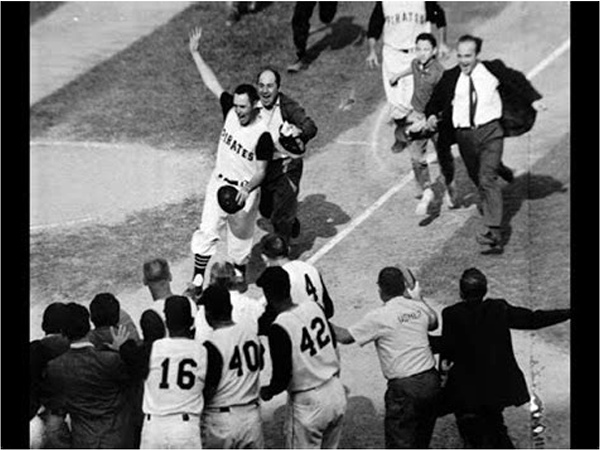
Above: Bill Mazeroski crosses the plate for the Game 7 victory! (photo courtesy YouTube)
It was a dramatic finish to an astonishing World Series, but as often happens, the backstory of that moment and how it was broadcast– and everything that led up to it – has been largely forgotten. As we follow this year’s MLB playoffs (while taking note of the anniversary), it’s worthwhile to look back at an earlier, very different era of post-season baseball…
******************************
The 1960 World Series opponents could hardly have been more different. The New York Yankees of that era were a machine, and the 1960 team easily dominated the American League on their way to the pennant. In contrast, the Pittsburgh Pirates were a surprise. The Pirates had not been to the Series since 1927, they were coming off a mediocre 1959 season, and expectations were low… but they got off to a good start and managed to keep it going. With timely pitching, clutch hitting, lucky breaks, and a never-say-die attitude (21 of their 95 wins came in their final at-bat), the Pirates claimed the National League pennant. The Yankees were studs, while the Pirates were scrappers, and the first six games of the Series reflected the character and personality of the respective teams.
In their three wins, the Yankee sluggers clobbered Pittsburgh pitchers for 38 runs. Yet, the Pirates managed to hang on, squeezing out three close victories in response. It all came down to Game 7 at Forbes Field on the afternoon of Thursday, October 13. Not only were there multiple Hall-of-Famers on the field and in the dugouts, there were Hall-of-Famers in both the TV and radio broadcast booths:
NBC’s national TV broadcast (in “Living Color!”) was handled by Yankees announcer Mel Allen and the Pirates’ Bob Prince, while NBC’s national radio broadcast was called by the Chicago Cubs’ Jack Quinlan, and Chuck Thompson, the play-by-play voice of the Washington Senators… wait, what? The Washington Senators? Wasn’t Chuck Thompson the voice of the Baltimore Orioles forever? For most of his career, yes… but Thompson was caught in a business dispute between the Baltimore brewery that owned the Orioles and the Baltimore brewery that owned his broadcasting contract, so Chuck wound up in Washington for a while (alas, as so often happens in life, it was a battle between money and beer, and money won out).
Game 7 combined and concentrated all the craziness of the previous six. Both pitching staffs were tired, and the hitters took advantage; it is the only game in World Series history where no pitcher from either team recorded even a single strikeout. The Pirates jumped out to an early 2-0 lead, but the New York offense awakened and the Yankees took a 7-4 lead into the bottom of the eighth inning. That’s when things really started to get strange…
In the Pittsburgh half of the 8th, it appeared a routine ground ball would start a double-play and stall a potential Pittsburgh rally… but the ball took a bad hop and hit Yankee shortstop (and later, Hall of Fame broadcaster) Tony Kubek in the throat. He got up bleeding and gasping for air, and was taken to the hospital with bruised vocal cords and a swollen trachea.The injury didn’t damage Kubek’s future career, but it kept the Pirates alive, and they followed with five runs to take a 9-7 lead into the 9th inning. Just three outs away, and yet…
The Yankees scored two runs to tie it at 9-9. The tying run was another odd play; a hard shot toward first base looked like a game-ending (and Series-ending) double play, but Pittsburgh first baseman Rocky Nelson took the easy out at first… which turned the play into a fielders’ choice. Mickey Mantle (the runner already on first) dove back to base and avoided the tag, which gave the Yankee runner on third the opportunity to tie it up. The Yankee inning ended with a routine ground out, so it all came down to the bottom of the 9th.
New York manager Casey Stengel left Ralph Terry in to pitch the 9th, with 15-game-winner Art Ditmar warming in the bullpen, if needed. Second baseman Bill Mazeroski would lead off the inning for the Pirates. Mazeroski was much better known for his outstanding glove work than his hitting, but he had one of the Pirates’ hottest bats late in the season, and it paid off.
Ball one, high. Catcher Johnny Blanchard went to the mound to briefly confer with Terry. Up in the radio booth, Chuck Thompson was obviously caught up in the excitement of the moment and everything leading up to it:
“Well, a little while ago, when we mentioned that this one, in typical fashion, was going right to the wire, little did we know…”
Then, at 3:36 pm, the 1-0 pitch, and…
“Art Ditmar throws…”
(Chuck, no! Ditmar’s still in the bullpen! Terry’s pitching!)
Thompson called the following moments superbly when Mazeroski connected and the ball sailed over the wall at the 406’ mark. Pandemonium ensued as Mazeroski quickly rounded the bases. Fans poured onto the field; it looked like half of Pittsburgh was poised to welcome him at home plate.
Unfortunately, Thompson committed another gaffe in the midst of the uproar:
“Ladies and gentlemen, Mazeroski has hit a one-nothing pitch over the left field fence at Forbes Field to win the 1960 World Series for the Pittsburgh Pirates by a score of ten to nothing!”
(Chuck, no! Look at the scoreboard! Look at your scorecard!)
…to his credit, he corrected himself moments later.
As both a long-time broadcaster and a Baltimore native – someone who heard Chuck Thompson broadcast countless games for the Baltimore Orioles and the Baltimore Colts of the NFL – it’s bizarre to hear Thompson commit these gaffes. Chuck Thompson did NOT make mistakes like this; he just didn’t. In his 1996 autobiography, he called it “easily the most embarrassing moment of my career behind the microphone.” His flawed moment did not derail a stellar career. In 1993, he received the Ford C. Frick broadcasting award from the Baseball Hall of Fame, and his name is honored in Cooperstown alongside the greats of the sport.
There’s a YouTube link, of course. Whoever produced it did a nice job of capturing this iconic event in sports history. You’ll hear Chuck Thompson’s “flawed but endearing” (as Wikipedia describes it) radio call of the homer, combined with the actual broadcast video. Although the audio portion switches over to Mel Allen’s TV call toward the conclusion, this minor deviation from the archived radio recording does nothing to spoil the drama and excitement. And by the way… the story behind how and why the Game 7 telecast was preserved is amazing enough on its own. So stay tuned for our post-game wrap-up!
The Greatest Home Run!
******************************
EPILOGUE
Although NBC videotaped all seven games (in “Living Color!”), those recordings soon disappeared. As I’ve mentioned in previous articles, videotape was very expensive back then, the reels were cumbersome, and storage was an issue. Thus, networks often re-used the tapes for various purposes, wiping everything that was recorded previously. Countless hours of television history have been lost due to this practice. So why did the entire TV broadcast of Game 7 survive intact (at least in black-and-white)?
You can thank Hollywood singing star Bing Crosby. Bing held an ownership interest in the Pirates then and was a huge fan, but he was oddly superstitious about things. He believed that watching the game on television would jinx the team, and showing up at Forbes Field would have been even worse. So he and his wife took off for a brief vacation in France, where he listened to the broadcast on shortwave radio. However…
Crosby had a close relationship with Ampex (including a financial interest), and he asked the folks at Ampex to record the game so he could watch it upon his return (but only if the Pirates won!). It’s not clear whether they taped it and transferred it to kinescope film or if they filmed a kinescope directly from the live broadcast. In any event, a black-and-white kinescope was saved and presented to Crosby. Presumably, Bing enjoyed viewing it and subsequently stashed it in his basement – where it remained untouched for forty-nine years!
In 2009, long after Crosby’s death, Robert Bader – an executive from Bing Crosby Enterprises – was going through materials at Crosby’s former home in Hillsborough, California. He was looking for any useful recorded video that could be transferred to DVD and marketed, and he stumbled onto the five-reel set in Bing’s wine cellar! It is the only known copy of the historic game. The reels were preserved and digitized, and later broadcast as part of several retrospectives covering the 1960 World Series and Game 7 specifically.
So… what’s mellowing in your wine cellar?
******************************
Mark Wainwright is a veteran radio performer and voiceover artist who has spent decades working as a disc jockey, talk show host, and morning personality at well-known radio stations throughout the United States. He was most recently the morning host at WSYR in Syracuse, New York. Mark can be reached through his LinkedIn page or at: markwainwright@earthlink.net
Share this with your network



 2018, Nielsen’s Total Audience Report reveals the 18-49 weekly reach of live and time-shifted TV has dropped -26%. Over the same period, TV’s daily time spent is down -59%; 2) cord-cutting is a major driver of TV’s audience collapse: The MRI Simmons January 2023 “How Americans Watch TV” report reveals 51% have cut the cord; 3) While a huge number of Americans have abandoned traditional TV for streaming, AM/FM radio remains the dominant audio platform: According to Edison Research’s Q2 2023 “Share of Ear,” AM/FM radio has a massive 69% share of U.S. ad-supported audio. AM/FM radio audience shares are over 17 times larger than ad-supported Pandora and ad-supported Spotify. See the full blog post here.
 After post-consolidation cutbacks have whacked local on-air content, there’s now angst that Artificial Intelligence can – literally – dehumanize radio (and other media – HUGE issue in the SAG-AFTRA strike). Voice cloning is child’s play; and several vendors are already peddling AI gimmicks to radio stations.
 money for the past 20 years, Gleason has built a massive online archive of broadcasting and cable trade publications, books, music magazines, technical manuals, directories, yearbooks, company and station publications, programming guides and more. The archive — www.worldradiohistory.com — now tops nine million pages. Because it is online, the pages are readily available to the public – and searchable.” LABF co-chairs Heidi Raphael and Jack Goodman say, “There is no stopping him. What David has accomplished – virtually single-handedly — is extraordinary. He’s made an unparalleled contribution not only to the history of broadcasting, but to the story of the modern world as reflected and shaped by the media.”
 own problems by increasing overall interference on the band, leading many stations to abandon it.” But all-digital AM is a much better signal and as more and more infotainment systems in new cars are HD compatible, more listeners are likely. Outfitting AM stations with digital transmitters is not inexpensive, even though they use far less electricity than an analog AM transmitter. And in the United Kingdom where digital audio broadcasting (DAB) launched more than 10 years ago, most commercial radio stations still broadcast an analog signal as well. Even though about 60% of listening in the UK is to DAB signals, Ofcom recently agreed to renew analog licenses through 2032 because many Britons still listen to analog on their old radios.
  Thanks to those who sent comments on last week’s column “
 As your friends get fired and on-air hosts are replaced with WideOrbit and Profitable Software, the mournful refrain is to unfairly blame consolidation. Consolidation has, in fact, made the medium financially viable and brought hundreds of individual stations from a river of red ink to the glow of black ink. Prior to consolidation, over half the radio stations in the U.S. lost money – year after year. Not a secret stat, those numbers were revealed annually by the NAB.
 compete effective in the Philadelphia market for six months after the official separation. This comes after Gargano announced his role as a content provider for AllCity Network’s new Philadelphia sports content platform PHLY and Beasley charged that Gargano was violating his deal with WPEN. According to the terms of the preliminary injunction, Gargano can’t do any work for AllCity that appears on PHLY; he may do a national podcast and radio show with Brian Baldinger but PHLY can’t promote it; he can’t divulge confidential information about Beasley practices and can’t solicit Beasley clients until 18 months after the date of the injunction.
 were 33% more likely to say the brand “partners with all my favorite stores,” 81% more likely to indicate the e-commerce retailer “is a brand I trust,” 140% more likely to associate the brand for offering “the best sales and coupons”; 2) among those exposed versus those not exposed, brand equity measures surged, showing 54% growth in familiarity, 31% lift in average brand images, 37% greater consideration, 102% increase in purchase intent, and 55% growth in customer forecast; and 3) concluded that best practices to power direct-to-consumer marketing effectiveness calls for allocating 74% of marketing budgets to creating future demand (brand building) and 26% to converting existing demand (sales activation), targeting broadly to expand the customer base, employing emotional advertising to build direct-to-consumer brands and drive sales and profit, being known before you are needed, and buying lots of ads in all days and dayparts.
  Thanks to those who sent comments on last week’s column “
 Glenn Beck, Sean Hannity, Jesse Kelly, and Clay Travis & Buck Sexton, as well as Key Networks’ Bill O’Reilly. The story indicates the station’s cume has skyrocketed from about 2,100 listeners per month to 29,000 in the first week after the change (Sept. 7-13). Adell tells the paper he has no regrets about the move, “The more divided we are, the better it is for radio. It comes down to one thing — show business. If we live in a utopia, we have nothing to talk about.” Adell also says he expects cume to jump to 200,000 per month as he continues to promote the new lineup. At the time of the change, the Black community was upset with the firing of the (unpaid) hosts and the format flip, but Adell said it was purely a business move. “[T]he format was no longer profitable and only attracted about 2,100 listeners a month, an abysmally small audience for a radio station. When you look at it, no one supported it. I couldn’t get the community to support it.”
 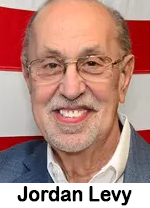 AM, Worcester talk radio host Jordan Levy died yesterday (10/5) after a years-long illness at age 79. Current WTAG morning personality Jim Polito is quoted in the story saying, “There are so many people he did things for. He loved the city of Worcester.” Levy was first elected mayor in 1987. After leaving office in 1993, he hosted the afternoon drive show on WTAG.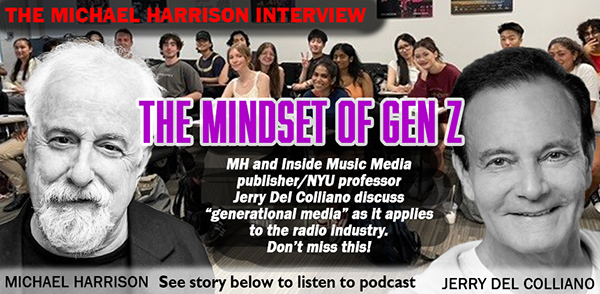
 personalities, programmers and operators who contributed with greatness to the radio industry and have since passed away. The 2023 class includes: talk radio personality Bob Grant, Saga Communications chief Ed Christian, and talk personality Long John Nebel. Radio Hall of Fame co-chair Kraig T. Kitchin comments, “It’s heartfelt recognition to see these individuals and their career contributions to the radio industry recognized with this induction. They’ve made a forever impact on the audiences and businesses they interacted with and for that, we’re grateful.”
  laundering scheme. The Court recognized that an important part of this sentence was for the defendant to provide restitution to the victims. In financial crimes cases such as this, providing restitution to victims is one of the highest priorities of the U.S. Department of Justice and this Office.” Free Talk Live co-founder Mark Edge (right) tells TALKERS magazine, “It was a sad day for ‘Free Talk Live’ yesterday. Ian, our co-founder, received eight years in prison, followed by two on probation and a $40,000 fine. Restitution and forfeiture are as yet to be determined but will likely be six figures. Ian maintains his innocence but was taken into custody following sentencing. We were prepared for this possibility, as much as we could be. ‘Free Talk Live’ will go on seven nights a week from 7:00 pm to 10:00 pm ET.”
  Macon, Georgia. The Macon Telegram reports that “Creekside Sports” is hosted by Steve Norris and Daniel Shirley. The piece notes that Norris has experience broadcasting area high school and junior college football and has served as a local sports and news reporter, having been a freelance sportswriter for The Telegraph from 2008 until 2012.
 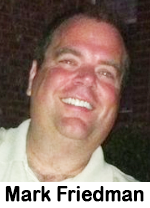 sports radio, starting at 570 KLIF in 1994 and eventually joining host Norm Hitzges in moving to 1310 The Ticket [KTCK-AM] in 2000.” Friedman’s brother Joel posted the news of his passing on Facebook, says, “It is with a heavy heart that I share the news of my brother’s passing. Many of you knew about his health battle over the past several years, and he had been doing remarkably well considering everything he had gone through.”
 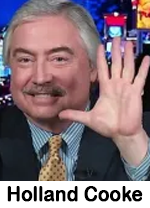 Radio talkers: What is this hour about? How will listeners benefit from listening? And how long do you expect them to wait to hear that?
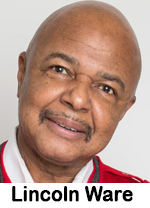 first gig at age 22 in WCIN-AM. WLWT-TV reports that Cincinnati Vice Mayor Jan-Michele Kearney will emcee the street-naming ceremony. She says, “Lincoln Ware is unbelievable. In my office in city hall, we keep the Lincoln Ware show on every day. Somebody’s assigned to listen, and they come back and say, ‘Here’s what they talked about today, listen to this.’ So, you know, we’re always well-informed.” The city says Ware is being honored due to his “lasting impact on the Cincinnati local media community and to health and wellness within the African American community with his Lincoln Ware Walking Club. His legacy, contributions, and dedication to the City of Cincinnati and its citizens will long be remembered.”

 radio and media company personnel focusing on where broadcasters are vulnerable and steps that should be taken to become more secure as well as comply with federal regulations. The 90-minute webinar will take place on Friday, October 20 at 2:00 pm ET.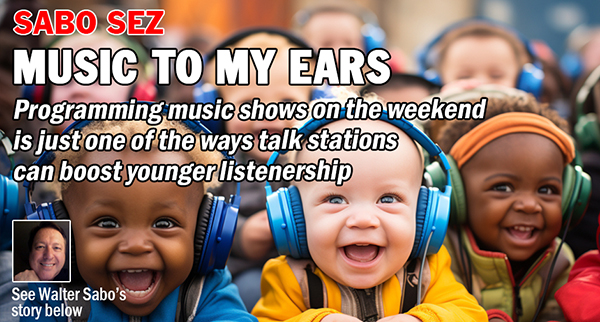
 The persistent liability of most talk stations is that they attract a high percentage of listeners over the age of 65. Consider that many of those older listeners are attracted to radio shows that are talking for companionship and comfort.
 Radio plans to reduce its workforce by 12% due to a “free fall in the advertising market.” The source is a memo to staffers from NYPR CEO LaFontaine Oliver. The story goes on to note that the organization employs about 340 full- and part-time workers at WNYC, classical WQXR, and the Gothamist news site.
  Attention news/talk radio sellers! Get ready to meet your new best friend… and it is not who you think it is.
 monthly, and 77% have ever listened to podcasts. “All of this podcast and AM/FM radio audience duplication means there are great cross-promotion opportunities.” Among the podcast audience, over half the ad-supported time spent goes to podcasts themselves at a 53% share. AM/FM radio follows with a 37% share. Distantly following are ad-supported SiriusXM (4%), ad-supported Spotify (3%), and ad-supported Pandora (3%). Additionally, MARU/Matchbox was commissioned to study Cumulus Media radio listeners who listened for at least an hour to stations in Dallas, Chicago, Detroit, San Francisco and Atlanta and were exposed to promos for eight Cumulus Podcast Network podcast titles. Overall, 54% of the Cumulus radio audience were aware of the eight Cumulus Podcast Network podcasts. A much larger promotion of heavy AM/FM radio listeners (67%) were aware of the podcast titles, and a whopping 75% of the heavy AM/FM radio streaming audience were aware of the podcast titles.
  publicly traded company controlled by the conglomerate. Liberty Media CEO Greg Maffei says, “SiriusXM minority shareholders will also benefit from enhanced trading dynamics, including increased liquidity and likelihood of future index inclusion.” A merger between the two would result in SiriusXM minority investors owning about 16% of the new company, with Liberty Media controlling the rest. SiriusXM says it is evaluating the offer.
  I asked my pal, longtime radio seller, now retired: “How often were you asked, ‘How much would you charge for ONE commercial?’”
 journalists “ask tough, but respectful questions to get answers,” and 61% say it is very important they fact-check those candidates. RTDNA president and CEO Dan Shelley comments, “In our highly polarized society, Americans need to rely on their trusted local sources of news to get the facts about candidates, campaigns and other political issues. These findings offer a clear roadmap to ensure local reporters and news managers are providing voters with the information they crave to make critical decisions in the voting booth.” Other data from the study reflects news consumers’ attitudes about news organizations, finding that 47% of those surveyed said they were in strong agreement that the information they get from local news sources is accurate and correct. That number drops to 41% when local news outlets cover political issues. It also found that just 39% of people were in strong agreement that local news sources were balanced and represented all sides of an issue.
 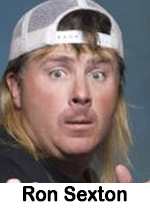 Sexton died from an overdose of fentanyl and alcohol. Sexton was found unresponsive in a hotel room in Ohio while on tour doing standup as the Donnie Baker character he often played on the nationally syndicated radio show. Sexton leaves behind his wife Tracey and four children.
  Wagoner writes, “Why is KFI so successful – isn’t conservative talk dead? Yes, it is… and it’s been decades since KFI was considered ‘conservative talk’ (even when it wasn’t). There have always been a balance of viewpoints on the station; as it moved away from politically centered topics to more general topics, it matched the mood of listeners who wanted to be entertained more than they wanted to be angry.”