

Industry Views

The Algorithm Knows What You Did But It Doesn’t Know Why
img

By Matthew B. Harrison
TALKERS, VP/Associate Publisher
Harrison Legal Group, Senior Partner
Goodphone Communications, Executive Producer
 

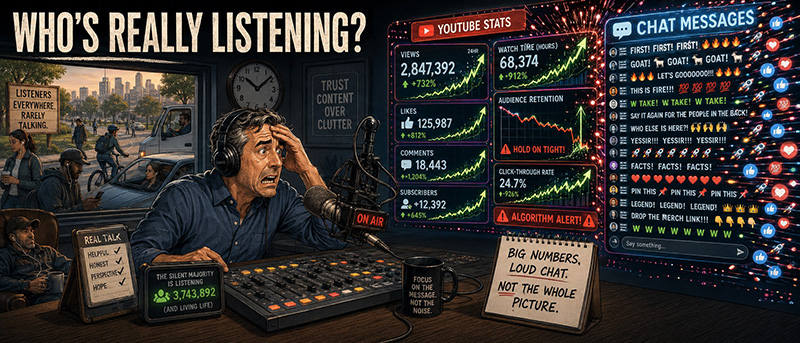
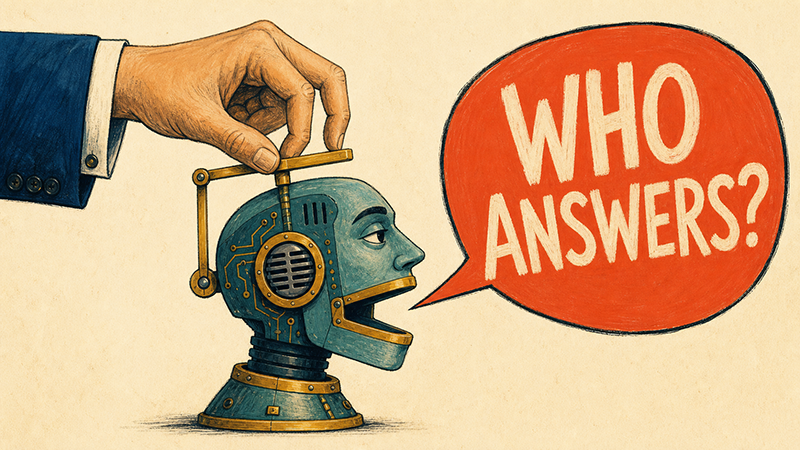
imgA viewer watches the same political clip three times. The platform sees a powerful signal: this person stopped, stayed, and came back. What it cannot reliably know is whether the viewer loved the argument, hated it, was factchecking it, or was showing it to someone else in disbelief. The algorithm knows a viewer watched. It does not necessarily know why. That is why YouTube looks beyond viewing itself to other signals of appeal, engagement, and satisfaction.

That distinction matters to broadcasters because digital analytics can look much more intelligent than they really are. An algorithm can measure behavior with extraordinary precision, but behavior is not motive. PPM taught radio a version of the same lesson. Nielsen’s meter can passively detect exposure to encoded audio, but the resulting audience measurement cannot tell a programmer why someone listened or why audience levels changed.

Livestreaming creates the opposite problem. Instead of too little explanation, the host suddenly gets too much of it. The chat is moving. People are demanding another topic, praising a guest, attacking a caller, or announcing that the segment is dying.

That feedback is valuable, but the people typing are not necessarily representative of the people listening. Radio hosts should already understand this because callers have never represented the entire audience. They represent the portion motivated enough to pick up the telephone. Livestream chat is the same phenomenon at digital speed.

The danger comes when these two imperfect signals reinforce each other. The dashboard says engagement jumped. The chat says, “More of this.” A host can easily conclude that the audience has spoken when what actually happened is that a particularly active portion of the audience became particularly visible.

Good broadcasters have always listened to the audience without surrendering the show to it. Digital tools make that listening faster and more detailed, but they do not eliminate the need for judgment.

The algorithm knows what people did. The chat tells you what some people said. The programmer still has to decide what either one means.

For the larger discussion of ratings, PPM, algorithms and digital distribution, read The Algorithm Is Listening here: https://talkers.com/category/industry-views/

Matthew B. Harrison is a media and intellectual property attorney who advises radio hosts, content creators, and creative entrepreneurs. He has written extensively on fair use, AI law, and the future of digital rights. Reach him at Matthew@HarrisonLegalGroup.com or read more at TALKERS.com.
Industry Views

Monday Memo: Radio’s New Fall Season

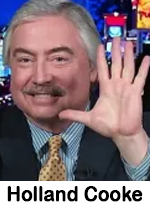
By Holland Cooke
Consultant


imgAs TV is touting its coming attractions, take a step back. We – inside the box – live-and-breathe radio.

Listeners have their hands full just living and breathing. Their day is time-crunched and financially-challenged, and we want to be its soundtrack. But listening is free, unlike umpteen other purchase decisions they agonize. So what’s high-stakes to us is low-stakes to them.

We only matter if we matter, and we’ve never had so much audio competition.

  • This month, as the school year begins in so many places, the listeners local retailers want as customers revert to “normal.” Their tempo changes, and builds to a holiday season climax. Do they know who you are and how you can help?
  • Off-air promotion (remember that?) merely says give-us-a-try. When they do, does what they hear deliver? Even with scant (or no) off-air promotion, much of what you can do to become more habit-forming costs nothing. As consultants do, I’m talking about “the fundamentals,” the blocking-and-tackling stuff. For starters, think: recognition and relevance.

Who are you?

  • Are call letters or station nickname delivered frequently? PPM myth: call letters matter less. Baloney. Awareness drives use. Ditto your dial position(s) and how to listen via smartphone, smart speaker, and streams. Name-and-address.
  • As your listeners cume 3 stations this week, help ’em remember yours more than the other 2 (not to mention streams and satellite radio and podcasts). And are you selling — or merely reciting — call letters, dial position, and slogans? This is often an issue with veteran talent, creatures of habit.

“Who cares?”

Or as my WTOP successor Jim Farley (RIP) asked: “W.G.A.S.?” He hung a sign in the newsroom there, meaning “Who Gives A Shit?”

  • Are topics relatable and useful? Enable listeners with helpful information, and they’ll keep coming back.
  • Do you say “you” and “your,” a lot? It’s a litmus test for relevance.
  • Do you keep setting the stage as audience tunes in? Someone JUST got in the car.
  • Are you teasing the next quarter hour? And what you’ll offer same-time-tomorrow?
  • Even with apps in the dashboard, weather and traffic are super-local and can be super-impactful.
  • Is your on-air imaging about the station? Or about listeners’ lives? “Because ONE traffic jam can jam-up your whole day…”

There’s more from radio’s right-now To-Do list at HollandCooke.com

Holland Cooke is a consultant working the intersection of broadcasting and the Internet. Follow HC on Twitter @HollandCooke and connect on LinkedIn

Industry News

Cumulus Brings John Lund Back for Middays at KNBR

Cumulus Media’s San Francisco sports talk outlet KNBR has laid off its midday team of “Papa & Silver” – Greg Papa and Greg Silver – and replaces them with former midday personality John imgLund. This change doesn’t come without controversy though as some Bay Area media outlets and KNBR fans are criticizing the company for firing Papa, who’s been battling cancer for the past year. Papa recently returned home after a 78-day stay in the hospital following a bone marrow transfusion. He’s been off the air with Silver hosting solo for much of the past year. Lund was Papa’s partner on the midday show prior to his departure from the station in 2024.

Industry News

TALKERS News Notes

Clay Travis to Launch New Media Venture. After selling his Outkick platform to Fox Corporation earlier this year, Front Office Sports is reporting that Clay Travis is working on launching a new sports and politics media platform. The publication says that Travis has filed a trademark application for the name, “Sports & State.” See the Front Office Sports story here.

KBNW, Spokane to Carry Vandals Sports. KBNW, Spokane has aligned with Learfield’s Idaho Vandals Sports Properties to carry Idaho Vandals football and men’s basketball for the next two seasons. KBNW market manager Roger Nelson says, “We are excited to partner with Idaho Vandals Sports Properties to bring Idaho football and basketball game broadcasts to the Spokane/Coeur d’ Alene market. The Vandals have a rich history in football and men’s basketball and have long been a leader in the Big Sky Conference. Approximately 16% of the University of Idaho’s alumni base reside in the Spokane/Coeur d’ Alene metro and we look forward to developing a strong partnership with the Vandals and their fans.”

Rob Parker to Receive Innovator Award. The Negro Leagues Baseball Museum (NLBM) announces that in conjunction with the induction of its 2026 Hall of Game class, it is recognizing FOX Sports Radio personality Rob Parker with the second annual JL Wilkinson “Innovator” Award during ceremonies on Saturday, September 26 at the Gem Theater in Kansas City.

Industry News

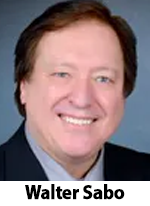
Sabo Sez: Mitch Reed’s Deserved Award

imgBy Walter Sabo
A.K.A. Walter Sterling
Host, The Other Side of Midnight
WABC, New York / Red Apple Audio Networks

The Radio Hall of Fame has just announced their “Legends” inductees, and it includes B. Mitchell Reed. YES!

One of the minor injustices of radio is the curious legacies of Tom Donahue and B. Mitchell Reed relative to the creation of free-form progressive rock radio. They were best friends with parallel careers. Both were top-of-their-game “screaming” Top 40 DJs. Tom in San Francisco, Mitch in LA and NYC. Top earnings, ratings, and both around 40 when they went to the Monterey Pop Festival. There they learned that their teens were changing fast. Harder rock, anger about Vietnam, and drugs. They knew their style of radio was out of synch with the moment.

Every day on his way to work in LA, Mitch drove past the Pasadena Presbyterian church and noticed a radio antenna on the grounds.

The tower was pumping out an FM signal that covered Los Angeles, broadcasting from the basement of the church. Underground. Mitch talked to the preacher he met along the way. And he bought time on the station at night and experimented with playing hard rock and a new form of presentation. His friend Donohue sent tapes from San Francisco, and the two of them created “free form” radio (also referred to as “underground” radio) from the basement of the church. The frequency became KPPC-FM.

Note: both of them created free-form radio at risk to their careers and income while over the age of 40. Tom continued as a progressive rock jock in San Francisco, and Mitch became an icon in Los Angeles as an album rock jock on KLOS and KMET. Oddly, Tom gets more of the image and credit, but they were very much partners.

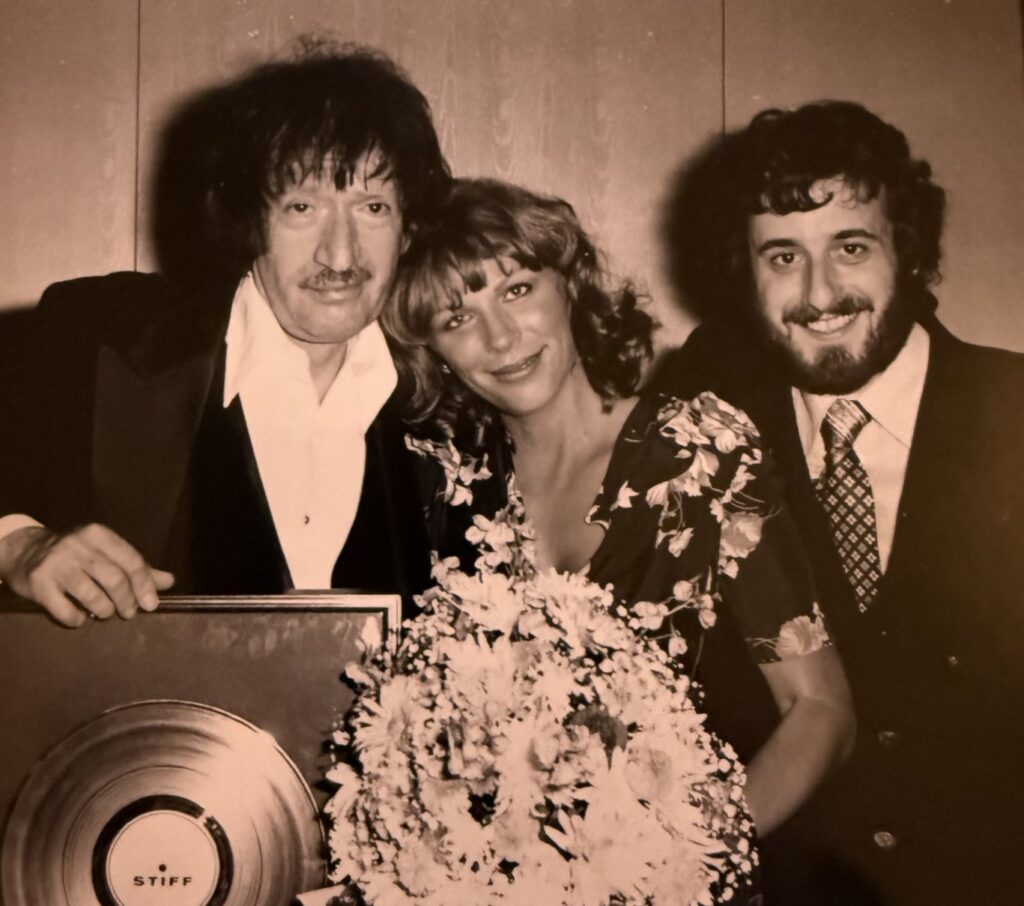
BMR MH
B. Mitchell Reed (l), his wife Carol (c), and Michael Harrison (r) at KMET, Los Angeles in the late seventies.

Walter Sabo has been a C-Suite action partner for companies such as SiriusXM, Hearst, Press Broadcasting, Gannett, RKO General, and many other leading media outlets. His company, HITVIEWS, in 2007, was the first to identify and monetize video influencers. His nightly show “The Other Side of Midnight” is heard on WABC, New York and the Red Apple Audio Network 1:00 am – 5:00 am. His syndicated show, “Sterling On Sunday,” from Talk Media Network, airs 10:00 pm – 1:00 am ET, and is now in its 10th year of success. He can be reached by email at sabowalter@gmail.com. He can be phoned at 646-678-1110.

Industry News

Dickey Broadcasting Announces Expanded Lineup on Sports Radio 680 The Fan

680 the fan logo vertical1200x1200 300x300Dickey Broadcasting Company announces, “an exciting new chapter” for Sports Radio 680 The Fan in Atlanta as veteran broadcaster John Kincade joins Matt Chernoff weekdays from 2:00 pm to 6:00 pm for the all-new “Kincade & Chernoff Show.” The pairing brings together two of Atlanta’s most respected and recognizable sports radio personalities. The new show will feature the latest sports news, interviews, and debate.
As part of this programming change, station personality Chuck Oliver will continue to play an “impactful” role on The Fan while expanding his focus on “The Chuck Oliver Show,” heard across the Southern Sports Today Network. According to station management, Oliver remains an integral part of 680 The Fan’s programming and will continue to provide the station’s signature college football coverage and analysis through exclusive segments, special features, and fan-favorite promotions including “Win Chuck’s Dinner.”  With his nationally recognized expertise, Oliver will also devote additional attention to growing “The Chuck Oliver Show,” further expanding coverage of SEC and ACC football, the College Football Playoff, recruiting, and the biggest stories from across the college football landscape throughout the Southeast.

“This is an exciting opportunity for all of our brands,” said David Dickey, president of Dickey Broadcasting Company. “John and Matt are an outstanding combination for afternoon drive, and our listeners should know that Chuck Oliver isn’t going anywhere. Chuck remains a huge part of The Fan and will continue to be our premier voice for college football through regular appearances, features, and promotions, while also expanding the reach of ‘The Chuck Oliver Show’ across the Southern Sports Today Network. These moves strengthen our commitment to delivering best-in-class sports programming both locally and throughout the Southeast.”

Industry News

TALKERS Charts for August 3-7, 2026

Stories
People
  1. Donald Trump
  2. Mike Johnson
Industry News

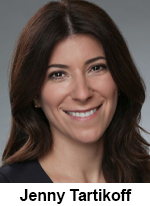
Jenny Tartikoff Named Senior Vice President and Head of Communications for SiriusXM

Jenny TartikoffSiriusXM today (8/6) announced that Jenny Tartikoff has been named senior vice president and head of communications, effective August 10, 2026. Tartikoff will report to president and chief content officer Scott Greenstein and lead SiriusXM’s overall communications and public relations strategy and execution. She will be responsible for promoting the company’s content and business narrative while serving as a senior advisor to the company’s leadership team on major business developments and high-profile moments. Tartikoff brings more than 20 years of communications experience across media, entertainment, and technology. She most recently served as EVP, Global Communications at Paramount Pictures, where she led internal and external corporate communications, corporate social responsibility and awards strategy for the studio’s live-action and animation properties. During her tenure, Tartikoff guided the company’s communications through the industry’s post-pandemic recovery and the evolution of Paramount’s multi-platform release strategy.
Industry News

97.5 The Fanatic in Philly Announces New On-Air Lineup Featuring Jon Marks in Morning Drive

Fanatic Philly logoBeasley Media Group’s 97.5 The Fanatic (WPEN-FM), Philadelphia’s announced a new weekday on-air lineup highlighted by the promotion of current midday host Jon Marks to the station’s morning drive program. Beginning Monday, August 17th, Marks will join Andrew Salciunas as co-host of the weekday morning show from 6:00 to 10:00 am, following the departure of John Kincade. Marks, who currently hosts the station’s popular “Middays with Marks” program, will transition to mornings alongside Salciunas, who has been part of the morning show for the past two-and-a-half years. The move pairs one of Philadelphia’s most recognized sports radio personalities with one of the market’s emerging voices while maintaining a strong local focus during the station’s highest-profile daypart.  The programming changes also create new opportunities across the station’s weekday schedule. Ray Dunne, who previously served as producer of the station’s midday program, moves into an on-air hosting role and will join Sean Brace to lead the midday show from 10:00 am to 2:00 pm. Meanwhile, “Unfiltered with Ricky Bo and Bill Colarulo” will continue in afternoon drive from 2:00 pm to 6:00 pm.  “Jon Marks has earned the trust of Philadelphia sports fans through years of outstanding work on the air, making him a natural choice to drive our morning show” said Paul Blake, Vice President and Market Manager, Beasley Media Group Philadelphia.  “Along with Andrew, Sean, Ray, Ricky and Bill, we’re confident this lineup reflects the depth of talent at The Fanatic and reinforces our commitment to delivering the best local sports talk in Philadelphia.”
Industry Views

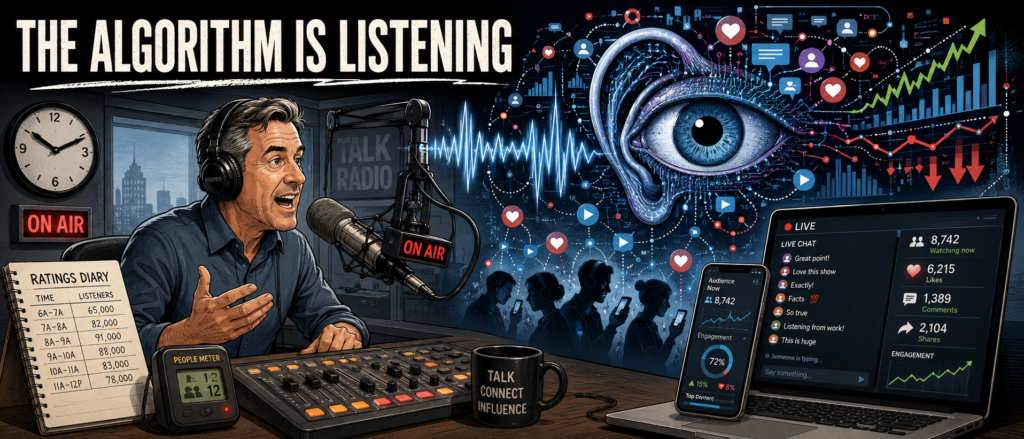
The Algorithm is Listening

1527a63f d481 4de5 8636 2bcf88a23c44

img

By Matthew B. Harrison
TALKERS, VP/Associate Publisher
Harrison Legal Group, Senior Partner
Goodphone Communications, Executive Producer

Radio once measured the audience… now digital platforms use the audience to decide what happens next

Radio programmers have always watched the audience. The difference for programmers today is that the audience can now watch back, respond instantly, influence the show, and determine whether the next person ever receives it.

That is the practical meaning of an algorithm for a broadcaster. It is not a mysterious robot hiding inside the black box of an enigmatic social platform. It is a set of instructions used to make decisions. On YouTube, Facebook, TikTok, Spotify, Twitch, and other services, those instructions help determine which content gets shown, to whom, in what order, and under what circumstances.

Radio has used simpler forms of algorithmic thinking for decades. A music clock is a set of instructions. So is a rule prohibiting two songs by the same artist within a specified period. Or two female vocals in a row. A programmer who schedules news at the top of the hour, traffic twice an hour, and the strongest feature before a commercial break has created a decision system.

Digital algorithms do something more consequential. They do not merely organize the program. They organize the audience around each individual piece of content.

From diaries to PPM

The traditional radio diary asked selected listeners to record what they heard and when they heard it. Nielsen defines the diary as a measurement method in which respondents manually record their listening habits. Those reported habits are then used to estimate listening across a larger market.

The system was necessarily crude. A diary could show that someone reported listening to a station during morning drive. It could not reliably establish whether that person loved the program, ignored it, hated it, stayed because the station was playing in a waiting room, or simply remembered the call letters incorrectly.

Still, the diary produced an enormously valuable number. Ratings influenced advertising rates, station formats, talent contracts, syndication opportunities, and management decisions. The ratings service measured the audience, but the station still controlled the programming and the transmitter.

The Portable People Meter changed the speed and granularity of that feedback. PPM panelists carry a small device that detects inaudible identification codes embedded in participating broadcasts. Instead of relying entirely on a listener’s memory and written entry, the meter passively detects exposure to encoded audio.

That gave programmers something closer to immediate feedback. They could study audience movement within smaller portions of a show, identify apparent tune-out points, compare features, evaluate commercial breaks, and make changes much more quickly.

PPM therefore became the bridge between traditional ratings and algorithmic distribution. The diary remembered the audience. PPM observed the audience more closely. Both still produced information for human beings to interpret.

A programmer could see a decline and decide to shorten a segment. The meter did not shorten it. A consultant could conclude that a feature hurt retention. The PPM system did not prevent tomorrow’s listeners from hearing it.

The algorithm closes that gap.

(more…)

Industry Views

Monday Memo: Trust is the New Currency

By Holland Cooke
Consultant

Holland Cooke

It is now the ultimate competitive advantage, and for broadcasters it’s a survival strategy. In The Five-Year Century: Bold Leadership and Accelerated Outcomes in the Age of AI, Mihir Shukla and Nancy Hauge explain how—as artificial intelligence accelerates change and demographics reshape the audience—trust becomes the only durable asset radio and television can bank on.

The book describes a 2026 world where the “twin engines” of growth—population and productivity—have stalled. Birth rates are plunging, workforces are shrinking, and productivity has flatlined across most industries. Meanwhile, AI is compressing decades of innovation into months. This collision creates what the authors call “The Five-Year Century,” in which the pace of change overwhelms institutions built for slower times—broadcasting, for instance.

Radio and television were built on industrial-era assumptions: mass audiences, standardized programming, rigid schedules, and hierarchical decision-making. Those assumptions worked when the audience was broad, predictable, and captive. On February 9, 1964, the Beatles tripled Ed Sullivan’s ratings. Back to the future…

AI is rewriting the rules of content creation, distribution, and consumption. Personalized news feeds, customized ad loads, and algorithmic programming are expectations. Younger audiences don’t wait for a newscast; they expect a feed. They don’t tune in; they scroll. They don’t accept one-size-fits-all; they demand one-size-fits-me.

In this environment, trust becomes the new currency because it’s the one thing AI cannot manufacture.

Broadcasting’s advantage has always been credibility. When a storm hits, people still turn to local radio. When a shelter-in-place alert hits their phone, they still switch on local TV. That instinct is powerful, but it’s not permanent. Trust must be earned continuously, especially as AI-generated misinformation floods the ecosystem.

The book’s chapter on the “Trust Economy” makes a critical point: trust accelerates outcomes. High-trust organizations move faster, innovate more boldly, and adapt more effectively. For broadcasters, trust accelerates audience loyalty, advertiser confidence, and community relevance. But trust now requires new behaviors.

It requires transparency about how AI is used in newsrooms. It requires clarity about what is human judgment and what is machine assistance. It requires authenticity as AI-generated talent becomes increasingly commonplace—and increasingly convincing.

Trust requires broadcasters to lean into what humans do best: context, empathy, moral reasoning, and community connection. The book reminds us that “work worthy of human potential” is work that machines cannot replicate. For broadcasters, that means storytelling, accountability journalism, and the human presence that makes local media local.

By all means, assign AI the routine tasks: editing, logging, transcription, versioning, and production. Then reinvest the human time you save in the relationship between a station and its community. In The Five-Year Century, trust isn’t just a virtue. It’s a conspicuous differentiator. It’s the currency that will determine which broadcasters thrive and which fade into the noise of an algorithmic world. As our industry suffers workforce cutbacks, we risk downsizing trust.

To read two sample chapters and watch a short video interview with the authors, click here.

Holland Cooke is a consultant working at the intersection of broadcasting and the Internet. Follow HC on Twitter @HollandCooke and connect on LinkedIn.

Industry Views

The Advertiser Gave Us an AI Commercial… Isn’t that Enough?

doublewiredaiproblem

imgBy Matthew B. Harrison
TALKERS, VP/Associate Publisher
Harrison Legal Group, Senior Partner
Goodphone Communications, Executive Producer

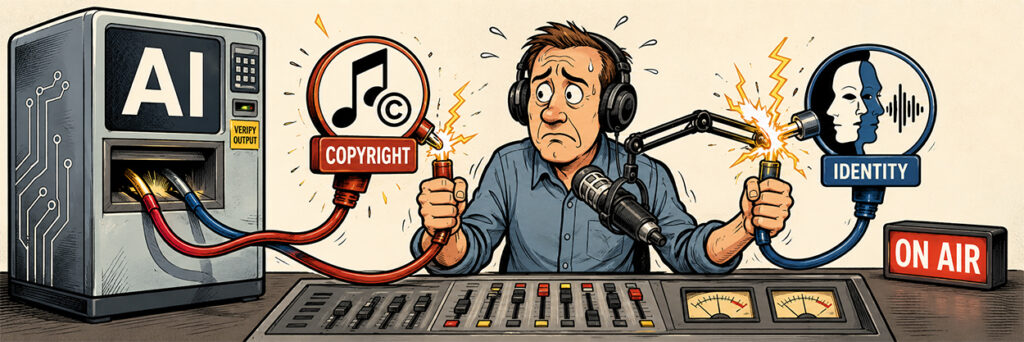
Synthetic audio can turn one clearance problem into two
An advertiser sends a finished commercial to a station. The script came from one AI platform, the announcer’s voice from another, and the music arrived inside the final audio file. The production value is surprisingly good for a dental office. Then someone notices that the announcer sounds remarkably like Matthew McConaughey. He does not say “alright, alright, alright,” exactly, but he says something close enough to make the association obvious.

A conventional infringing commercial may misuse a song, recording, photograph, or written copy. An AI commercial can create the same copyright problem while adding another: the unauthorized commercial use of a recognizable person’s identity. One file can therefore produce two entirely different claims.

Copyright protects original expression, including scripts, music, and sound recordings. It generally does not give anyone a copyright in the sound of a natural voice. That does not make a distinctive voice free for advertisers to imitate.

Tom Waits established the distinction decades before generative AI. After Waits declined to participate in a Frito-Lay campaign, the company used a singer who imitated him in a radio commercial. Waits successfully pursued claims for voice misappropriation and false endorsement. AI now makes that imitation faster, cheaper, and potentially more convincing. Waits v. Frito-Lay⁠

The rights do not travel together 

Clearing the script or music does not clear the voice. Permission from the person whose voice was cloned does not clear protected material that the system may have reproduced. The station needs to ask two questions: Who owns everything in this commercial, and whose identity is doing the selling?

There is another wrinkle. The AI company may possess defenses that do not travel with the finished audio. In Walters v. OpenAI, ChatGPT falsely accused radio host Mark Walters of embezzlement. OpenAI defeated the defamation claim because the recipient encountered warnings that the system could be inaccurate, did not believe the accusation, verified that it was false, and did not republish it. Walters also failed to prove the necessary fault or damages. Walters v. OpenAI⁠ case summary⁠

That ruling did not grant AI companies blanket immunity. It does suggest an uncomfortable result for broadcasters. A provider’s warning that its output requires verification may help protect the provider while making it harder for a station to argue that airing the output without checking was reasonable. The company that generated the problem may have a better defense than the broadcaster that delivered it to the public.

California’s AI Transparency Act, operative August 2, 2026, now requires certain large AI providers to offer detection tools and place provenance disclosures in generated audio, images, and video. Those tools may help identify origin. They do not establish copyright clearance, consent, accuracy, or authority to imitate someone. California AI Transparency Act⁠

Stations should require advertisers to warrant both ownership and permission for identifiable voices or likenesses, backed by indemnification. AI has not replaced the old clearance problem. It can place a second problem beside it, then leave the broadcaster holding both.

Matthew B. Harrison is a media and intellectual property attorney who advises radio hosts, content creators, and creative entrepreneurs. He has written extensively on fair use, AI law, and the future of digital rights. Reach him at Matthew@HarrisonLegalGroup.com or read more at TALKERS.com.

Industry News

Radio Hall of Fame Announces “Legends” Inductees

imgThe Radio Hall of Fame announced today (8/3) the selection of nine 2026 Legends inductees. These individuals were selected by the Radio Hall of Fame’s 2026 Nominating Committee, which meets annually to recognize deceased individuals who made significant contributions to the radio industry. The Radio Hall of Fame is housed within the Museum of Broadcast Communications in Chicago.
The following nine radio legends take their place in the Radio Hall of Fame immediately:

  • Lin Brehmer — on-air personality
  • Vivian Carter — on-air personality and record company executive
  • Dale Dorman — on-air personality
  • Gary Krantz — network radio and syndication executive
  • Wink Martindale — on-air personality, game show host, and television producer
  • B. Mitchell Reed — on-air personality
  • Pierre Robert — on-air personality
  • Polito Vega — on-air personality
  • D.E. “Duke” Wright — radio station owner and executive

Dennis Green, co-chair of the Radio Hall of Fame, tells TALKERS: “The Radio Hall of Fame is proud to honor this year’s Legends inductees, whose extraordinary careers have helped define the history and enduring impact of radio. From iconic on-air personalities to visionary executives, each has left an indelible mark on our industry and earned their rightful place in the Radio Hall of Fame.”

Kraig Kitchin, co-chair of the Radio Hall of Fame, adds: “It’s an honor and privilege to witness the induction of these radio industry legends. We hope this recognition of their industry contributions benefits their family, colleagues, friends, and listeners.”

The Radio Hall of Fame will recognize its 2026 class of inductees at the 2026 Radio Hall of Fame induction ceremony on Thursday, October 8, 2026, at the Fairmont Chicago. Tickets are on sale now at RadioHallOfFame.com. A portion of each ticket purchase is a tax-deductible charitable donation to the Museum of Broadcast Communications.`

Industry News

FCC’s Gomez Comments on ABC-Disney Case After Public Comment Period Closes

FCC Commissioner Anna M. Gomez continues to address the Commission’s forcing ABC/Disney to go through an early license renewal for its eight owned-and-operated television stations ostensibly for “news distortion.” After the recent close of the public comment period in the matter, Gomez states, “When given the imgchance to weigh in on whether to allow the FCC to continue its campaign of censorship and control, the American public showed up in a big way, and the vast majority who spoke up delivered the same message. They believe in the value of their local news, they trust those who cover their communities, and they understand that the FCC has no business deciding who is a journalist and what counts as real news. A small number of partisan voices tried to hijack this process into a referendum on a network they dislike, but the public refuses to let local stations become collateral damage in the FCC’s political games. The FCC has no authority to police the ideological balance of the airwaves, and no matter what this Commission does next, the record now makes clear that this was never a genuine search for the public interest.”
Gomez’s press release adds, “In the docket covering the early license renewal proceeding, the agency received more than 150,000 comments. In the docket covering the FCC’s effort to unwind a more than two-decade old precedent recognizing the interview portion of ‘The View’ as a bona fide news program, the agency received nearly 80,000 comments. In both dockets, totaling more than 230,000 comments, the vast majority of commenters defended the stations and rejected the FCC’s attempt to use its licensing authority to punish constitutionally protected speech.”

Industry Views

Sabo Sez: It’s All Media

Sabo Sez:  It’s All Media
By Walter Sabo
A.K.A. Walter Sterling
Host, The Other Side of Midnight
WABC, New York / Red Apple Audio Networks
img“It’s all media,” declared accomplished media executive Jack Griffin when confronted with brand new definitions of content and content distribution. Jack, for years, was president of Meredith Publishing, Time Inc., and The Tribune Company. I met Jack when he was publisher of PARADE magazine. Jack is pragmatic, won’t waste your time and spots BS faster than most humans. We were listening to discussions of the impact of online media versus traditional media, and his line was running out. Jack declared “It’s all media” and the meeting blessedly ended. The phrase haunts me and it is being proven true every second of every day.

Steve Goldstein, CEO of Podcast consultancy, AMPLIFI, published a white paper on the growing acceptance of podcasts in the dashboards of media buyers. The paper tackles the challenge industry committees have had defining a podcast! [link]

Answer: It defines a podcast as an on-demand, spoken-word show intelligible with your eyes closed – video and RSS are both allowed, neither required.
 
The definition of a podcast is simple, broad, and can be met by any podcaster! And every person and entity is making a podcast. Follow that through to what Griffin declared.
VOGUE magazine puts out podcasts constantly. By most definitions they are really good and brand appropriate. Pretty, gossipy, urgent and current. Much more entertaining than the magazine. The New York Times has more podcast viewers than newspaper readers.
The ever-prescient Michael Harrison was right on the money more than two decades ago when he coined the term “media station” to describe the multi-media platform potential of ANY then-traditional venue such as radio and TV stations, newspapers, magazines, books, and cinema.  The media station has since become a reality and the podcast is one of its main engines.
NPR leads the top 20 lists of podcasters, and they can sell advertising in their podcasts without violating their prime directive.
It’s all media
 
When brands evolve from their original product and mission to a podcast, their methodology for success changes but not their definition of success. Brands want revenue and profit. If a brand’s assets can generate the most profit through podcasts, then podcasts will become their business.
 Audience time with media is the target. Capturing their time. Not viewership, listenership, readership, attention: T I M E because it’s ALL MEDIA.
Ultimately a corporate entity’s starter business could be shuttered in order to grow its podcast.  Good to note that every single newspaper and magazine publisher has one fantasy: Get rid of the paper.  Your competition isn’t WXXX it is becoming the VOGUE podcast.
Walter Sabo has been a C-Suite action partner for companies such as SiriusXM, Hearst, Press Broadcasting, Gannett, RKO General, and many other leading media outlets. His company, HITVIEWS, in 2007, was the first to identify and monetize video influencers. His nightly show “The Other Side of Midnight” is heard on WABC, New York and the Red Apple Audio Network 1:00 am – 5:00 am. His syndicated show, “Sterling On Sunday,” from Talk Media Network, airs 10:00 pm-1:00 am ET, and is now in its 10th year of success. He can be reached by email at sabowalter@gmail.com.  He can be phoned at 646-678-1110.
Industry News

NAB Joins Radio Ready

The National Association of Broadcasters joins Radio Ready – a global coalition dedicated to safeguarding radio’s prominence in the connected car dashboard. Radio Ready was launched as a unified global response to the rise of the digital dashboard in automobiles and the initiative “brings broadcasters together to ensure AM/FM and digital radio remain prominent, accessible and easy to use in connected vehicles, while giving the industry a imgpowerful, collective voice when negotiating with automakers, tech platforms and policymakers.” NAB president and CEO Curtis LeGeyt adds, “Radio has long been an essential part of the driving experience, delivering trusted local news, lifesaving emergency information and the entertainment Americans rely on every day. As dashboards evolve, ensuring broadcast radio remains accessible is more important than ever. By joining Radio Ready, NAB looks forward to partnering with broadcasters from across the world to ensure that free, trusted radio remains easy for drivers to find and use in the vehicles of today and tomorrow.”

Industry News

TALKERS News Notes

NYPR Announces Collaboration with URL Media. New York Public Radio is collaborating with URL Media, a network of more than 50 independent publishers and content creators serving diverse communities across the United States. NYPR president and CEO Christy Tanner says, “New coalitions, bold approaches, and radical collaborations such as our work with URL are essential as we lead a new era of democracy where journalism and creativity thrive, facts unite us, and power answers to the people. Our collaboration with URL Media is a call to action and an invitation to reimagine how creators and media organizations can collectively amplify impact and build community.”

WUSF Plans Expanded Election Coverage. Listener-supported radio station WUSF, Tampa announces a project to produce dramatically expanded news coverage and resources for voters in advance of elections across Florida this year. The station says it is enlisting more reporters into this effort, including journalists from the WUSF newsroom, plus student journalists from the University of South Florida, and partner public media stations across the state. WUSF general manager Leslie Laney states, “The result is the residents of this state will have access to some of our strongest-ever election coverage. And as part of our public service mission, all of this coverage will be free – not behind a paywall.”

Industry Views

When AI Speaks, Who’s Accountable?

img

By Matthew B. Harrison
TALKERS, VP/Associate Publisher
Harrison Legal Group, Senior Partner
Goodphone Communications, Executive Producer


imgNew laws may hold AI companies responsible, but regulating machine-generated speech presents risks of its own.

Florida recently sued OpenAI and CEO Sam Altman, alleging that they marketed ChatGPT while concealing known safety risks. California has taken a different approach: a company accused of causing harm cannot defend itself simply by saying the AI acted autonomously. Neither development guarantees liability, but both signal that “the AI did it” may no longer work as a legal escape hatch.  

That sounds sensible. An AI model cannot pay damages, carry insurance, exercise professional judgment, or go to jail. If a company releases a system, profits from it, and markets it as useful or reliable, the law should at least ask what the company knew, promised, and reasonably could have prevented.

Mark Walters – host of Armed America Radio – learned how difficult that can be. ChatGPT falsely reported that he had been accused of embezzling money from a gun-rights organization. Walters sued OpenAI for defamation, but a Georgia court granted the company summary judgment in 2025, finding insufficient evidence that OpenAI knew the output was probably false. The machine was wrong; the legal remedy failed.

The harder question involves speech. Colorado adopted requirements intended to prevent discriminatory automated decisions, prompting AI to sue on First Amendment and equal-protection grounds. The Federal Trade Commission has now suggested that secretly steering a model away from the accurate or objective answers users expect could itself constitute consumer deception.

This presents a genuine slippery slope. Government should protect people from fraud, defamation, discrimination, dangerous products, and nonconsensual deepfakes. It should not acquire a broad power to decide what an AI system must identify as “truth,” particularly in areas involving politics, history, public policy, or contested scientific opinion.

For broadcasters and content creators, the immediate lesson remains familiar. AI may assist with research, writing, editing, and production, but it does not inherit responsibility for the finished product. The person or company that publishes the words still needs to verify them, while the companies building the machines should not escape scrutiny merely because no human typed the final sentence.

Accountability should follow control, knowledge, and profit. The challenge will be imposing that accountability without turning AI regulation into government supervision of lawful speech.

Matthew B. Harrison is a media and intellectual property attorney who advises radio hosts, content creators, and creative entrepreneurs. He has written extensively on fair use, AI law, and the future of digital rights. Reach him at Matthew@HarrisonLegalGroup.com or read more at TALKERS.com.

Industry News

Court Grants Cumulus Bankruptcy Extension

Cumulus Media has requested and received an extension of its exclusive rights period from a Bankruptcy Court judge. The company is in Chapter 11 imgreorganization and is waiting for the Federal Communications Commission to finish its regulatory approval process. The court is extending the company’s filing deadline for its Chapter 11 plan to October 30.
Industry News

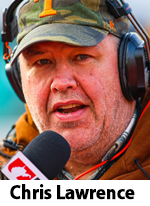
Marconi Finalists Unveiled Revealing a Dearth of Talk Hosts

The National Association of Broadcasters reveals the list of finalists for the 2026 NAB Marconi Radio Awards. The winners of the 2026 NAB Marconi Radio Awards will be imgannounced during a special dinner at the Edison Ballroom in New York City on October 20. While four spoken-word-formatted stations made the cut in the Legendary Station category, it’s interesting to note that just one talk host – news/talk or sports talk – is a finalist across five personality categories. That distinction goes to WCHS-AM, Charleston, West Virginia morning drive host Chris Lawrence who is a finalist in the Small Market Personality of the Year category. Go get, ‘em Chris! We’re pulling for you.
Industry News

JFMN Partners with Past the Wire Sports

The John Fredericks Media Network enters into a relationship with the sports wagering media company Past The Wire Sports that will the company’s content appear across JFMN’s more than 20 terrestrial radio stations and connected TV, as well as its digital assets, beginning August 3. JFMN notes that Past The Wire Sports has evolved from a horse racing media brand into a platform covering sports wagering, prediction markets, professional sports, premium video programming, and proprietary technology.

Industry News

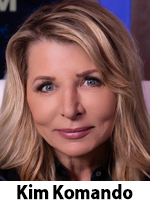
Komando Show Joins KEIB, Los Angeles

“The Kim Komando Show” is now airing on iHeartMedia’s KEIB, Los Angeles “The Patriot” on imgSaturdays from 12:00 noon to 3:00 pm. Industry affiliate relations pro Jim Watkins is serving WestStar Entertainment as director of affiliate sales, he says, “We’re excited to partner with KEIB and expand Kim’s presence in one of the nation’s most important radio markets. Technology touches every part of daily life, and Kim’s rare ability to make complex issues entertaining and easy to understand makes her program an outstanding addition to The Patriot’s weekend lineup.
Industry News

95.5 WSB Raises $2.3 Million for Cancer

img
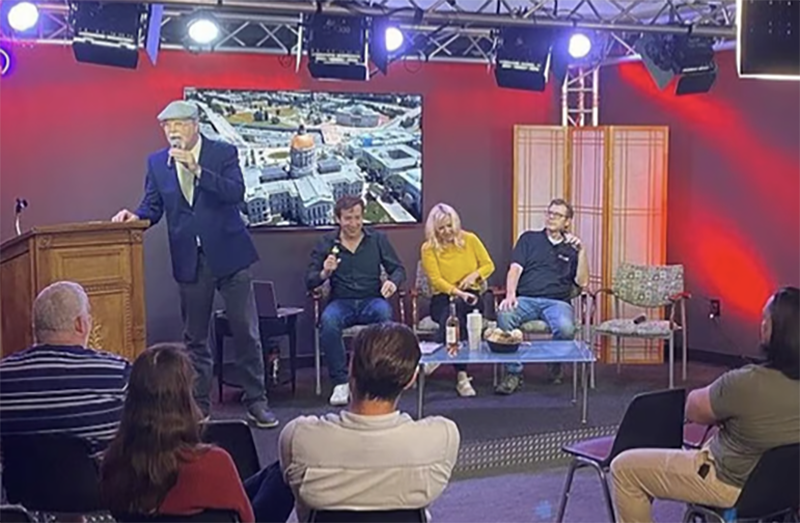
On the set of “The Von Haessler Doctrine” during the 95.5 WSB Care-a-Thon

Cox Media Group’s news/talk 95.5 WSB (WSB-AM/WSBB-FM, Atlanta) raised a record $2.3 million to benefit the Aflac Cancer and Blood Disorders Center of Children’s Healthcare of Atlanta during its 26th annual 95.5 WSB Care-a-Thon broadcast on July 23 and 24. WSB director of operations, branding and programming Ken Charles says, “Thanks to the generosity of the 95.5 WSB listeners and the passion and commitment of our team, we had another record-breaking year. I couldn’t be prouder of what we achieved over these incredible and inspirational 38 hours.” Since 2001, the 95.5 WSB Care-a-Thon has raised more than $38 million for the Aflac Cancer and Blood Disorders Center.

Industry News

Kings County Conservative Party Honors Dominic Carter with American Heritage Award

By Robert Pearl

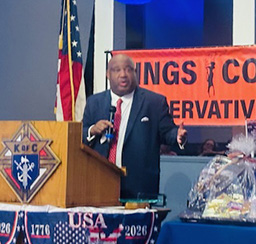
imgVeteran journalist, author, political commentator, and 77WABC Radio personality Dominic Carter was honored with the American Heritage Award at the Kings County Conservative Party’s Annual American Heritage Reception on July 23 at the Knights of Baron DeKalb in Sheepshead Bay, Brooklyn. The event celebrated Carter’s more than four decades in broadcast journalism, recognizing his distinguished career as a radio host, television commentator, author, and one of New York’s most respected media voices.
Hosted by Kings County Conservative Party and Chairwomanimg Frances Vella Marrone, the reception brought together elected officials, candidates, community leaders, and supporters to recognize Carter’s professional achievements while celebrating the values of perseverance, public service, and the American Dream.

Presenting the award, Vella Marrone praised Carter’s remarkable journey from a difficult childhood in a Bronx housing project to becoming a nationally recognized broadcaster.

“Where you begin in life does not determine where you can go,” she said, describing Carter as someone whose life story reflects the opportunities made possible through determination, personal responsibility, and hard work. She also commended his willingness to openly share his experiences through his journalism and bestselling memoir, “No Momma’s Boy”, inspiring listeners and readers far beyond New York City.

Accepting the honor, Carter explained that he had undergone surgery less than 24 hours earlier but was determined to attend.

“I was not going to miss this event,” he told the audience. “The Conservative Party has saved my life.” Carter reflected on his upbringing in public housing and his political evolution, saying he came to embrace the values of work, family, accountability, and opportunity. “I was a lifelong Democrat… but the Democrat Party left me. I didn’t leave them,” he said, noting he proudly shares those beliefs on the air and during speaking engagements nationwide.

One of the evening’s heartfelt moments came when Carter invited his son, Dominic Jr., and wife, Marilyn, to the stage. Sharing that doctors once believed his son would never graduate from high school because of epilepsy and a learning disability, Carter proudly announced that Dominic Jr. earned two college degrees.

“Never let anybody define who you are,” Carter said, drawing sustained applause.

Vella Marrone thanked supporters and volunteers for strengthening the Kings County Conservative Party and encouraged continued grassroots involvement.

“We’re going to keep fighting and fighting,” she said, urging attendees to remain engaged in preserving liberty and opportunity through civic participation.

Additional remarks were delivered by Conservative Party State Chairman Gerard Kassar, Assembly Minority Leader Edward Ra, Assemblyman Alec Brook-Krasny, and other elected officials, all of whom praised Carter’s broadcasting career and contributions to journalism. The evening concluded with a standing ovation, featuring book signings, and photographs as guests celebrated Carter’s enduring impact on New York media and public discourse.

Robert Pearl is a Brooklyn-based journalist who writes about New York City media, politics, and culture.  He can be emailed at pearlknows@yahoo.com.

Industry News

TALKERS News Notes

The Divorce Hour Hits Five-Year Mark. “The Divorce Hour,” hosted by acclaimed divorce journalist and advocate Ilyssa Panitz, proudly celebrates its fifth anniversary on CRN Digital Talk Radio. CRN says, “‘The Divorce Hour’ has become a staple and respected voice in the divorce and relationship space, featuring carefully vetted attorneys, financial planners, therapists, mediators, coaches, authors, wellness experts, celebrities, and other notable guests. Every episode is carefully designed to educate, inform, inspire, and empower listeners with the knowledge and confidence they need to navigate one of life’s most difficult transitions.”

NHPR Promotes Content Leaders. New Hampshire Public Radio names 16-year NHPR staffer Rebecca Lavoie the organization’s first chief content officer. Lavoi, who previously ran NHPR’s podcast studio, will ensure that NHPR’s journalism and programming meet its business objectives and strategic goals. Additionally, NHPR promotes news director Dan Barrick to vice president of news.