 By Matthew B. Harrison
TALKERS, VP/Associate Publisher
Harrison Legal Group, Senior Partner
Goodphone Communications, Executive Producer
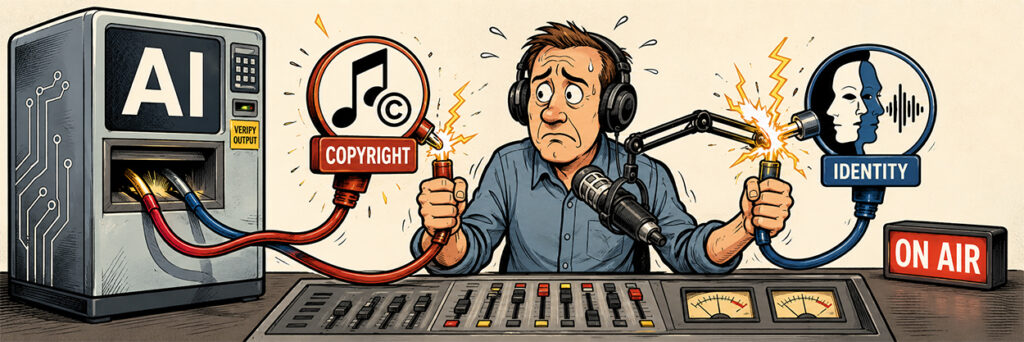
A conventional infringing commercial may misuse a song, recording, photograph, or written copy. An AI commercial can create the same copyright problem while adding another: the unauthorized commercial use of a recognizable person’s identity. One file can therefore produce two entirely different claims.
Copyright protects original expression, including scripts, music, and sound recordings. It generally does not give anyone a copyright in the sound of a natural voice. That does not make a distinctive voice free for advertisers to imitate.
Tom Waits established the distinction decades before generative AI. After Waits declined to participate in a Frito-Lay campaign, the company used a singer who imitated him in a radio commercial. Waits successfully pursued claims for voice misappropriation and false endorsement. AI now makes that imitation faster, cheaper, and potentially more convincing. Waits v. Frito-Lay
The rights do not travel together
There is another wrinkle. The AI company may possess defenses that do not travel with the finished audio. In Walters v. OpenAI, ChatGPT falsely accused radio host Mark Walters of embezzlement. OpenAI defeated the defamation claim because the recipient encountered warnings that the system could be inaccurate, did not believe the accusation, verified that it was false, and did not republish it. Walters also failed to prove the necessary fault or damages. Walters v. OpenAI case summary
That ruling did not grant AI companies blanket immunity. It does suggest an uncomfortable result for broadcasters. A provider’s warning that its output requires verification may help protect the provider while making it harder for a station to argue that airing the output without checking was reasonable. The company that generated the problem may have a better defense than the broadcaster that delivered it to the public.
California’s AI Transparency Act, operative August 2, 2026, now requires certain large AI providers to offer detection tools and place provenance disclosures in generated audio, images, and video. Those tools may help identify origin. They do not establish copyright clearance, consent, accuracy, or authority to imitate someone. California AI Transparency Act
Stations should require advertisers to warrant both ownership and permission for identifiable voices or likenesses, backed by indemnification. AI has not replaced the old clearance problem. It can place a second problem beside it, then leave the broadcaster holding both.
Matthew B. Harrison is a media and intellectual property attorney who advises radio hosts, content creators, and creative entrepreneurs. He has written extensively on fair use, AI law, and the future of digital rights. Reach him at Matthew@HarrisonLegalGroup.com or read more at TALKERS.com.