


Industry Views

Changing the Words Isn’t Changing the Use
img

By Matthew B. Harrison
TALKERS, VP/Associate Publisher
Harrison Media Law, Senior Partner
Goodphone Communications, Executive Producer

imgAI can make someone else’s story sound like you. What have you added?

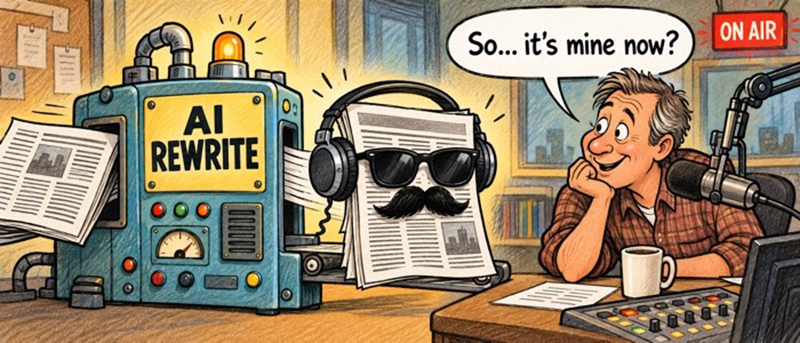
Imagine this morning’s show prep: a host finds a terrific newspaper feature, drops it into an AI tool, and types, “Make this 90-seconds, conversational, in my voice.” Seconds later, there is a polished script. The sentences are different, the pacing works, and it even sounds like something the host would say. The software has changed the words. But has it changed the use?

That question deserves a moment before the microphone opens. “Rewrite this” is an instruction to software, not a legal clearance process. Copyright reaches beyond identical sentences: an abridgment or adaptation can still use protected material from the original. Replacing the vocabulary does not necessarily remove the underlying copyright issue.

First, though, let’s protect something equally important: the freedom to report the news. A newspaper does not own the facts it uncovers, and broadcasters can report those facts in their own words. Copyright protects the author’s expression, not the event, information, or idea itself. An AI-assisted factual summary is therefore not automatically an infringement, either.

When a use does borrow protected expression, fair use requires more than checking whether the wording changed. Courts consider the purpose and character of the use, the nature of the original, how much protected material the user took, and the effect on the original’s potential market. News reporting and commentary can qualify, but neither label guarantees the result. A shorter version that serves as a substitute for the original raises a different question from an excerpt used to examine or criticize it.

For a host, a useful editorial question follows: What am I adding besides my voice? Perhaps the story prompts an interview with the reporter, a challenge to the conclusions, or an explanation of what the issue means locally. Those choices give the audience a reason to hear your treatment. They do not automatically establish fair use, but they help distinguish developing a segment from repackaging a feature.

AI can help with that development. Ask it to suggest follow-up questions, identify assertions worth checking, or organize your own notes into a workable outline. Then read the source, verify the facts, and make the editorial decisions yourself. Credit the reporting that helped you, while remembering that attribution and permission serve different purposes. A source acknowledgment is good practice, but it does not authorize an otherwise infringing use.

The opportunity here goes beyond avoiding a claim. A host’s value includes judgment, curiosity, experience, and the relationship with listeners, all things worth bringing to the microphone. Use AI to make room for more of that work. A script can sound like you without giving the audience anything of yours.

Matthew B. Harrison is a media and intellectual property attorney who advises radio hosts, content creators, and creative entrepreneurs. He has written extensively on fair use, AI law, and the future of digital rights. Reach him at Matthew@HarrisonMediaLaw.com or read more at TALKERS.com.
Industry Views

The Advertiser Gave Us an AI Commercial… Isn’t that Enough?

doublewiredaiproblem

imgBy Matthew B. Harrison
TALKERS, VP/Associate Publisher
Harrison Legal Group, Senior Partner
Goodphone Communications, Executive Producer

Synthetic audio can turn one clearance problem into two
An advertiser sends a finished commercial to a station. The script came from one AI platform, the announcer’s voice from another, and the music arrived inside the final audio file. The production value is surprisingly good for a dental office. Then someone notices that the announcer sounds remarkably like Matthew McConaughey. He does not say “alright, alright, alright,” exactly, but he says something close enough to make the association obvious.

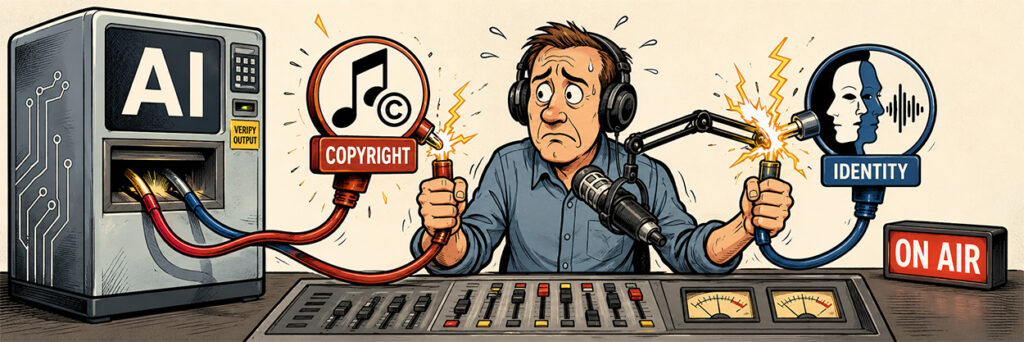
A conventional infringing commercial may misuse a song, recording, photograph, or written copy. An AI commercial can create the same copyright problem while adding another: the unauthorized commercial use of a recognizable person’s identity. One file can therefore produce two entirely different claims.

Copyright protects original expression, including scripts, music, and sound recordings. It generally does not give anyone a copyright in the sound of a natural voice. That does not make a distinctive voice free for advertisers to imitate.

Tom Waits established the distinction decades before generative AI. After Waits declined to participate in a Frito-Lay campaign, the company used a singer who imitated him in a radio commercial. Waits successfully pursued claims for voice misappropriation and false endorsement. AI now makes that imitation faster, cheaper, and potentially more convincing. Waits v. Frito-Lay⁠

The rights do not travel together 

Clearing the script or music does not clear the voice. Permission from the person whose voice was cloned does not clear protected material that the system may have reproduced. The station needs to ask two questions: Who owns everything in this commercial, and whose identity is doing the selling?

There is another wrinkle. The AI company may possess defenses that do not travel with the finished audio. In Walters v. OpenAI, ChatGPT falsely accused radio host Mark Walters of embezzlement. OpenAI defeated the defamation claim because the recipient encountered warnings that the system could be inaccurate, did not believe the accusation, verified that it was false, and did not republish it. Walters also failed to prove the necessary fault or damages. Walters v. OpenAI⁠ case summary⁠

That ruling did not grant AI companies blanket immunity. It does suggest an uncomfortable result for broadcasters. A provider’s warning that its output requires verification may help protect the provider while making it harder for a station to argue that airing the output without checking was reasonable. The company that generated the problem may have a better defense than the broadcaster that delivered it to the public.

California’s AI Transparency Act, operative August 2, 2026, now requires certain large AI providers to offer detection tools and place provenance disclosures in generated audio, images, and video. Those tools may help identify origin. They do not establish copyright clearance, consent, accuracy, or authority to imitate someone. California AI Transparency Act⁠

Stations should require advertisers to warrant both ownership and permission for identifiable voices or likenesses, backed by indemnification. AI has not replaced the old clearance problem. It can place a second problem beside it, then leave the broadcaster holding both.

Matthew B. Harrison is a media and intellectual property attorney who advises radio hosts, content creators, and creative entrepreneurs. He has written extensively on fair use, AI law, and the future of digital rights. Reach him at Matthew@HarrisonLegalGroup.com or read more at TALKERS.com.

Industry Views

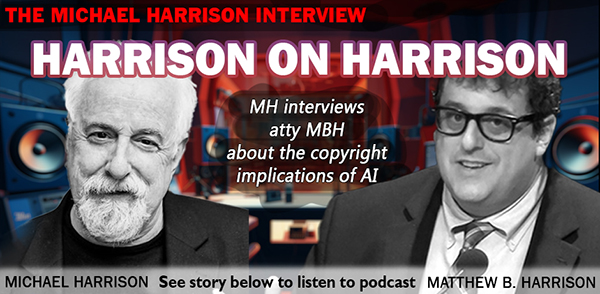
Matthew B. Harrison is This Week’s Guest on Harrison Podcast

Two generations of the Harrison radio family meet on mic discussing the copyright implications of artificial intelligence as Matthew B. Harrison is this week’s guest on the award-winning PodcastOne series, “The Michael Harrison Interview.” Matthew, the son of Michael, is VP/associate publisher of TALKERS in addition to being a media and intellectual property attorney, talent manager and audio/video producer.  His latest productions, “I Got a Line in New York City” (www.igotaline.com) and “My Friend is Going Away” (www.myfriendisgoingaway.com) are experimental exercises in the utilization of AI graphics in the music video genre. On this podcast, Harrison and Harrison bring into focus the somewhat murky application of copyright law in communications and the arts as we hurtle into the frontier age of artificial intelligence. Listen to the podcast in its entirety here.