By Walter Sabo
a.k.a. Walter Sterling, Host
WPHT, Philadelphia, “Walter Sterling Every Damn Night”
TMN syndicated, “Sterling on Sunday”
 Network TV often delivers Nielsen hashmarks. No viewers! The no numbers reports started coming in over 20 years ago and they met with silence. Often on Holiday nights, long weekends, NBC, CBS, ABC or FOX delivered no measurable audience. Simultaneously, online video stars were attracting millions of views. In 2007, the media world witnessed the audience shift from broadcast TV to online video. In the following years, media buyers made the definition of a bad investment: Between the time a buy was placed on network TV to the day of air, the audience diminished. Every month. Year after year.
Marketing types refer to the adoption rate of new ideas in stages:
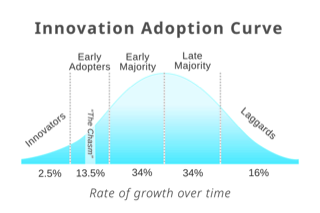
Last week, YouTube entered the golden phase: Laggards. There has been a misperception that YouTube viewers skewed young. That was never true. Their viewership demographic has always matched the demographic spread of America. That means month after month for 20 years, YouTube has been embraced by all demographics at higher and higher rates. Now YouTube has scored the final 10% of adopters: Laggards.
YouTube Wins the Oscars
The Oscars. A major ratings-generating, newsworthy event on YouTube. In Variety, questions were asked. The wrong questions: How will advertising be handled? Will there be a new category for Influencers? On demand? Wrong questions.
The answer is: The Oscars are on YouTube! Game over for ABC, CBS, NBC, FOX. The final segment of the population that frequented broadcast TV will now come to YouTube. The Oscars were the most efficient way to appeal to the laggards.
BONUS: The Oscars announcement just mentioned a key part of the deal: The entire library of the Academy of Arts and Sciences will be uploaded to YouTube. Hundreds of thousands of films from around the world, of all genres coming to YouTube.
And what was the deal? How much did Google pay? It doesn’t matter. Google’s challenge is how to get rid of all of their cash!
The Oscars will be on YouTube. Mark the date. The media landscape has changed forever.
Walter Sabo has been a C-Suite action partner for companies such as SiriusXM, Hearst, Press Broadcasting, Gannett, RKO General, and many other leading media outlets. His company, HITVIEWS, in 2007, was the first to identify and monetize video influencers. His nightly show “Walter Sterling Every Damn Night” is heard on WPHT, Philadelphia. His syndicated show, “Sterling On Sunday,” from Talk Media Network, airs 10:00 pm-1:00 am ET, and is now in its 10th year of success. He can be reached by email at sabowalter@gmail.com.



 PPM service in the Baltimore, Jacksonville, Philadelphia and Pittsburgh markets. Additionally, the MRC denied accreditation for the Audio PPM service in 18 markets including Austin, Baltimore, Boston, Dallas, Hartford, Houston, Jacksonville, Las Vegas, Memphis, Nashville, New York, Norfolk, Orlando, Philadelphia, Pittsburgh, Providence, Raleigh, Sacramento, San Francisco, Seattle, Washington DC, and West Palm Beach. This does not mean that Nielsen cannot continue to market the service; the PPM ratings in the above markets will lose their “audited” label. As in the past when accreditation is revoked or denied, Nielsen says it is working to improve the measurement systems.
 forgetting that ease of measurement doesn’t always equal effectiveness. Yet there is a legacy powerhouse that continues to outperform nearly every other medium in the one metric that matters most: actual human reach. That’s radio.” The piece underscores radio’s reach, zeroing in on the fact that radio doesn’t just reach older demos, every month it reaches the 87% of adults 18-34 – the demo often described as “digital only.” Additionally, the report says, “Americans spend nearly four hours a day with audio. Of the ad-supported time advertisers can actually buy, radio and podcasts account for 82%, while streaming music services account for only 16%. An audio plan built without both radio and podcasts misses most of the audience.”
 remains bedrock equipment.” Some of the findings include: 1) Around half of all respondents stated they would outright refuse to purchase a vehicle that lacks an AM/FM radio; 2) More than seven in 10 consumers view AM/FM radio as an essential feature that should come standard as basic equipment in all new vehicles. This places its perceived importance on par with smartphone integration (Apple CarPlay/Android Auto) and significantly ahead of satellite radio or built-in subscription music apps; 3) Around half of respondents indicated that if an OEM decided to completely remove AM/FM radio from its lineup, they would instantly have a less favorable perception of that car brand; and 4) This brand erosion and purchase refusal is significantly more pronounced among buyers aged 55+, creating a massive hurdle for brands relying on loyal, returning buyers.
  Act. The ruling affirmed the district court’s findings regarding coercion, anticompetitive effects, irreparable harm, and the tailored injunction, and held that Cumulus’ current bankruptcy did not require a stay of the appeal. In 2024, Nielsen instituted a policy requiring national broadcasters to purchase its local data in every market where they operate in order to access the full national
 report. This policy forced Cumulus’ Westwood One to choose between buying all local data from the firm or losing access to the essential national data product. Cumulus is suing Nielsen United States District Court for the Southern District of New York, alleging that the Nielsen’s policy constitutes an unlawful tying arrangement. The district court found that Nielsen used its monopoly power in the national data market to coerce customers into buying local data products, resulting in anticompetitive effects in local markets by excluding competitors.
 of Americans listen to AM/FM radio as part of their daily audio consumption. Podcast listening gets 20% with ad-supported streaming getting 16%, and ad-supported satellite radio accounting for 2%. The report also indicates that the news/talk radio format maintained its position as the top format with 10.9% share of total radio listening (P18+), a slight uptick from the 10.8% it captured in Q4 2025. All-news listening also increased, climbing from 2.7% to 2.9%.
  Cumulus’s relationships with advertisers, goodwill, and market share, and push it towards financial collapse. The District Court accordingly enjoined Nielsen’s anticompetitive conduct.
  Nielsen’s brief attacks those findings as speculative, asserting that Cumulus never showed any real risk of bankruptcy or any other non-compensable harm, but one of those irreparable harms has now come to pass: After a motions panel stayed the injunction, Cumulus declared bankruptcy—citing “the Nielsen network tying policy” as a significant contributing cause. The other harms identified by the District Court remain today and have become increasingly urgent, as Cumulus will lose access to Nationwide this September.” TALKERS associate publisher and Harrison Media Law senior partner Matthew B. Harrison comments, “Cumulus has fundamentally shifted the posture of this case. What began as a forward-looking claim of irreparable harm is now being presented as a realized outcome, following its Chapter 11 filing. The appellate court is no longer being asked to prevent potential damage, but to assess whether the harm that has already occurred can be attributed to Nielsen’s challenged conduct — or to broader economic pressures facing the radio industry.”
 is nearly universal among Hispanic (94%) and Black (93%) consumers; 2) AM/FM radio commands more than 80% of all ad-supported audio time in vehicles. Nearly three-quarters of out-of-home radio use during peak drive times occurs in the car, placing brands closest to the point of purchase; 3) however, a significant “perception gap” exists; while marketers often rank radio low for effectiveness, Nielsen data reveals it delivers the highest ROI of any platform trailing only social media; and 4) radio and podcasts combined account for more than 80% of all daily ad-supported audio time, while streaming music accounts for only 15%.
  pharmaceutical brand’s original buy targeting adults 18-54, 100% of the budget was allocated to traditional television, with 87% to broadcast and 13% to cable. This achieved a reach of 39%. By shifting only 5% of the total spend away from the usual go-to television outlets, and into podcasts, reach increased significantly. Reach among those ages 18-54 went from 39% in the old campaign to 55% in the new campaign, a lift of 41%. Note that this is shifting dollars, not adding dollars. The brand reached 26 million additional people without increasing the advertising budget.
 and 25–54 with double-digit shares of 13.9 and 13.1, respectively. The show is hosted by DJ Envy, Jess Hilarious, and Charlamagne Tha God and plays an important role in urban youth culture. iHeartMedia EVP of programming Thea Mitchem states, “The Breakfast Club continues to set the standard for what a truly multiplatform powerhouse looks like. These record‑setting ratings are a direct reflection of the team’s talent, consistency, and cultural impact. DJ Envy, Jess Hilarious, Charlamagne Tha God, and our exceptional production and digital teams deliver a show that resonates deeply with audiences across every platform. We’re incredibly proud of this achievement and grateful to the listeners of New York who make ‘The Breakfast Club’ a defining force in media.”
 appeal of the District Court’s ruling on Cumulus’ request to seal the record and protect witnesses’ identities. That request was granted by the District Court. Cumulus Media is suing Nielsen alleging that the company is illegally leveraging its dominance over national and local radio audience data to stifle rivals and charge inflated prices. At the heart of the complaint is the charge that Nielsen is providing access to the national broadcast radio ratings only if the client spends a lot of extra money on the separate local ratings. Cumulus argues that Nielsen’s policy forces them to buy ratings in U.S. markets where it doesn’t operate stations in order to have the complete national ratings data.
 commercially unreasonable rate for its Nationwide Report may cause it to have to do away with the Nationwide Report altogether. This testimony accompanied Nielsen’s request for a stay pending appeal as it appeals to the Second Circuit. This is the latest in action in Cumulus’ suit alleging that
  Nielsen is illegally leveraging its dominance over national and local radio audience data to stifle rivals and charge inflated prices. Judge Vargas denied the stay pending appeal but did grant an administrative stay will be in effect only until January 16, 2026, to allow Nielsen time to file a motion for a stay in the Second Circuit Court of Appeals. Tunkel’s testimony states that the order would cause Nielsen “significant irreparable harm if required to comply with the Court’s ruling during the pendency of Nielsen’s appeal… As a result, Nielsen would not be able to apply that policy in any of the at least ten negotiations with clients that Nielsen expects to have in 2026. If Nielsen is unable to apply the Network Policy, then it will be hindered in its ability to ensure that it can recover the costs of collecting the local radio-ratings data that make up the Nationwide report and spread those costs appropriately across the customers that use the products generated from those joint costs. If Nielsen cannot recover these costs, then it may have to retire the Nationwide report, similar to when Nielsen retired its other national data product, RADAR. If it does not retire the Nationwide report, it may have to pass a higher share of the costs of collecting local data on to other customers, including local radio stations, hurting Nielsen’s negotiating position with respect to those customers, as well as those customers themselves.”
 that the company is illegally leveraging its dominance over national and local radio audience data to stifle rivals and charge inflated prices. At the heart of the complaint is the charge that Nielsen is providing access to the national broadcast radio ratings only if the client spends a lot of extra money on the separate local ratings. Cumulus argues that Nielsen’s policy forces them to buy ratings in U.S. markets where it doesn’t operate stations in order to have the complete national ratings data. Vargas’ injunction orders Nielsen to cease conditioning national ratings access on local subscriptions during ongoing contract negotiations. It also bars Nielsen from charging a commercially unreasonable rate for its nationwide ratings when sold as a standalone product while the case proceeds.
 rate increases. Cumulus argued, “Nielsen, a monopolist engaging in anticompetitive behavior, holds all of the power during contract negotiations, resulting in an unequal bargaining dynamic that is ripe for retaliation. For example, Nielsen can and has raised its rates significantly during negotiations.
  If identifying information is revealed to Nielsen’s businesspeople, Nielsen can retaliate with additional rate increases, resulting in manifest injustice to these third parties actively involved or who will be involved in negotiations with Nielsen.” After denying Cumulus’ request on December 4, Cumulus filed a supplemental brief and on December 15 Judge Jeannette Vargas agreed with Cumulus, writing, “Cumulus has established that sufficient countervailing factors – in particular, the privacy interests of these non-party declarants, the lack of bearing these narrowly tailored redactions have on the merits of this action, and the non-party declarants’ susceptibility to economic retaliation – outweigh the strong presumption in favor of public access to judicial documents.”
  advertisers and publishers across traditional and digital channels. Naylor will ensure the measurement company is meeting the needs of a wide array of clients, while working with Nielsen’s sales, product and research teams to help partners enhance their businesses.” Nielsen CEO Karthik Rao says, “The key to Nielsen’s continued success is working closely with our clients to build the best marketing intelligence platform in the world. Peter is the perfect person to help that mission, building on Nielsen’s momentum of Big Data + Panel measurement, live streaming innovation and our AI transformation. He has led teams across linear TV, streaming and social media. He knows what consumers and clients want – and need – as behaviors continue to evolve. We can’t wait to keep building with him and our partners.”
 platforms like radio, podcasts, streaming music services and satellite radio, with ad-supported audio representing 64% of total listening.” Breaking that down further, the study reveals that within the ad-supported audio universe,
  consumers spent 62% of their daily time with radio, 20% with podcasts, 15% with streaming audio services and 3% with satellite radio. Among 18-34 year-olds radio accounted for 43% of daily ad-supported audio time, where podcasts accounted for 31%. And adults 35+ spent 69% of daily ad-supported audio time listening to radio and only 16% listening to podcasts. Looking at listening based on radio formats (Nielsen PPM Cross-Market AQH Share. Q3 2025. Mon-Sun 6a-Mid), news/talk garnered a 10.6 share for Persons 18+ and a 12.0 share for Persons 35+, and a 6.1 share in the 25-54 demo.
  revocation of accreditation for Nielsen Audio Diary markets as reported in the RMR and TAPSCAN Web including Bryan College Station, Texas; Hudson Valley; Killeen-Temple, Texas; Odessa- Midland, Texas; Portsmouth-Dover-Rochester, New Hampshire; Reno; and Trenton. At the same time, the MRC has approved accreditations for all of Nielsen’s 28 PPM markets.
 charge inflated prices, according to a report by Reuters. At the heart of the complaint is the charge that Nielsen is providing access to the national broadcast radio ratings only if the client spends a lot of extra money on
  the separate local ratings. Cumulus argues that Nielsen’s policy forces them to buy ratings in U.S. markets where it doesn’t operate stations in order to have the complete national ratings data. Nielsen has stated that Cumulus’ suit is “entirely without merit” and “we will respond accordingly.” The complaint also says Nielsen is “degrading product quality, raising prices without justification and blocking competitors from gaining footholds in the industry.”
  U.S. Other takeaways include: Listeners aged 18-34 spend 32% of their daily ad-supported audio time with podcasts; and podcasts consistently drive top funnel advertising impact. Nielsen says its Podcast Brand Impact Database draws on nearly 2,000 case studies and shows that podcast ads continue to drive strong brand awareness, motivate listeners to learn more, and purchase products.
  place. This new data fusion will integrate the industry-leading Edison Podcast Metrics into Nielsen’s widely used media planning tool, Nielsen Media Impact
  (NMI).” Nielsen adds, “As podcast listenership continues to grow, it is critical for advertisers to have sophisticated tools and data to effectively plan, measure and optimize their audio investments. Nielsen Podcast Fusion in NMI will provide an even more holistic view of media planning and help users uncover valuable insights and demonstrate the effectiveness of their campaigns. NMI users will also be able to optimize media plans by specific podcast networks and genres, as well as top podcast programs.” NPR and Ocean Media are among the charter subscribers at launch.
 says, “Weekday shows ‘Sunrise Carolina with Joey Hudson,’ ‘The Tara Show,’ ‘The Mike Gallagher Show,’ ‘Straight Talk with Bill Frady,’ and ‘The Charlie James Show’ also secured the top spot across all prime dayparts with persons 12+ and adults 35+.” Audacy South Carolina operations manager Mark Hendrix says, “The exceptional performance of our Audacy Greenville stations is a direct reflection of our incredible talent, the passion they bring every day, and their connection with our listeners.”
 satellite radio; 2) In the second quarter of 2025, ad supported audio accounted for 64% of all listening, while in the TV landscape, 74% of viewing was done on ad supported platforms; 3) Zeroing in on the ad supported audio universe, consumers spent 64% of their daily time in the second quarter with radio, 19% with podcasts, 14% with streaming audio services and 3% with satellite radio. The study also tracks listening by format and news/talk (AM/FM and streaming) not surprisingly dominated the 35+ demo with more than a 12 share. But the format also did well with 25-54s, notching a 6.5 share (which topped all other formats except adult contemporary
 solutions executive Michael Katz writes that, according to Scarborough consumer purchase data, consumers were asked to “select auto dealerships where you or other household members might shop if you were planning to buy or lease a new or used vehicle (including in-store and online shopping)” and 36% were unable to name an auto dealer. Katz adds that one out five auto intenders (21%), those who will lease or buy a new or used vehicle in the next year, cannot name one auto dealer. He says, “Auto dealers need ads that teach people who they are and build their brands.”
  KPIs and lower CPMs can be misleading, and a channel’s ability to claim conversion credit doesn’t necessarily translate to real value. This bias can lead to underinvestment in traditional channels, like radio, which, despite being perceived as less effective, can deliver substantial ROI.” The perceived effectiveness of radio by marketers puts it dead last in ROI. But a weighted average shows that radio is second only to social media in ROI. The study also found that “podcasts demonstrate strong ROI, comparable to TV and digital display, yet they are often overlooked or undervalued.”