


Industry Views

Just Because You Found It Online Doesn’t Mean You Can Use It

By Matthew B. Harrison
TALKERS, VP/Associate Publisher
Harrison Media Law, Senior Partner
Goodphone Communications, Executive Producer

imgA New Jersey radio station thought they were just being clever online. They scanned a photo from New Jersey Monthly, cropped out the photographer’s credit line, and posted it on Facebook – inviting listeners to edit and reshare it for fun. ying to engage listeners to interact with the station with more than just their ears.”

But that station, WKXW 101.5, ended up in federal court.

Photographer Peter Murphy sued for copyright infringement and removal of attribution. The Third Circuit ruled against the station – finding that the image was used without permission, credit removed, and the photographer’s ability to license his work damaged.

It wasn’t fair use. It was infringement.

Fair Use Won’t Save You from Getting Sued

Fair use isn’t a free pass – it’s a defense. That means someone’s already accused you of infringement, and now it’s on you to justify it.

Even when it works, fair use still costs time and money. In the WKXW case, the station used the entire photo, failed to transform it, and encouraged widespread online sharing. The court saw that as market harm – one of the most important fair use factors.

And don’t assume you’re safe just because it wasn’t part of the broadcast. Courts have made clear that even social media posts by broadcasters can undermine the value of the original and trigger liability.

Don’t Ignore It Just Because It Feels Small

In my own experience with clients fending off these kinds of claims, sometimes it’s obvious. Other times it’s a bluff. But even bogus claims can cost you if you don’t take them seriously from the beginning.

License It, Link to It, or Leave It

If you didn’t create it or license it, don’t assume it’s fair game. Look for content with clear reuse rights. Better yet – link to the source instead of copying it.

Because if a copyright holder comes after you, your intentions won’t matter. Only your rights will.

Matthew B. Harrison is a media and intellectual property attorney who advises radio hosts, content creators, and creative entrepreneurs. He has written extensively on fair use, AI law, and the future of digital rights. Reach him at Matthew@HarrisonMediaLaw.com or read more at TALKERS.com.

Industry Views

In the Age of Blogs, Podcasts, and Substack, Defamation Law is Asking: How Public is Too Public?

By Matthew B. Harrison
TALKERS, VP/Associate Publisher
Harrison Media Law, Senior Partner
Goodphone Communications, Executive Producer

imgMark Walters didn’t expect to lose private-figure legal protections over something he never talked about – especially since the thing he never talked about never even happened. A nationally syndicated radio host and outspoken Second Amendment advocate, Walters is publicly known, but in a specific lane. He never discussed nonprofits, financial misconduct, or legal ethics. Yet when ChatGPT hallucinated a claim that he had embezzled from a charity, a Georgia court ruled he was a public figure – and dismissed his defamation suit. 

The logic? Walters had a platform, a following, and a history of public commentary. That was enough. The court held that his general media presence elevated him to public-figure status, even though the allegedly defamatory statement had nothing to do with the subject matter of his actual work. wasn’t defamed about what he’s known for—but his visibility was used against him anyway.

The case didn’t just shut down a complaint. It opened a wider question: who qualifies as a public figure in the modern media era – and when does that designation apply to topics you never touched?

Mark Walters Inspired editorial cartoon for exclusive use by TALKERS


Why Public Figure Status Matters

Defamation law protects people from false, reputation-harming statements – but not equally. A private figure needs only to show that the speaker was negligent. A public figure, by contrast, must prove actual malice – that the speaker knew the statement was false or recklessly disregarded the truth.

This high standard, first articulated in New York Times v. Sullivan, was intended to protect freedom of speech and the press. But in the age of digital publishing and algorithmic reach, it’s increasingly used to deny protection to people who never thought they were stepping into the spotlight.

What Makes Someone a Public Figure?

Courts recognize two main categories:

– General-purpose public figures are household names – people famous across all topics and platforms.

– Limited-purpose public figures are individuals who have voluntarily entered public controversy or engaged in widespread public commentary on specific issues.

Here’s where the modern problem begins.

Thanks to blogs, newsletters, podcasts, and social media, it’s easier than ever to participate in public dialogue – and harder than ever to keep that participation confined to just one topic.

Post a viral thread on immigration?

Host a weekly podcast about school choice?

Weigh in on TikTok about local politics?

You may have just stepped into “limited-purpose public figure” territory – whether you intended to or not.

The Walters v. OpenAI Case – Now the Law

In Walters v. OpenAI, the court didn’t question whether the claim was false – only whether Walters could meet the public figure burden of proof. The court held that he could not. Despite the fact that he had never discussed the subject matter in question, his general visibility was enough to require that he prove actual malice. And he couldn’t.

The decision came with no trial, no settlement – just a dismissal. It now stands as legal precedent: having a public voice on one issue may cost you private-figure protections on others.

Microphone, Meet Microscope

This shift affects:

Independent journalists

– Podcast hosts

– Niche content creators

– Local activists with modest but vocal platforms

They may not feel “public,” but courts increasingly view them that way. And once that threshold is crossed, the burden in a defamation case becomes dramatically harder to meet.

he more you speak publicly—even on one topic—the more legally exposed you are everywhere else.

That wasn’t the intent of Sullivan. But in today’s fragmented, always-on media culture, visibility leaks- and so do legal thresholds.

Final Takeaway

You don’t need to be famous to be “public.” You just need to be findable.

Whether you’re behind a mic, a blog, or a camera, your platform may elevate you into public figure status – and bring defamation law’s toughest burdens with it. If you’re defamed, you’ll have to prove the speaker acted with knowing falsehood. If you’re doing the speaking, your target’s legal classification could determine how costly a misstep becomes.

In 2025, every microphone is also a microscope. Know what the law sees before you go live.

Matthew B. Harrison is a media and intellectual property attorney who advises radio hosts, content creators, and creative entrepreneurs. He has written extensively on fair use, AI law, and the future of digital rights. Reach him at Matthew@HarrisonMediaLaw.com or read more at TALKERS.com.

Industry Views

When One Clip Cuts Two Ways: How Copyright and Defamation Risks Collide

img

By Matthew B. Harrison
TALKERS, VP/Associate Publisher
Harrison Media Law, Senior Partner
Goodphone Communications, Executive Producer

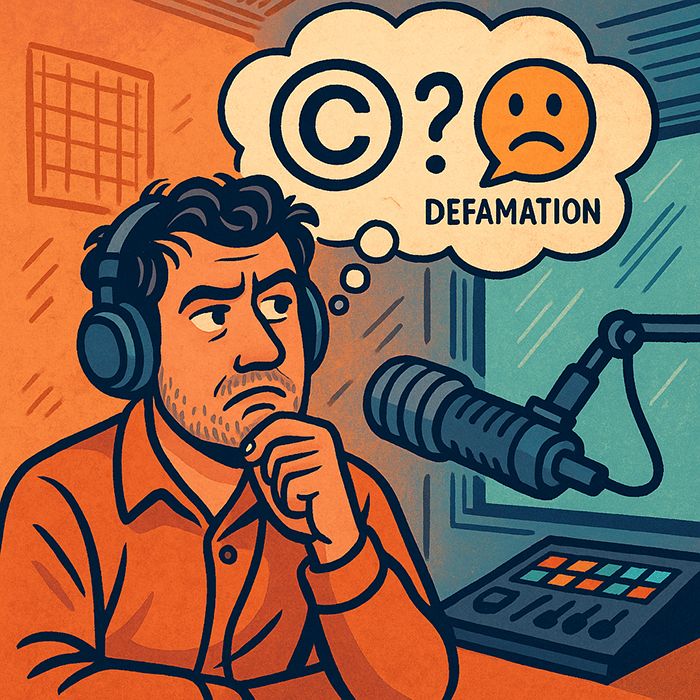
imgA radio (or video podcast) host grabs a viral clip, tosses in some sharp commentary, and shares it online. The goal? Make some noise. The result? A takedown notice for copyright infringement – and then a letter threatening a defamation suit.

Sound far-fetched? It’s not. In today’s media world, copyright misuse and defamation risks often run on parallel tracks – and sometimes crash into each other. They come from different areas of law, but creators are finding themselves tangled up in both over the same piece of content.

Copyright Protects Ownership. Defamation Protects Reputation

It’s easy to think of copyright and defamation as two separate beasts. One guards creative work. The other shields reputation. But when creators use or edit someone else’s content – especially for commentary, parody, or critique – both risks can hit at once.

Take Smith v. Summit Entertainment LLC (2007). Smith wrote an original song. Summit Entertainment slapped him with a false DMCA takedown notice, claiming copyright they didn’t actually own. Smith fought back, suing not just for the bogus takedown but also for defamation, arguing that Summit’s public accusations hurt his reputation. The court said both claims could go forward.

That case shows just how easily copyright claims and defamation threats can pile up when bad information meets bad behavior.

Murphy v. Millennium Radio: A Close Call with a Clear Message

In Murphy v. Millennium Radio Group LLC, a New Jersey radio station scanned a photographer’s work – with his credit – and posted it online without permission. That alone triggered a copyright claim. But the hosts didn’t stop there. They mocked the photographer on-air, which sparked a defamation lawsuit.

Even though the copyright and defamation claims came from different actions – using the photo without permission and trash-talking the photographer – they landed in the same legal fight. It’s a reminder that separate problems can quickly become one big headache.

Why This Double Threat Matters

Fair Use Isn’t a Free Pass on Defamation. Even if you have a solid fair use argument, that won’t protect you if your edits or commentary twist facts or attack someone unfairly.
Public Comments Can Double Your Trouble. The second you speak publicly about how you’re using content – whether you’re bragging about rights you don’t have or taking a shot at someone – you risk adding a defamation claim on top of an IP dispute.
Smart Lawyers Play Both Angles. Plaintiffs know the playbook. They’ll use copyright claims for takedown leverage and defamation claims for reputational damage – sometimes in the same demand letter.
FCC Rules Don’t Cover This. It doesn’t matter if you’re FCC-regulated or a podcaster on your own. These risks come from civil law – and they’re coming for everyone.

The Takeaway

The overlap between copyright and defamation isn’t just a legal footnote – it’s a growing reality. In a world of viral clips, reaction videos, and borrowed content, creators need to watch how they frame and comment on what they use, just as much as whether they have permission to use it in the first place.

Because when one clip cuts two ways, you could take a hit from both directions.

Matthew B. Harrison is a media and intellectual property attorney who advises radio hosts, content creators, and creative entrepreneurs. He has written extensively on fair use, AI law, and the future of digital rights. Reach him at Matthew@HarrisonMediaLaw.com or read more at TALKERS.com.

Industry Views

The Soundbite Trap: How Editing in Radio and Podcasting Creates Legal Risk

By Matthew B. Harrison
TALKERS, VP/Associate Publisher
Harrison Media Law, Senior Partner
Goodphone Communications, Executive Producer

imgIn radio and podcasting, editing isn’t just technical – it shapes narratives and influences audiences. Whether trimming dead air, tightening a guest’s comment, or pulling a clip for social media, every cut leaves an impression.

But here’s the legal reality: editing also creates risk.

For FCC-regulated broadcasters, that risk isn’t about content violations. The FCC polices indecency, licensing, and political fairness – not whether your edit changes a guest’s meaning.

For podcasters and online creators, the misconception is even riskier. Just because you’re not on terrestrial radio doesn’t mean you’re free from scrutiny. Defamation, false light, and misrepresentation laws apply to everyone — whether you broadcast on a 50,000-watt signal or a free podcast platform.

At the end of the day, it’s not the FCC that will hold you accountable for your edits. It’s a judge.

1. Alex Jones and the $1 Billion Lesson

Alex Jones became infamous for promoting conspiracy theories on Infowars, especially his repeated claim that the Sandy Hook shooting was a hoax – supported by selectively aired clips and distorted facts.

The result? Nearly $1 billion in defamation verdicts after lawsuits from victims’ families.

Takeaway: You can’t hide behind “just asking questions” or “it was my guest’s opinion.” If your platform publishes it – over the airwaves or online – you’re legally responsible for the content, including how it’s edited or framed. 

2. Katie Couric and the Gun Rights Group Edit

In “Under the Gun,” filmmakers inserted an eight-second pause after Katie Couric asked a tough question, making it seem like a gun rights group was stumped. In reality, they had answered immediately.

The group sued for defamation. The case was dismissed, but reputations took a hit.

Takeaway: Even subtle edits – like manufactured pauses – can distort meaning and expose creators to risk. 

3. FOX News and the Dominion Settlement

FOX News paid $787 million to Dominion Voting Systems after airing content suggesting election fraud – often based on selectively edited interviews and unsupported claims.

Though FOX is (among other things) a cable network, the impact shook the media world. Broadcasters reassessed risks, host contracts, and editorial practices. 

Takeaway: Major networks aren’t the only ones at risk. Radio hosts and podcasters who echo misleading narratives may face similar legal consequences. 

4. The Serial Podcast and the Power of Editing

“Serial” captivated millions by exploring Adnan Syed’s murder conviction. While no lawsuit followed, critics argued the producers presented facts selectively to build a certain narrative. 

Takeaway: Even without a lawsuit, editing shapes public perception. Misleading edits may not land you in court but can damage trust and invite scrutiny.

Whether you’re behind a radio microphone or a podcast mic, your editing decisions carry weight – and legal consequence.

The FCC might care if you drop an indecent word on air, but they won’t be the ones suing you when a guest claims you twisted their words. That’s civil law, where defamation, false light, and misrepresentation have no broadcast exemption.

There’s one set of rules for editing that every content creator lives by – and they’re written in the civil courts, not the FCC code.

Edit with care. 

Matthew B. Harrison is a media and intellectual property attorney who advises radio hosts, content creators, and creative entrepreneurs. He has written extensively on fair use, AI law, and the future of digital rights. Reach him at Matthew@HarrisonMediaLaw.com or read more at TALKERS.com.

Industry Views

You Cut for Time. They Cut You a Lawsuit.

By Matthew B. Harrison
TALKERS, VP/Associate Publisher
Harrison Media Law, Senior Partner
Goodphone Communications, Executive Producer

imgLet’s discuss how CBS’s $16 million settlement became a warning shot for every talk host, editor, and content creator with a mic.

When CBS settled a lawsuit with Donald Trump for $16 million over a selectively edited “60 Minutes” interview with Kamala Harris, it wasn’t about guilt. It was about leverage. The lawsuit happened to coincide with Paramount’s FCC merger review – coincidentally, right when regulatory pressure was needed the most.

For broadcasters and digital creators alike, the message is clear: even lawful edits can become political weapons. If you shape content, you’re a target. And the courts aren’t the only battleground. Public outrage, regulatory scrutiny, and advertiser anxiety all shape the cost of controversy.

For Broadcasters: Every Cut Counts

Editing always alters reality. That doesn’t make it wrong – but it makes it risky. Even good-faith trims for time or tone can be reframed as distortion. What matters isn’t just what you cut, but whether you can defend it.

Case in Point: “60 Minutes” vs. DeSantis

CBS was accused of misleading edits in a 2021 vaccine rollout story. They published full transcripts and stood their ground. No apology, no payout.

Takeaways:

— Archive raw footage.
— Log your editorial decisions.
— Be ready to explain your process with clarity and conviction.

For Digital Creators: You’re Not as Untouchable as You Think

Section 230 might protect platforms, but it doesn’t shield you from smear campaigns, takedowns, or frivolous lawsuits. Editing with commentary or critique is often fair use – but that doesn’t stop bad-faith actors from flipping the narrative.

Case in Point: “Decoding Fox News”

Jules Terpak’s critique series survived coordinated attacks thanks to clear sourcing, transparency, and credibility built ahead of time.

Takeaways:

— Know your rights, but also your vulnerabilities.
— Keep receipts.
— Build audience trust before someone tries to burn it down.

The Real Risk Isn’t the Edit – It’s the Optics

Trump didn’t need to win the lawsuit. He just needed the headlines – and CBS needed their merger. Settlements aren’t always about truth. They’re about timing.

So protect yourself:

— Document your work.
— Develop internal standards.
— Don’t panic under pressure – prepare for it.

Because in an era where outrage spreads faster than facts, defending the integrity of your edit isn’t optional. It’s essential.

Matthew B. Harrison is a media and intellectual property attorney who advises radio hosts, content creators, and creative entrepreneurs. He has written extensively on fair use, AI law, and the future of digital rights. Reach him at Matthew@HarrisonMediaLaw.com or read more at TALKERS.com.

Industry Views

Is That Even Legal? Talk Radio in the Age of Deepfake Voices: Where Fair Use Ends and the Law Steps In

By Matthew B. Harrison
TALKERS, VP/Associate Publisher
Harrison Media Law, Senior Partner
Goodphone Communications, Executive Producer

imgIn early 2024, voters in New Hampshire got strange robocalls. The voice sounded just like President Joe Biden, telling people not to vote in the primary. But it wasn’t him. It was an AI clone of his voice – sent out to confuse voters.

The calls were meant to mislead, not entertain. The response was quick. The FCC banned AI robocalls. State officials launched investigations. Still, a big question remains for radio and podcast creators:

Is using an AI cloned voice of a real person ever legal?

This question hits hard for talk radio, where satire, parody, and political commentary are daily staples. And the line between creative expression and illegal impersonation is starting to blur.

It’s already happening online. AI-generated clips of Howard Stern have popped up on TikTok and Reddit, making him say things he never actually said. They’re not airing on the radio yet – but they could be soon.

Then came a major moment. In 2024, a group called Dudesy released a fake comedy special called, “I’m Glad I’m Dead,” using AI to copy the voice and style of the late George Carlin. The hour-long show sounded uncannily like Carlin, and the creators claimed it was a tribute. His daughter, Kelly Carlin, strongly disagreed. The Carlin estate sued, calling it theft, not parody. That lawsuit could shape how courts treat voice cloning for years.

The danger isn’t just legal – it’s reputational. A cloned voice can be used to create fake outrage, fake interviews, or fake endorsements. Even if meant as satire, if it’s too realistic, it can do real damage.

So, what does fair use actually protect? It covers commentary, criticism, parody, education, and news. But a voice isn’t just creative work – it’s part of someone’s identity. That’s where the right of publicity comes in. It protects how your name, image, and voice are used, especially in commercial settings.

If a fake voice confuses listeners, suggests false approval, or harms someone’s brand, fair use probably won’t apply. And if it doesn’t clearly comment on the real person, it’s not parody – it’s just impersonation.

For talk show hosts and podcasters, here’s the bottom line: use caution. If you’re using AI voices, make it obvious they’re fake. Add labels. Give context. And best of all, avoid cloning real people unless you have their OK.

Fair use is a shield – but it’s not a free pass. When content feels deceptive, the law – and your audience – may not be forgiving.

Matthew B. Harrison is a media and intellectual property attorney who advises radio hosts, content creators, and creative entrepreneurs. He has written extensively on fair use, AI law, and the future of digital rights. Reach him at Harrison Legal Group or read more at TALKERS.com.

Industry Views

Mark Walters v. OpenAI: A Landmark Case for Spoken Word Media

By Matthew B. Harrison
TALKERS, VP/Associate Publisher
Harrison Media Law, Senior Partner
Goodphone Communications, Executive Producer

imgWhen Georgia-based nationally syndicated radio personality, and Second Amendment advocate Mark Walters (longtime host of “Armed American Radio”) learned that ChatGPT had falsely claimed he was involved in a criminal embezzlement scheme, he did what few in the media world have dared to do. Walters stood up when others were silent, and took on an incredibly powerful tech company, one of the biggest in the world, in a court of law.

Taking the Fight to Big Tech

Walters, by filing suit against OpenAI, the creator of ChatGPT, become the first person in the United States to test the boundaries of defamation law in the age of generative artificial intelligence.

His case was not simply about clearing his name. It was about drawing a line. Can artificial intelligence generate and distribute false and damaging information about a real person without any legal accountability?

While the court ultimately ruled in OpenAI’s favor on specific legal procedure concerns, the impact of this case is far from finished. Walters’ lawsuit broke new ground in several important ways:

— It was the first known defamation lawsuit filed against an AI developer based on content generated by an AI system.
— It brought into the open critical questions about responsibility, accuracy, and liability when AI systems are used to produce statements that sound human but carry no editorial oversight.
— It continued to add fuel to the conversation of the effectiveness of “use at your own risk” disclaimers when there is real world reputational damage hanging in the balance.

Implications for the Radio and Podcasting Community

For those spoken-word creators, regardless of platform on terrestrial, satellite, or the open internet, this case is a wake-up call, your canary in a coal mine. Many shows rely on AI tools for research, summaries, voice generation, or even show scripts. But what happens when those tools get it wrong? (Other than being embarrassed, and in some cases fined or terminated) And worse, what happens when those errors affect real people?

The legal system, as has been often written about, is still playing catch-up. Although the court ruled that the fabricated ChatGPT statement lacked the necessary elements of defamation under Georgia law, including provable harm and demonstrable fault, the decision highlighted how unprepared current frameworks are for this fast-moving, voice-driven digital landscape.

Where the Industry Goes from Here

Walters’ experience points to the urgent need for new protection and clearer guidelines:

— Creators deserve assurance that the tools they use are built with accountability in mind. This would extend to copyright infringement and to defamation.
— Developers must be more transparent about how their systems operate and the risks they create. This would identify bias and attempt to counteract it.
— Policymakers need to bring clarity to who bears responsibility when software, not a person, becomes the speaker.

A Case That Signals a Larger Reckoning

Mark Walters may not have won this round in court, but his decision to take on a tech giant helped illuminate how quickly generative AI can create legal, ethical, and reputational risks for anyone with a public presence. For those of us working in media, especially in formats built on trust, voice, and credibility, his case should not be ignored.

“This wasn’t about money. This was about the truth,” Walters tells TALKERS. “If we don’t draw a line now, there may not be one left to draw.”

To listen to a longform interview with Mark Walters conducted by TALKERS publisher Michael Harrison, please click here

Media attorney, Matthew B. Harrison is VP/Associate Publisher at TALKERS; Senior Partner at Harrison Media Law; and Executive Producer at Goodphone Communications. He is available for private consultation and media industry contract representation. He can be reached by phone at 724-484-3529 or email at matthew@harrisonmedialaw.com. He teaches “Legal Issues in Digital Media” and serves as a regular contributor to industry discussions on fair use, AI, and free expression.

Industry Views

When the Algorithm Misses the Mark: What the Walters v. OpenAI Case Means for Talk Hosts

By Matthew B. Harrison
TALKERS VP/Associate Publisher
Harrison Media Law, Senior Partner
Goodphone Communications, Executive Producer

imgIn a ruling that should catch the attention of every talk host and media creator dabbling in AI, a Georgia court has dismissed “Armed American Radio” syndicated host Mark Walters’ defamation lawsuit against OpenAI. The case revolved around a disturbing but increasingly common glitch: a chatbot “hallucinating” canonically false but believable information.
The Happenings: A journalist asked ChatGPT to summarize a real court case. Instead, the AI invented a fictional lawsuit accusing Walters of embezzling from the Second Amendment Foundation — a group with which he’s never been employed. The journalist spotted the error and never published inaccurate information. But the damage, at least emotionally and reputationally, was done. That untruth was out there, and Walters sued for defamation.

Last week, the court kicked the case. The court determined Walters was a public figure, and as such, Walters had to prove “actual malice” — that OpenAI knowingly or recklessly published falsehoods. He couldn’t but now it may be impossible.

The judge emphasized the basis that there was an assumption false information was never shared publicly. It stayed within a private conversation between the journalist and ChatGPT. No dissemination, no defamation.

But while OpenAI may have escaped liability, the ruling raises serious questions for the rest in the content creation space.

What This Means for Talk Hosts

Let’s be honest: AI tools like ChatGPT are already part of the media ecosystem. Hosts use them to summarize articles, brainstorm show topics, generate ad copy, and even suggest guest questions. They’re efficient — and also dangerous.

This case shows just how easily AI can generate falsehoods with confidence and detail. If a host were to read something like that hallucinated lawsuit on air, without verifying it, the legal risk would shift. It wouldn’t be the AI company on the hook — it would be the broadcaster who repeated it.

Key Lessons

  1. AI is not a source.
    It’s a starting point. Just like a tip from a caller or a line on social media, AI-generated content must be verified before use.
  2. Public figures are more exposed.
    The legal system gives less protection to people in the public eye — like talk hosts — and requires a higher burden of proof in defamation claims. That cuts both ways.
  3. Disclosure helps.
    OpenAI’s disclaimers about potential inaccuracies helped them in court. On air, disclosing when you use AI can offer similar protection — and builds trust with your audience.
  4. Editorial judgment still rules.
    No matter how fast or slick AI gets, it doesn’t replace a producer’s instincts or a host’s responsibility.

Bottom line: the lawsuit may be over, but the conversation is just beginning. The more we rely on machines to shape our words, the more we need to sharpen our filters. Because when AI gets it wrong, the real fallout hits the human behind the mic.

And for talk hosts, that means the stakes are personal. Your credibility, your syndication, your audience trust — none of it can be outsourced to an algorithm. AI might be a tool in the kit, but editorial judgment is still the sharpest weapon in your arsenal. Use it. Or risk learning the hard way what Mark Walters just did. Walters has yet to comment on what steps – if any – he and his lawyers will take next.

TALKERS publisher Michael Harrison issued the following comment regarding the Georgia ruling: “In the age of internet ‘influencers’ and media personalities with various degrees of clout operating within the same space, the definition of ‘public figure’ is far less clear than in earlier times. The media and courts must revisit this striking change. Also, in an era of self-serving political weaponization, this ruling opens the door to ‘big tech’ having enormous, unbridled power in influencing the circumstances of news events and reputations to meet its own goals and agendas.”

Matthew B. Harrison is a media attorney and executive producer specializing in broadcast law, intellectual property, and First Amendment issues. He serves as VP/Associate Publisher of TALKERS magazine and is a senior partner at Harrison Media Law. He also leads creative development at Goodphone Communications.

Industry News

Outstanding Speakers Joining “GENERATIONS 2025” Agenda

The lineup of industry speakers set to speak at the forthcoming GENERATIONS 2025 conference being presented by TALKERS at the forthcoming Intercollegiate Broadcasting System (IBS) convention – IBSNYC 2025 – continues to grow.

img

A stellar line-up of speakers have already signed up to speak at this groundbreaking industry event including (in alphabetical order): Vince Benedetto, CEO, Bold Gold Media Group; Chris Berry, VP News/Talk/Sports, iHeartMedia; Scot Bertram, General Manager, WRFH, Hillsdale College, Hillsdale, MI / Lecturer In Journalism; Mike Gallagher, talk show host, Salem Radio Network; Dom Giordano, talk show host, WPHT, Philadelphia; Lee Harris, Director of Integrated Operations, NewsNation / WGN, Chicago; Michael Harrison, Publisher, TALKERS; Matthew B. Harrison, Esq., VP/Associate Publisher, TALKERS; Harrison Media Law, Senior Partner; Harry Hurley, morning talk show host, WPG, Atlantic City; Jeff Katz, talk show host, WRVA, Richmond, VA; Chad Lopez, President, WABC, New York, Red Apple Media Group; John T. Mullen, general manager, WRHU-FM/WRHU.org, Hofstra University, Hempstead, NY; Walter Sabo (a.k.a. Walter M Sterling), consultant / talk show host / WPHT, Philadelphia / Talk Media Network; Rich Valdés, talk show host, Westwood One; with several more to be announced in the next few days. See agenda and accompanying stories below.

Sheraton Times Square New York Hotel
New York East Room
Saturday March 8, 2025
12:30 pm – 4:30 pm

AGENDA

12:30 – 1:00 pm Keynote Address “Welcome to the Brave New World”

Speakers:
Michael Harrison, Publisher, TALKERS
Matthew B. Harrison, Esq., VP/Associate Publisher, TALKERS; Harrison Media Law, Senior Partner

1:10 – 1:40 pm Fireside Chat “Setting the Stage”

Facilitator: Michael Harrison, Publisher, TALKERS
Special Guest: Chad Lopez, President, WABC, New York, Red Apple Media Group

1:50 – 2:20 pm Discussion: “Launching and Managing a Career in a Changing Media Industry”

Moderator: Dom Giordano, talk show host, WPHT, Philadelphia
Speaker: John T. Mullen, general manager, WRHU-FM/WRHU.org, Hofstra University, Hempstead, NY
Speaker: TBA
Speaker: TBA

2:30 – 3:00 pm Discussion: “Old School/New School/Next School – Learning from Each Other”

Moderator:  Harry Hurley, morning talk show host, WPG, Atlantic City
Speaker:  Vince Benedetto, CEO, Bold Gold Media Group
Speaker: Scot Bertram, General Manager, WRFH, Hillsdale College, Hillsdale, MI / Lecturer In Journalism
Speaker: Walter Sabo (a.k.a. Walter M Sterling), consultant / talk show host / WPHT, Philadelphia / Talk Media Network

3:10 – 3:40 pm Discussion: “Radio’s Place in a Diverse, Digital World”

Moderator: TBA
Speaker: Mike Gallagher, talk show host, Salem Radio Network
Speaker: Rich Valdés, talk show host, Westwood One
Speaker: TBA

3:50 – 4:20 pm Discussion: “Finding Truth in an Age of Misinformation”

Moderator: Lee Harris, Director of Integrated Operations, NewsNation / WGN, Chicago
Speaker:  Chris Berry, VP News/Talk/Sports, iHeartMedia
Speaker: Jeff Katz, talk show host, WRVA, Richmond, VA
Speaker: TBA

4:20 – 4:30 pm Wrap Up:  Group Chat

Industry Views

Fair Use or Foul Play? Lessons from “Equals Three”

By Matthew B. Harrison
TALKERS, VP/Associate Publisher
Harrison Media Law, Senior Partner
Goodphone Communications, Executive Producer

imgIn the ever-evolving landscape of digital media, creators often walk a fine line between inspiration and infringement. The 2015 case of “Equals Three, LLC v. Jukin Media, Inc.” offers a cautionary tale for anyone producing reaction videos or commentary-based content: fair use is not a free pass, and transformation is key.

The Case at a Glance

“Equals Three,” a popular YouTube series, built its reputation on humorously reacting to viral videos. The show used 10-30 second clips of these videos, pausing periodically for the host to add jokes and reactions. Jukin Media, which owns the rights to many viral clips, sued for copyright infringement, arguing the use was not protected under fair use.

The court sided with Jukin Media, ruling that “Equals Three’s” use was not sufficiently transformative. While the show added humor and commentary, it primarily repackaged the original content for entertainment without enough new meaning.

What This Means for You

Fair use requires creators to add something new, such as critique or analysis. Simply reacting to content with jokes or minimal commentary isn’t enough. Use only what’s necessary and ensure your work doesn’t substitute for the original.

Additionally, fair use considers market impact. If your content diminishes the value of the original by serving as a substitute, it’s unlikely to qualify. 

Why This Matters

Reaction videos and commentary are staples of digital media, but they come with risks. The “Equals Three” case highlights the need for meaningful transformation. By focusing on critique, analysis, or education, creators can navigate fair use confidently while respecting intellectual property rights. 

Media attorney, Matthew B. Harrison is VP/associate publisher, TALKERS; Senior Partner, Harrison Media Law; and executive producer, Goodphone Communications.  He is available for private consultation and media industry contract representation. He can be reached by phone at 724.484.3529 or email at matthew@harrisonmedialaw.com

Industry Views

FAIR USE: What Constitutes “Publishing” or a “Publication” on Today’s Media Playing Field?

By Matthew B. Harrison
TALKERS, VP/Associate Publisher
Harrison Media Law, Senior Partner
Goodphone Communications, Executive Producer

imAs the practice of “clip jockeying” becomes an increasingly ubiquitous and taken-for-granted technique in modern audio and video talk media, an understanding of the legal concept “fair use” is vital to the safety and survival of practitioners and their platforms.

When assessing fair use in audio media, courts closely examine the “nature of the copyrighted work,” especially focusing on whether the work is factual or creative, and published or unpublished. Factual content, such as news reports or data, is more likely to be seen as fair use material, as it’s in the public interest to keep factual information accessible. Creative works, like music, fiction, or original performances, often enjoy stronger protection because they embody the creator’s unique expression and should be compensated accordingly.

Unpublished interviews or speeches.  When audio content includes unpublished material – such as a speech or interview that hasn’t been publicly released – courts typically approach it with heightened caution. For example, if a podcast includes clips from an unpublished interview with a politician to enhance commentary, courts might scrutinize this more heavily than they would a published work, as the speaker retains significant control over whether and how the content reaches the public.

Case study insight: Salinger v. Random House (1987).  The landmark case Salinger v. Random House highlighted how unpublished works generally receive stronger copyright protection. In this case, the use of unpublished letters in a biography was ruled as infringing, emphasizing that unpublished materials hold a unique status in copyright law. If a podcaster today were to use a similarly unpublished interview with a public figure without significant commentary or transformation, they might face greater legal challenges.

Redefining “published” in the digital era.  With digital platforms, the meaning of “published” is evolving. Traditionally, a work was deemed “published” when made available for sale, license, or public distribution. Now, sharing content online, even in a limited way – such as within a closed social media group or private online forum – raises questions about whether the content should be considered published. Courts are increasingly aware that limited digital sharing doesn’t necessarily reduce a work’s unpublished protections, but extensive online distribution might.

Modern considerations of online sharing. Courts today analyze factors like control over access and the sharing platform’s nature. For instance, an audio clip shared in a restricted forum might retain its unpublished protections, while a widely posted clip could lose some of those protections. Additionally, when creators post content on platforms like Instagram or YouTube before officially “publishing” it elsewhere, courts may take the creator’s intent and distribution scope into account when determining the content’s legal status.

As online platforms reshape how creators distribute their work, they also impact fair use, pushing courts to reinterpret what it means for a work to be “published.” This evolving understanding means that copyright protections depend not only on whether a work is accessible but also on the level of control over its distribution, especially for audio content.

Media attorney, Matthew B. Harrison is VP/associate publisher, TALKERS; Senior Partner, Harrison Media Law; and executive producer, Goodphone Communications.  He is available for private consultation and media industry contract representation. He can be reached by phone at 724-484-3529 or email at matthew@harrisonmedialaw.com

Industry News

TALKERS Launching YouTube Channel

im

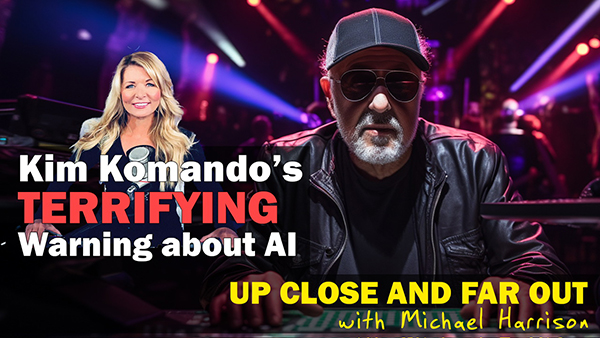
TALKERS is adding a YouTube channel to its array of talk media platforms. The venue – titled Talkers Media Channel – will initially provide a base for the organization’s conference videos and a platform for its founder Michael Harrison’s reimagined video iteration of his pioneering audio podcast, “Up Close and Far Out.” Videos from the recently held TALKERS 2024: Radio and Beyond will begin being posted after the July 4th holiday. “Up Close and Far Out with Michael Harrison” soft launches today with a conversation between Harrison and radio tech star Kim Komando examining the sociological, biological, and theological implications of artificial intelligence. The Harrison talk show will take several forms including one-on-one interviews, panel discussions and solo commentaries. Harrison and his guests will sometimes appear on camera and on other occasions just be voices enhanced by stunning visuals and music provided by the channel’s producer TALKERS VP/associate publisher, Matthew B. Harrison. The series will be targeted to an audience Harrison describes as “pop culture aficionados, political junkies, media enthusiasts, fans of science, followers of technology and the philosophically curious.” The Harrisons plan to focus heavily upon a stable of guests composed of professionals from the world of talk media covered by TALKERS magazine but stretch beyond that core as well. After it is fully up and running, plans are in place to expand the channel’s menu to include shows and properties produced by an array of content providers. To visit the debut installment of “Up Close and Far Out with Michael Harrison,” please click here.

Industry News

Michael Harrison Embarks Upon “Obsolete Slobs” Media Tour in Support of Provocative New Music Video

im

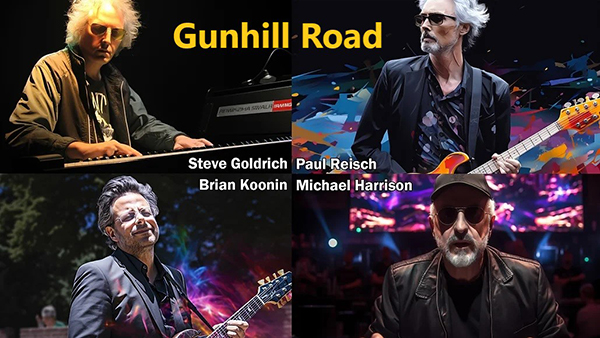
Now that the TALKERS 2024: Radio and Beyond conference is in the history books, TALKERS founder (and Gunhill Road member) Michael Harrison has embarked upon what is being called the Summer of ‘24 “Obsolete Slobs” media tour in support of the perennial rock group’s latest music video endeavor. Gunhill Road, the ensemble that has been creating multi-genre rock and pop music spanning more than five decades, has released a breathtaking new song and video titled, “Artificial Intelligence (No Robots Were Injured in the Production of this Song).” The piece – which is an unapologetic examination of the potential consequences AI poses to current human civilization – is an advance release from the band’s forthcoming fifth album. Gunhill Road has developed a unique niche in recent years attracting hundreds of thousands of internet followers powered, in large part, by the attention and airplay given it on talk radio. New songs by the group typically debut on multiple radio talk shows sparking conversation about today’s pressing topics of news and social concern. The compositions feature clever, biting lyrics delivered in a highly musical and original way. The band consists of co-founding member/pianist/vocalist/songwriter Steve Goldrich, longtime guitarist/vocalist/songwriter Paul Reisch, noted Broadway theater instrumentalist/guitarist/vocalist/songwriter Brian Koonin, and vocalist/songwriter Michael Harrison. (Harrison co-wrote this song and performs lead vocals.) This production features a special guest vocal appearance by recording artist Bibi Farber, daughter of the late talk radio pioneer, Barry Farber. The visually stunning video for “Artificial Intelligence (No Robots Were Injured in the Production of this Song)” which, ironically, employs generative AI for many of its remarkable images, was produced by Matthew B. Harrison. The song, an infectious rocker marked by driving guitars, riveting keyboards, soaring horns and a multi-layered group chorus depicts the dangers human civilization faces in an increasingly uncertain environment marked by the rising corruption of deep fakes and manipulative algorithms that threaten elections and question the very premise of “self-evident” truths. It ultimately asks the question, “What does it mean to be human?” Check out the video here. To arrange a talk media interview with Michael Harrison to discuss the song and its implications, email info@talkers.com or call 413-565-5413.

Industry News

Gunhill Road Music Video on YouTube Flagged and “Shadow Banned” by Google for Containing Shocking Content

im

The music video for the Gunhill Road song “Damn Scammers (Get Off My Phone)” has been flagged by the editorial powers-that-be at Google for containing “shocking” content. The video has, thus, been relegated to a covert censorship process on YouTube commonly known as shadow banning which drastically inhibits its ability to garner views and potentially go viral within the processes of the platform’s algorithms. The song and video make a powerful statement against the growing practice of scamming that is polluting the internet and sowing the seeds of distrust throughout modern society. TALKERS publisher Michael Harrison, a member of the heritage rock band and co-writer (with Steve GoldrichPaul Reisch and Brian Koonin) of the controversial song states, “When we wrote the song and created the accompanying video images, we knew that some folks – including the censors at Google – might find it troubling. But we were pretty sure that most people (and hopefully the folks at Google) would realize it is just provocative satire and not a literal call for violence. After all, we are only venting in highly dramatic fashion against a universally hated category of criminals who operate in the darkness of anonymity and are destroying innocent people’s lives. Perhaps we misjudged its potential impact. Regardless, we are neither withdrawing it from distribution nor apologizing for its alleged offensiveness. We realize this is not a First Amendment issue. Google and YouTube have the right to post whatever they choose. And for the most part, I love and am a big fan of YouTube. However, because of the enormous, borderline monopolistic power of Big Tech, it might eventually be considered a First Amendment issue.” The song and video presents scammers as hideously ugly, troll-like figures and calls for their deaths by firing squad, electric chair, hanging, burning at the stake, castration and being blown up by drones.

Media attorney and TALKERS associate publisher, Matthew B. Harrison – the video’s producer – states, “It’s like being silenced but without a whisper – shadow banning – an invisible barrier between your content and your audience. Social media platforms may limit the visibility of your content without any notification, causing confusion and frustration. Why does this happen? Often, it’s due to violations of community guidelines, albeit sometimes mistakenly. Do you think they’ve got people watching everything? No. It was most likely a bot. So, understanding context is not going to be at the top of its abilities. The solution? Regularly review the platform’s policies, engage with your content positively, and diversify your social media presence to ensure your voice is widely heard.”

To view the unedited version of “Damn Scammers (Get off My Phone)” (viewer discretion is now advised) please click here.

Industry News

Gunhill Road Attacks Fraudsters with a Powerful New Rocker, “Damn Scammers (Get Off My Phone)”

im

Gunhill Road, the timeless band that has been creating multi-genre rock and pop music spanning more than five decades, has released a stunning new song and video titled, “Damn Scammers (Get Off My Phone).” The piece – which is a no-holds-barred attack on the rise of scams and fraud in our society – is an advance release from the band’s forthcoming fifth album. Gunhill Road has developed a unique niche in recent years attracting tens of thousands of internet followers powered, in large part, by the attention and airplay given it on talk radio. New songs by the group typically debut on hundreds of radio talk shows sparking conversation about today’s pressing topics of news and social concern. The compositions feature clever, candid lyrics delivered in a highly musical and original way. The band consists of co-founding member/pianist/vocalist Steve Goldrich, longtime guitarist/vocalist Paul Reisch, noted Broadway theater instrumentalist/guitarist/vocalist Brian Koonin, and TALKERS publisher/vocalist Michael Harrison. The provocative video for “Damn Scammers (Get Off My Phone)” was produced by Matthew B. Harrison. The song, a powerful rocker marked by driving guitars, riveting keyboards, an exuberant group chorus and a compelling lead vocal by Brian Koonin, expresses the frustration we all face in an increasingly dangerous environment marked by the rising corruption of identity theft, charity scams, grandparent scams, imposter scams, mail fraud, romance scams, lottery scams, crypto scams, blackmail, phishing, and disingenuous institutions. Click here scammersvideo.com to see the video.  To arrange an interview with Michael Harrison to discuss the scam crisis, please email info@talkers.com.

Industry News

Matthew B. Harrison Holds Court Over Section 230 Explanation for Law Students at 1st Circuit Court of Appeals in Boston

As an attorney with extensive front-line expertise in media law, TALKERS associate publisher and senior partner in the Harrison Legal Group Matthew B. Harrison (pictured at right on the bench), was selected to hold court as “acting” judge in a moot trial involving Section 230 for law students engaged in a nationalim competition last evening (2/22) at the 1st Circuit Court of Appeals in Boston, MA. The American Bar Association, Law Student Division holds a number of annual national moot court competitions. One such event, the National Appellate Advocacy Competition, emphasizes the development of oral advocacy skills through a realistic appellate advocacy experience with moot court competitors participating in a hypothetical appeal to the United States Supreme Court. This year’s legal question focused on the Communications Decency Act – “Section 230” – and the applications of the exception from liability of internet service providers for the acts of third parties to the realistic scenario of a journalist’s photo/turned meme being used in advertising (CBD, ED treatment, gambling) without permission or compensation in violation of applicable state right of publicity statutes. Harrison tells TALKERS, “We are at one of those sensitive times in history where technology is changing at a quicker pace than the legal system and legislators can keep up with – particularly at the consequential juncture of big tech and mass communications. I was impressed and heartened by the articulateness and grasp of the Section 230 issue displayed by the law students arguing before me.”

Industry Views

Matthew B. Harrison is This Week’s Guest on Harrison Podcast

Two generations of the Harrison radio family meet on mic discussing the copyright implications of artificial intelligence as Matthew B. Harrison is this week’s guest on the award-winning PodcastOne series, “The Michael Harrison Interview.” Matthew, the son of Michael, is VP/associate publisher of TALKERS in addition to being a media and intellectual property attorney, talent manager and audio/video producer.  His latest productions, “I Got a Line in New York City” (www.igotaline.com) and “My Friend is Going Away” (www.myfriendisgoingaway.com) are experimental exercises in the utilization of AI graphics in the music video genre. On this podcast, Harrison and Harrison bring into focus the somewhat murky application of copyright law in communications and the arts as we hurtle into the frontier age of artificial intelligence. Listen to the podcast in its entirety here

Industry News

Michael Harrison Says AI is One of the Most Important Talk Topics of Our Times

TALKERS founder Michael Harrison has kicked off a nationwide guesting tour of talk shows promoting discussion of the upside and downside of AI in conjunction with the release of the new song, “I Got a Line in New York City,” by the long-established classic rock group, Gunhill Road. Harrison performs lead vocals on the track performed with band members Steve GoldrichPaul Reisch and Brian Koonin. The music video of the song (produced by Harrison’s son and TALKERS associate publisher Matthew B. Harrison) has been described as a computer’s “fever dream about the Big Apple.” Although the music is totally organic, all of the visual graphics on the video have been assisted in their creation by generative artificial intelligence. Harrison says, “There’s huge interest in the topic of AI including the existential issues of its potential impact on our species. In the art community, debate is raging over whether AI enhances originality and creativity or if it is ushering in the death of individual artists and the role they play in the humanities.” See that video here.

Harrison launched the tour late last week appearing on the Rich Valdes show on Westwood One and has subsequently appeared on network programs hosted by Doug Stephan, Dr. Daliah Wachs, and WABC’s Frank Morano, as well as Harry Hurley on WPG, Atlantic City,  Todd Feinburg on WTIC-AM, Hartford and Michael Zwerling on KSCO, Santa Cruz.  WOR, New York has posted the video and an  accompanying story here.

To book Michael Harrison please call Barbara Kurland at 413-565-5413 or email info@talkers.com

Industry News

Michael Harrison Discusses AI as Used to Create Stunning Images on New Gunhill Road Video

The historic rock band Gunhill Road, of which TALKERS founder Michael Harrison is a member, has just released a new advance track from its forthcoming fifth album. The song, “I Got a Line in New York City,” is a genre-bending combination of jazz, rock, and blues with a Broadway flair. Harrison serves as lead vocalist on the song which he co-wrote with his bandmates Steve GoldrichPaul Reisch and Brian Koonin. Further energized by its provocative music video, “I Got a Line in New York City” is slightly abstract and even mystical – while, simultaneously, heart-tugging and down-to-earth. The engaging narrative puts an ultra-modern-but-somewhat-retro twist on the classic story of a young person (Brando Young) whose lifelong dream of making it on the stage is dashed by the cold, harsh reality of the big time. HERE’S THE HOOK: The visual images that bring stunning dimension to the video were created by human artists – under the direction of the video’s producer, TALKERS associate publisher Matthew B. Harrison – tapping into the assistance of leading-edge generative AI on every panel. Michael Harrison states, “The experience of employing the assistance of ‘generative artificial intelligence’ to render these images of an ‘alternate universe’ version of the Big Apple, sprinkled with bizarre characters and weird technology, has been one of the most exciting, challenging, and educational experiences of my media career. I’m thrilled to be able to go out there now and talk about life-changing AI with this knowledge under my belt.” Harrison is embarking on a mini-media tour to discuss the AI aspect of the video and the sociological implications of this game changer.  To arrange a phone interview with Michael Harrison please call Barbara Kurland at 413-565-5413 or email info@talkers.com.  To view the video, please click here: www.igotaline.com

Industry News

TALKERS 2023: Video of “The BIG Picture” Panel Discussion Posted

im

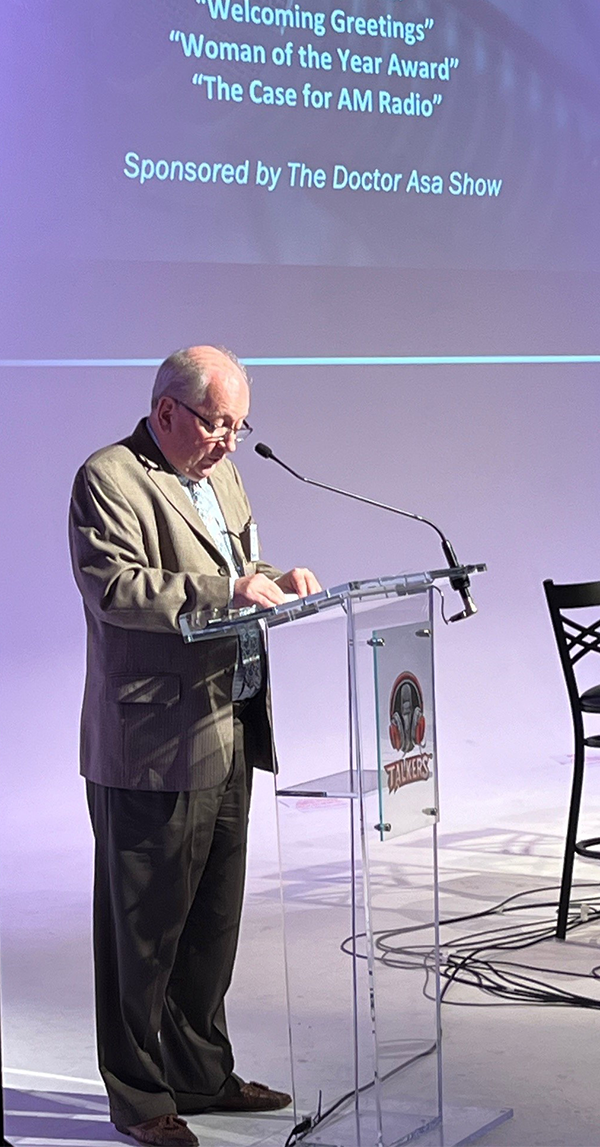
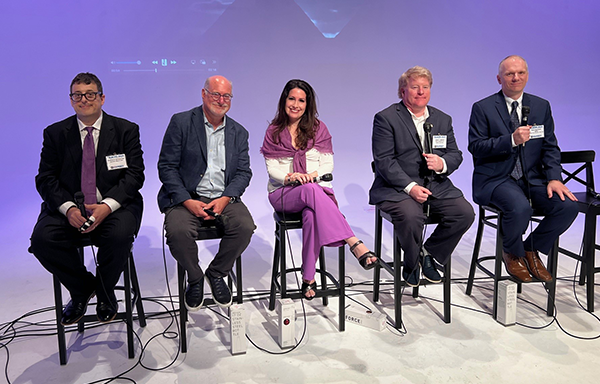
During the coming days, videos of all of TALKERS 2023’s numerous sessions conducted June 2 at Hofstra University will be posted, continuing today (6/16) with the panel discussion, “The BIG Picture.” The session,im sponsored by Newsmax, was introduced by TALKERS associate publisher and media attorney, Matthew B. Harrison, Esq. (pictured at right) and moderated by TALKERS publisher, Michael Harrison (pictured above). Panelists (pictured below from left to right) include Lee Harris, director of integrated operations, NewsNationLee Habeeb, host/producer, “Our American Stories”; Kraig Kitchin, CEO, Sound Mind, LLC/chair, Radio Hall of FameArthur Aidala, Esq., founding partner, Aidala, Bertuna & Kamins, PC/host, AM 970 The Answer, New York; Chad Lopez, president, WABC, New York/Big Apple Media; and Dr. Asa Andrew, CEO/host, “The Doctor Asa Show.” See video of the session here.

im


Industry News

Panel Discussion to Tackle the Talk Media Industry’s Key Concerns

One of the most popular sessions at the annual TALKERS Conference is “The Big Picture” panel and this year’s planned installment of the discussion promises to continue in that tradition of perspective and pertinence.  The panel will be introduced by TALKERS associate publisher/media attorney, Matthew B. Harrison, Esq. and moderated by TALKERS publisher Michael Harrison.  Panelists include (in alphabetical order): Arthur Aidala, Esq. founding partner, Aidala, Bertuna & Kamins, PC/host, AM 970 The Answer, New York; Dr. Asa Andrew, CEO/host, The Doctor Asa NetworkLee Habeeb, host/producer, Our American StoriesLee Harris, director of Integrated Operations, NewsNation; and Kraig Kitchin, CEO, Sound Mind, LLC/chairman, Radio Hall of Fame.  One more panelist has yet to be named.  The issues that the session will cover include: the existential cultural, technological and financial issues facing radio and talk media; the medium’s role in the national political conversation and culture wars; the impact of artificial intelligence on intellectual property and creative originality; the evolution of ethics, justice and journalism in American society; and an examination of potential topics and concerns that will keep the medium vibrant as we move deeper into the 21st century. “It’s all about perspective,” says panel moderator Michael Harrison. “If we are to survive as an industry as well as a community, we have to step back and look at the big picture within which we operate… and it is getting bigger and bigger with each passing moment. We must avoid becoming smaller and smaller.”  More than 60 luminaries from the talk media industry are set to speak at a power-packed day of fireside chats, solo addresses, panel discussions, workshops, award presentations, new equipment showcases and endless networking opportunities. TALKERS 2023 is nearing an advance sellout. See more about the agenda, registration, sponsorship and hotel information here

Front Page News Industry News

Friday, November 11, 2022

NOW POSTED: This Weekend’s Installment (Series Finale) of “The Michael Harrison Wrap: An Overview of the National Conversation.” The latest installment and series finale of the one-hour weekend special, “The Michael Harrison Wrap,” that has looked back each week for the past three-and-a-half years at the hottest topics discussed in the American talk media per the research of TALKERS, is now posted. This new episode titled, “A House Divided,” reviews this past week of 11/7-11. The program features guests (in order of appearance): Kevin Casey, executive editor, TALKERS; Dr. Murray Sabrin, professor emeritus of finance, Ramapo College, NJ; Harry Hurley, talk show host, WPG, Atlantic City, NJ; Victoria Jones, executive director, DC Radio Company; and Matthew B. HarrisonEsq., associate publisher, TALKERS/law professor, Springfield, MA. The show has been airing weekends (Friday evenings to Sunday nights) on 100-plus broadcast signals and networks across the U.S. and U.K as well as having developed a significant international following as a podcast. To listen to this week’s milestone episode, please click here. To view the latest TALKERS topic research, please click here.

LiveOne Reports Revenue for 2023 Fiscal Q2 Up 7.3%. Reporting its financial data for the second quarter of Fiscal 2023, LiveOne says consolidated revenue was $23.5 million – an increase of 7.3% over the same period in 2022 Fiscal Q2. LiveOne is the parent company of PodcastOne and the filing reveals that PodcastOne “posted record 1H Fiscal 2023 revenue of $17.2 million as U.S. unique monthly audience surpassed 6.7 million in September 2022.” LiveOne is planning to spin out PodcastOne as a separate, publicly traded company and expects to file an S-1 with the SEC by December 15. Returning to the company’s consolidated financial data, LiveOne posted a net loss of $3.4 million, a dramatic reduction from the net loss of $15.2 million it reported for second quarter of Fiscal 2022. LiveOne CEO and chairman Robert Ellin comments, “The momentum in LiveOne’s audio business, which includes Slacker Radio and PodcastOne, continues to experience growth of paid members through partnerships, including Tesla, as well as an increase in advertising and sponsorships. We expect our audio business to collectively achieve revenue in excess of $80 million in Fiscal 2023 and generate more than $16 million in Adjusted EBITDA. Over the past year, we have successfully reduced costs and overhead by an expected $25 million on an annual basis while focusing on the operating performance of our audio division. A significant part of our strategy is a decision to forgo any live tentpole and pay-per-view events until Fiscal 2024, which has resulted in a lowering of expected Fiscal 2023 revenue to between $100 million and $110 million. These measures will allow us to utilize our capital and resources to strengthen our balance sheet, buyback stock and focus on the growth of our profitable businesses.”

Christian Arcand Returns to WEEI, Boston to Produce PM Drive Show. Sports talk radio pro Christian Arcand – who was a casualty of the recent cuts at Beasley Media Group and served as an air personality at WBZ-FM, Boston “98.5 The Sports Hub” – joins Audacy’s WEEI-FM, Boston as producer of the “Merloni, Fauria & Mego” show and as host of the Saturday 1:00 pm to 4:00 pm program. Arcand originally served with WEEI first as co-host on the “Planet Mikey” show with Mike Adams and then hosted the “WEEI Late Night” program before joining WBZ-FM five years ago. Audacy Boston SVP and market manager Mike Thomas says, “Christian is a talented guy and a great team player. A lot of people in the building, including myself, have had the pleasure of working with him in the past. What he will bring to ‘Merloni, Fauria and Mego’ on and off the air will really help propel the show and the station forward.”

Clay Travis and Buck Sexton Host Election Event. Pictured above at Tuesday night’s midterm election night event in Nashville are Premiere Networks-syndicated personalities Clay Travis (right) and Buck Sexton (left) – hosts of “The Clay Travis & Buck Sexton Show” with U.S. Senator Marsha Blackburn (R-TN). Travis and Sexton hosted the event for key advertisers, political guests and others. Among the special guests who attended the private event to watch the election results were: Premiere Networks-syndicated personality Jesse Kelly, Sen. Bill Hagerty, Tennessee Attorney General Jonathan Skrmetti, FOX News commentator and Outkick The Coverage host Tomi Lahren, country music star John Rich, former NFL quarterback Jay Cutler, among others.

Hillsdale College Produces Election Night Coverage. In the photo above, student broadcasters at Hillsdale College’s radio station WRFH-LPFM, Hillsdale, Michigan “Radio Free Hillsdale 101.7 FM” present their live election night coverage on the station with a remote broadcast. The school says that more than 20 staffers were involved in some way during the evening, as they welcomed panels of fellow students, Hillsdale professors, candidates, reporters, and pundits to the airwaves. The event was open to the campus community and more than 200 people turned out to watch and listen.

KDWN, Las Vegas Hosts Election Night Special. In the Las Vegas market, KDWN talk host Steve Sanchez (right) presented election night coverage on the station that included contributions from GCN nationally syndicated talk host Dr. Daliah Wachs (center) and “Finding Common Ground” host Patrick Casale (left).

New York Festivals Welcomes Diego Cannizzaro to Radio Awards Advisory Board. The New York Festivals announces that DMC Studio owner Diego Cannizzaro is joining the NYF Radio Awards Advisory Board. New York Festivals Radio Awards vice president Rose Anderson says, “The 14-member Advisory Board panel is an international brain trust of innovative storytellers and industry executives whose expertise spans all genres of audio entertainment and journalism. Diego’s mastery of every aspect of his craft in works like ‘Madre’ and ‘Weightless’ brings emotions, memories, and sensations to his listening audiences. These insights and the Board’s essential guidance ensure that New York Festivals will continue to honor world-wide excellence across all platforms.” Cannizzaro’s DMC Studio is located in Buenos Aires and specializes in radio arts, sound stories, commercials, field recording, sound design and mixing. He is an industry pro known for award-winning work. He creates audiovisual productions for radio, TV, social networks, and movies. He comments, “I consider New York Festivals as an iconic common place, in a global level speaking. A meeting point for all who are really involved in storytelling in the media. Personally, it is an honor to be part of the Advisory Board with outstanding colleagues from all the media worldwide.”

NOT TOO LATE! Comrex Offers Talk Broadcasters Free Trial of Gagl Remote Contribution Service for Post-Election Programming. High-quality, remote contribution is a vital part of any live broadcast – and that’s especially true during election season. Comrex has provided talk radio hosts, reporters and sportscasters with great remote broadcasting tools for decades. Their Comrex ACCESS units have become a ubiquitous presence at political conventions, breaking news stories and anywhere broadcast-worthy things are happening. While Tuesday’s elections are in the rear-view mirror, post-election contribution to your station’s coverage of local and national races is still going strong and will for the foreseeable future. Those contributors need to be able to connect from remote locations at the drop of a hat. Often, reporters and contributors will call in from their remote locations on a mobile phone, which is a simple solution, but results in poor audio quality. Other reporters will have access to a remote audio codec, which provides excellent audio quality, but also requires some management from the engineering team. Gagl, the new remote contribution solution from Comrex, is the best of both worlds. According to the folks at Comrex, reporters and contributors can connect to the Gagl interface from a web browser on a smartphone or laptop, meaning it’s as easy as a phone call to get connected. Up to five reporters can be in a Gagl session at the same time. The Gagl session is connected to a Comrex IP audio codec in the studio, and so on-air hosts are able to talk with field reporters. Each reporter has their own mix-minus, and their audio is studio quality with very low delay, so quality isn’t sacrificed for simplicity. Gagl is a subscription-based service and it’s a first for Comrex. “It’s kind of a pivot for us,” Comrex director of sales, Chris Crump tells TALKERS. “Broadcasters are looking for easier, faster and less expensive ways to do their job. But quality and reliability are just as important,” says Crump. “Gagl uses a web browser on a smartphone or computer. It’s as easy as clicking a link to connect. But it connects to a Comrex IP Audio Codec back in the studio for reliability and greater stability. It sounds great and is designed to be dependable as Comrex customers would expect.” Anyone with an ACCESS or BRIC-Link codec can try Gagl free for two weeks by contacting Chris Crump at Comrex Corporation: chris@comrex.com. Office phone: 978-784-1776. Mobil phone. 404-610-5954. comrex.com

Politics and Midterm Elections Top News/Talk Story for Week of November 7 – 11, 2022. The politics surrounding the 2022 midterm elections and the races that will determine control of Congress for the next two years combined as the most-talked-about story on news/talk radio this week, landing atop the Talkers TenTM. At #2 this week was former President Donald Trump’s position as a Republican kingmaker and his expected announcement he’ll run for president in 2024, followed by inflation and fears of a recession at #3. The Takers TenTM is a weekly chart of the top stories and people discussed on news/talk radio during the week and is the result of ongoing research from TALKERS magazine. It is published every Friday at Talkers.com. See this week’s complete chart here.


KWAM, Memphis Seeks News/Talk Morning Host. Memphis news/talk outlet KWAM-AM “The Mighty 990” is looking for the next great talk show host in America. We have an immediate opening for a morning show host. Our host must have at least three years experience and must be well-versed on national, Tennessee and Memphis news. Send resumes and audio clips to todd@starnesmediagroup.com.

Front Page News Industry News

Friday, November 4, 2022

NOW POSTED: This Weekend’s Installment of “The Michael Harrison Wrap: An Overview of the National Conversation.” The latest installment of the one-hour weekend special, “The Michael Harrison Wrap,” that looks back each week at the hottest topics discussed in American talk media per the research of TALKERS, is now posted. This new episode titled, “Trick or Tweet,” looks back at this past week of 10/31-11/4. The program features guests (in order of appearance): Kevin Casey, executive editor, TALKERS; Dr. Murray Sabrin, professor emeritus of finance, Ramapo College, NJ; Mark Davis, talk show host, 660 AM The Answer, Dallas/Fort Worth; Bobbie Winston a.k.a. La Femme Bobbie, musician/artist/American ex-pat, Rio de Janeiro; Renee Kohanski, M.D., forensic psychiatrist/podcaster, Somerset, NJ; Matthew B. HarrisonEsq., associate publisher, TALKERS/law professor, Springfield, MA. The show airs weekends (Friday evenings to Sunday nights) on 100-plus broadcast signals and networks across the U.S. and U.K as well as having developed a significant international following as a podcast. To listen to this week’s episode, please click here. To view the latest TALKERS topic research, please click here.

iHeartMedia Q3 Revenue Up 7%. Reporting its financial data for the third quarter of 2022, iHeartMedia says revenue was $989 million, an increase of 7% over the same quarter a year ago. The company is also posting an operating loss of $211 million for the third quarter of 2022 compared to the operating income of $80 million it reported for Q3 of 2021. Additionally, iHeartMedia reports a net loss of almost $310 million compared to the net income of $3.6 million it posted in the third quarter of 2021. iHeartMedia breaks its operations into three segments. Third quarter results for those segments are as follows: the Multiplatform Group that includes its radio stations and program networks was basically flat with a revenue increase of 0.1% “as a result of increased political advertising revenue as 2022 is a midterm election year, partially offset by a decrease in revenue due to a more challenging macroeconomic environment. Broadcast revenue grew $2.1 million, or 0.4% year-over-year, driven by higher political advertising revenue and an increase in trade and barter revenue, partially offset by lower spot revenue, while Networks declined $(0.7) million, or 0.5% year-over-year.” The Digital Audio Group was up 23.4% on revenue of $254 million. This group’s revenue increased by $48.2 million compared to the prior year, “including growth from Digital, excluding Podcast revenue, which grew $21.1 million to $162.7 million, driven by increased demand for digital advertising as well as Podcast revenue which increased by $27.1 million to $91.3 million, driven by higher revenues from the development of new podcasts as well as growth from existing podcasts. Digital Audio Group revenue increased as a result of general increased demand for digital advertising and the growing popularity of podcasting.” And the Audio & Media Services Group was up 17.7% on revenue of $77.8 million. Chairman and CEO Bob Pittman says, “We’re pleased to report another quarter of solid operating results for iHeart, and our performance in the midst of the current climate of economic uncertainty is a strong indication of the successful transformation this company has undergone in which our high-growth digital revenues comprises 26% of total company revenues. Our Digital Audio Group continues to deliver industry-leading growth, and our Multiplatform Group has again demonstrated its resiliency during a difficult economic environment. We believe the strong positions of both of these groups with both consumers and advertisers give us the ability to both navigate through this period of economic uncertainty and position us for continued growth through the recovery and beyond.”

Salem Media Group Total Revenue Rises 1.3%. The company reports that its total revenue for the third quarter of 2022 was $66.9 million, an increase of 1.3% over the same period in 2021. Salem Media Group also reports an operating loss of $8.8 million compared to operating income of $15.8 million in Q3 of 2021, and a net loss of $11.9 million compared to the net income of $22.1 million is reported during the same period in 2021. Salem presents its financial data in three segments. The Broadcast segment reports revenue of $51.1 million, an increase of 3.1% over Q3 of 2021, Digital Media revenue was $10.2 million, down 4.3% from the third quarter of 2021, and Publishing revenue was $5.5 million, a decrease of 3.7% from the same period a year ago.

Round Four of October PPMs Released. The fourth and final round of ratings data from Nielsen Audio’s October 2022 PPM survey has been released for 12 markets including Austin, Raleigh, Indianapolis, Milwaukee, Nashville, Providence, Norfolk, Jacksonville, West Palm Beach, Greensboro, Memphis, and Hartford. Nielsen’s October 2022 sweep covered September 15 – October 12. Today, TALKERS magazine managing editor Mike Kinosian presents his Ratings Takeaways from this group of markets. In the Raleigh market, iHeartMedia’s news/talk WTKK-FM tacks on three-tenths to wrap the survey with a 9.1 share that puts it in the #1 spot, while Curtis Media Group’s news/talk WPTF sheds one-tenth for a 1.8 share finish to remain ranked #15. The top dogs in Milwaukee flip as iHeartMedia’s news/talk WISN adds a full share for a 10.6 share finish that lifts it from #2 to #1, while Good Karma Brands’ WTMJ loses 1.9 shares for an 8.1 share finish that drops it from #1 to #4. Cumulus Media’s news/talk WPRO-AM/WEAN-FM, Providence adds on nine-tenths for wrap the survey with a 6.4 share that lifts it from #6 to #5. And in Jacksonville, Cox Media Group’s WOKV-FM is up one-tenth to a 7.9 share good for the #3 rank in the market. You can see Mike Kinosian’s complete Ratings Takeaways from this group of markets (as well as the previous three groups) here.

Comrex Unveils New BRIC-Link III Audio Codec. The company officially unveils BRIC-Link III – the newest addition to its popular BRIC-Link family of codecs. Comrex says there are more than 10,000 BRIC-Link codecs circulating world-wide, and BRIC-Link III is an updated version that takes advantage of the latest improvements in IP audio transmission technology. BRIC-Link III is a true codec, offering a full-duplex stereo encoder and decoder in each box. A jitter buffer manager is incorporated that automatically balances delay and stability, dynamically increasing and decreasing delay based on network performance. BRIC-link III offers a wide range of encoding algorithms including stereo and mono linear mode, FLAC modes, AAC/HE-AAC modes, Opus, G.722 and G.711. BRIC-Link III features a new, more powerful processor for improved reliability. It also features enhanced front panel indicators, including four buttons which will trigger contact closures by default and configurable for auto-connections to other Comrex IP audio codecs. BRIC-Link III is compatible with all other Comrex IP audio codecs, including the ACCESS codec line as well as older BRIC-Link models. BRIC-Link III also works with Gagl, a new service now available for purchase for audio contribution. Gagl turns any Comrex IP audio codec into a hub for up to five remote participants. Like other BRIC-Link codecs, BRIC-Link III includes CrossLock VPN technology, Comrex’s proprietary suite of reliability tools. In addition to bonding technology, CrossLock also includes a Redundancy Mode for mission-critical applications. BRIC-Link III can take advantage of HotSwap, meaning that users can set a 4G/5G modem as a backup connection to only be engaged when the primary internet fails, providing an extra layer of reliability. Customers can also choose to purchase an optional one-time license per codec to utilize SwitchBoard, a private server that Comrex maintains which allows for easy connections between IP codecs. You can get more information on this and other Comrex products here.

GAB Radio Talent Institute Returns to University of Georgia. The RAB’s National Radio Talent System announces the return of the GAB Radio Talent Institute at the Grady School of Journalism at the University of Georgia. The institute takes place in person May 15 – 24, 2023 thanks to sponsorship from The Georgia Association of Broadcasters. The talent incubator spans 10 days and is led by broadcast professionals that bring their real-world industry knowledge from around the state and country to educate students. RAB says that college students from universities throughout the state and region apply to be accepted into the GAB Radio Talent Institute. This provides an ideal networking pool for the students and a wide variety of potential interests within the classroom for industry professionals to identify and actively recruit from. Upon completion of the Institute, students can further their networking capabilities with the ability to access the National Radio Talent System’s Career Center. RAB president and CEO Erica Farber states, “We are delighted to have the GAB Radio Talent Institute make its return after a three-year hiatus due to the pandemic. Collaborating with Bob Houghton and the Georgia Association of Broadcasters enables us to bring this world-class program to life in the southeast and further develop the next generation of broadcasters.”

TALKERS News Notes. Inside TowersLeslie Stimson writes an interesting piece about the FCC’s creation of a Space Bureau. Stimson writes that FCC Chairwoman Jessica Rosenworcel announced the move at the Satellite Industry Association meeting yesterday (11/3). “She said the growth of satellite broadband internet plays a big part in why the agency is making the move. ‘Ninety-eight percent of all satellite launches in 2021 were deployed into low-earth orbit to provide internet connectivity back here on Earth. They can help advance the FCC’s goals to connect everyone, everywhere,’ Rosenworcel said. ‘More than that, the success of these low-earth orbit communications satellites could be seen as an early litmus test for the broader commercialization of space.’” Read Stimson’s entire piece here…..Three Hillsdale College students have won national College Broadcasters, Inc. awards for their work with “Radio Free Hillsdale 101.7 FM.” The awards were announced at the National Student Electronic Media Convention in Baltimore. Sophomore Lauren Smyth placed first in Best Newscast or Sportscast category for “Lauren Smyth News,” senior Josh Barker placed third in Best Hard News Reporting for his feature “The Policy Corner: Michigan Voting Laws,” and Rachel Kookogey (class of ’22) received both first and second place for two segments of her feature, “Sports Story Time.” WRFH general manager Scot Bertram says, “I’m very proud of our students for their well-deserved wins. It is great to see our students being recognized on the national level for their continued hard work and dedication.”…..SiriusXM announces its play-by-play coverage of the 2022-23 college basketball season that begins Monday (11/7). The opening night schedule features 24 teams from the men’s Associated Press Top 25, including defending national champion and #5-ranked Kansas facing Omaha and top-ranked North Carolina, coming off their 12th National Championship appearance, hosting UNC Wilmington…..Host Bethenny Frankel, the most successful business mogul to emerge from “The Real Housewives” franchise, and iHeartPodcasts launch a first-of-its-kind rewatch podcast titled, “ReWives.” Frankel, formerly of Bravo’s “The Real Housewives of New York,” breaks down the franchise that launched her career. In each episode, she’s “joined by unexpected celebrity guests ranging from superfans to Housewives newbies for hilarious conversations and surprising insight on real topics.” “ReWives” premieres on November 14 with Elisabeth Moss as Frankel’s first guest. New episodes will post each Monday with additional guests including Jerry Springer, Suze Orman, Kevin Nealon, Dave Portnoy, Griffin Johnson and more.

Broadcaster Raising Awareness of Need for Organ Donors. Western Massachusetts broadcaster and public relations pro Mark Auerbach (pictured) is revealing his battle with kidney disease in an effort to raise awareness of the need for organ donors. Auerbach hosts “ArtsBeat,” “On The Mark” and “Athenaeum Spotlight” on WCPC15 and 89.5fm/WSKB. He’s also the ArtsBeat reporter for Pioneer Valley Radio. On today’s program that you can see here, Auerbach reveals his battle with Stage 5 kidney disease and the need for donors. Auerbach says people can help by taking any of three steps: 1) becoming an organ donor upon your death; 2) consider donating while you’re alive (get details at kidney.org); and 3) donating to him at Mass General Hospital’s living donors program (https://mghlivingdonors.org/).

Politics and Midterms Top News/Talk Story for Week of October 31 – November 4. The politics leading up to Tuesday’s midterm elections were the most-talked-about story on news/talk radio, landing atop the Talkers TenTM. At #2 this week was the economy combined with the Fed’s rate hike, followed by the aftermath of the Pelosi home invasion at #3. The Talkers TenTM is a weekly chart of the top stories and people discussed on news/talk radio during the week and is the result of ongoing research from TALKERS magazine. It is published every Friday at Talkers.com. See this week’s complete chart here.

Front Page News Industry News

Friday, October 21, 2022

NOW POSTED: This Weekend’s Installment of “The Michael Harrison Wrap: An Overview of the National Conversation.” The latest installment of the one-hour weekend special, “The Michael Harrison Wrap,” that looks back each week at the hottest topics discussed in American talk media per the research of TALKERS, is now posted. This new episode titled, “Inflation Inflammation,” looks back at this past week of 10/17-10/21. The program features guests (in order of appearance): Kevin Casey, executive editor, TALKERS; Victoria Jones, executive director, DC Radio CompanyJack Heath, talk show host, the Pulse of NHDom Giordano, talk show host, WPHT, Philadelphia; Jerry Reynolds, talk show host, CarPro Radio Network/WBAP, Dallas; and Matthew B. Harrison, Esq., associate publisher, TALKERS.  The show airs weekends (Friday evenings to Sunday nights) on 100-plus broadcast signals and networks across the U.S. and U.K as well as having developed a significant international following as a podcast. To listen to this week’s episode, please click here. To view the latest TALKERS topic research, please click here.

Wisconsin Talk Hosts Avoid Prosecution for Entering Locked State House. According to coverage from Madison.com, charges against Michael Crute (left) and Dominic Salvia (right) – hosts of the progressive talk program, “The Devil’s Advocates Radio Show,” for entering the Wisconsin Capitol illegally on December 22 of 2020 are being dropped. Crute and Salvia’s program is heard in Milwaukee on Good Karma Brands’ WAUK-AM/W266DR, on WTTN-AM/W224EG in Madison and other Wisconsin signals. The duo, along with producer Bryan Kelly, accessed the locked Capitol during the pandemic lockdown to “put up a Christmas tree that included ornaments lampooning Republican lawmakers after Republican state Reps. Paul Tittl and Shae Sortwell and others put up their own tree in the Capitol rotunda and held other activities without a permit because Democratic Gov. Tony Evers had decided not to put up a tree during the pandemic.” Crute, Salvia and Kelly’s lawyer told the program’s listeners that his defensive strategy “was going to be the defense of selective prosecution” on the part of the district attorney. In the end it didn’t matter because ultimately the prosecution “did not feel at this time in the interest of justice jury trials in these matters was warranted.”

Salem Announces Midterm Election Coverage. The company says that its coverage of the November midterm elections will begin on Tuesday (11/8) at 7:00 pm ET and run through 2:00 am the next morning. Salem Media Group says that the Salem Radio Network will join forces with the new Salem News Channel platform to provide marathon “DECISION 22” Midterm Election coverage focusing on the battle over which political party will gain control of the U.S. Senate and U.S. House of Representatives for the next two years. “DECISION 22” will also track election results in hotly contested races for governor from coast-to-coast. SRN VP/news & talk programming Tom Tradup states, “This promises to be quite very possibly the most historic Midterm election and it will offer our audiences the first ever live broadcast partnership between our ground-breaking Salem News Channel and the Salem Radio Network nationwide.” For the first five hours starting at 7:00 pm ET, SNC’s Andrew Wilkow and SRN’s nationally syndicated talk hosts Hugh Hewitt and Dr. Sebastian Gorka will anchor the live coverage that will include perspective and analysis from invited guests including SRN hosts Mike Gallagher and Brandon Tatum live from midterm “watch parties.” Correspondents updating key races will include Chris Stigall of “AM990 The Answer” in Philadelphia covering the pivotal Pennsylvania U.S. Senate contest. SRN News White House correspondent Greg Clugston will provide breaking news throughout the evening from the Decision Desk in the Washington bureau. At 12:00 midnight ET coverage switches to the Los Angeles studios of Salem’s “870AM The ANSWER” for continuing coverage anchored by Jennifer Horn (host of The Morning Answer of KRLA and KTIE) and KRLA news anchor Larry Marino.

Mike Miller Named VP of Programming for iHeartMedia Central PA. Radio programming pro Mike Miller is named vice president of programming for iHeartMedia’s Central PA stations that include news/talk WHP-AM and sports talk WTKT-AM “FOX Sports 1460” in Harrisburg, as well as five music brands. iHeartMedia national programming group EVP Jeff Hurley comments, “Mike brings an unparalleled understanding of our business and operations. His track record of innovation speaks for itself. He has created and grown unique brands from the ground up for over 20 years in Central PA. We’re excited to welcome Mike back to our programming team, where he got his first start on ‘FM97’ in Lancaster at age 16.”

Broadcasters Foundation of America Lauded for Hurricane Assistance. After hurricanes swept through Puerto Rico and Southwest Florida, those working in the broadcasting business in the those areas have had to deal with personal and family issues in addition to having to keep up their  professional duties to keep the public informed and apprised of everything that is happening in clean-up efforts. At best, it has been difficult for those in the broadcast community to continue working while also dealing with damage to their property or automobiles. At worst, they may be dealing with something such as injury to a family member or pet. While there is certainly no way to replace something as precious as life, the Broadcasters Foundation of America has stepped in to provide some financial security to those colleagues who are suffering from these natural disasters. Dozens of employees from various radio and television companies in those areas have reached out for help and the BFOA has either already delivered or is in the process of providing financial support. Beasley Media Group CEO Caroline Beasley says, “Hurricane Ian was one of the worst natural disasters to hit Southwest Florida in over a century. A near category 5 hurricane, the storm devastated communities that Beasley serves. Our employees worked around the clock, serving as a lifeline to listeners when radio was the only source of communication available to them with the outside world. Throughout the storm, Tim McCarthy and the Broadcasters Foundation of America team were front and center, checking in and offering assistance to our employees who were directly impacted by the hurricane. It’s that type of true commitment and dedication to broadcasters on the front lines every day that makes the BFOA so incredibly important and vital as they take care of those who selflessly take care of others every day. That is what the Broadcasters Foundation of America is all about!”

TALKERS News Notes. A new deal between SiriusXM and New York Times bestselling author Rachel Hollis gives SXM the exclusive rights to distribute and sell advertising for “The Rachel Hollis Podcast.” Additionally, the agreement calls for Stitcher to distribute the show across all podcast platforms. Hollis says, “Teaming up with SiriusXM allows us to further elevate the show, bringing it into an exciting new chapter. I believe we learn the most by listening to other people’s stories and sharing in conversation. My hope is to keep seeking out wisdom from our guests that spark curiosity and openness with an ever-evolving audience.”…..Salem Media Group is presenting at the Annual LD Micro Main Event XV investor conference at 5:00 pm ET on October 26. The presentation will be available on the investor relations portion of Salem’s website prior to the company’s presentation…..Dr. Daliah WachsGCN-syndicated talk radio program adds a new affiliate as Fairview Broadcasting’s news/talk KWBG-AM, Boone, Iowa adds the show to its program schedule in the 6:00 pm to 9:00 pm daypart.

Politics and the Midterm Elections Top News/Talk Story for Week of October 17-21. The politics and the debates leading up to the November midterm elections combined as the most-talked-about-stories on news/talk radio this week, landing atop the Takers TenTM. At #2 this week was the economy – including inflation, the up-and-down financial markets, and fears of a recession – followed by the ongoing Russian invasion of Ukraine tied with other foreign affairs stories at #3. The Talkers TenTM is a weekly chart of the top stories and people discussed on news/talk radio during the week and is the result of ongoing research from TALKERS magazine. It is published every Friday at Talkers.com. See this week’s complete chart here.

Front Page News Industry News

Friday, October 7, 2022

NOW POSTED: This Weekend’s Installment of “The Michael Harrison Wrap: An Overview of the National Conversation.” The latest installment of the one-hour weekend special, “The Michael Harrison Wrap,” that looks back each week at the hottest topics discussed in American talk media per the research of TALKERS, is now posted. This new episode titled, “Going to Pot,” looks back at this past week of 10/3-10/7. The program features guests (in order of appearance): Kevin Casey, executive editor, TALKERS; Martha Zoller, talk show host, WDUN, Gainesville, GA; Jack Heath, talk show host, “The Pulse of NH”; Dr. Murray Sabrin, emeritus professor of finance, Ramapo College, NJ/author; Matthew B. HarrisonEsq., associate publisher, TALKERSGlenn Beck, talk show host, Premiere Networks/author; Tavis Smiley, author/talk show host/owner, KBLA, Los Angeles. The show airs weekends (Friday evenings to Sunday nights) on 100-plus broadcast signals and networks across the U.S. and U.K as well as having developed a significant international following as a podcast. To listen to this week’s episode, please click here. To view the latest TALKERS topic research, please click here. “The Michael Harrison Wrap” is available in syndication via Talk Media Network to stations across America on a market exclusive basis. For affiliation information, please click here or call 616-884-8616.

KGO, San Francisco to Begin Sports/Wagering Format on Monday. The end of the news/talk format on Cumulus Media’s legendary KGO-AM, San Francisco came in a way that many market observers are calling bizarre – just to give one adjective. During the late morning Mark Thompson show, the station suddenly ended the talk show and began airing a recorded announcement followed by music stunting. Thompson himself was as surprised as the listeners to learn the that station will flip to a new format on Monday (10/10) – some form of sports betting talk. The message from Cumulus was: “Today we say goodbye to the legendary KGO. Over the last 80 years, KGO has been here for Bay Area listeners covering and discussing all the news that has impacted our world and local communities. We thank you for your loyalty and for trusting KGO to be your source for information. We also want to sincerely thank all the talented men and women that worked so hard over the years to produce award-winning programming on KGO. On Monday, 810AM begins a new era. We hope you will tune in.” Northern California-based journalist Matthew Keys reports that sources say the new format will be branded “The Spread 810AM.”

Beasley and Audacy Swap Las Vegas Stations. The two companies are entering into an asset exchange agreement that will see Beasley Media Group’s news/talk KDWN-AM and FM translator K268CS (101.5) go to Audacy, which will give FM station KXTE (currently alternative rock) to Beasley. As part of the agreement, longtime Las Vegas-based syndicated morning personalities “Dave and Mahoney” will continue to be heard on KXTE-FM. Beasley CEO Caroline Beasley says, “Throughout Beasley Broadcast Group’s 61-year history, we have actively managed our station portfolio with the goal of serving the communities where we operate with the best local programming and brands, diversifying our operations, managing risk and improving financial results. The agreement to exchange KDWN-AM/FM translator for KXTE-FM addresses all of these strategic objectives and upon completion, will complement our Las Vegas market presence and content with five strong signals in the market.” The transaction is expected to close in the fourth quarter of this year subject to Federal Communications Commission approval and other customary closing conditions.

Round Two of September PPMs Released. The second of two rounds of ratings information from Nielsen Audio’s September 2022 PPM survey has been released for 12 markets including Washington, Boston, Miami, Seattle, Detroit, Phoenix, Minneapolis, San Diego, Tampa, Denver, Baltimore, and St. Louis. Nielsen’s September 2022 sweep covered August 18 – September 14. Today, TALKERS magazine managing editor Mike Kinosian presents his Ratings Takeaways from this group of markets. Hubbard Broadcasting’s all-news WTOP-FM, Washington remains ranked #1 in the market after adding one-tenth to finish the survey with an 8.1 share (weekly, 6+ AQH share). Cumulus Media’s crosstown news/talk WMAL-FM tacks on six-tenths for a 4.5 share that lifts it to the #7 rank. In Boston, iHeartMedia news/talk WRKO slips half a share for a 3.8 share that leaves it ranked #9, while the company’s all-news WBZ-AM adds seven-tenths for a 5.3 share good for the #5 rank in the market. Audacy’s WCCO-AM, Minneapolis rises eight-tenths to finish the survey with a 5.6 share that lifts it to the #7 rank, while iHeartMedia’s crosstown news/talk KTLK-AM is up one-tenth for a 3.1 share finish and Hubbard Broadcasting’s talk KTMY-FM dips two-tenths for a 3.1 share finish leaving them tied at the #15 rank. You can see Mike Kinosian’s complete Ratings Takeaways from this group of markets (as well as the first round) here.

iHeartMedia Sells New Orleans Office Building. The New Orleans City Business reports that iHeartMedia has sold the downtown New Orleans building that houses its operations there. The three-story, 17,765-square-foot building has been on the market for two years and was acquired by a Florida-based investment group. The story notes that the building was constructed in the mid-1990s. It has “a 250-kilowatt generator, 60 parking spots with a secured gate and two adjacent lots.” The sale price is reported to be just over $3.57 million. It was originally listed at $3.7 million in August 2020.

Grant Stinchfield Launches Show on Salem Podcast Network. KRLA-AM, Los Angeles morning drive personality Grant Stinchfield is launching a podcast on Salem Media Group’s Salem Podcast Network on Monday (10/10) titled, “Stinchfield.” He currently hosts “The Morning Answer” show on KRLA alongside Jennifer Horn. Salem SVP for spoken word Phil Boyce says, “Grant does a great morning show with Jen in Los Angeles, and we’re excited that he’s moving up on the Salem platform. Now, listeners all over the country get to hear his take on the day’s news and events. We’re delighted to give him this opportunity.” Stinchfield comments, “America is in crisis and the corporate media establishment continues to silence strong conservative voices. This podcast is about pushing back and refusing to be silenced. We will expose the stories the mainstream media refuses to cover. I am so proud to be a part of Salem Media, an organization that refuses to sit idly by and watch our nation fall deeper and deeper into debt and despair. Its commitment to free speech is why I am proud to call Salem Media a partner.”

TALKERS News Notes. According to a report by Kevin Kinkead at Crossing BroadJamie Lynch is out at Beasley Media Group’s sports talk WPEN-FM “97.5 the Fanatic.” There is no information from the company on Lynch’s departure, although a cost-cutting motive is the most likely. Morning drive host John Kincade said on the program, “Obviously you will notice Jamie is not here. I can only say that we miss Jamie because a situation like this is a time when Jamie is of the greatest joy. We miss him not being here with us today. And if you miss Jamie this morning you can only imagine how much we do. I don’t know how much more to say. I’m not at liberty to say. But we miss him and we wish he was here with us.”…..Public media company GBH announces that Jim Braude will leave the WGBH-TV program “Greater Boston” at the end of this year. Braude also co-hosts the “Boston Public Radio” program on WGBH-FM, Boston with Margery Eagan and will continue in that role. Braude has hosted the “Greater Boston” television program since 2015 and co-hosted the radio program with Eagan since 2013…..Cipolla Analytics announces the appointment of Dr. Ed Cohen as chief research officer for the company, overseeing the expansion of its SpotGPS advanced intelligence software for radio. Developed especially for PPM markets, Cipolla Analytics says, “SpotGPS makes it easy to get the listening credit you deserve. SpotGPS reveals content placement and quantity on your stations and the competition in a way that is clear, colorful, and compelling.” Cohen was previously vice president, ratings and research for Cumulus Media, and led Nielsen Audio’s connected car streaming audio research initiative as vice president, measurement innovation.

Russia-Ukraine War and Foreign Affairs Top News/Talk Story for Week of October 3-7. Russia’s annexation of portions of Ukraine, its continuing military invasion of the country, and surrounding foreign affairs combined as the most-talked-about story on news/talk radio this week, landing atop the Talkers TenTM. At #2 this week was the economy – including inflation, the financial markets and the threat of a recession – followed by politics and the November midterm elections at #3. The Talkers TenTM is a weekly chart of the top stories and people discussed on news/talk radio during the week and is the result of ongoing research from TALKERS magazine. It is published every Friday at Talkers.com. See this week’s complete chart here.


KWAM Seeks News Staffers. KWAM, Memphis “The Mighty 990” is expanding its local news coverage. KWAM has promoted Ben Deeter – executive producer of “Wake Up Memphis” – to full-time news anchor and anchor of the radio station’s political coverage. KWAM owner Todd Starnes says there are plans to add more reporters and anchors. Email resumes to: info@kwamradio.com.

FOX News Media Seeks Freelance Radio Anchor. This onsite position in either Los Angeles, Chicago or New York is a freelance radio anchor for the FOX News Audio family as on-air talent for FOX News Radio Network/FOX News Headlines 24/7 Sirius XM Channel 115. In this position, you will work under tight deadlines and deliver top-notch newscasts. You have a passion for breaking news and the flexibility to work on a day’s notice. Learn more about this position here.

Reporter Position Open at FOX News Media in Washington, DC. For this onsite reporter position FOX News Media is looking for an experienced, full-time reporter to join the Washington DC team. You will cover a wide range of political, government, and Congressional stories for FOX News Audio (FOX News Headlines 24/7 and FOX News Terrestrial Radio). You possess strong journalism skills and thrive in a fast-paced, deadline-driven environment. Most importantly, you have great editorial judgment and the ability to break important news stories. Learn more and apply here.

Freelance Producer/Editor Opportunity at FOX News Media. This exciting opportunity is based in New York for a freelance producer/news editor to supervise the staff for our network radio news operations (terrestrial and FOX News Headlines 24/7 – Channel 115 on SiriusXM Radio). In this role you are our editorial leader, working with news anchors to craft the content and structure of a 24/7 news operation. This is fast-moving news environment! Your ability to thrive in a fast-paced, deadline-driven newsroom allows you to deliver top-quality segments/newscasts. You excel at multi-tasking and pay close attention to details. Your writing and editing skills are excellent and your editorial judgment is first-rate. Find out more here.