By Holland Cooke
Consultant
 Companies hire consultants to avoid experiments. We improve results by customizing and implementing Best Practices proven elsewhere. So, I’m about to break a rule, because advertisers in a super-opportune category have become a noisy blur.
Personal Injury: The gift that keeps-on-giving
Legal representation of purported victims of fender benders, slip-and-fall accidents, and other “injuries caused by the negligent, careless, or reckless actions of others” is an industry in which supply exceeds demand. Thus, all the outdoor and TV advertising. And too little radio.
In the Providence, RI TV market I watch at home, this category stands shoulder-to-shoulder with look-alike automotive spots in sheer dollars over-spent. And their message is the same on billboards:
— The attorney’s head shot (also a real estate agent cliché); and
— 6-figure settlements touted.
Because they’re all shouting the same thing, they resort to tactics:
— Attorney Rob Levine is “The Heavy Hitter,” and runs enough TV that viewers in Southern New England can sing the jingle: “The Heavy Hitter is the one for you. Call one-eight-hundred-law-one-two-two-two.” To his credit, it’s a different phone number than his web site offers, so he can track TV results.
— Easier to remember: Bottaro Law: 777-7777.
Watching local Las Vegas TV while at CES recently was a deep dive into Law advertising. The pitch from several I saw was we charge less, like a shameless radio competitor dropping-trou’ to get the entire buy.
If we don’t win, you don’t pay
“What are your rights? What is your case worth?” Possibly a cash amount divisible-by-3, if that’s the attorney’s contingency.
Those expensive nationally syndicated TV spots (customized for the local firm) depict fearful insurance executives eager to settle. And the attorney may threaten that, “if they don’t, we’ll beat ‘em in court.” Baloney, that’s the last thing the lawyer wants. Too time-consuming and risking a losing verdict.

Like radio commercials, attorneys’ inventory is perishable
— We can’t sell yesterday’s empty spot avail; and lawyers’ closing opportunity is “B.I.S.,” Butts In Seats for that free, no-obligation consultation, in-person, where the seller goes for the close.
— If nobody was sitting in that chair today (“intake”), no sale.
— And that’s how attorneys are missing a bet not using radio.
“The lawyer is in, the meter is off”
That’s the proposition when they field listener calls in brokered weekend talk radio shows.
— DONE RIGHT, these shows can run-rings-around TV and outdoor ROI.
— Forgive caps lock in that last sentence, but it’s a crying shame how – at too many stations – the audition for pay-for-play weekend talkers is the-check-didn’t-bounce. One of the things I do for client stations is coach-up weekend warriors — in hosting fundamentals that are second-nature to us — but not to non-career broadcasters. Results = renewals. Otherwise brokered hosts churn, a management distraction, and upsetting listening habits.
— Occasionally, in markets where I don’t even have a client station, I’m working with lawyers (and real estate agents, financial advisors, foodies, and other ask-the-expert hosts), because nobody at the station is doing airchecks with them.
— No billboard or tacky TV spot can humanize the attorney – and demonstrate the comforting counsel – like eavesdropping on a conversation with a caller’s relatable situation.
Think “sales funnel”
We know how to make the phone ring, specific dance steps. The more callers, the better.
— When lines are full, screeners can choose callers whose dilemma is in the attorney’s lane. If, for instance, the host specializes in Personal Injury (or “Family Law,” translation divorce; or another specialty), calls about real estate transactions are off-topic.
— Do this right, and – before the host can offer – callers will often ask “May I call you in the office on Monday?”
Admittedly, this is an experiment…
…because I am frustrated witnessing all this noisy me-too advertising.
Personal Injury cases are he-said-she-said. So try this, and tell me if it works.
— Sales 101: That first call is Needs Assessment, right? Know the prospect’s pain.
— Yet too many radio reps resemble Herb Tarlek, telling the station’s story. Amoeba-shaped coverage maps and ratings rankers and rate cards all look alike…like Law firm marketing.
— I’m telling any attorney willing to listen to make four words the centerpiece of the marketing message, and they’re the same four words that turn callers into clients for weekend talkers: “Tell me what happened.”
The Free Prize Inside: Podcasts
Lifting weekend calls to repurpose as on-demand audio is digital marketing value-added.
Holland Cooke (HollandCooke.com) is a consultant working at the intersection of broadcasting and the Internet. He is the author of “Multiply Your Podcast Subscribers, Without Buying Clicks,” available from Talkers books; and “Spot-On: Commercial Copy Points That Earned The Benjamins,” a FREE download; and the E-book and FREE on-air radio features “Inflation Hacks: Save Those Benjamins.” Follow HC on Twitter @HollandCooke

 Thanks to those who sent comments on last week’s column “Beware The Banter.” For those asking how-much-is-too-much, this follow-up.
 Radio talkers: What is this hour about? How will listeners benefit from listening? And how long do you expect them to wait to hear that?
 I asked my pal, longtime radio seller, now retired: “How often were you asked, ‘How much would you charge for ONE commercial?’”
 Many news/talk stations broker weekend hours to professionals who host ask-the-expert shows to attract new clients.
 The stations I work with make big money with live endorsement spots delivered by familiar local on-air personalities. Remember them? With most AM/FM broadcast hours now robotic or non-local, your relationship with the listener is precious and can be leveraged… carefully.
 Those are the two consultant buzzwords that hosts I coach are hearing in their sleep. And a couple more “E” words: Empathy and Empower.
 She was the agent I enjoyed working with most over three decades I was an active real estate investor. We remain good friends, and her technique informs the work I do coaching agents – and attorneys and financial advisors and other professionals – who host ask-the-expert radio shows.
 Fellow longtime, long-ago DJs: You know what I’m talking about. And it’s a life sentence, eh?
 THE Best Bit I’ve Heard This Month was by Gene Valicenti, morning host, WPRO-AM/WEAN-FM, Providence.
 Mark Twain reckoned that “the difference between the almost right word and the right word is the difference between the lightning bug and the lightning.”
 How will AI tools like ChatGPT impact the way we work? The clues are everywhere. Several client stations have automated weather, and even with your consultant’s trained ear, I had to ask. And yes, she’s a robot.
 Warning: The Commonwealth of Massachusetts certified me to teach high school English, in the early 1970s, the last year certifications were for life. Though I was lured-away by VU-meter hypnosis, I still carry a red pen. And radio news has it running-dry.
 Ever lost your phone? It’s an instant sick, sinking feeling. It’s quaint to even call it a “phone,” because it’s…everything. Including us. Like the transistor radio Boomers toted in our youth, it’s audio in your pocket.
 Tik-Tok is hot (largely among users too young to be heavy AM/FM listeners) and it’s in-the-news (about its possible ban). And, yes, Facebook remains T-Rex in the social media jungle. But people on Twitter seem to live there.
 Every time I visit a station, I meet with sales, and I leave ’em a thumb drive of “spots that have produced results elsewhere, for businesses just like yours,” magic words on local direct retail sales calls. Help yourself to these, all of which produced results.
 The first thing we heard was an earful from NAB president & CEO Curtis LeGeyt regarding automakers dropping AM receivers from new cars: “This is an issue we consider to be absolutely existential.”
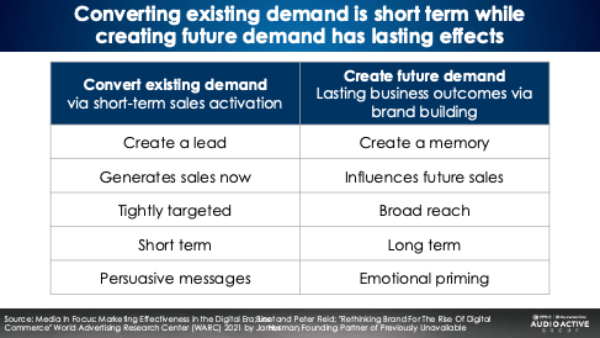
 National TV advertising sells things, local radio advertising sells services. And in
 In Dominion Voting Systems’ $1.6 billion lawsuit, testimony and internal communications demonstrate that FOX News management and talent privately doubted election fraud claims they were broadcasting. Tucker Carlson messaged Laura Ingraham: “Sidney Powell is lying by the way. I caught her. It’s insane.”
 We’ve seen autopsies depicted on various cop shows. As the doctor dispassionately probes the deceased, he or she is dictating into an audio recorder: “I’m opening up the chest cavity…”
 Oh, excuse me, hold on. Here it is! The hourly report from quasi research companies or real research companies like Nielsen declaring that radio is just fine, thank you! Massive surveys (choose one) reveal that radio works! Radio appeals to younger demos! Radio moves product! Radio has more listeners in AM drive than the “Tonight Show” has viewers! A landslide of data proves that after 100 years of success, radio is a viable medium.
 Tip: If you’re auditioning for voiceover work, call yourself a “voice actor,” not an announcer.
 Whenever possible, USA consumers will pay cash, and they’re paying-down credit card balances, per recently released
 It’s tough enough for radio talent to navigate stable careers in these days of consolidated station ownership, personnel cutbacks and drastic salary reductions – but the NAB’s newly stated stance on non-competes adds insult to injury and is out of step with the interests of beleaguered professionals still hanging on for dear life in the programming sector of this industry. I understand that the National Association of Broadcasters is at heart a lobbying group representing the interests of the medium’s ownership but, c’mon – non-competes really are of another era and egregiously unfair.
 Local news sponsorship is an opportunity to “fish for whales,” institutional advertisers who can associate with something special. And, well-done, local news sure is special, because: