Industry News

Cumulus v. Nielsen: Harm Has Already Happened

The latest court filing in the Cumulus v Nielsen monopolistic practices suit tells the court it is no longer asking it to prevent harm, it’s asking the court to recognize that the harm has already happened. The filing states: “After a three-day evidentiary hearing, the District Court ruled for Cumulus, finding that Nielsen’s unlawful tying would irreparably injureimg Cumulus’s relationships with advertisers, goodwill, and market share, and push it towards financial collapse. The District Court accordingly enjoined Nielsen’s anticompetitive conduct. imgNielsen’s brief attacks those findings as speculative, asserting that Cumulus never showed any real risk of bankruptcy or any other non-compensable harm, but one of those irreparable harms has now come to pass: After a motions panel stayed the injunction, Cumulus declared bankruptcy—citing “the Nielsen network tying policy” as a significant contributing cause. The other harms identified by the District Court remain today and have become increasingly urgent, as Cumulus will lose access to Nationwide this September.” TALKERS associate publisher and Harrison Media Law senior partner Matthew B. Harrison comments, “Cumulus has fundamentally shifted the posture of this case. What began as a forward-looking claim of irreparable harm is now being presented as a realized outcome, following its Chapter 11 filing. The appellate court is no longer being asked to prevent potential damage, but to assess whether the harm that has already occurred can be attributed to Nielsen’s challenged conduct — or to broader economic pressures facing the radio industry.”
Industry News

Study: Honda Drivers Use AM/FM for Ad-Supported Listening

Cumulus Media | Westwood One’s Audio Active Group reveals that according to Edison Research Share of Ear data, Honda automobile drives listen predominantly to AM/FM radio when listening to ad-supported audio (83%). Ad-supported podcasts come in second at 8%. The report goes on to say, “U.S.img government studies report most commutes are a solo affair. In the car, Honda drivers cannot be reached by social media, online video, or any digital platform while commuting to work. What are the audio habits of Honda drivers in all locations (home, work, vehicle, and some other place)? Edison examined audience shares among Honda drivers to ad-supported audio platforms at home, in the car, at work, and some other place. In all locations, Honda drivers devote 62% of all their ad-supported audio time spent to AM/FM radio.” See more about the study here.
Industry News

Podtrac Releases March Multi-Channel Podcast Ranker

This is the third month of Podtrac’s Multi-Channel Podcast ranker that combines audio, video and video clips consumption to rank the top podcasts in the U.S. and Meidas Touch Network’s “The Meidas Touch” remains ranked #1, with “The Joe Rogan Experience” steady at #2. This chart presents theimg ratio of the three measurement types and it’s notable that more than half of Joe Rogan’s consumption is audio. For comparison, the audience for Candace Owen’s “Candace” (#9) is mostly from video and video clips – split evenly between the two. “The Tucker Carlson Show” (#10) audience is predominantly from video clips, while The New York Times’ “The Daily” (#6) is almost exclusively consumed via audio. See the chart here.

Industry News

Jeff Katz Recognized for 10 Years of Blue Friday Award

imgWRVA, Richmond afternoon drive host Jeff Katz (right) is pictured here with Richmond city council member Reva Trammel (left), while being recognized on the 10th anniversary of Katz’s Lieutenant Jan McTernan Blue Friday Honor Award. Katz, a former police officer, has been honoring Central Virginia law enforcement heroes on the final Friday of each month. The award is named in memory of Janice Ann McTernan a retired, longtime veteran of the Richmond Police Department.

Subscribe

* indicates required

Industry News

John Catsimatidis’ Presence Growing with Role in Marty Supreme

In a piece by Stephen Battaglio in the Los Angeles Times, billionaire businessman and WABC, New York owner John Catsimatidis is profiled as his image soars nationally due to his role in the Oscar-nominated Timothée Chalamet film, Marty Supreme. Battaglio writes, “‘Marty Supreme’ director Josh Safdie cast Catsimatidis as Christopher Galanis, imga financial backer of the table tennis phenom played by Timothée Chalamet in the film. Safdie told Vanity Fair he liked Catsimatidis’ ‘larger-than-life regional businessman’ look, which he noticed when the mogul ran for New York City mayor in 2013.” Interestingly, a key focus in the piece is on Catsimatidis’ ownership of news/talker 77WABC. He writes, “Catsimatidis made millions from buying New York real estate on the cheap in the 1970s when the city was in deep economic trouble. So, he recognized a bargain when his Red Apple Media group bought WABC for $12 million from Cumulus Media.” See the LA Times piece here.
Industry News

Yesterday’s Top News/Talk Media Stories (4/21)
The most discussed stories yesterday (4/21) on news/talk radio and related talk media according to TALKERS research:
  1. Trump Extends Ceasefire / Hormuz Blockade Continues
  2. Warsh Confirmation Hearing
  3. Virginia Redistricting Vote
  4. Gas Prices / Positive Retail Sales Data
  5. Sheila Cherfilus-McCormick Resigns
Industry Views

NAB Show: Competing on the Omnimedia Landscape

By Holland Cooke
Consultant

img“We are competing in an attention economy,” and Magid COO Jaime Spencer reckons that “the playing field is massive.”

For decades, Magid has been known as a TV news research and consulting firm. But its newest Omnimedia work widens the lens – and radio should be paying close attention. Because the consumers Magid describes aren’t “viewers” or “listeners.” They’re attention grazers, moving across platforms, devices, and dayparts without ever thinking in “TV” or “radio” terms. And that shift changes our game.

Magid’s core point lands hard: We no longer operate in a content economy. We operate in an attention economy. Radio isn’t competingimg with the station across town anymore. It’s competing with 50,000 news brands, nearly half a million podcasts, and an infinite scroll of feeds that never sleep.

And here’s the kicker: the audience doesn’t distinguish platforms – only relevance. They follow whatever captures attention in the moment. If your brand can’t travel across social, smart speakers, mobile, and on air with a consistent voice and value, you could be invisible to the modern consumer.

Spencer also flags a new disruptor: AI as a news gateway. “17% of people now discover news first on AI platforms – higher than push alerts and newsletters. Considering that platform didn’t exist two years ago, that’s a big number.” That’s also a flashing red light for radio. If AI becomes the first stop for facts, radio must become the first stop for context, clarity, and humanity – the things AI can’t localize, empathize with, or improvise.

“Consumers are overwhelmed.” They’re juggling nearly six streaming services and still feel behind. That’s an opening. Radio’s superpower has always been curation – a trusted voice cutting through the noise. In an Omnimedia world, that skill becomes a premium product.

Finally, Magid’s emotional driver research reinforces what great programmers already know: passion beats function. Utility alone (i.e., “Breaking News”) won’t hold audience. Emotional gravity will. “Consumers are looking for comfort and affirmation.” Per Magid’s Trust Index research: Public media outlets like NPR perform strongly, while polarizing figures such as Glenn Beck, Rachel Maddow, and Sean Hannity also rank in the top quartile, skewed by affirmation of audience beliefs.

The bottom line? The Omnimedia consumer is already here. Radio wins by being the most human, most local, most emotionally resonant voice in a chaotic media diet – not by being “radio,” but by being essential wherever the audience happens to be.

See Jaime Spencer’s deck here.

If you missed yesterday’s NAB Show update, click here. And if you are here in ‘Vegas this week, look for me. Maybe we can grab a cuppa cawfee. If you aren’t here, look for my NAB Show update here tomorrow.

Holland Cooke (HollandCooke.com) is a consultant working the intersection of broadcasting and the Internet. Follow HC on Twitter @HollandCooke and connect on LinkedIn

Industry News

Gregg Bell Returns to KJR-AM, Seattle

Sports media personality Gregg Bell is returning to iHeartMedia’s “KJR Sports Radio” as host of the 10:00 am to 12:00 noon program. This comes a week after talk host Marc James exited the station. The new program, “The Gregg Bell Show with Christopher Kidd” leads into “The imgIan Furness Show,” which moves to an earlier start by an hour. The Seattle Times notes that Bell has covered the Seahawks for the Tacoma News Tribune since 2014, and Kidd is an executive producer with KJR who co-hosts the “Seahawks Man 2 Man” podcast. Bell comments about working Kidd, saying, “We have great rapport. I value his input. He’s a Seattle kid, born and raised, and a Coug. He’s a little younger than I am, so that gives another perspective.” See the Seattle Times’ coverage here.

Industry News

WWO: Guidelines for Using AI to Build Your Media Plans
Today’s blog post from Cumulus Media | Westwood One’s Audio Active Group addresses the use of AI by local advertisers to inform their media plans. Cumulus president of operations Bob Walker says that use of AI is fine but there are “some watchouts and best practices to consider.” Heimg offers these tips: 1) Be exact: The more specific the language used, the more accurate the response; State a desired outcome like “grow awareness”, “increase sales”, or “expand my customer base”; 2) Use reputable sources within search queries to get accurate information; 3) Take careful note of sourcing and dates: Don’t take data at face value without checking it; 4) Understand that AI platforms are different: Results will vary depending on the platform; and 5) Expect responses will change: Lots of factors impact the AI answers so read them carefully. See the full blog post here.
Industry News

TALKERS News Notes

Presslaff Named 2026 MIW Frances Preston Trailblazer. Mentoring and Inspiring Women in Radio, Inc named Ruth Presslaff the 2026 MIW Frances Preston Trailblazer. She is the founder of Presslaff Interactive Revenue, former MIW board president, and current MIW advisory board member. The Trailblazer Award is named for music industry pioneer and longtime BMI president and CEO Frances Preston. Presslaff was honored on Monday (4/20) during the 2026 NAB Show.

SiriusXM Announces NFL Draft Coverage. SiriusXM will cover all seven rounds of the 2026 NFL Draft from Pittsburgh Thursday through Saturday (4-23-25) on the NFL Radio channel. The broadcast will be anchored by Jason Horowitz with expert analysis from will be provided by Pat Kirwan, Jacob Hester, Danny Kanell, and Bobby Carpenter.

Industry News

Yesterday’s Top News/Talk Media Stories (4/20)
The most discussed stories yesterday (4/20) on news/talk radio and related talk media according to TALKERS research:
  1. U.S.-Israel-Iran War / Iran Closes Hormuz
  2. Lori Chavez-DeRemer Resigns as Labor Secretary
  3. Virginia Redistricting Vote / Looming House Expulsion Votes
  4. Patel Sues The Atlantic
  5. Tucker Carlson Apologizes for Supporting Trump /The Onion Bids to Lease InfoWars
Industry News

Live, Local Saturday Night Show Gains Traction in Hartford

“Nighttime Neighbors” – a multi-topic talk show launched this past January on heritage giant WTIC-AM, Hartford is making waves. Hosted by the station’s morning news anchor, Morgan Cunningham, the program airs late Saturday evenings 9:00 pm to 12:00 midnight and is quickly connecting with an engaged audience of what he describes as img“truckers, shift-workers, travelers, insomniacs, shut-ins, and anyone else looking for a late-night community.” Cunningham tells TALKERS, “I grew unhappy with what was my usual dancing at Manhattan-area nightclubs on Saturday nights. Yet, I sought conversation and connection in an environment that didn’t involve crowds or virtual chats. My talk show was born.” In describing the show’s format, Cunningham continues, “There are no guests. It’s just me, various topics as I see them, and open lines. The formula is simple… and it’s a hit.” Before the show’s debut in January, Cunningham studied comparable news/talk stations in each of the top 75 radio markets explaining, “I could only find a handful of stations that offered live, late-night talk heading into overnights, particularly on Saturday nights. You can now add Hartford to that list.”

Industry Views

Monday Memo: The Future of Radio isn’t Radio, It’s Reach

By Holland Cooke
Consultant

imgAs a newly minted program director (remember them?), I found the 1980 “NAB Radio Programming Conference” downright enchanting. New-tech cart machines (remember them?) would FIND the splice! And after the cart played, a flashing light saved careless DJs from accidentally playing it again.

Back to The Future: Hello from fabulous Las Vegas, where radio has been folded-into what is now called The NAB Show. Among sessions I will be attending here this week:

  • “Improving the Listener Experience,” which has suffered from cutback-after-cutback;
  • And I will be the guy typing as fast as I can at “The Local Advertising Buying Landscape: Find Out What’s Driving Digital Sales, Revenue and Growth Opportunities.”

At the annual TALKERS conference 20+ years ago, publisher Michael Harrison coined the term “Media Station,” meaning: “Analog-rooted media such as radio stations, TV stations, and newspapers will have the digital capability of assuming each other’s roles in the multi-platform environment of the 21st century. No media brand will be limited to the AM/FM dial, the VHF/UHF TV set, the printed page delivered to the front porch, or even a specific channel. Every small AM radio station could be a sleeping SiriusXM Satellite Radio.”

This year’s NAB Show goes-there, with, among other sessions:

  • “Hot Digital Trends: What to Know About Video, Podcasts and AI;” and
  • “The Omni-Media Landscape: Mapping Reach, Affinity, and the Future of Media.

Recently, when CBS Legal wouldn’t let Stephen Colbert air his interview with surging Texas U.S. Senate candidate James Talarico (D), he posted it to YouTube, where it got roughly FIVE TIMES the views his TV show gets most nights. So… with technology now enabling individuals, I sure won’t miss:

  • “A Crew of One: Solo Storytelling Strategies,” where the NAB Show says we will “Learn how to manipulate space and time as a solo storyteller, getting set up for success, working with multiple cameras, and keeping the flow from start to finish.”
  • Ditto “The Ultimate Creator Studio Tips and Tricks;” and
  • “The Fandom Flywheel: Building Scalable Media Ecosystems in The Bravoverse.”

With Uncle Sam’s big birthday looming, there’s “America 250: Owning the Moment – How Radio and TV Will Drive Community, Culture and Revenue in 2026;” and “The First Amendment and Press Freedom in Today’s Media Landscape.”

If you are in ‘Vegas this week, look for me at all-of-the-above. Maybe we can grab a cuppa cawfee. And no matter WHAT the dealer is showing, always-always split Aces and 8s. If you aren’t here, look for my NAB Show report again here tomorrow.

Holland Cooke (HollandCooke.com) is a consultant working the intersection of broadcasting and the Internet. Follow HC on Twitter @HollandCooke and connect on LinkedIn

Industry News

Bob Kevoian Dies at 75

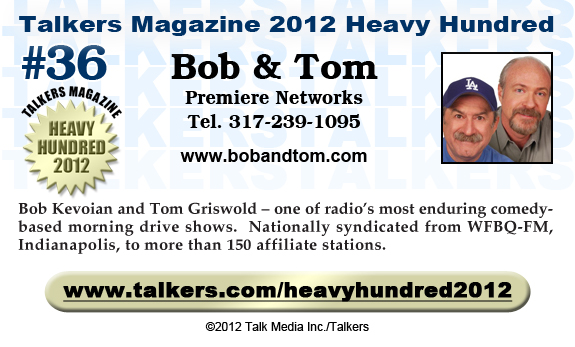
“The Bob & Tom Show” co-founder Bob Kevoian died on Friday at the age of 75 after a three-year battle with cancer. With partner Tom imgGriswold, the two launched The Bob & Tom Show in 1983 and the WFBQ, Indianapolis-based program took off, going into syndicated in 1995. The program, still led by Griswold, is heard on some 100 affiliate stations. Kevoian retired from the show in 2015. Kevoian went public with his cancer diagnosis in 2023 and launched “The Bob & Cancer Show” podcast with his wife Becky and Whit Grayson.

Industry News

Host Ron Slay and “104.5 The Zone” Renew Deal

Afternoon drive personality Ron Slay and Cumulus Media agree to a new contract that will keep him co-hosting the afternoon drive “3HL” show on WGFX-FM, Nashville “104.5 The Zone” alongside Brent Dougherty and Dawn Davenport. The station says that since joining “3HL” in 2021, Slay has become an essential part of the show’s identity – blending sharp sports insight, humor, and a natural storyteller’s instinct that resonates far beyond the studio. Station programming operations manager Paul Mason comments, “Ron is a game‑changer. He brings energy, curiosity, and joy to everything he touches. Watching his growth – not just as a broadcaster, but as a leader and connector – has been incredible. His ceiling truly doesn’t exist, and we’re excited to see what this next chapter brings.” In addition to his work with “104.5 The Zone,” Slay serves as a college basketball analyst for ESPN and the SEC Network.

Industry News

FARM Announces New Weekend Show

Farm and Ranch Media announces the addition of a weekend version of their popular weekday talk show, “Agriculture of America” that will launch on May 1. FARM VP of national ag content and host of the program Jesse Allen says, “There continues to be no shortage of news andimg information for farmers and ranchers and we are looking to double down on our efforts to bring that information to them through our radio affiliate partners. I am honored that we are able to grow the AOA footprint and expand to include a weekend offering that will continue to tell the story of agriculture, one conversation at a time.” Agriculture of America” debuted in 2018 by the team at FARM in conjunction with National Association of Farm Broadcasting Hall of Fame broadcaster Mike Adams featuring interviews and conversations with agricultural leaders, members of congress, market analysts, newsmakers and more and has grown into a nationally syndicated radio show heard on over 70 affiliate radio stations and SiriusXM Rural Radio 147 every weekday.

Industry News

Beasley Extends Exchange Offers

Beasley Broadcast Group extends its Tender Offer Settlement Date and the Exchange Offer Settlement to 5:00 pm ET on April 24. The company reports that as of the Early First Lien Tender Date, 100% of the Existing First Lien Notes had been tendered, and the company accordinglyimg accepted $15,899,000 in aggregate principal amount of such tenders in accordance with the terms of the Tender Offer. On March 30, 2026, the company completed the purchase of $15,899,000 in aggregate principal amount of the Existing First Lien Notes pursuant to the Tender Offer. As of 5:00 pm on April 15, 2026, approximately 98% of the aggregate principal amount of the Existing Second Lien Notes have validly tendered in the Exchange Offer and provided consents to the proposed amendments to the Existing Second Lien Notes Indenture.

Industry News

Seaboard to Distribute “Killer Carl” Show

Seaboard Networks announces it is completing a deal to distribute the syndicated political interview talk show, “The Killer Carl Program.” Theimg show is hosted by Carl “Killer Carl” Brown and has been on the air for almost a decade and is part of the John Frederick Radio Network. Seaboard marketing solutions consultant Bob Stei says, “We welcome all shows that affiliates will desire. Carl seems to put his own views and thoughts first, and they are not based on just ideology. That is refreshing.” The program currently airs on stations throughout America including WJFM, Richmond; WJFV, Norfolk; WBRG, Lynchburg; and WLMB, Atlanta.

Industry News

Cumulus Speeding Toward Chapter 11 Exit

Yesterday (4/13) in U.S. Bankruptcy Court in Houston the Modified Joint Prepackaged Chapter 11 Plan of Reorganization of Cumulus Media Inc. and Its Debtor Affiliates was filed. While the proposed order has yet to be approved by the judge, it is expected to be approved soon and clears theimg way for the reorganization to move to the next step – approval from the Federal Communications Commission. When fully consummated, the plan will have eliminated $592 million of debt for Cumulus and puts control of the company into the hands of secured creditors. A new board of directors will be elected and although current executive management may remain in their positions, it is entirely up to the new board of directors to determine the company’s officers.

Industry News

WJR’s Jamie Edmonds to Take Leave to Battle Breast Cancer

WJR, Detroit morning drive co-host Jamie Edmonds announces to listeners that she will be taking a leave of absence after being diagnosed with breast cancer. Cumulus Media notes on the WJR website that Edmonds shared the news during the program yesterday, “explaining that her absence from some recent shows had been related to her health and imgtreatment schedule. Edmonds, 42, said the diagnosis came unexpectedly about two months ago and described it on the air as a ‘total gut punch.’ A mother of a young daughter, she acknowledged the fear that followed the discovery but said she is confident in her care team and treatment plan at Henry Ford Health. Edmonds told listeners she has already begun chemotherapy and believes she will get through the process.” Edmonds says her oncologist emphasized the importance of consistent sleep and recovery during chemotherapy. She made clear that the change is temporary and that she plans to remain connected to WJR and its audience as she is able while focusing on her health.

Industry News

Pearson Acquiring KISR-FM, Fort Smith for Sports Talk

Pearson Broadcasting Group is acquiring KISR-FM, Fort Smith, Arkansas from Baker Family Trust and the company plans to use the signal for its “ESPN Arkansas” sports format in the Fort Smith market. In a statement, Pearson says, “This marks a significant expansion for Pearsonimg Broadcasting and ESPN Arkansas, which will now serve all the Fort Smith, Hot Springs, Northwest Arkansas, Harrison, Mountain Home, and much of Eastern Oklahoma. Top rated KISR will continue to serve the River Valley from just below its previous dial position, moving to 93.1 FM.” ESPN Arkansas general manager Tommy Craft adds, “We are excited to expand and grow the footprint and coverage areas of our ESPN Arkansas radio stations. The addition of a 100,000-watt station to our roster of current stations is a true game changer. Fred Baker and KISR have spent more than 55 years building something that is far more than just a radio station for so many people, and we are humbled to be able to continue that kind of commitment to listeners. We live in a state where the sports we love and the daily conversations about the teams we follow matter. The opportunity to expand our coverage so that more of the great people in Arkansas can join in the conversation with our live and local sports talk radio shows is a thrill, and we cannot wait to get started.”

Industry Views

Monday Memo: The 2026 Case for Weekend Talk Radio

By Holland Cooke
Consultant

imgTime Spent Listening to podcasts has now surpassed TSL with spoken word radio. And both are fraught.

Anyone can do a podcast, and everyone seems to be. How to get found/subscribed-to/shared?

  • And in this listen-when-ever-you-want culture, basing Return On Investment in a brokered-time weekend ask-the-expert radio show that only reaches real-time listeners is increasingly dubious.

So, I’m helping podcasters I work with to do both. To amplify the impact of all the work you put into a podcast, make radio your content engine.

Yes, radio, for two big reasons:

  • Credibility, because? Anyone can do a podcast. But being on broadcast radio makes you seem “real.” The station delivers you an existing audience that trusts its information, supports its advertisers, and listens habitually. You are live, interactive, and “car radio.” And interview guests will be easier to attract to your on-air show than to a podcast.
  • As a podcaster, you are already an audio publisher – but you’re doing all the work yourself, reckoning what’s relevant to your listeners – a slow, lonely way to build an audience. Host a call-in radio show, and everything changes. Your callers and guests become the content pipeline that makes your podcast more than just you-talking. Their questions position you as an authority and offer proof of what your audience wants. No guesswork. No blind spots. Just nonstop relevance that keeps listeners leaning-in, coming back, and sharing your podcast with friends.

This 1 + 1 can = lots more than 2, when your show and podcast promote each other; and as this process repurposes content to social media, E-newsletters, video, and other online resources. Here’s the schematic: http://getonthenet.com/workflow.png

Holland Cooke (HollandCooke.com) is a consultant working the intersection of broadcasting and the Internet. Follow HC on Twitter @HollandCooke and connect on LinkedIn

Industry News

Cumulus Media’s Q4 2025 Revenue Down 14%

Cumulus Media reports its operating results for the fourth quarter and for the full year of 2025. Cumulus’ net revenue in Q4 of 2025 was $188 million, a decline of 14% from the same period in 2024. For the full yearimg` of 2025, net revenue was $741.6 million, a decrease of 10.3% from 2024. For the full year 2025, the company posted a loss of $200.7 million. Cumulus reports by segments and for all of 2025, broadcast revenue was $116.2 million, a decline of 22.2% from 2024. Even digital revenue fell in 2025 to $151.3 million, down 1.9%. Cumulus Media president and CEO Mary G. Berner says, “The Company’s recently announced financial restructuring marks an important step toward meaningfully reducing the debt burden that has constrained the business. Looking ahead, we remain focused on building on the core strengths of the Company to maximize value.”

Industry Views

Creators, Commentators, or Publishers: Liability Remains the Same

By Matthew B. Harrison
TALKERS, VP/Associate Publisher
Harrison Media Law, Senior Partner
Goodphone Communications, Executive Producer

imgThe rise of independent, talk show-style political commentary on YouTube has created a new class of media actors who do not see themselves as broadcasters, journalists, or publishers. They see themselves as creators. That distinction is real in terms of identity, tone, and platform. It is not real where it matters most: liability.

The difference exists in how the work is produced and presented. It disappears the moment the content is published.

In practice, these creators are engaging in acts that courts have long recognized as publication. They are selecting topics, framing narratives, editing clips, and distributing content to large audiences. Those decisions are not neutral. They are editorial.

The absence of FCC regulation in this space has created a persistent misunderstanding. Traditional broadcasters operate under a regulatory framework that includes licensing and content restrictions. Independent creators do not. But the lack of FCC oversight does not reduce exposure. It removes one layer of regulation while leaving the core legal risk fully intact.

Defamation law applies equally to both groups. A false statement of fact about a real person that causes reputational harm can give rise to liability whether it is spoken on a licensed radio station or uploaded to a monetized YouTube channel. The standards may differ depending on whether the subject is a public or private figure, but the underlying obligation remains the same: accuracy matters.

There is no YouTube exception. There is no creator carveout. The law does not care how the content was distributed, what the platform calls you, or how you see yourself. It cares who made the statement, who chose to publish it, and whether it was false.

The structure of YouTube content introduces additional risk. Many creators rely on rapid production cycles and clip-based commentary. This increases the likelihood of error, particularly when context is compressed or omitted. Editing choices that seem minor from a production standpoint can materially change meaning, which is precisely the type of conduct that courts examine in defamation and false light claims.

Monetization further complicates the analysis. Revenue from ads, memberships, or sponsorships strengthens the argument that content is commercial in nature. That does not eliminate First Amendment protections, but it can influence how a court evaluates intent and reasonableness.

There is also a tendency to assume that platform norms provide a form of protection. If a piece of content is allowed to remain online, or even promoted by an algorithm, it can feel implicitly validated. That assumption is misplaced. Platform enforcement decisions are not legal determinations. They are business judgments.

The most important point is simple and often overlooked. Liability does not turn on intent. It turns on what was said, whether it was false, and whether reasonable steps were taken to verify it.

The platform may change how content looks. It may change how fast it spreads. It may change who gets to participate.

It does not change the consequences of getting it wrong.

Time passes. Technology and fancy packaging change. Exposure and liability do not. 

Matthew B. Harrison is a media and intellectual property attorney who advises talk show hosts, content creators, and creative entrepreneurs. He has written extensively on fair use, AI law, and the future of digital rights. Reach him at Matthew@HarrisonMediaLaw.com or read more at TALKERS.com.

Industry News

Top News/Talk Media Stories This Past Week (April 6-10)

Here are the most talked about stories of the past week (4/6-10) on news/talk radio and related talk media according to TALKERS:

Stories

  1. Iran Ceasefire / Israel’s Lebanon Strikes
  2. Oil Prices / Financial Markets Activity
  3. Trump and 25th Amendment Talk
  4. Trump vs NATO / Vance in Hungary
  5. Bondi Epstein Deposition
  6. Melania Epstein Statement / Epstein Files
  7. Birthright Citizenship / Georgia, Wisconsin Elections
  8. DHS Funding / Privatization of TSA
  9. SCOTUS Bannon Case Ruling
  10. Artemis II Mission

People

  1. Donald Trump
  2. Pete Hegseth
  3. Benjamin Netanyahu
  4. JD Vance / Marco Rubio
  1. Melania Trump / Jeffrey Epstein
  2. Jared Kushner / Steve Witkoff
  3. Mohammad Bagher Qalibaf
  4. Clay Fuller
  5. Markwayne Mullin
  6. Steven K. Bannon

To see the full TALKERS Stories, Topics, and People Charts, please click HERE.

Industry News

WTOP Promotes Woodfork as Part of Renewed Sports Initiative

Hubbard Radio all-news WTOP, Washington promotes Rob Woodfork to senior sports analyst in what the organization calls its “ongoing evolution of its local sports coverage.” WTOP director of news and programming Julia Ziegler states, “We are excited to announce Rob’s promotion. This imgis a key part of our long-term strategy to transform how we cover sports. We’re committed to delivering content that goes beyond highlights and final scores – focusing instead on context, analysis, and storytelling that resonates with today’s audience.” WTOP says that in his new role, Woodfork will lead a more dynamic, multi-platform approach to sports journalism, anchored by daily video and audio commentary designed for modern consumption habits. His work will prioritize insight and authenticity – meeting audiences where they are, particularly among Gen X and Millennial fans seeking more than traditional sports updates.

Industry News

BIA Revises Local Ad Forecast; Political Key to Broadcast’s Success

BIA Advisory Services revises its 2026 U.S. Local Advertising Forecast that it first released in Q4 2025 and is now projecting total local ad revenue to reach $184.5 billion, reflecting approximately 8.1% year-over-year growth compared with 2025. Among the reasons for the increase is a stronger-than-expected performance in mobile political ad spend.  BIAimg says, “Political advertising will drive key spending this year. BIA projects approximately $8.4 billion in local political spending, creating substantial revenue opportunities across broadcast television, linear cable, CTV/OTT, radio, and direct mail. While some legacy formats, including print, continue to face long-term declines, others are evolving. Across the market, advertisers are increasingly adopting full-funnel strategies, combining high-reach media such as cable, broadcast, and OOH with data-driven digital channels to drive both awareness and measurable outcomes. Radio also remains a stable local medium, with additional opportunities emerging through digital audio, including streaming and podcasts.”

Industry News

Audacy: 84% Trust All-News Radio

Audacy says that based on a study by Alter Agents that it commissioned, 84% of respondents placed their confidence in all-news radio for local news and information – outpacing both broadcast TV and social media. This comes at a time when Americans report low confidence in traditional media. Additionally, while cable news audiences skew either heavilyimg conservative or liberal – depending on the channel – all-news radio’s audience is almost perfectly balanced. Audacy adds that it matters when it comes to election season. “While most national news platforms reach consumers who already lean one way or another, all-news radio’s neutrality makes listeners more willing to hear a message – even from a candidate they might initially distrust. The Alter Agents study found that 77% of listeners considered all-news advertisers to be ‘trustworthy’ simply by running adjacent to the content.” See the full story here.

Industry News

Beasley 2025 Q4 Net Revenue Falls 21.1%

Beasley Broadcast Group reports net revenue of $53 million in the fourth quarter of 2025, a decline of 21.1% from the same period in 2024. For the full year of 2025, net revenue was $205.9 million, a decrease of 14.3% from the full year of 2024. Regarding the Q4 2025 numbers, Beasley says they “reflect persistent weakness in the traditional agencyimg advertising market that was partially offset by the continued expansion of our high-margin, owned-and-operated direct digital revenues. Beasley recorded an operating loss of approximately $230.0 million in the fourth quarter of 2025, compared to operating income of $7.6 million in the fourth quarter of 2024, driven primarily by a non-cash FCC license impairment charge of $224.8 million, reflecting the company’s updated assessment of the fair value of its broadcast licenses in light of continued secular pressures on the radio industry, as well as $1.7 million in other operating expenses.”

Beasley CEO Caroline Beasley states, “2025 was a year of meaningful transformation for Beasley. Against a persistently challenging advertising environment — marked by continued secular pressure on traditional audio and the ongoing contraction of agency-driven revenue channels — imgwe made tangible progress reshaping this company for long-term value creation. Our digital business delivered record performance, with digital revenue representing approximately 24% of net revenue, up from roughly 19% of net revenue in 2024, and digital segment operating margins reached record levels as our continued shift toward owned-and-operated and programmatic products gained traction across our markets… Building on this progress, we recently announced a debt exchange transaction with our second lien bondholders, pursuant to which we expect to reduce our second lien debt by approximately 50% and repay roughly $15 million of our first lien debt. Upon completion of the transaction, which is subject to bondholder participation and expected to close by the end of April, we anticipate total outstanding debt will be reduced to approximately $110 million from $220 million today. We believe this transaction will meaningfully strengthen our balance sheet, enhance financial flexibility, and better position the Company to execute on its strategic priorities. Following its completion, our focus will shift toward further deleveraging through EBITDA growth and continued portfolio optimization.”

Industry News

Segura Named OM for WMAL-FM, Washington

Cumulus Media appoints Luis Segura operations manager for its news/talk WMAL-FM, Washington, DC, effective May 4. Program director Bill Hess retired at the end of 2025 after a long time leading the station. Segura was most recently program director for the company’s KSFO,img San Francisco. Cumulus chief content officer Brian Philips says, “Among our strong field of Cumulus programmers, Luis leapt from the pack as the person possessing the energy and imagination to lead WMAL. Luis visualizes the multi-dimensional future of this big brand. The immense benefit of keeping Luis ‘in house’ is that he will continue to offer expert counsel to our revitalized operations in San Francisco and Los Angeles, as needed.” Segura says, “I’m incredibly excited to work with the legendary staff of Cumulus’ flagship news/talk. WMAL is packed with national names like Larry O’Connor and Chris Plante, and I can’t wait to join the team.”

Industry News

WHBY, Appleton Updates its Brand

Woodward Community Media’s Appleton, Wisconsin news/talk WHBY says that following a historic year celebrating a century of service to Northeast Wisconsin, it is launching its new brand identity and logo. Woodward says, “The rebranding effort comes on the heels of WHBY’s year-long, 100th-anniversary celebration, which concluded last week. While the festivities honored the station’s deep roots and legacy since 1925, the new visual identity is designed to carry that legacy into a multi-platform future. The new look is encapsulated by the station’s rebrand slogan: Brand New Look. Same Trusted Voice. Woodward Fox Valley market manager B.J. DeGroot says, “We spent the last year lookingimg back at a century of service to the Fox Valley, but today, we turn our gaze forward. After retiring our special 100-year commemorative look, we didn’t want to just go back to ‘business as usual.’ We’re kicking off our second century with a fresh new look that reflects the evolution of WHBY and our unwavering commitment to the next generation of listeners.” WHBY brand manager Alex Thomas adds, “We are excited to usher in a new era of WHBY. Our rebrand represents a new chapter of WHBY and reflects who we are today and where we are heading next. This transformation goes beyond a new logo. It represents our vision of strengthening community awareness, enhancing the way we deliver news and conversation in the Fox Cities and beyond. While our look may be changing, our core values remain the same. Being trusted, local, and community driven remains a pillar of WHBY.”

Industry Views

Sabo Sez: The “Constant Threat” Isn’t Exactly What It’s Cracked Up to Be

By Walter Sabo 
A.K.A. Walter Sterling, Radio Talk Show Host

imgAssessing the hourly threat to the very existence of the medium of radio is a popular hobby among conventioneers. The audience levels for radio are astonishingly constant since 1970, but according to “radio people,” they are living at the edge of a volcano. Spotify radio, SiriusXM radio, Pandora radio, TuneIn radio, Internet radio, there are all kinds of radio! General Motors wants to throw AM/FM radio out of the car as in “do you really need radio in the car?” Radio’s response to the in-car-removal threat is by promising non-stop typhoons and hurricanes.

The actual threats to established radio companies are non-established radio companies. With the death of meaningful on-air competition, a consolidated industry can easily anticipate the strategies of all major “brands” (formerly known as stations). What cannot be anticipated are actions that are a true threat: Outlier owners throwing creative grenades into the sleepy radio ecosystem.

All viable radio formats launched as unanticipated surprises. New formats are greeted with hostility and predictions of doom. All of them. Yes, even adult contemporary. Eventually – or tomorrow – a new format will be deployed by a desperate owner with a handful of stations, an owner with a retailer’s mentality will go for broke with a format – or a series of shows – that will not be anticipated, cannot be duplicated and is not cheap.

See the threat? A true threat will be a new format that successfully attacks the core of dozens – hundreds of established stations, stations owned by venture capital. It will not be anticipated, cannot be duplicated by hundreds of stations and does not “scale” i.e. isn’t cheap. But the new format would be so rapaciously embraced by the public that it would force all other stations to completely change their on-air content and their sales strategies. Imagine the impact of that threat.

Walter Sabo has been a C-Suite action partner for companies such as SiriusXM, Hearst, Press Broadcasting, Gannett, RKO General, and many others. His nightly show “Walter Sterling Every Damn Night” is heard on WPHT, Philadelphia. His syndicated show, “Sterling On Sunday,” from Talk Media Network, airs 10:00 pm-1:00 am ET, and is now in its 10th year of success. He recently began hosting “Another Side of Midnight” weekends on WABC, New York. He can be reached by email at sabowalter@gmail.com or phoned at 646-678-1110.

Industry News

Audacy Partners with Portland Fire and Portland Thorns Clubs

Audacy is entering into broadcast agreements in Portland to use its radio stations as the official radio home of the WNBA’s Portland Fire and the NWSL’s Portland Thorns. KMTT-AM “910 ESPN Portland” will serve asimg the flagship for the Portland Fire. Select games will also simulcast on KRSK-FM “105.1 The Fan.” Portland Thorns games will air on KNRK-HD2 with 10 select games airing on “910 ESPN Portland.” Audacy Portland SVP of sales Ryan Cooley states, “We’re incredibly proud to welcome the Portland Fire and the Portland Thorns to the FAN Sports Network. Our city has long been a leader in supporting women’s sports, and we’re especially excited to welcome the Fire back to Portland after over two decades.”

Industry Views

Monday Memo: Why Local Media Still Moves Communities

By Holland Cooke
Consultant

imgIn “When Everyone Knows That Everyone Knows” (Scribner) cognitive scientist Steven Pinker unpacks a deceptively simple idea: Society runs on common knowledge. Not just what people know individually, but what they know OTHERS know-they-know.

Read that again, aloud. It describes the invisible wiring that drives humans to coordinate, trust, cooperate, and sometimes revolt.

If that sounds abstract, it shouldn’t. Radio and television are the most powerful common knowledge machines ever invented. And in an era when media fragmentation has turned audiences into isolated microtribes, broadcasters who understand Pinker’s point gain a strategic advantage.

Broadcasting creates the “Shared Reality” communities run on

When a radio or TV station says, “Schools are closed,” that’s not just information. It’s a signal that everyone else in town heard the same thing. That shared certainty is what lets a community move in sync. Pinker reckons that this is the essence of coordination: people don’t just act on facts – they act on what they believe others believe.

This is why broadcasters remain indispensable during storms, emergencies, elections, and civic moments. Digital platforms can inform individuals. Only broadcasting can inform everyone at once, and – crucially – make it known that everyone else heard it too.

Trust and legitimacy flow from common knowledge

Pinker notes that institutions derive their authority from shared understanding. Money works because everyone knows everyone else accepts it. Laws work because everyone knows everyone else knows the rules.

Local broadcasters occupy that same psychological space.

A trusted anchor or morning host doesn’t just deliver news – they confer legitimacy. When they say, “Here’s what’s happening,” they’re not merely reporting; they’re establishing the community’s shared frame of reference. In a fragmented media world, that’s gold.

Dueling Realities: FOX News vs MSNow

Inside each bubble, people know what everyone-like-them knows. When national narratives clash, local broadcasters become the last shared reality left.

Local radio and TV, by contrast, still operate in the realm Pinker describes: weather, schools (and EVERYTHING ELSE that triggers a parent’s concern), roads, emergencies, local elections, shared rituals and routines. These are not ideological. They’re lived. Local broadcasters still produce the kind of common knowledge that makes a town function. Cable networks and partisan talk radio produce the kind that makes a tribe feel coherent.

Local broadcasting is still where a community becomes a community.

Holland Cooke (HollandCooke.com) is a consultant working the intersection of broadcasting and the Internet. Follow HC on Twitter @HollandCooke and connect on LinkedIn

Uncategorized

Dr. Asa Andrew Poised at Dynamic Intersection of Radio and Pro Wrestling

Health/lifestyle syndicated talk media star and ringside physician, Asa Andrew, M.D. (a.k.a. Dr. Asa) finds himself strategically positioned at the dynamic intersection of radio and wrestling as TNA Wrestling announces a collaboration that will integrate its premium live events, weekly television programming, digital platforms, and fan experiences across iHeartMedia’s formidable audio network. Dr. Asa has achieved imgTALKERS “Heavy Hundred” national prominence for years, originally launching his daily three-hour “The Dr. Asa Show” on its flagship radio affiliate, iHeart’s WLAC, Nashville. Andrew has subsequently and simultaneously returned to his roots as a professional wrestler and recently joined TNA Wrestling as the company’s ringside physician and head of sports medicine.

Andrew tells TALKERS, “I am excited to see these two entertainment and media giants come together. Finally, my two passions are aligning synergistically. TNA Wrestling has seen immense expansion this year as its president Carlos Silva led the company into one of its largest growth periods. This includes a major TV network deal with AMC for our weekly live show, ‘Thursday Night iMPACT!,’ as well as filling up arenas in major cities across America with record breaking crowds. Now – from the radio, TV, and podcast studio to the professional wrestling ring – talk media’s ‘America’s Health Coach’ and professional wrestling’s ‘Ringside Physician’ Dr. Asa has a significant cross-section of his brand in one place.”

As part of the agreement, iHeartMedia will serve as the presenting sponsor of the TNA Wrestling Pay-Per-View Pre-Show for all remaining 2026 premium live events. The integration will feature prominent brand visibility across broadcast graphics, in-arena announcements and event marketing. On TNA’s flagship weekly television program, “Thursday Night iMPACT!,” airing nationally on AMC, and streaming on AMC+ in the U.S., and worldwide on TNA+, iHeartMedia will receive premium broadcast integration including sponsorship of the LED Walkout Ramp, one of the most visually recognizable elements of TNA’s live events and television presentations.

Check out Dr. Asa, the ringside physician, in action

Dr. Asa had to respond a real-life medical emergency during a recent TNA World Championship match in New Orleans between current standard bearer Mike Santana and challenger, “Bulletproof” Steve Maclin. Maclin took a superkick and Santana connected with the left side of his jaw almost knocking him out and delivering an instant concussion (as immediately evaluated by referee Alice Lane).  Dr. Asa‘s instincts were equally quick as he was sliding into the ring while referee Lane was throwing up the X sign. That’s when a referee crosses the two forearms to make an X. It signals there is a serious injury and the match needs to pause until a medical doctor can evaluate the wrestler to see if the match is to be stopped or can continue. Dr. Asa made the decision to stop the match, and Maclin was transported to the hospital for further evaluation. Thankfully, Maclin only suffered a mild concussion with slight neck pain and spasm. He should be returning to the ring soon once he is medically cleared.  To see a video clip of this incident, please click here