Industry News

FOX Announces 9/11 Anniversary Coverage

FOX News Media reveals its plans for covering the 25th anniversary of the September 11, 2001 terrorist attacks. FOX network personalities and correspondents will present commemorative packages and interviews while reporting live from locations across New York, Pennsylvania and Washington, D.C. imgOn the TV side, FOX News Channel’s “FOX & Friends” is broadcasting live from several locations and will feature interviews with guests about their experiences 25 years ago. FOX News Radio will also offer breaking news coverage of the NYC memorial ceremony on Friday, featuring reporting from Ground Zero. “The Brian Kilmeade Show,” “FOX Across America with Jimmy Failla” and “The Guy Benson Show” will interview guests and newsmakers impacted by the attacks. On YouTube, “The Brian Kilmeade Show” will provide access to some of Kilmeade’s most notable 9/11 interviews, and FNR affiliates will be offered an anniversary special from Kilmeade that reflects on how America has evolved since then.

Industry News

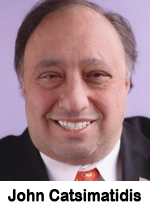
John Catsimatidis Interviews Hunter Biden on WABC

Red Apple Media and WABC, New York owner John Catsimatidis interviewed Hunter Biden for his “Cats Roundtable” show that aired on WABC on Sunday (9/6). In the interview, Biden defends his father’s term, crediting Joe Biden with “rebuilding NATO, rallying the world against Russian imgaggression in Ukraine and helping bring the country back after COVID.” Biden tells Catsimatidis he believes the current political climate has made it difficult for people to judge his father’s presidency clearly, but said historians will eventually take a different view. “I think the historians will look at my dad’s presidency as an incredible success,” Biden said. The interview also touches on Hunter Biden’s recovery, the attacks he faced during his father’s presidency, the future of the Democratic Party, immigration, veterans, addiction and whether he would ever consider running for public office.

Industry Views

Monday Memo: “So What?”

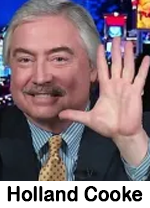
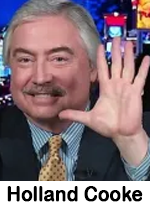
By Holland Cooke
Consultant
imgAbout those commercials… which pay for you. When a prospective client says, “We tried radio. It didn’t work,” I ask to hear the commercial. Within seconds I can tell why.

It opens with the business name. It lists products. It rattles off prices. It stuffs in an address, a website, a phone number, and a slogan. Then it ends. Nothing happened. Nothing memorable. Nothing emotional. Nothing that gave a listener a reason to care. Yet radio gets blamed. Like blaming a fishing rod because you cast with no bait.

The commercial has one job: Make someone care enough to take the next step

That’s it. Not explain everything. Not impress everyone with how many years you’ve been in business.

Its purpose is to create curiosity…confidence…desire…trust…urgency…hope. Any one of those emotions can motivate action. A list of merchandise almost never does.

The listener doesn’t wake up hoping to buy a water heater, or hire a lawyer, or replace a roof. People act when something in their lives creates a need. Good advertising connects with that moment.

A mattress store isn’t selling mattresses. It’s selling better mornings. A financial planner isn’t selling investments. She’s selling confidence. A heating contractor isn’t selling furnaces. He’s selling warmth on the coldest night of the year.

Translate Features into Benefits

Every advertiser has a product. Every customer has a problem. Say it with me: “Successful spots connect the dots.”

Here’s a simple exercise: Every time they mention a feature, ask, “So what?”

  • “We stock thousands of [item].” So what? “You won’t spend your weekend driving from store to store.”
  • “We’ve been serving this community since [year].” So what? “We’ve helped generations of local families buy homes, build businesses, and send kids to college.”
  • “We offer custom designs.” So what? “The ring she’ll wear forever will be unlike anyone else’s.”

If the answer explains how the listener’s life becomes:

  • easier
  • safer
  • faster
  • healthier
  • happier
  • less stressful
  • more convenient
  • more secure
  • more enjoyable

…you’ve found the benefit, and you get paid.

Holland Cooke (HollandCooke.com) is a consultant working the intersection of broadcasting and the Internet. Follow HC on Twitter @HollandCooke and connect on LinkedIn

Industry News

WFEA, Manchester Promotes Prostate Cancer Awareness

Saga Communications’ news/talk WFEA, Manchester, New Hampshire program “The Morning Update with Jeff Chidester” recently devoted its monthly “Roundtable” to the issue of prostate cancer. Chidester hosted Cathi Bachhuber and Peter McGee, co-imgpresidents of the New Hampshire Prostate Cancer Coalition to talk about awareness, early detection and getting men and their families to start talking about prostate health. Chidester says, “One of the reasons we created the ‘Morning Update Roundtable’ is to give important issues the time and attention they deserve. Prostate cancer is something that affects so many New Hampshire families, but it’s still a conversation many men are reluctant to have. If this discussion encourages even one listener to talk with his doctor, ask about a PSA test, or start a conversation with someone he loves, then we’ve done something worthwhile. I’m incredibly grateful to Kathy and Peter for being so open with our listeners and for the work the New Hampshire Prostate Cancer Coalition is doing across our state.”

Industry Views

Radio: Human Reserved

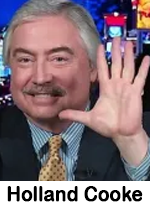
By Holland Cooke
Consultant

imgBill Gates has a useful term for something radio should be thinking about: “Human Reserved.” In an essay about a turbulent AI era, he sketches an unsettling future, and – for broadcasters – has a consequential warning… and an opportunity.

As artificial intelligence performs more and more work traditionally done by humans, he suggests there will be activities we could turn over to machines and deliberately choose not to, because something important would be lost. AI can write a weather forecast, summarize a police report, transcribe a school-board meeting, generate a commercial, voice a liner, research a sales prospect, and assemble an hour of music.

As content gets cheap, human presence becomes more valuable

Search results are AI summaries. Social posts, photos, voices, and videos may be synthetic. Gates warns of AI-powered fraud, disinformation, and deepfakes. Amid all that uncertainty, imagine hearing: “I’m here at the courthouse, where the jury just returned a verdict…”

Could AI manufacture that sentence? Sure. But I know who’s saying it. That’s an asset radio shouldn’t automate away.

Yes, use AI aggressively behind the scenes. Let it transcribe meetings, research prospects, clean up audio, draft proposals, repurpose interviews, and handle routine administrative work. Automate tasks. Protect relationships. Let AI summarize the school-board meeting. Then have your reporter tell me what it means to my kid. Let AI draft ten commercials. Have someone who understands the advertiser decide which idea might actually make the phone ring.

Why advertisers still need us?

Soon every local business owner will be able to generate logos, videos, emails, websites, social posts, and commercial scripts almost instantly. So, “We’ll make your commercial” becomes a nearly worthless sales proposition. The station’s value needs to migrate from selling spots and making ads to: We know this market. We know how to get people here to notice you. And we help make your advertising work.

AI will create an infinite supply of information. What’s scarce will be trust, judgment, relevance, relationships, and recognizable local humans. So, radio’s AI strategy can be surprisingly simple: Use AI to DO more. Use humans to MEAN more.

Here is Bill Gates’ essay: https://www.gatesnotes.com/a-turbulent-ai-era-and-critical-choices-to-make

Holland Cooke (HollandCooke.com) is a consultant working the intersection of broadcasting and the Internet. Follow HC on Twitter @HollandCooke and connect on LinkedIn

Industry News

Jason Goff Joins Hubbard’s 312 Sports

img

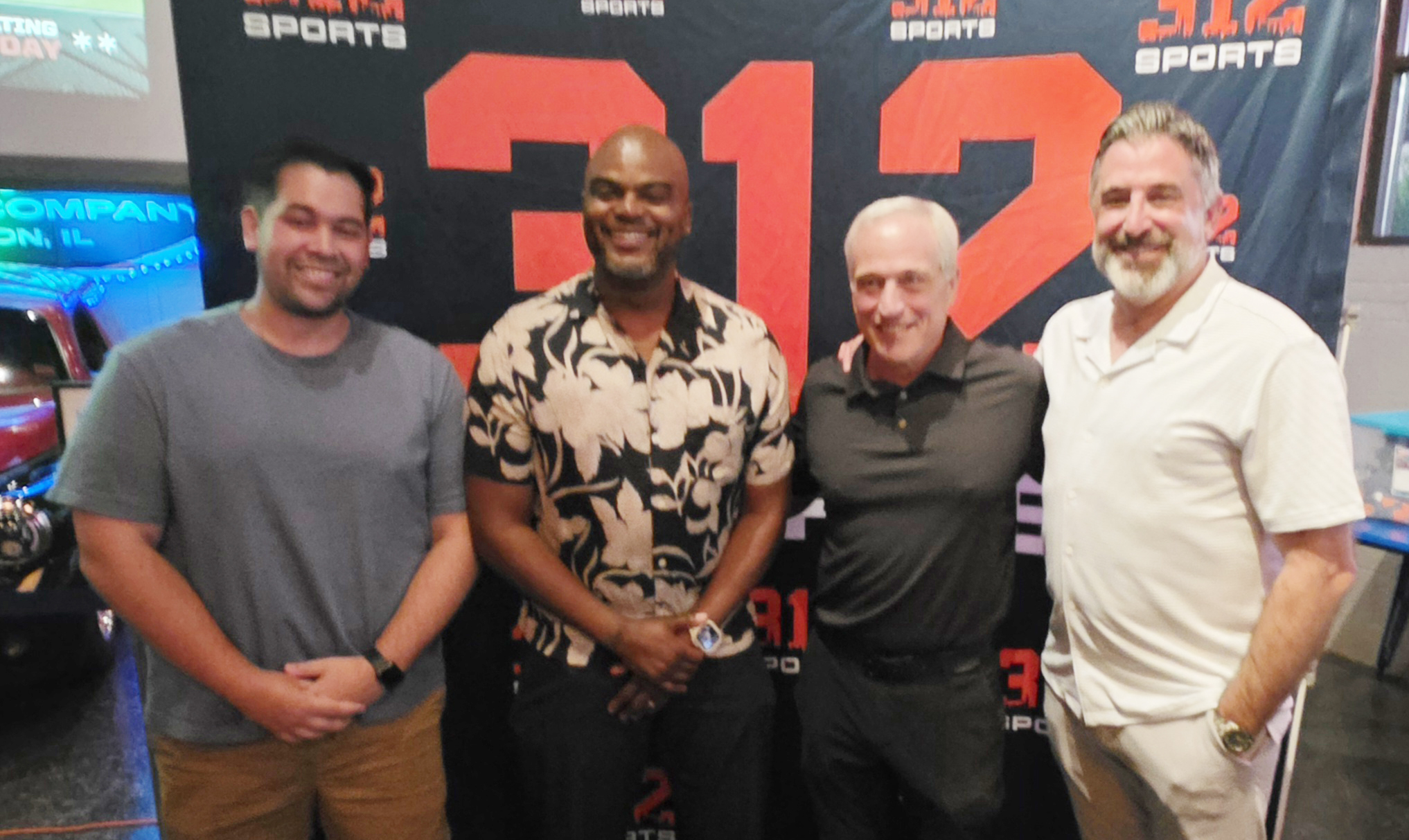
Windy City sports media personality Jason Goff is joining Hubbard’s digital platform 312 Sports. Goff is pictured above (second from the left) along with Cody Delmendo (left), Dan Bernstein (second from right), and Matt Abbatacola(right) at Double Clutch Brewing in Evanston during the 312 Sports Year One Anniversary Party. Hubbard says Goff will launch a new podcast, “Jason Goff: Unscripted,” followed by a twice-weekly national football show with a partner to be announced. Goff started his media career producing the “Boers & Bernstein” show on WSCR, Chicago. John Goforth is general manager of Hubbard’s Gamut Podcast Network and he says, “This is a memorable stretch in sports media, nationally and here at home, and a lot of good people are figuring out what comes next. There’s no joy in that. But it has clarified something: audiences follow people, not call letters. Jason’s talent, his experience and his roots in this city make him a natural fit for what we’re building. He had his pick of what to do next and he chose to build it here, with us, in the city that made him.”

Industry News

Craig Karmazin Announces Rebrand of Company to Good Karma Sports

Gone is the corporate name Good Karma Brands as the company unveils its new name Good Karma Sports. Founder and CEO Craig Karmazin says, “For nearly 30 years, we’ve built our imgbusiness around sports, expanding our capabilities and relationships while staying deeply connected to the local markets we serve. The business we’ve built gives brands a unique and customizable point of entry into the sports ecosystem, bringing together audiences, content, partnerships, talent and experiences around the teams, sports and moments that matter to them. At the same time, our expertise allows us to create value for sports partners in increasingly broad ways. That’s what Good Karma Sports represents, and there is tremendous opportunity ahead for our league, team, publisher, and advertising partners.”

Industry News

Sandy Beach Dies at 86

Buffalo radio legend Sandy Beach has died at the age of 86. Beach spent much of his career in the Buffalo market, including the last 23 years at WBEN-AM, Buffalo. Beach joined WKBW, Buffalo in 1968 when it was a Top 40 station. He worked in a number of markets during his 60-year career, including Hartford, imgDallas, San Francisco, and Milwaukee. Former Audacy Buffalo general manager Tim Wenger posted his thoughts about Beach’s passing and wrote: “When I was asked about programming WBEN ‘back in the day’ and what I would do first, I quickly said I would go to Milwaukee and bring Sandy Beach back to Buffalo and talk radio, where he belongs. I got the job, I got Sandy, and I never looked back. Sandy quickly became an institution on WBEN and a co-worker so many cherished and loved off the microphone and respected for his unrivaled wit, intelligence, logic and even sometimes caustic sense of humor on the air. The most-asked question I get when I encounter WBEN listeners is, hands-down, ‘How is Sandy Beach?’ Susan and I had the privilege of continuing our close friendship with Sandy and I can assure you that his humor, personality and wit was with him until his brief illness took hold.”

Industry News

iHeartMedia: Gen Z Driving Resurgence in Radio Engagement

iHeartMedia releases the results of a study by its Critical Mass Media that looks at Gen Z’z relationship with audio and says the data indicates there’s a “surprising resilience of broadcast radio among younger audiences” that is based on the cohort’s “desire for community and belonging.”  iHeartMedia president of insights Lainie Fertick says, “While Gen Z is conventionally thought to want everything on-demand and tailored to their needs, the data shows that teenagers are gravitating to the safety and anonymity of radio to create community. In a world where young people often feel pressure to curate how they present themselves online, radio offers a shared experience where identity isn’t being evaluated and personal taste isn’t on trial.”

Industry News

FCC’s Gomez Comments on ABC Suit

Following Tuesday’s news that ABC is filing suit against the FCC alleging a violation of its First Amendment rights, FCC Commissioner Anna M. Gomez comments on the matter. She states: “For months, the FCC has waged a campaign of imgcensorship and control against Disney’s ABC stations, using the threat of broadcast license revocations to punish a company for speech this administration doesn’t like. I have long called on companies to push back against this kind of government intimidation, and I’m glad Disney has shown courage and stepped up. This should be a welcome sign for every broadcaster who has felt the weight of this overreaching government pressure in silence.

“I am hopeful that this will mark the beginning of the end of this administration’s disregard for the Constitution and the law, and that the coming months will bring the costly legal defeat this agency has been asking for since it started down this path. It is time this administration understands that the Constitution does not bend to political convenience, and that the First Amendment protects the news and commentary Americans see on their screens even when those in power wish it didn’t.”

Matthew B. Harrison

Matthew B. Harrison is vice president and associate publisher of TALKERS magazine, founder and senior partner of Harrison Legal Group, and executive producer at Goodphone Communications, Inc.

Role at TALKERS

Matthew B. Harrison serves as vice president and associate publisher of TALKERS, the trade publication serving the talk media industry since 1990. He writes for the publication on media law, copyright, fair use, artificial intelligence, and the legal questions facing broadcasters, podcasters, and digital creators.

As executive producer at Goodphone Communications, Inc., the company that manages TALKERS, he handles audio and television production for the publication and its related projects, including Up Close Far Out with Michael Harrison.

All TALKERS coverage by and about Matthew B. Harrison

Law practice

Matthew is founder and senior partner of Harrison Legal Group, a Massachusetts practice serving creators, broadcasters, publishers, artists, photographers, and media businesses. He practices media law through Harrison Media Law, the firm’s dedicated media-law practice.

His work covers evaluating rights before publication, responding when work is copied or misused, addressing claims and demand letters, protecting brands and creative assets, and disputes involving digital platforms and emerging technology.

He was admitted to the Massachusetts Bar on December 12, 2005, and is admitted to practice before the Massachusetts state courts, the federal courts in Massachusetts, and the federal courts in Washington, D.C. His Massachusetts Board of Bar Overseers number is 664196.

Playing the Clip

Matthew is the author of Playing the Clip: The Digital Media Creator’s Legal Guide to Fair Use, published by TALKERS Books in April 2026. See TALKERS Books Announces Publication of Playing the Clip.

Selected writing

Education

  • Juris Doctor, Western New England University School of Law, 2005 – magna cum laude; assistant editor, Western New England Law Review
  • Master of Fine Arts, Academy of Art University, San Francisco, 2010
  • Bachelor of Arts in political science and Bachelor of Arts in legal studies, University of Massachusetts Amherst and Commonwealth Honors College, 2002

Elsewhere

He uses Matthew, not Matt, professionally.

Industry News

Craig Carton to Host Show for Outkick

Outkick – the sports and culture platform recently acquired by FOX News Digital – is bringing WFAN, New York afternoon drive host Craig Carton aboard to host a new show that will drop on Mondays, Wednesdays and Fridays, beginning September 8. imgOutkick says this new show debut coincides with OutKick integrating as the official sports brand of FOX News Digital on August 24. FOX News Digital editorial executive vice president Tommy Firth says, “This is a pivotal moment for OutKick as the integration with FOX News Digital will expand its reach and influence throughout sports media. Craig Carton’s distinctive voice will resonate with our audience and seamlessly meets this moment for OutKick.” Carton says, “I’m beyond thrilled to be joining OutKick. I’ve always been a fan and appreciate their authenticity and willingness to speak their minds. It’s something I’ve done throughout my career and will do during this next chapter of hosting ‘The Craig Carton Show.’”

Industry News

Dan Bongino Returns to Radio on Syndicated Afternoon Drive Show

Cumulus Media’s Westwood One is launching a syndicated radio show starring Dan Bongino that will debut next Monday (8/24). The program is called “The Bongino Report PM with Dan Bongino and Shawn Farash” that will air live 3:00 pm to 6:00 pm ET. imgBongino returned to the Cumulus fold doing his podcast that’s sold by the Cumulus Podcast Network after leaving his assistant director position with the FBI. The new show will feature Shawn Farash hosting the first hour and Bongino hosting hours two and three. Bongino comments, “I’m excited to partner with Shawn to bring listeners a daily program focused on the stories that matter most. Our goal is simple: deliver honest analysis and keep ourimg audience informed and engaged. Radio remains one of the most powerful ways to connect directly with people, and I’m excited to be back on Westwood One!” Farash adds, “This is an incredible opportunity for me to connect with listeners across the country every day. Working alongside Dan and the team at Westwood One allows us to bring a fresh, energetic approach to afternoons while staying focused on the stories our audience cares about most.”

Industry News

KVET’s “The Morning Kickoff” Expands to Three Hours

iHeartMedia sports talker KVET, Austin “1300 The Zone” expands the morning drive show by and hour, to have “The Morning Kickoff” imgwith Mike Hardge and Mark Henry air from 6:00 am to 9:00 am. Station program director Bryan Erickson says, “With the 2026 college football season just around the corner, this move gives Longhorn fans another hour of the in-depth analysis, big-name interviews and passionate discussion they’ve come to expect from Hardge and Henry.”

2012 Heavy Hundred – 1-10

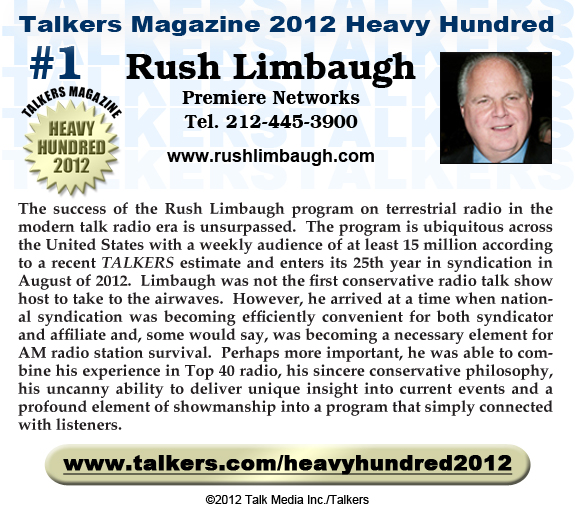
TALKERS 2012 Heavy Hundred #1: Rush Limbaugh, Premiere Networks

1. Rush Limbaugh – Premiere Networks

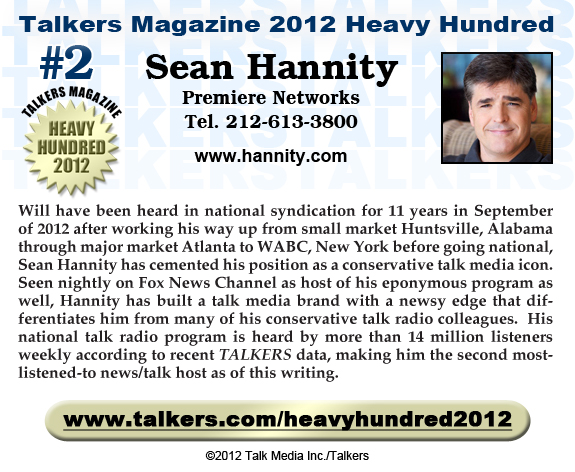
TALKERS 2012 Heavy Hundred #2: Sean Hannity, Premiere Networks

2. Sean Hannity – Premiere Networks

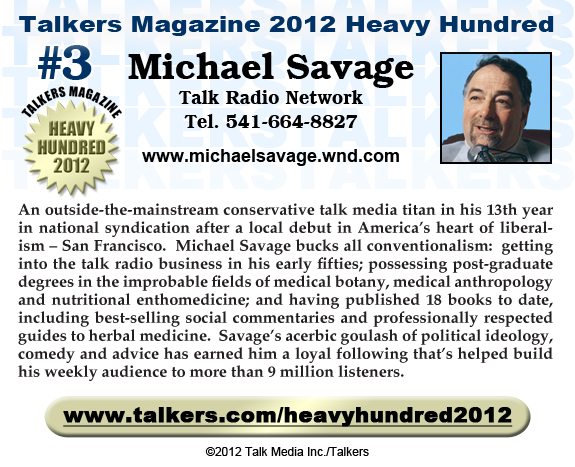
TALKERS 2012 Heavy Hundred #3: Michael Savage, Talk Radio Network

3. Michael Savage – Talk Radio Network

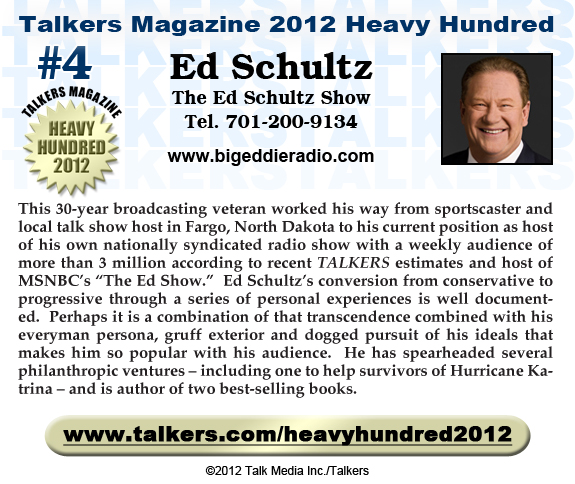
TALKERS 2012 Heavy Hundred #4: Ed Schultz, The Ed Schultz Show

4. Ed Schultz – The Ed Schultz Show

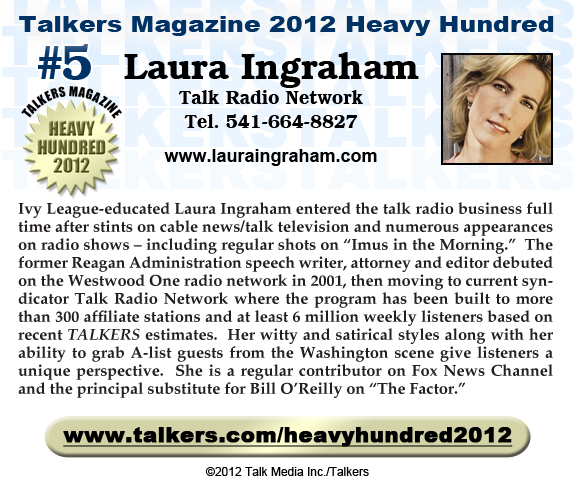
TALKERS 2012 Heavy Hundred #5: Laura Ingraham, Talk Radio Network

5. Laura Ingraham – Talk Radio Network

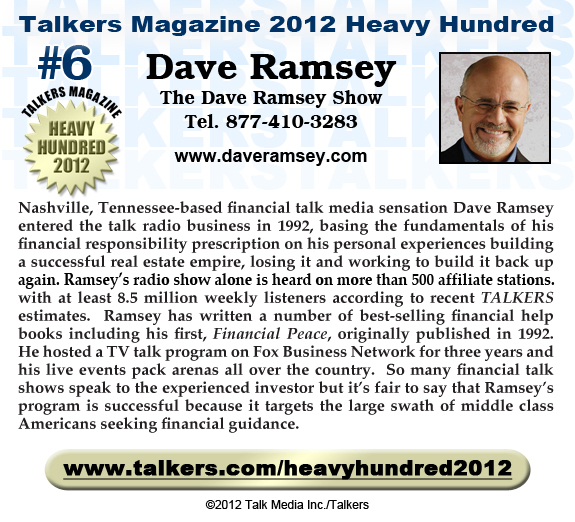
TALKERS 2012 Heavy Hundred #6: Dave Ramsey, The Dave Ramsey Show

6. Dave Ramsey – The Dave Ramsey Show

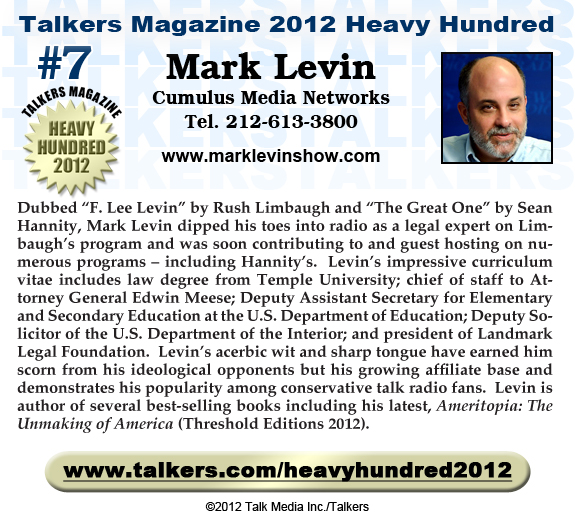
TALKERS 2012 Heavy Hundred #7: Mark Levin, Cumulus Media Networks

7. Mark Levin – Cumulus Media Networks

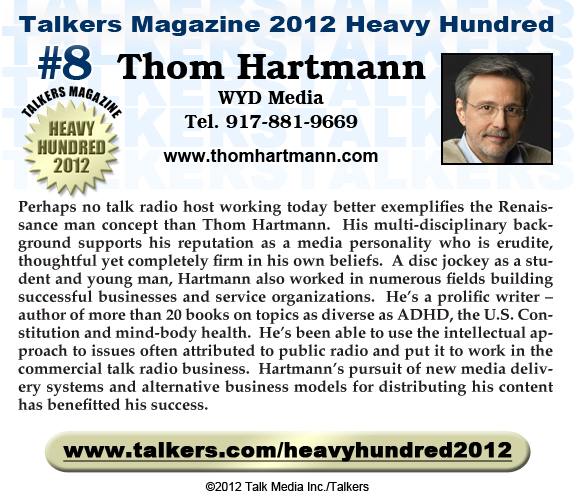
TALKERS 2012 Heavy Hundred #8: Thom Hartmann, WYD Media

8. Thom Hartmann – WYD Media

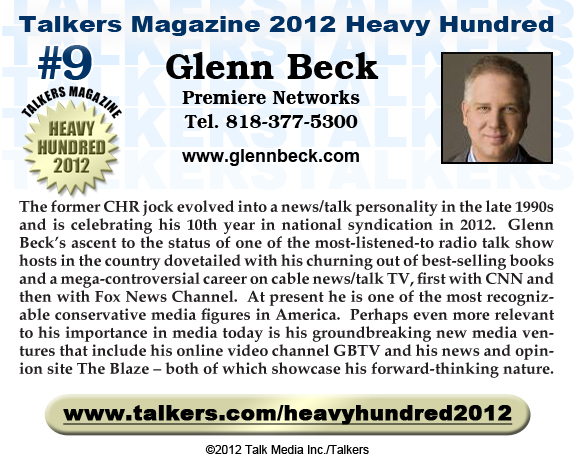
TALKERS 2012 Heavy Hundred #9: Glenn Beck, Premiere Networks

9. Glenn Beck – Premiere Networks

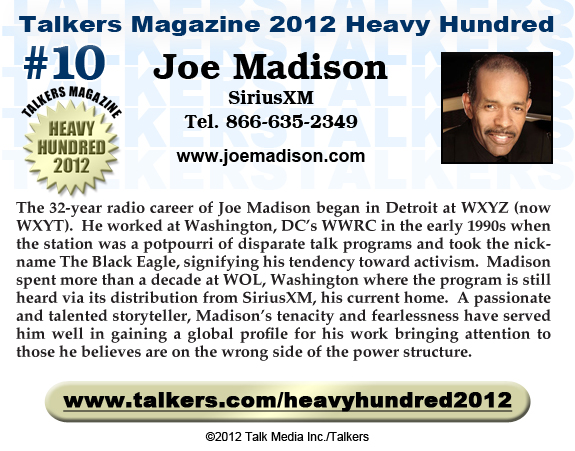
TALKERS 2012 Heavy Hundred #10: Joe Madison, SiriusXM

10. Joe Madison – SiriusXM

1 – 10 | 11 – 20 | 21 – 35 | 36 – 50 | 51 – 65 | 66 – 80 | 81 – 95 | 96 – 100

Industry News

Saga Communications’ Q2 2026 Net Revenue Down 6.5%

Reporting its operating result for the second quarter of 2026, Saga Communications says net revenue for the period was $26.4 imgmillion, a decline of 6.5% from the same period in 2025. Saga’s net income for the quarter was $960,000. In the report, Saga said it sold 24 towers and other assets that brought it $10.7 million.  Saga Communications reports $27.8 million in cash and short-term investments as of June 30, 2026.

Industry News

Zimmer Petitions FCC for Ownership Cap Exemption

Zimmer Communications files a request with the FCC to waive the ownership cap for its acquisition of four radio stations from Mid-West Family Broadcasting that includes sports talk KOSP, Springfield, Missouri “102.1 The Won” and three music brands. imgZimmer argues in its filing that relief from the ownership cap would not adversely affect competition in the Springfield, Missouri market and notes that if approved, its revenue share in the market would be 33.6% (up from its current 8.5%), while SummitMedia’s revenue share is currently 34.8%. Zimmer goes on to add that in terms of audience share, Zimmer would have 21.3% of the market’s audience compared to iHeartMedia’s 22.3%. Additionally, Zimmer points out that, if approved, 18 different owners would control stations in the Springfield market.

Industry News

WTOP Reimagines Top News Podcast

Hubbard Media’s all-news WTOP, Washington says it is reimagining its “Top News Podcast,” transforming it “into a dynamic, on-demand extension of WTOP’s award-winning on-air imgnews product.” WTOP says the “Top News Podcast” will deliver 12-14 episodes each weekday between 6:00 am and 7:00 pm. WTOP will also produce a video version of the podcast for digital platforms. Head of news and programming Julia Ziegler says, “This new podcast represents a natural evolution of the WTOP brand. It meets news consumers where they are – on more platforms than ever before – allowing us to grow our audience and develop new revenue streams.”

Industry News

Sabo Sez: Mitch Reed’s Deserved Award

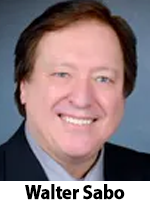
imgBy Walter Sabo
A.K.A. Walter Sterling
Host, The Other Side of Midnight
WABC, New York / Red Apple Audio Networks

The Radio Hall of Fame has just announced their “Legends” inductees, and it includes B. Mitchell Reed. YES!

One of the minor injustices of radio is the curious legacies of Tom Donahue and B. Mitchell Reed relative to the creation of free-form progressive rock radio. They were best friends with parallel careers. Both were top-of-their-game “screaming” Top 40 DJs. Tom in San Francisco, Mitch in LA and NYC. Top earnings, ratings, and both around 40 when they went to the Monterey Pop Festival. There they learned that their teens were changing fast. Harder rock, anger about Vietnam, and drugs. They knew their style of radio was out of synch with the moment.

Every day on his way to work in LA, Mitch drove past the Pasadena Presbyterian church and noticed a radio antenna on the grounds.

The tower was pumping out an FM signal that covered Los Angeles, broadcasting from the basement of the church. Underground. Mitch talked to the preacher he met along the way. And he bought time on the station at night and experimented with playing hard rock and a new form of presentation. His friend Donohue sent tapes from San Francisco, and the two of them created “free form” radio (also referred to as “underground” radio) from the basement of the church. The frequency became KPPC-FM.

Note: both of them created free-form radio at risk to their careers and income while over the age of 40. Tom continued as a progressive rock jock in San Francisco, and Mitch became an icon in Los Angeles as an album rock jock on KLOS and KMET. Oddly, Tom gets more of the image and credit, but they were very much partners.

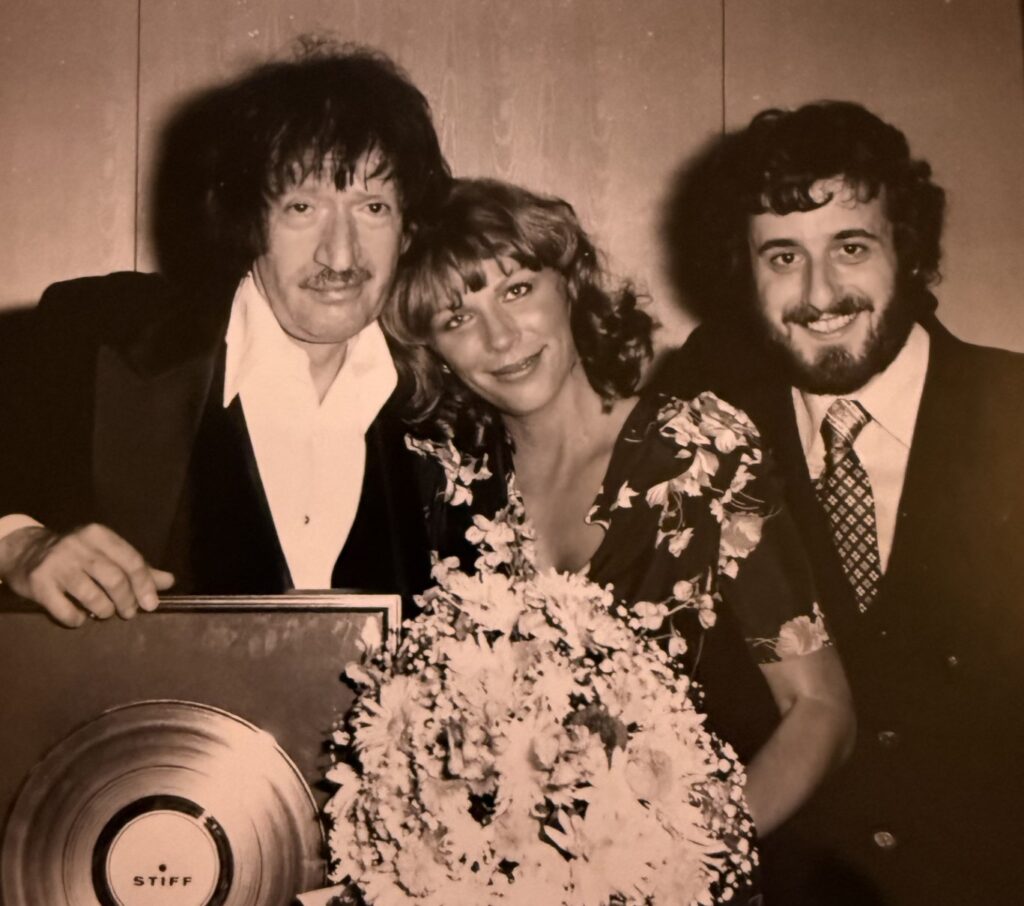
BMR MH
B. Mitchell Reed (l), his wife Carol (c), and Michael Harrison (r) at KMET, Los Angeles in the late seventies.

Walter Sabo has been a C-Suite action partner for companies such as SiriusXM, Hearst, Press Broadcasting, Gannett, RKO General, and many other leading media outlets. His company, HITVIEWS, in 2007, was the first to identify and monetize video influencers. His nightly show “The Other Side of Midnight” is heard on WABC, New York and the Red Apple Audio Network 1:00 am – 5:00 am. His syndicated show, “Sterling On Sunday,” from Talk Media Network, airs 10:00 pm – 1:00 am ET, and is now in its 10th year of success. He can be reached by email at sabowalter@gmail.com. He can be phoned at 646-678-1110.

Industry News

Jenny Tartikoff Named Senior Vice President and Head of Communications for SiriusXM

Jenny TartikoffSiriusXM today (8/6) announced that Jenny Tartikoff has been named senior vice president and head of communications, effective August 10, 2026. Tartikoff will report to president and chief content officer Scott Greenstein and lead SiriusXM’s overall communications and public relations strategy and execution. She will be responsible for promoting the company’s content and business narrative while serving as a senior advisor to the company’s leadership team on major business developments and high-profile moments. Tartikoff brings more than 20 years of communications experience across media, entertainment, and technology. She most recently served as EVP, Global Communications at Paramount Pictures, where she led internal and external corporate communications, corporate social responsibility and awards strategy for the studio’s live-action and animation properties. During her tenure, Tartikoff guided the company’s communications through the industry’s post-pandemic recovery and the evolution of Paramount’s multi-platform release strategy.

Industry Views

Monday Memo: Trust is the New Currency

By Holland Cooke
Consultant

Holland Cooke

It is now the ultimate competitive advantage, and for broadcasters it’s a survival strategy. In The Five-Year Century: Bold Leadership and Accelerated Outcomes in the Age of AI, Mihir Shukla and Nancy Hauge explain how—as artificial intelligence accelerates change and demographics reshape the audience—trust becomes the only durable asset radio and television can bank on.

The book describes a 2026 world where the “twin engines” of growth—population and productivity—have stalled. Birth rates are plunging, workforces are shrinking, and productivity has flatlined across most industries. Meanwhile, AI is compressing decades of innovation into months. This collision creates what the authors call “The Five-Year Century,” in which the pace of change overwhelms institutions built for slower times—broadcasting, for instance.

Radio and television were built on industrial-era assumptions: mass audiences, standardized programming, rigid schedules, and hierarchical decision-making. Those assumptions worked when the audience was broad, predictable, and captive. On February 9, 1964, the Beatles tripled Ed Sullivan’s ratings. Back to the future…

AI is rewriting the rules of content creation, distribution, and consumption. Personalized news feeds, customized ad loads, and algorithmic programming are expectations. Younger audiences don’t wait for a newscast; they expect a feed. They don’t tune in; they scroll. They don’t accept one-size-fits-all; they demand one-size-fits-me.

In this environment, trust becomes the new currency because it’s the one thing AI cannot manufacture.

Broadcasting’s advantage has always been credibility. When a storm hits, people still turn to local radio. When a shelter-in-place alert hits their phone, they still switch on local TV. That instinct is powerful, but it’s not permanent. Trust must be earned continuously, especially as AI-generated misinformation floods the ecosystem.

The book’s chapter on the “Trust Economy” makes a critical point: trust accelerates outcomes. High-trust organizations move faster, innovate more boldly, and adapt more effectively. For broadcasters, trust accelerates audience loyalty, advertiser confidence, and community relevance. But trust now requires new behaviors.

It requires transparency about how AI is used in newsrooms. It requires clarity about what is human judgment and what is machine assistance. It requires authenticity as AI-generated talent becomes increasingly commonplace—and increasingly convincing.

Trust requires broadcasters to lean into what humans do best: context, empathy, moral reasoning, and community connection. The book reminds us that “work worthy of human potential” is work that machines cannot replicate. For broadcasters, that means storytelling, accountability journalism, and the human presence that makes local media local.

By all means, assign AI the routine tasks: editing, logging, transcription, versioning, and production. Then reinvest the human time you save in the relationship between a station and its community. In The Five-Year Century, trust isn’t just a virtue. It’s a conspicuous differentiator. It’s the currency that will determine which broadcasters thrive and which fade into the noise of an algorithmic world. As our industry suffers workforce cutbacks, we risk downsizing trust.

To read two sample chapters and watch a short video interview with the authors, click here.

Holland Cooke is a consultant working at the intersection of broadcasting and the Internet. Follow HC on Twitter @HollandCooke and connect on LinkedIn.

Industry News

NAB Joins Radio Ready

The National Association of Broadcasters joins Radio Ready – a global coalition dedicated to safeguarding radio’s prominence in the connected car dashboard. Radio Ready was launched as a unified global response to the rise of the digital dashboard in automobiles and the initiative “brings broadcasters together to ensure AM/FM and digital radio remain prominent, accessible and easy to use in connected vehicles, while giving the industry a imgpowerful, collective voice when negotiating with automakers, tech platforms and policymakers.” NAB president and CEO Curtis LeGeyt adds, “Radio has long been an essential part of the driving experience, delivering trusted local news, lifesaving emergency information and the entertainment Americans rely on every day. As dashboards evolve, ensuring broadcast radio remains accessible is more important than ever. By joining Radio Ready, NAB looks forward to partnering with broadcasters from across the world to ensure that free, trusted radio remains easy for drivers to find and use in the vehicles of today and tomorrow.”