By Matthew B. Harrison
TALKERS, VP/Associate Publisher
Harrison Legal Group, Senior Partner
Goodphone Communications, Executive Producer
 For years, Harrison Legal Group has informed media creators about the legal risks of using copyrighted clips, songs, images, and broadcasts without permission. The issue became central enough to inspire my book, Playing the Clip: The Definitive Digital Media Creator’s Guide to Fair Use (TALKERS Books, 2026). The premise was straightforward: modern media runs on borrowed material, but borrowing comes with legal exposure.
Now the fight is shifting toward something more personal.
The voice itself.
Not the recording. Not necessarily the script. The identity embedded in the sound.
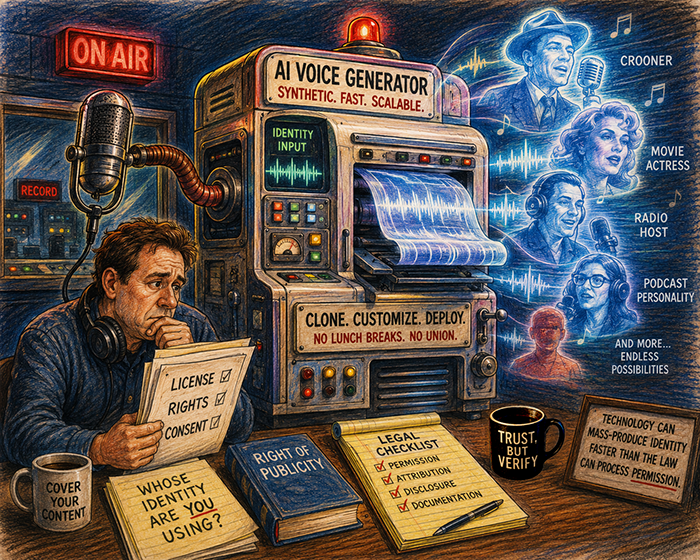
That distinction is becoming increasingly important as AI voice systems improve to the point where listeners can recognize a performer even when the company insists it used a “different actor” or synthetic generation. The Scarlett Johansson dispute with OpenAI may become the defining example. Johansson alleged that OpenAI created a voice assistant that sounded “eerily similar” to her after she declined the company’s request to license her actual voice. OpenAI denied intentionally imitating her and stated the voice belonged to another actress but still paused what they branded the “Sky” voice after backlash intensified.
The case matters because it exposes a legal gray area many creators misunderstand.
A voice is generally not protected by copyright law in the same way a song recording is. But a recognizable voice may still trigger claims involving the right of publicity, false endorsement, unfair competition, or misappropriation of identity. In other words, the legal risk is often not “you copied audio.” The risk is “you exploited identity.”
That distinction matters for broadcasters, podcasters, advertisers, and AI companies experimenting with synthetic hosts, cloned announcers, or celebrity-style narration.
If listeners reasonably believe a celebrity endorsed, participated in, or authorized the content, the legal exposure changes dramatically.
Read more….
Another recent example involves Dua Lipa and Samsung. According to reports, Lipa alleges Samsung used her image on television packaging without authorization, creating the impression she endorsed the product. Samsung reportedly claims the image came from a third-party provider that assured the company all rights were cleared.
That defense may sound familiar to media professionals.
“We got it from somebody else.”
Legally, that is often not enough.
A broadcaster cannot avoid defamation liability merely because a guest made the statement. A publisher cannot automatically avoid infringement exposure because a freelancer supplied the material. And a company may not avoid publicity-rights claims simply because a vendor promised the paperwork existed.
The underlying legal theme is the same: delegation is not immunity.
The AI layer complicates things further because modern systems do not necessarily reproduce exact copies. Instead, they generate approximations that may still evoke a specific person strongly enough to create marketplace confusion.
Courts have dealt with similar issues before. Bette Midler and Tom Waits both successfully sued over soundalike performances used in advertising after declining to participate themselves. The principle is not new. AI simply makes imitation faster, cheaper, and easier to distribute.
That should concern media creators who assume these disputes only affect billion-dollar tech companies.
They do not.
A local station, podcast producer, YouTube creator, or advertiser can now generate celebrity-adjacent voices in seconds. The barrier to entry collapsed. The liability did not.
The safest question is no longer merely “Do we own the audio?”
It is: “Whose identity does this remind people of?”
That answer may determine whether the next lawsuit is really about technology at all.
Or simply old-fashioned commercial exploitation wearing futuristic clothing.
Get your copy of “Play the Clip: The Definitive Digital Media Creator’s Guide to Fair Use” by filling out the request form at HarrisonMediaLaw.com.
Matthew B. Harrison is a media and intellectual property attorney who advises radio hosts, content creators, and creative entrepreneurs. He has written extensively on fair use, AI law, and the future of digital rights. Reach him at Matthew@HarrisonLegalGroup.com or read more at TALKERS.com.




 and Gothamist newsrooms, and Delahunty is now head of WQXR. Tanner says, “Stephanie, Emily and Eileen are exceptional, forward-looking leaders with deep commitment to excellence in journalism, culture and storytelling. As audiences increasingly engage with content across multiple platforms, we’re focused on creating experiences that connect our award-winning newsrooms, podcasts, live events and cultural partnerships. I’m excited to see the continued collaboration across NYPR as we strengthen our mission and help shape the future of public media for the next generation.”
 Maryland. The award is given annually for excellence among radio and TV stations in Baltimore and Washington, D.C. The award is one of five first-place awards given to WBAL NewsRadio at the annual CAPBA banquet. WBAL director of programming and news director Jeff Wade says, “The WBAL NewsRadio team proves once again they are best-in-class in the region with this outstanding showing at the CAPBA Awards. We’re honored to win Outstanding News Operation for the second consecutive year – a testament to our staff’s consistent pursuit of excellence in broadcast journalism.”
 Radio has always been about connection, the feeling of belonging to something larger than yourself, of being drawn into a story told by a voice you trust. Perhaps, that’s why you tune in as well. There is little that is more rewarding for us than finding a way to connect you to what you want to hear, whether that’s your favorite jazz station, a particular show, or your former alma mater’s student-run station. It’s why we do what we do, and why we show up for the people who keep those stories alive.
 formats. The program is hosted by talk radio personality Larry O’Connor and tells the stories of America’s military heroes, the families who serve by their side, and how Fisher House plays a role in their journey. Fisher House Foundation provides a home away from home for families of patients receiving medical care at major military and VA medical centers. Fisher Houses provide temporary, free lodging so families can be close to their loved ones during medical care because “A Family’s LOVE is Good Medicine.” This year’s program features a special focus on the incredibly inspiring victories our wounded warriors enjoy on the field of competitive, adaptive sports. Fisher House supports the Wounded Warrior Games and the Invictus Games as a vital part of the physical, emotional, and mental healing process for our wounded veterans. Listeners will hear about the riveting war stories detailing the injuries these heroes sustained, the ensuing medical and therapeutic healing process, right through the triumph on the field of international sports, as these brave veterans continue their dedication of service, representing America in international competition.
  (FNN), and 2060 Digital have achieved consistent growth in revenue, profitability, and audience reach. The organization is on track to exceed last year’s performance and outperform its 2026 budget, reflecting strong results across digital, audio, video, and social platforms.” Oxley adds, “Our success is the result of extraordinary people doing exceptional work every day. I’ve been fortunate to work alongside some of the most talented journalists, finance people, marketers, sales professionals, tech people and leaders in the industry.” Hubbard Broadcasting president and CEO Ginny Hubbard states, “Joel’s leadership, integrity, and deep commitment to excellence have shaped this organization for decades. His impact on our people and our brands is lasting, and we are grateful for his remarkable service. We are also incredibly grateful that he is willing to continue offering his experience and expertise to the company once he steps away from leading WTOP-WFED’s daily operations and strategy.”
 Jason Reddick’s The Complete Guide to AI Side Hustles is aimed at beginners trying to build passive income. But read it through a broadcaster’s lens and it suggests a blueprint for how radio talent and podcasters can leverage AI to expand their influence, diversify revenue, and stay indispensable in a media economy that rewards relevance and speed.
 local journalism across the state.” GBH president Susan Goldberg tells the paper the proposed merger of GBH, NEPM, and Cape and Islands radio station CAI will form “one of the largest and most trusted statewide public media newsroom networks in the Commonwealth.” Goldberg adds, “In a media landscape that is constantly changing, and particularly in the
  wake of federal defunding of public media, we are finding new ways to be as impactful as possible for the communities we serve. Simply put, we are stronger together.” Goldberg tells the Globe they have no plans to reduce staff and are planning to invest in new roles. The story adds, “According to the proposal. NEPM will continue to operate as the primary public media provider in Western Massachusetts, maintaining its studios in Springfield and at the University of Massachusetts. Its brand and programming – including local news, music, and educational shows – will remain in place.”
 FM translator W269DL (fed by WGKB-AM and branded “101.7 The Truth”) and, eventually, WNOV-AM “860 The Voice.” Civic Media says it created the Milwaukee Black Media Trust to ensure no individual or corporation can sell, consolidate, or redirect these institutions away from the community they serve. Civic Media CEO Sage Weil comments, “We are very excited about Milwaukee Black Media because it puts these important community media assets under the control of the community that they serve, with a financial structure that benefits the employees doing the work. We look forward to working closely with Milwaukee Black Media to support the new organization’s growth and success in the years to come.” Civic Media will support Milwaukee Black Media’s operations through a services agreement, providing administrative, technology, and sales support services but Milwaukee Black Media will operate with full editorial and programming independence. The newly formed trust entered into a local marketing agreement with Good Karma Brands to program “The Truth,” with an option to purchase the station. Good Karma CEO Craig Karmazin states, “Good Karma Brands is proud to support a model that keeps these important media institutions rooted in the community they serve and expands the opportunity for our teammates. From the start, our focus has been on building a strong platform and positioning it for continued growth and impact.”
 To quote a radio friend, “Some talk show hosts think the news of the day only exists to serve up interesting fodder for their shows.” Many media practitioners, whose jobs encompass letting their audiences know about the pain and suffering of “others,” feel personally exempt from experiencing a connection to the talking points of poverty, ignorance, violence, and injustice that they eagerly collect (and even welcome) as fresh “content” for their platforms. It’s all just “material” to them.
 and Gabriel Brotman of Soros Fund Management. Audacy president and CEO Kelli Turner states, “The appointments of Walker and Gabe to the Audacy board of directors further advance our ability to capture all the opportunities we see across the fast-changing audio landscape. Their expertise and guidance will be invaluable as we continue to evolve our platform, strengthen our partnerships, and drive long-term value for our audiences, advertisers and shareholders.”
 2025. The company reports declines in all segments of its business; even digital revenue was off 8.3% ($33.5 million). Network spot revenue was down 25% ($33 million), and broadcast spot revenue was $67.7 million, a decline of 16.3% from Q1 of 2025. Cumulus president and CEO Mary G. Berner says, “We are pleased to report first quarter earnings. The Court’s recent approval of our reorganization plan marks a pivotal milestone in strengthening our financial foundation and positioning the company to compete in the evolving media landscape. While we await FCC approval of the plan, we remain focused on leveraging our core strengths to drive long-term value creation.”
 As a newly minted program director (remember them?), I found the 1980 “NAB Radio Programming Conference” downright enchanting. New-tech cart machines (remember them?) would FIND the splice! And after the cart played, a flashing light saved careless DJs from accidentally playing it again.
 In a
In a  previously disclosed Plan of Reorganization. Cumulus Media president and CEO Mary G. Berner says, “When we initiated this prepackaged restructuring in March, we did so with a clear objective: to right-size our balance sheet to support long-term success. The court’s prompt approval of our plan keeps us firmly on track to eliminate approximately $600 million in debt and positions us to emerge with a significantly stronger financial foundation. We look forward to completing the restructuring and emerging as a well-capitalized company, better equipped to compete in the evolving audio landscape.”
 U.S. newspapers has shrunk, but right now it accounts for less than 10% of total revenue. In fact, “Revenue from that cohort has declined 25% over the past few years, while revenue from tech companies has grown roughly 200%.” The story goes on to note, “Over the past few years, the AP’s business has evolved to become less reliant on local newspaper revenue and more reliant on a broader set of customers, including digital outlets, broadcasters and non-news companies.”
  iHeartMedia division president Jeff Thomas says, “Over the past three months I have had the opportunity to work with Care and I can say without hesitation that she is the best person for this important role. Her leadership and coaching skills make her a perfect fit for the position.” Jones comments, “I’m absolutely thrilled to step into the role of market president at iHeartMedia — it’s an incredible honor and an even greater opportunity. I can’t wait to celebrate big wins, chase bold goals and grow alongside a truly exceptional team.”
 show while Hale was away on vacation in Florida. Blueberry vice president Bruce Biette told the paper it is “time to evolve the station.” Biette added, “Simply put, George has had a magnificent media career. He’s the reason a lot of us chose to get into this business, and we here at Blueberry Broadcasting appreciate everything he’s done for VOM.” The Daily News states, “WVOM is an influential station because it is one of only three in the state that runs a locally produced news talk show and the only one based in the Bangor area. WGAN and WLOB, with shows hosted by conservatives Matt Gagnon and Ray Richardson, respectively, are based in the Portland area.”
  Worldwide provides audio creation tools, media intelligence, music analytics and television operations technology. She takes over for Philippe Generali. RCS says, “Her leadership roles in major markets further shaped her as an operator who understands scale, complexity, and the disciplined, data‑driven decision‑making required to deliver strong performance across diverse portfolios.”
 The recent shutdown of CBS News Radio isn’t just another media headline – it’s a wake-up call. A clear example of what happens when decisions about our information, our communities, and our voices are made in corporate boardrooms disconnected from real life.
 If you work in radio, you’ve heard every flavor of AI anxiety. Some fear it will wipe out jobs. Others treat it like a super shortcut – cranking-out spots, promos, and proposals faster and cheaper. Kate O’Neill’s
  music-driven and spoken-word programming. Maryland Media One CEO Steve Clendenin says, “The landscape of radio programming is changing. We’re here to partner with stations to develop and distribute top-tier music and spoken-word formats and content. Our goal is to help stations grow with compelling programming that is affordable, easy to implement, and designed for today’s radio and streaming environment.” Among the first offerings available through Seaboard Networks is the Outdoor Radio Network, a full-time programming format built around hunting, fishing, conservation, and outdoor lifestyle content.
 Right,’ and ‘3 Martini Lunch.’” Radio America president and CEO Mike Paradiso states, “Helios Media is the natural progression of what Radio America has been building for decades – trusted content, powerful reach, and authentic voices that resonate with millions of Americans. With Helios Media, we’re giving creators the tools, the platform, and the audience to stand out in the competitive landscape of podcasting and digital media.” Radio America adds, “While Radio America continues its leadership in radio syndication – home to popular shows like ‘The Dana Show’ with Dana Loesch and ‘The Chad Benson Show’ – Helios Media serves as a distinct brand, purpose-built for podcast development, distribution, marketing and sales, amplifying news, culture, and entertainment stories through voices that challenge the mainstream and speak with conviction.”
  “designed to help brands reach and engage multicultural audiences across today’s digital media landscape.” AURN CEO Chesley Maddox-Dorsey says, “AURN has always been committed to helping brands connect authentically with multicultural audiences. Our partnership with AdGrid allows us to expand that connection beyond audio and into the broader digital ecosystem, giving advertisers new ways to reach these influential audiences with scale, cultural relevance and measurable results.”