 LOS ANGELES – As students, enthusiasts and caretakers of this wonderful medium, we’re keenly aware that radio’s “Golden Age” boasted an incredible array of entertainers and broadcasters.
With lifestyles, technology and society being what they are today, it’s almost inconceivable to imagine that families would actually gather around the radio and attentively listen – and indeed hang onto – each and every word that emanated from that mysterious entertainment-laden box sitting in the living room.
Fundamentally important back then, of course, was a concept known as “Theater Of The Mind.”
No one embodied and personified it better than one of the bigger-than-life talents of that era: Orson Welles.
Most are familiar with his epic “War Of The Worlds.”
Pictures Set In Songs
The list of other outstanding “Mercury Theater” presentations Welles was responsible for is much too lengthy to cite here, but his legendary “Theater Of The Mind” mystique lived on nightly in Los Angeles, where Jim Ladd was a welcome guest for Southern California listeners dating back to 1969 and hosted a regular show on SiriusXM’s Deep Tracks channel the past 11 years.
Theater Of The Mind so perfectly describes what Ladd tried to do, although it’s not radio drama in the pure sense. “What I [attempt] at night is to show you pictures and do that by playing sets of songs,” the (then) highly popular KLOS-FM, Los Angeles 10:00 pm – 2:00 am personality remarked to me. “If you follow the lyric content of each song, as well as the song’s emotional feel, it should tell you a story with a beginning, middle and end. Thus, it’s theater.”
Throwback To Creativity
In addition to providing his special spin to Theater Of The Mind, Ladd was also responsible for keeping another bit of radio history on life-support.
Most air personalities are required to adhere to strictly enforced music lists, but Ladd’s nightly, four-hour, Los Angeles air-shift was a throwback to the days of “free-form” radio.
The result was similar to what existed in April 1967, when a new phenomenon started taking shape. “That was the beginning of FM and this multi-billion dollar industry,” Ladd recalled. “[Free-form] started on a station [KMPX, San Francisco] where the phone was literally disconnected, because they couldn’t pay the bill. [Tom Donahue] had an idea; he went there and it took off. For a while before deregulation, that’s what all FM radio did in any market. Free-form worked great, until they killed the golden goose.”
Right Place, Right Time
Southern California native Ladd was extremely fortunate to have been able to launch his radio career in the country’s second-largest market. “Part of it was timing,” he admitted. “I was at a little station in Long Beach [KNAC-FM] that decided it was going to try this new, hippie, underground thing. They didn’t know what it was, but [the feeling was to] hire some hippies and see if they could make some money with it. I happened to be right there at that time.”
A frustrated musician, who wanted to be a songwriter, Ladd recounted a life-altering conversation he and a buddy had in a car. “My friend said that I should be in radio. I was 19 or 20 at the time and your friends at that age seldom notice anything but themselves. For some reason, that stuck with me. Thank God, FM was in its infancy and they’d take complete novices like me off the street and give us shows. Owners didn’t know anything about the Grateful Dead or The Who, but we did.”
Check Mate
Instead of walking into a studio and following a computer-generated music log, Ladd was given freedom to use his imagination. His only preparation was what was happening in life.
Resulting sharp, clever music sets he composed weren’t written out in advance. “The way I work is to turn the music up loud and get the song working on me,” he commented. “Once [that happens], it keys in my mind what will fit next.”
Such an intricate process included a mental checklist. “I’ve figured out the lyrics will work, but I need to know how the song I’m playing ends and how the next song begins,” he explained. “If I’m playing a balls-out rocker, I can’t go into some acoustic piece. In that way, it’s really like a chess game. I have to plan these things to start every single segue as I’m doing it. That’s the way that works best for me.”
There were nights, however, that Ladd knew that he “[didn’t] have it,” but as he maintained, “I’ve been doing it long enough to put on a good professional show. Sometimes, I don’t have what I’m striving for, which is to make a connection with the audience. Without having to prompt them or explain anything, my audience lights up the phones. They call because they get what I’m doing. Once that connection is made, then look out, because the rocket is taking off.”
Gracefully Handling The Tragedy
Recalling the horrific September 11, 2001 “Attack On America,” Ladd noted that although it was one of the country’s greatest tragedies, “It was easy to immerse myself into something like that. It so moved me that I had no problem thinking of songs to play or what I wanted to say.”
Judy Collins’ version of “Amazing Grace” was the first song he played when he went on the air that night. “Believe it or not, it set the tone for what I did for … the next two weeks.”
As it usually did, the audience – even or perhaps especially in this painful period – stepped up to the plate. “This is the thing about free-form radio that’s so precious to me,” Ladd emphasized. “Nobody called me on 9/11 with an idiot request. When I played sets of 9/11 songs, everybody was calling in with [appropriate] suggestions. Second only to dealing with the tragedy, the hardest part was to know when I could play groups like AC/DC again. I found that very difficult; you can only feel your way through it.”
Loyal Listeners
In his third tour of duty at (then ABC-owned) classic rocker KLOS, Ladd was a legitimate cult figure in the Southland for his work at legendary cross-town rocker KMET.
Southern California listeners were stunned on Valentine’s Day 1987 when the “The Mighty Met” (now Audacy smooth AC KTWV) – became smooth jazz “The Wave.”
Also on Ladd’s impressive resume were stints at Los Angeles outlets KLSX and KEDG.
The notion of an air personality “connecting” with the audience is both elementary and elusive. Ladd was a rare case of a non-drive time music personality who amassed a loyal, vocal following.
Grateful for such audience allegiance, Ladd didn’t take it for granted. “My audience has been that loyal from KMET to KLOS and all the [other] stations in between. My part of the bargain is that I won’t lie to them or let them down by doing a format. I was off the air twice in my career for two years each. That was very difficult, but because I did that, I’ve earned the right to do this and I think the audience responds to that.”
Offered jobs by stations that wanted the “Jim Ladd” name, he opined, “They didn’t understand what that meant. They thought they could just plug in my name, not let me do what I did and it would be the same thing.”
Your Attention Please
Evenings and nights were Ladd’s domain throughout his career. “I wouldn’t want to do middays or afternoon drive,” pointed out the personality known for his “Lord have mercy” exclamations. “Listening habits are such that you can’t sit and listen like you can at night. People are working, picking up the kids and doing life.”
Much like Welles’ Mercury Theater, Ladd’s show required attention. Otherwise, it was just like playing one song after another, without making that all-important connection. “The audience’s side of the bargain is that they have to bring their attention to the show,” he insisted. “I’ve done [6:00 pm – 10:00 pm] in my career and that worked out very well. The show is a bit different, in that, it’s not quite as eclectic. I don’t know if I’d be playing Judy Collins and Johnny Cash in [that time]; maybe – but maybe not.”
Convinced his free-form style could be utilized elsewhere, Ladd, nevertheless, pondered that to his knowledge, “I’m the Alamo – the last guy standing. That’s certainly the case in a major market. The big tragedy is that there are so many talented [personalities] who, although they wouldn’t do the same show that I do, could do free-form radio. We’re losing all that talent. I’m not the only guy in the world who can do it. I’m the one who was stubborn enough to say that I won’t follow a list – I just won’t do it.”
Powerful Trinity
Among those who influenced Ladd’s on-air style were former MTV personality and ex-KEDG program director J.J. Jackson; veteran Los Angeles air talent Raechel Donahue, who went on to do 7:00 pm -12:00 midnight in Denver at KQMT “The Mountain”; longtime KMET personality the late B. Mitchel Reed; KMET’s Pat Kelley; Cynthia Fox; Jack Snyder; and the late, underrated Mary Turner. “The wonderful, beautiful part of free-form radio – and most importantly – at KMET was that it wasn’t about being a star,” Ladd asserted. “What we were doing was our part of the ‘social revolution’ at the time. It was like a triad: The people on the street, the music, and us. We took the message of Dr. [Martin Luther] King and combined it with the music of Bob Dylan.”
One highly significant aspect in noting those former KMET staffers was that they’d each listen to everyone else’s show and it elevated their own game. “I’d hear Cynthia do a great segue, or Mary would do a great segment and that would inspire me,” Ladd enthused. “What I miss most is that kind of camaraderie – it’s just me now. I can’t tune in to hear someone else’s great segue. When I heard one of my colleagues do something that touched me, the first thing I wanted to do was to call them and tell them it was great. The second thing was that – from their subject matter – I got 15 different ideas to use when I got to work that night. That was the beauty of it.”
Role Model
National audiences became aware of the iconic Los Angeles talent through shows such as “Innerview,” “Headsets,” and “Jim Ladd’s Living Room.”
Considerably more than someone who voiced a script for a syndicated show, Ladd spent a great deal of time scrutinizing the fine art of interviewing. “I ripped off just about everything I know about interviewing people from Elliot Mintz,” he confided to me. “Elliott was my role model. He’d interview the Shah of Iran one week and John Lennon & Yoko Ono the following week. He’d talk with everyone in a warm, low-key and intelligent manner. It was completely unlike anything [else] I’d heard at the time and that really impressed me.”
The “Innerview” show had an 11-year run and was carried by 160 stations. “It was the first of its kind,” boasted Ladd, whose other syndication work involved voiceovers for an overseas television show. “I’m very proud of the work we did [on ‘Innerview’]. I did 99% of the interviews in the front room of my house in an artistic community in Laurel Canyon. People would immediately be put in a very comfortable place. It’s not a studio – it’s my home.”
The Work Is The Key
Another reason why people felt at ease was that, instead of focusing on a person’s life, Ladd addressed their work. “They loved that. Rather than talking about how many girls they had, what kind of drugs they did and life backstage, I studied every word of every lyric of the new album they wanted to talk about and grilled them about their songs on the environment. It would require six to eight hours of preparation. Then there was another 20 – 25 hours to write the one-hour show; it was a lot of work.”
Writing became such a worthwhile experience that, in 1991, he penned “Radio Waves: Life And Revolution On The FM Dial.”
As a result of these syndicated projects, this immensely respected rock personality diversified himself; the book became a big hit. “I guess I’m a radio guy who learned how to become a writer,” Ladd mused. “In order to get up enough courage to write my book, I read authors I like. I was required to do a great deal of writing for ‘Innerview’ and would write out what I’d say – which is something I never do [on my live show]. You’d also end up with two hours of tape and pick out what the person was going to say, how I was going to introduce it and what song would follow it.”
A Distant Second
Whenever anyone asked Ladd to name his favorite band, he qualified his answer by separating the Beatles.
The quartet, he stressed, had to be placed in a completely different category.
After that’s been done, he named the Doors as his favorite.
The same applied to his most memorable radio experiences, with KMET being the Beatles’ equivalent. “We were at the right place at the right time with the right people. We loved each other and there’s never been anything else like it.”
Nonetheless, he quickly stated that his favorite time is the next time he was able to sit behind a microphone. “The reason for that is [KLOS’-then program director] Rita Wilde,” he proclaimed. “I don’t know how I got so lucky to have a boss who was [such a great on-air personality] and so supportive. If it weren’t for Rita Wilde, I wouldn’t be on the air – that’s just a fact. I want to keep free-form radio alive for the audience, but I also owe her to make this happen. She’s under a lot of pressure [when it comes to my show]. When I go in at 10:00 pm, the format literally stops. I can’t think of another boss in the world who would understand that.”
Numbers Game
His multi-decade Los Angeles track record and loyal following notwithstanding, Ladd still realized that ratings played a role in dictating his employment; however, as he declared, “Rita is one of the first people I’ve ever worked for in this business I trust when she says the numbers are up or down. Sometimes in my career I’ve found out from people who didn’t work at the station that my show was doing great. When there’s a down book, [management is usually] right there.”
Ultimate People Skills
Certain managers and programmers, he claimed, kept good books a secret from him; however, “Rita calls immediately when I have an up book. If I have a down book, I don’t hear from her; I have to call her. That says volumes to me. We’ll deal with a problem, but she doesn’t want to get me upset. She might tell me that I’m playing too much of this or not enough of that, but she never says anything [threatening]. It’s always from a helpful and suggestive [stance]. When the numbers are good, she leaves me totally alone. From my perspective, you can’t ask for more than that. Her people skills are unbelievable.”
In addition to have wanted to keep free-form radio alive as long as possible, Ladd disclosed that he wanted “to walk away before I can no longer do my job. I don’t know when it will happen, but the next stage in my life will probably be to write fulltime – I’m working on it.”
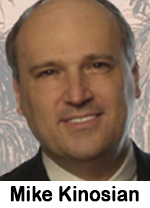
Contact TALKERS Managing Editor Mike Kinosian at Mike.Kinosian@gmail.com
Share this with your network


 flexibility rarely found in corporate-structured environments.” Duties include: Managing the station’s audio image via branding, focusing on timely and frequent updates; overseeing social media and creating content that relates to the station’s brand and target audience; hosting a daily on-air shift; proficiency with Google’s G Suite, Selector, and Wide Orbit Automation system; and coaching staff. Learn more at https://zimmermarketing.com/. Send your resume and audio to Mark Zimmer at: mark@zrimarketing.com
 several other KNBR staffers were released from the station in a budget move. Santangelo’s first shift on “The Game” will be as a fill-in host for Dan Dibley on the afternoon drive show “Willard and Dibs” tomorrow (12/21). Also let go from KNBR last month was digital team member Jake Hutchinson, who recently joined “The Game” in a similar capacity. He says, “I am truly grateful to Audacy and 95.7 for this opportunity and recognition of what I bring to the table. The people I’ve worked next to from 95.7 have always been motivated, innovative and encouraging. They were enormously fun to share press boxes and interview rooms with, and I am ecstatic to now be able to work with them.”
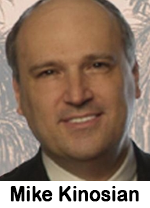
  As TALKERS magazine reported yesterday, rock radio personality Jim Ladd died over the weekend at age 75 after suffering a heart attack. In remembering Ladd and his contributions to the radio industry, TALKERS magazine managing editor Mike Kinosian presents a profile piece on Ladd that he wrote years ago while serving as special features editor for Inside Radio.
 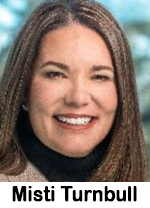 most recently served as executive director of news with a focus on broadcast, digital content, and streaming content. CMG EVP of content, product, innovation, and research Marian Pittman says, “Misti understands CMG’s pursuit of journalism excellence. Her knowledge of multi-platform content strategies and
 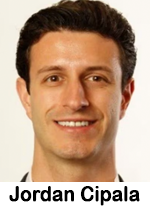 audience insights makes us better every day. She exemplifies the power of dedication and what it takes to be the best.” In his new role as VP of strategy & operations, Jordan Cipala will be responsible for evaluating business development opportunities, bolstering CMG’s market-intelligence capabilities, managing M&A and integration efforts, and supporting more streamlined collaboration and execution across CMG’s business units. CMG president and CEO Dan York comments, “Jordan has been an indispensable member of the CMG team in leading our annual strategic planning process, supporting our Board interactions, and operationalizing our M&A efforts. We’re thrilled to promote from within and reward his invaluable expertise and dedication to CMG’s future and continued evolution.”
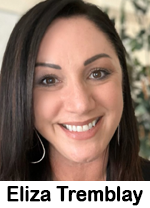 cluster of radio stations to the director of sales operations for the state of Maine. At the same time, Bronwyn Lapointe is promoted from managing outdoor properties to director of sales operations for the state of New Hampshire. Binnie
 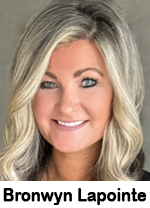 Media EVP Faith Francis says, “Both Eliza and Bronwyn have been crucial to our success in key areas of the business, and this will give them the ability to affect change on a broader scale. We have created a great work culture here at Binnie Media, allowing people to have flexibility with accountability, and as we all know, women can multi-task!” The company says that late last year Cindi Skillin was promoted to vice president of finance, making Binnie Media’s executive team a dynamic, and diverse group. Binnie president and CEO Massimo Rosati adds, “We love this business, value our people, and always try to promote from within.”
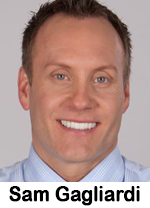 Gagliardi, who goes by Sam Elliot on the air, most recently served as the director of content for Townsquare’s Monmouth-Ocean market. Gagliardi says, “I sincerely thank the leadership at Townsquare – Bill Wilson, Erik Hellum, Jared Willig, and Brian Lang — for this incredible opportunity. Collaborating with the skilled professionals at the iconic brands of ‘New Jersey 101.5’ and PST presents an amazing opportunity. I am excited about working with such a highly talented group and look forward to engaging in collaborative efforts with the fantastic on-air and online creators at the Jersey
  It happens to everyone at least once.
 The fourth of four rounds of ratings information from Nielsen Audio’s November PPM survey has been released for 12 markets including Austin, Raleigh, Indianapolis, Milwaukee, Nashville, Providence, Norfolk, Jacksonville, West Palm Beach, Greensboro, Memphis, and Hartford. The survey period covered October 12 through November 8. Today, TALKERS magazine managing editor Mike Kinosian presents his Ratings Takeaways from this group of markets. In Milwaukee, iHeartMedia news/talk WISN adds a full share for a 10.7 share (weekly, 6+ AQH share) finish that keeps it ranked #1, while Good Karma Brands news/talk WTMJ loses 1.9 shares for a 7.7 share but remains ranked #2. In Nashville, Cumulus Media news/talk WWTN-FM is flat with a 5.7 share and remains ranked #5, while iHeartMedia news/talk WLAC-AM inches up one-tenth and remains ranked #19. In West Palm Beach, Hubbard Broadcasting news/talk WFTL adds four-tenths for a 2.7 share and stays locked in the #9 rank, while iHeartMedia talk WZZR-FM adds two-tenths for a 2.0 share and climbs to the #11 rank, and iHeartMedia’s news/talk WJNO is flat with a 1.2 share but falls back to the #15 rank.
  million viewers, according to data from Nielsen Media Research. The Sean Hannity-hosted program pulled in 742,000 viewers in the 25-54 demo, which FNC says represented nearly 73% of the cable news share in total viewers and 77% of the cable news share in the key demo. Additionally, the Hannity-hosted post-debate show earned 3.4 million total viewers and 541,000 in the A25-54 demo.
 Broadcasting executives spend millions building their radio station’s brand in the marketplace. But is it being spent in the right place?
 incorporating SourceAudio’s cutting-edge AI technology to access top-tier movie and TV music catalogs of 1.2 million songs, PodcastOne aims to elevate the creative quality of their podcasts, providing audiences with an immersive and iconic audio experience.” PodcastOne co-founder and president Kit Gray states, “This partnership marks a significant leap forward in our commitment to delivering an unparalleled podcasting experience. By leveraging SourceAudio’s AI technology, we are empowering our podcasters to discover audio elements that resonate with the essence of their shows, creating a more engaging and immersive listening experience.”
 Have you tried the $7 cup of coffee at Starbucks?
 What’s old is new again.
 Here’s actual news copy, from Joe Connolly’s business report one morning on WCBS, NY: “One third of all domestic flights are now late, by an average of one hour.”
 that resonate with them! The position requires extreme reliability and flexibility. Females are encouraged to apply. Second, Cumulus is seeking a news director to work with both stations. It says, “This is not a 9 to 5 weekday desk job. If news runs in your blood, if you get an adrenaline rush from breaking stories, if you are hands-on, and you realize the commitment that it takes to win from you and your team, then this job could be for you. Our ideal candidate should possess an extremely good work ethic and have a history of news department success as a news director.” And third, the company is looking for a managing editor for both stations. This is an early morning position from 2:30 am until 10:30 am. The main job is to make sure the shows on both stations have the content they need to have a successful broadcast.
 conversations and connections on topics relevant to our local communities throughout the year.” The next “Audacy Conversations” explores the state of downtown. It says, “Over three years later, America’s cities are still grappling with challenges and unexpected fallout caused by the COVID-19 pandemic. WBBM Newsradio (WBBM-AM/WCFS-FM) in Chicago will host a live town hall on November 9 to explore those impacts in-depth and what’s at stake for businesses and community members as cities look to revitalize their downtowns.” The program will air on WBBM Newsradio, KRLD NewsRadio 1080 (KRLD-AM) in Dallas, WWJ News Radio 950 (WWJ-AM) in Detroit, KNX News 97.1 FM (KNX-FM) in Los Angeles, WCBS 880 (WCBS-AM) in New York, KYW Newsradio (103.9 FM/1060 AM) in Philadelphia and KCBS All News (106.9 FM/740 AM) in San Francisco on November 16 at 7:00 pm local time. It will also air on WBEN-AM, Buffalo; WCCO-AM, Minneapolis; WWL-AM/FM, New Orleans; KDKA-AM, Pittsburgh; and KMOX-AM, St. Louis. Throughout the week of November 13 to 17, the all-news stations will air special content catered to the town hall topics, including interviews, news stories and feature reporting.
 Folks in the Gen Z and millennial demographics are heavily
  The fourth of four rounds of ratings information from Nielsen Audio’s October 2023 PPM survey has been released for 12 markets including Austin, Raleigh, Indianapolis, Milwaukee, Nashville, Providence, Norfolk, Jacksonville, West Palm Beach, Greensboro, Memphis, and Hartford. The survey period covers September 14 through October 11. Today, TALKERS magazine managing editor Mike Kinosian presents his Ratings Takeaways from this group of markets. In Austin, Waterloo Media’s news/talk KLBJ-AM adds 1.3 shares (weekly, 6+ AQH share) to finish with a 4.7 share that lifts it from the #10 rank to #5. In Milwaukee, iHeartMedia’s news/talk WISN adds one-tenth for a 9.7 share finish that’s good enough to lift it to the #1 rank, as Good Karma Brands’ news/talk WTMJ sheds two-tenths for a 9.6 share and the #2 rank. In West Palm Beach, Hubbard Broadcasting’s news/talk WFTL rises half a share to a 2.3 share and jumps to the #9 rank, as iHeartMedia’s talk WZZR loses one-tenth to finish with a 1.8 share good for the #13 rank and sister news/talk WJNO is up one-tenth to a 1.2 share and is ranked #14 for the fourth consecutive month.
 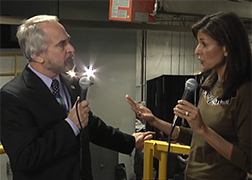 Gov. Ron DeSantis, Amb. Nikki Haley, Vivek Ramaswamy, Sen. Tim Scott, Gov. Doug Burgum, Gov. Asa Hutchinson, and Ryan Binkley. “Iowa Talking Points” is produced for live video stream,
 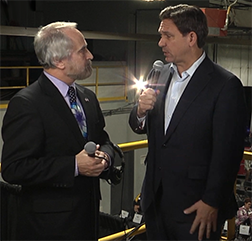 video and audio on-demand playback, and radio rebroadcast by NRG’s “News/Talk 1540” KXEL, Cedar Rapids-Waterloo and is hosted by KXEL program director and host Jeff Stein. Previous programs in the series have been produced in front of a live studio audience from Mudd’s state-of-the-art “Studio5@Mudd” facility in Cedar Falls. Last week, the team arranged a special live broadcast from the annual tailgate fundraiser sponsored by Iowa State Rep. Mariannette Miller-Meeks. Stein says, “There are very few opportunities to have access to this many candidates at one time. Engaging with them in this way gives our audience the best information free from sound bites and media filters.” Pictured here is Stein with DeSantis (left) and Haley (right).