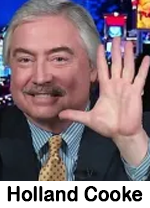
By Holland Cooke
Consultant
 Music radio’s competitors were vinyl, then tape, then CDs – before smartphone streaming and satellite radio offered more portability and variety. And before consolidation, broadcasters were under less of the revenue pressure that now commercializes many stations beyond listeners’ tolerance. TALKERS NAB Show coverage included Edison Research founder Larry Rosin lamenting “many, many [music] stations now loading all their spots into two interminable breaks per hour.” I cringe hearing FMs struggle to remain among listeners’ music appliances. And I fret that monologue-heavy talk radio is relinquishing interactive dialogue to social media.
Before moving to all-news, and eventually news/talk, I worked in music formats less-structured than today’s. So now I hear music radio as an outsider, more like a consumer. Which got me wondering: How does my format sound to music consultants? So, I asked several whose work I respect.
Beware the one-joke act
Mike McVay reckons that “listeners want to know a little bit about a lot of things,” a point other colleagues echo. Explaining that “music radio is all about variety,” adult contemporary specialist Gary Berkowitz: “To me, listeners are tired of all this political back and forth. Sure, it has its place, but it’s like if music radio only played five different artists!” Jon Holiday – who customizes station playlists for a variety of formats – asks “are talk listeners getting what they want?” Calling some formats “very artist-heavy,” he thinks stations were right to play so much Taylor Swift in 2024, certainly her year. And 2025 sure is Trump’s, but Holiday calls “banging the same drum all day, every day” the most common flaw he hears on talk radio.
McVay says listeners like “stories that pull on their heart strings. It’s why “NBC Nightly News” ends with a touching story. It’s not fluff. It’s information relief.” He also recommends topics you are likely to overhear at the next table during lunch: “Discretionary Time Information” (binge-worthy shows on Apple+, Max, Netflix). Health. And – lately more than ever – what Mike calls “purse” stories (think: eggs). Been to Costco? On weekends it’s mobbed. Ask any member and they’ll recite a shopping list of Kirkland-brand bargains.
Play the hits
When Gary Berkowitz – then an accomplished music programmer – took over stately WJR, he “approached it like it was a music station, the only difference was my ‘songs’ were my personalities, news coverage and, at the time, play-by-play of all the major Detroit teams.” He bought a jingle package “to ‘decorate’ the station;” and “got ‘JR involved with everything that was happening in Detroit. All I did was put it all together and present it like my top-40 upbringing taught me.”
I can relate. Before I programmed all-news WTOP, Washington, I had no news experience. I came from a music FM. The WTOP staff I inherited was impressive, and their work was solid, but the station wasn’t “programmed enough.” I was sent there to convert Cume to Average Quarter Hour – the blocking-and-tackling formatics fundamental to music radio. We owned “the Top news…instantly” image, and we said those very words LOTS. But research told us that traffic and weather were “the hits;” and how we presented them moved the needle.

Great talkers are great listeners
In every transaction, consumers now expect to interact; and “listeners like to hear others’ voices,” Mike McVay observes: “When the audience is comfortable enough to weigh in with an opinion, their own story, or a reaction, you’ve created a ‘friend circle.’” Jon Holiday tells morning shows he works with to “take time going into breaks to be topical and interact with callers.” And engage by texting and social media. And don’t just push-TO listeners. Be quick to REPLY, and you will make them feel special.
Yet, in three decades coaching talk hosts, the most unwelcome word I say seems to be “callers.” Imitating gifted Rush Limbaugh, many hosts are prone to windy monologue, rather than inviting the busy dialogue that makes a station sound popular (something local advertisers notice). DJs deftly weaving interactivity into music shows often sound more inviting than sermonizing talkers. Holiday remembers El Rushbo as “a master at having fun, particularly in his early days as a syndicated personality.”
Prescription: Local
Twenty years ago at the TALKERS conference, publisher Michael Harrison’s advice was elegantly simple: “Give them something they can’t get anywhere else.” Especially now, with so many non-local audio competitors. Regardless of format, helpful local information can increase Occasions of Tune-In per week.
Simply doing local news is a start. But does yours enable the listener by telling what an item means to him or her? On any given day, what you’re overhearing at lunch is something big that’s happening somewhere else. Can you explain the local impact? “National news needs to mean something to me, my community, my region or state,” according to McVay.
With weather so erratic in so many places, owning that image is gold. If you’re news/talk, don’t assume that you’re the market’s weather station. If you’re music, don’t assume you can’t be. Noting typical news/talk demographics, Jon Holiday surmises that, “as we get older, we seem to be more interested in weather.”
And as successful music stations have always done, show up! Gary Berkowitz had WJR go all-in on Detroit’s Thanksgiving Day parade, “with our people all over the parade route. It was better than the TV coverage!”
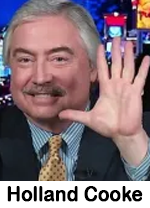
Holland Cooke (HollandCooke.com) is a consultant working the intersection of broadcasting and the Internet. Follow HC on Twitter @HollandCooke and connect on LinkedIn
Share this with your network


 Don’t let Halloween sneak-up on you. The only holiday Americans spend more for is Christmas. So – to seem more in-touch than your robotic and/or non-local audio competitors – plan something spook-tacular.
 Radio programmers and sales managers know the drill: The GM drops an idea, a client makes a request, or a listener offers feedback – and the reflex is to jump straight into execution. But what if the real opportunity lies not in what’s asked for, but in what’s actually needed?
 My kitchen faucet wouldn’t shut off. It died, of old age. Things start doing that when your “new” house turns 25.
 Why I love going on sales calls with station reps: Meeting retailers, who have SUCH a feel for their customers’ (our listeners’) mindset. Following-up
 As TV touts its perennial New Fall Season, our DVR is already set to “record series” so we can pick-up where the “Matlock” sequel left-us-hanging; and for a third season of quirky “Elsbeth” (a closet reboot, the female “Columbo”). And where I live – where everyone seems to know everyone – we are salivating for “The Real Housewives of Rhode Island.”
 Baby Boomers (born 1946–1964) are some 20% of the U.S. population, but control more than 50% of all household wealth. They hold $70+ trillion in assets and spend an estimated $548 billion annually. They are lifelong AM/FM listeners, and they’re redefining what life after 60 looks like. Are you into what they’re up to?
 South Florida viewers are confused. WPLG, which brands as “Local 10,” was an ABC-TV affiliate for 69 years… until yesterday. Now it’s more local than ever, after divorcing its network, whose programming moved to the FOX affiliate’s digital channels 18.1 and 7.2, now branded “ABC Miami.” Among courteous FAQs about this change on WPLG’s web site: “How do I rescan my TV?” to find ABC programming.
 Why we’re already seeing TV tout its coming attractions: They understand how, after Labor Day, routines settle in. Viewers will be ready to re-engage.
 Ask any dog: The humans’ greatest invention EVER? Ice cream. Share summer’s sweetest treat with them, and listeners, during National Ice Cream Month.
 How obsolete does this sound? “Newsweek magazine.” News, gathered during most-of the week, had to be frozen by week’s-end, on deadline, to roll the presses in time for hard copy to be delivered in Monday’s snail mail. Back then – picture people dressed like “Mad Men” characters – enough subscribers felt informed-enough to deliver Return On Investment for the magazine’s advertisers. Seems antique. Now, news is reported moment-to-moment, on any device. And newsweek.com is there… along with everyone else competing for attention.
 Are archived shows – whole hours – your station’s only on-demand offering? It’s an easy checkbox: post the aircheck, call it a podcast.
 If you saved back issues from when TALKERS was a print tabloid, dig-down about 20 years into the stack. A couple times a year beginning then, I was reporting from conferences then called The Podcast and New Media Expo, which later evolved into NMX and BlogWorld and other incarnations.
 With so many of us taking vacation time soon, guest hosts are often local somebodies who are not career broadcasters and don’t share our second-nature performance routines. For their benefit, these tips, based on my experience on both sides of the mic:
 This coming Sunday, June 15, is Father’s Day. For that day – and the Friday before (hint-hint) – you might have already readied Harry Chapin’s “
 “Fewer than half of Americans plan to travel this Summer,” according to a
  TALKERS publisher Michael Harrison introduced the term in the 1990s, inviting us to think-beyond the real-time audio we were sending up those towers. What he described seemed conceptual, even futuristic, back then, when we were still logging-onto AOL via dial-up (screech).
 When a blogger found “no biography, or further information about the woman who is supposedly presenting this show,” it forced Australian Radio Network to
  Remember how Larry King would interrupt rambling callers to ask, “What’s your question?” It could sound gruff, but it was really a courtesy, to viewers or listeners. Larry feared TV clickers and dashboard radio buttons. He kept-it-moving to keep viewers and listeners from wandering.
 These conventions used to be about making-the-most-of those towers behind radio stations that played in several rooms at home and occupied two knobs and six buttons in the dashboard. Back to the future…
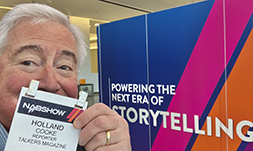
 Hello from Las Vegas, ever-changing yet timeless. Here this week the NAB Show is “Powering the Next Era of Storytelling.” And it’s about time. While there is now a filibuster-proof U.S. Senate majority to require that cars include AM receivers, some AM stations are being shut off. Over the weekend millions took to the streets and this morning Wall Street braced for more. So, the vibe here is positively rejuvenating.
 Corporate cost cuts continue. In
  There has never been more news. And news has never been more quotable. It costs two-plus cents to make a penny.
 Observation, as a heavy CNBC viewer: Artificial Intelligence is to 2025 what Dot Com was to the late 1990s, game-changer… and shiny object.