By Walter Sabo
a.k.a. Walter Sterling, Host
WPHT, Philadelphia, “Walter Sterling Every Damn Night”
and TMN syndicated, “Sterling on Sunday”
 There are two broad categories of thought: Task. Creative. When in creative mode, a person innovates, imagines, plans, and solves problems. An idea bank is a bank! Money grows from the results of imagination: new products, new music, new formats, new sales strategies. Business growth depends on new!
Task mode is focused on the past. Accounting, legal, sorting, painting, mowing, eating, surviving. Tasks are essential activities but financially break even, at best.
Your colleagues probably suffer from thoughts of radio industry consolidation and cutbacks. Personally, there was a moment in my career that still haunts me at this writing. A moment more profound than consolidation or repeal of FCC ownership financial requirements.
The crash moment in the history of radio was when a program director uttered these words:
“It’s not in the budget.”
The words were less shocking than the source. Owners and general managers had said, we don’t have the money, but never the program director. Program directors, in my experience, lived in a charged creative fantasy. They imagined better shows, contests, DJ patter, bigger, better, fun-er radio for bigger ratings. Programmers thrived in an environment of creative challenges rather than tasks. PDs were often not even shown their budgets.
Creative-mode results in breathtaking promotions (win a house, win your rent, win a six pack of Corvettes.) Audience-daring formats such as album-oriented rock and all sports. Exciting air talent: Howard Stern, Neil Rogers, Jake Fogelnest, John Kobylt.
Programmers heard general managers say, “A good salesman is one with a good product.” Or, “If you deliver ratings, the sales department will sell it.” Intuitively, general managers and owners knew that if they kept their programmers and talent on the creative side of their brains, the station could succeed.
There were conversations between general managers and program directors when the PD would have “suggestions” about sales and the GMs would say, “That’s the sales manager’s job” and shut down the PD! Therefore, PDs were kept on the creative side of their brains, the idea bank.
Driving a new idea, a new format, promotion, or on-air technique demands a programmer’s knowledge and passion. Without passion, few new strategies are launched. Birthing a new idea in radio is way too difficult to achieve with just logic. New ideas come to exist by fighting for budgets, fighting to win acceptance from staff.
New ideas are worth the fight because they can bring audience growth and fresh cash.
As the industry puzzles over declining sales, declining youth listening, and declining buzz, don’t blame consolidation and streaming. Blame owners that have given programmers the ultimate excuse to not try new ideas, not push new promotions, not embrace fresh talent, not take risks that lead to growth. “It’s not in the budget.”
Shut the door on your way out.
Walter Sabo has been a C Suite action partner for companies such as SiriusXM, Hearst, Press Broadcasting, Gannett, RKO General and many other leading media outlets. His company HITVIEWS, in 2007, was the first to identify and monetize video influencers.. His nightly show “Walter Sterling Every Damn Night” is heard on WPHT, Philadelphia. His syndicated show, “Sterling On Sunday,” from Talk Media Network, airs 10:00 pm-1:00 am ET, and is now in its 10th year of success. He can be reached by email at sabowalter@gmail.com.
Share this with your network



 the country, particularly in rural and underserved areas. However, Americans are increasingly skeptical of media institutions, with trust in media at historic lows. That reality cannot be ignored. It is not unreasonable for taxpayers to expect transparency, accountability, and balance from any outlet receiving federal support. Nor is it unreasonable for Congress to reassess whether public funding models established in a different media era remain justified today, especially when Americans have more access to more content from more sources than ever before. This action does not signal the end of public media. Instead, it presents an opportunity for innovation, partnerships, and more localized decision-making. As a regulator, I will continue to support policies that promote access and competition in media, without presupposing that one model of funding or content creation should be immune from public scrutiny or reform.”
 defund, or threaten news outlets that support the government’s views, and there’s a reason for that. This has never been about saving money. It’s about silencing those who report the news accurately, without fear or favor. The true cost of this one-sided attack on free speech will be felt most by small and rural communities across the country. Much like the disappearance of local newspapers, cutting off support for public stations could create a new kind of ‘news desert.’ In many hard-to-reach areas, these stations may be the only source for the public to receive emergency alerts, traffic updates, and information about local events and ways to stay engaged in their own neighborhoods. Defunding them strips away these essential services and further isolates the very communities these stations seek to serve. The FCC is playing a dangerous game with its own baseless attacks on public broadcast stations. Its role should be to protect and expand the public’s access to timely, accurate news that is free from political interference. I will continue fighting this FCC’s politically motivated efforts to investigate and harass these stations.”
  In radio and podcasting, editing isn’t just technical – it shapes narratives and influences audiences. Whether trimming dead air, tightening a guest’s comment, or pulling a clip for social media, every cut leaves an impression.
 Internet adopted under the Biden Administration and network interconnection. FCC chairman Brendan Carr says, “We’re continuing to clean house at the FCC, working to identify and eliminate rules that no longer serve a purpose, have been on our books for decades, and have no place in the current Code of Federal Regulations. Today’s action is just the latest step the FCC is taking to follow the Trump Administration’s effort to usher in prosperity through deregulation. And it’s just one of many, with more on the horizon, so stay tuned.”
 Let’s discuss how CBS’s $16 million settlement became a warning shot for every talk host, editor, and content creator with a mic.
 strengthen America’s tower and telecom workforce. We will deliver on all of this by implementing smart policies while carrying out a massive and comprehensive deregulatory agenda. As we do so, we will be guided at the agency by a few simple ideas. For one, we will keep the Gretzky test front and center. We want to keep our eye on where the proverbial puck is going, not where it has been. For another, we are going to take a first principles approach. Just because a regulation has been on the books for 30 years, we are not going to keep it there simply out of a sense of inertia. For still another, we will focus on competition as it exists today. The old regulatory silos have been breaking down for quite some time, so the agency must move forward with a keen understanding of today’s converged markets. We are going to focus on outcomes, rather than process to nowhere. We are going to have a bias towards action. After all, delay has an unappreciated economic and social cost. We are going to push for simple, clear rules, rather than complex and bespoke frameworks. And we are going to support U.S. businesses and domestic onshoring.”
  market manager Lance Hawkins says, “Joe Pags represents everything we value at KTSA. He’s dynamic, authentic, and rooted in Texas values. Our mission is to build radio brands that are Live and Local, deeply involved in the communities they serve, and always evolving. Pags’ addition to KTSA proves that mission in action.” Pags says that his welcome to KTSA is both professional and personal. “I am thrilled to call KTSA the new flagship for the Joe Pags Show. I’ve been based in San Antonio for 20 years and have always been a fan of the amazing hosts on KTSA. It’s truly an honor to get back on the air in SA and talk with these amazing people on their ride home once again. I can’t thank Jeff Warshaw, Lance Hawkins
 provide cultural, social, and political commentary across all FOX News Media platforms. Cooper launched her podcast, “The Brett Cooper Show” in January 2025. From 2022-2024, Cooper hosted “The Comments Section,” a video podcast on The Daily Wire.
 The addition of these stations fits perfectly into our late founder, my father, Thomas H. Draper’s motto that it is our moral obligation to serve our audience and advertising partners.” In a press release, Draper says it currently operates WBOC-TV, FOX21, WRDE-TV, Telemundo Delmarva, Antenna TV, My Cozi TV, The DSN Sports Network, and multiple FM radio stations across the Delmarva Peninsula. Speaking for seller Forever Media, president Lynn Deppen comments, “We are proud of the legacy these stations have built in their communities and grateful to our dedicated teams who have served listeners with passion and professionalism. We are confident that Draper Media shares our commitment to local broadcasting and will continue to provide outstanding service to audiences and advertisers alike as these stations enter an exciting new chapter.” The transaction is expected to close in the third quarter of 2025, subject to approval by the FCC.
 demonstrating that they have met their duty of inquiry in seeking to obtain the information needed to determine whether programming is sponsored, paid for, or furnished by a foreign governmental entity.” While this new sponsorship identification requirements for foreign government-provided programming was passed 3-2 by the Commission last summer, it has been challenged in the courts and remains there. Because of this, yesterday’s announcement of the publication of the rules in the federal register also adds that the implementation of the rules are being put off for six months until December 8, 2025. One of the arguments put forth by broadcasters opposed to the new rules is that they put radio and TV stations in the position of having to conduct an investigation in order to comply with the law.
 In early 2024, voters in New Hampshire got strange robocalls. The voice sounded just like President Joe Biden, telling people not to vote in the primary. But it wasn’t him. It was an AI clone of his voice – sent out to confuse voters.
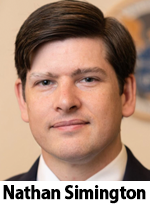
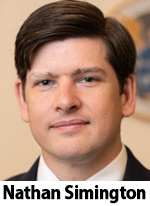
 Commission and Republican Commissioner Nathan Simington abruptly announced his departure from his commissioner role earlier this week. President Trump nominated Olivia Trusty for the open seat that existed prior to Starks’ and Simington’s departures but that has been stalled in the Senate. Interestingly, FOX News reports that Simington’s chief of staff Gavin Wax is being floated as a potential nominee, according to “a source close to the FCC.” Regardless, the Senate needs to get at least one nominee confirmed soon as the Commission’s ability to do business is disrupted.
  Free Press for the very first stop of our First Amendment Tour outside of Washington. Together, we must continue to stand up for free expression and push back against the Administration’s growing campaign of censorship and control.” Gomez’s office says that as part of her tour, Gomez is partnering with consumer and civil society organizations across the ideological spectrum to participate in speaking engagements and listening sessions focused on protecting the rights and freedoms enshrined in the First Amendment. Most recently, she held an event in partnership with the Center for Democracy and Technology, spoke at the Media Institute, and participated in a workshop held by the Competitive Enterprise Institute and TechFreedom.
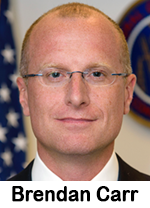 regulatory burdens. We received great feedback from a range of stakeholders already and plan on eliminating onerous, antiquated, and unlawful requirements across the board.” Carr added, “And we have been delivering these results with a focus on efficiency. At the beginning of Fiscal Year 2025, the FCC employed 1,461 full-time employees. As of April 28, 2025, the FCC employed 1,383 full-time employees. The difference over the last six months can be attributed to many factors, including FCC employees who took advantage of the early retirement window opened by my predecessor, the deferred resignation program offered by President Trump, and natural turnover. The agency is well positioned to continue carrying out its statutory mission for the remainder of Fiscal Year 2025 and beyond.”
 1940s, when broadcast dominated mass communications in the U.S. Since then, the media marketplace has changed drastically – from widespread deployment of cable and satellite television networks to the rise of social media, podcasts, and streaming. Local broadcasters compete directly with Big Tech, streaming services, and social media platforms in the marketplace of consumer content. Yet, unlike their competitors such as YouTube and Facebook, broadcasters are limited by the ownership rules in how many households and consumers they can reach. This is an inherent disadvantage.” The letter adds, “By eliminating the national television cap, local TV duopoly restrictions, and local radio ownership caps, broadcasters can better achieve the scale and efficiencies necessary to compete – and to attract vital investment – in a fragmented and rapidly evolving information market.”
 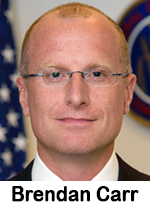 great results for the country and doing so in an efficient manner. That starts with being good stewards of taxpayer dollars. From day one, we have been combing through every FCC contract to eliminate redundancies and wasteful spending. No stone is being left unturned. To date, we have reduced more than $567 million in authorized contract spending, including by ending bloated or unnecessary IT contracts. This is an important step towards ensuring long-term efficiency and maintaining our focus on the FCC’s core responsibilities.”
 Global, the parent company of CBS, have begun charging what’s known as ‘reverse’ retransmission fees to broadcasters. The networks demand a share of broadcasters’ revenue for the right to use their content. This practice was once unheard of, but some networks now regularly require more than 100% of broadcasters’ retransmission fees as ‘reverse’ fees, leaving broadcasters to sustain themselves solely on whatever ad sales they can make with their limited inventory (also capped by the networks, and often amounts to only a few minutes of airtime per hour). This funnels more and more money out of local markets and local journalism and into the hands of mega media corporations, who threaten broadcasters with content blackouts if they don’t get sky-high payouts.” They go on to argue that the “problem gets even worse with providers like YouTube TV and Hulu Live. Under their affiliate agreements with the networks, local affiliates can’t even negotiate for online providers to carry the content. The networks do it for them and pay the affiliates whatever they deem reasonable (sometimes, nothing). This gives the networks total control over streaming distribution while robbing local stations of revenue and autonomy in the rapidly growing online video space. What was once a mechanism to support hometown news is now a corporate racket. Instead of investing in local reporters, meteorologists, and producers, local broadcasters’ funds are siphoned to bloated national newsrooms that churn out anti-Trump propaganda and woke talking points. Meanwhile, higher cable bills pass the cost to everyday Americans.”
  lies in its ability to deploy high-end, labor-light, automation-heavy processes at scale. It’s a productivity story now, driven by robotics, industrial AI, and, most crucially, advanced 5G infrastructure deployed as an industrial platform — not just as a consumer gimmick.” He adds, “Compare this with our own policy environment, where even the best private sector players are hamstrung by outdated regulations, capricious permitting processes, and the dogma that government shouldn’t pick winners — especially in telecom or manufacturing. That ideology might have made sense in the 1990s, but it’s lethal to the future of our telecommunications industry now, and in consequence, our manufacturing future.”
  Carr of “illegally targeting broadcast networks and media companies perceived to be unfavorably covering the Trump Administration – wasting critical agency resources on bogus investigations in the process.” The lawmakers are also questioning Carr’s “commitment to his agency’s independence, given his frequent trips with the president to Mar-a-Lago and his targeting of entities that the president has criticized or sued in his personal capacity.” Committee Ranking Members says that “under Carr’s leadership, the FCC has harassed CBS for routine editing practices, reinstated lawfully denied complaints against ABC and NBC, launched a bogus investigation into KCBS-AM in San Jose simply for reporting publicly available information, and directed the FCC’s Enforcement Bureau to launch investigations into NPR and PBS based on false allegations.” The Committee is requesting documents and communications “related to its investigations of media entities,” “all communications between Carr and current White House officials and between Carr and other Trump Administration officials that relate to investigations,” as well as Carr’s travel records.
  fundamental ownership restrictions have remained largely unchanged since the 1990s, imposing undue constraints on broadcasters’ ability to innovate and invest in local content. These regulations are a relic of an era when broadcasters were the only electronic media. Today, any one of the largest Big Tech platforms dwarfs the entire broadcast industry – yet they are held to no similar limitations on their reach. This imbalance places broadcasters at a severe disadvantage in competing for advertising dollars and audience engagement… We urge the FCC to act swiftly in eliminating antiquated ownership restrictions and to embrace a broadcast regulatory framework that reflects the realities of today’s dynamic media ecosystem.”
 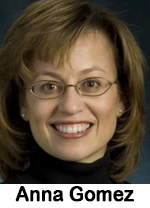 making companies think twice about the way they describe internal diversity programs. They’re afraid the government may retaliate against them simply because of actions that are responsive to how consumers use their services or choose to buy their products. Sadly, the hard-fought lessons of the civil rights movement are being erased – or worse, distorted – to claim that fairness for all requires discrimination against some. That could not be further from the truth.” Gomez says she’s concerned about the Commission weaponizing “its regulatory authority to enforce government mandates that seek to eliminate voluntary efforts by private companies to increase fair and equal employment opportunities.”
  networks, developing infrastructure, and offering innovative and advanced capabilities.” The Notice goes on to say, “The Communications Act directs the FCC to regularly review its rules to identify and eliminate those that are unnecessary in light of current circumstances, recognizing that in addition to imposing unnecessary burdens, unnecessary rules may stand in the way of deployment, expansion, competition, and technological innovation in communications that the Commission is directed to advance. Government-wide administrative law requires review of rules to ensure that unnecessary—or affirmatively detrimental—rules are not retained.” The public comment period runs through April 15 and the Commission encourages “commenters to consider certain policy factors including cost-benefit considerations, marketplace and technological changes, barrier to entry, and more, as well as statutory and regulatory retrospective review standards.”
  Day the Music Died, that involves pirates hijacking 100 radio stations in five major U.S. cities and follows one company’s story over the course of 24 hours. Orchard was raised in a radio family that owned and operated stations in the 1980s and 1990s. Her family later launched a consulting business that conducted mock FCC inspections and she says the idea for her novel was born from those experiences.
  impairment charge of $224.5 million compared to a pre-tax non-cash impairment of $65.3 million in 2023, both primarily reflecting FCC-related charges.” Cumulus president and CEO Mary G. Berner states, “Since the pandemic’s onset, the radio industry has experienced tough economic and secular headwinds. In the face of those, we outperformed our peers through the end of 2023 on key metrics including cost takeouts, EBITDA
 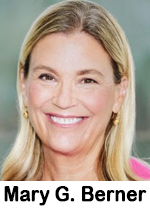 margin recovery, free cash flow generation, net leverage, and liquidity. 2024 brought additional challenges, including accelerated national headwinds as well as an industry-wide slowdown in local radio advertising. In response, we doubled down on investing in growth areas, particularly in our digital marketing services business, which is pacing up 30% in Q1. Additionally, we continued evolving our broadcast go-to-market strategies, including with new offerings that are successfully attracting large new broadcast clients, and we drove additional cost efficiencies with 2024 actions that will result in $43 million of annualized fixed cost savings, of which $15 million benefited 2024 with the balance in 2025. Though the industry environment remains challenging for now, our 2024 refinancing efforts provided us with the time needed to both execute our day-to-day blocking and tackling and, in parallel, continue to reimagine the ways in which we can get the most out of our key assets to create new revenue streams and build additional long-term value.”
 executive branch and must therefore: “(1) submit draft regulations for White House review—with no carve-out for so-called independent agencies, except for the monetary policy functions of the Federal Reserve; and (2) consult with the White House on their priorities and strategic plans, and the White House will set their performance standards. The Office of Management and Budget will adjust so-called independent agencies’ apportionments to ensure tax dollars are spent wisely. The President and the Attorney General (subject to the President’s supervision and control) will interpret the law for the executive branch, instead of having separate agencies adopt conflicting interpretations.” The order also argues that since the president is elected by the people and all agencies are accountable to the American people, therefore the president represents the will of the people. Critics of the move are questioning the constitutionality of the order and some expect this matter will be decided by the courts.
  Commission stated that Hennen was expressing “his own individual opinion on the current state of journalism,” but “even if it was assumed that such an opinion might be expressed on WDAY under BBM’s ownership, that is not a ground for the FCC to deny or withhold consent to the instant assignment.” The Commission further states, “We reject the assertion that Hennen’s social media comments justify a denial of the proposed assignment applications. The Objection does not cite to any provision under the Act or the rules, any cases, or any Commission policy for its argument that Hennen’s social media comments are pertinent to our review of the Applications. We disagree with Wolff’s argument that Hennen’s viewpoint on the state of journalism, as expressed in his social media comments, is in any way relevant to our determination of BBM’s qualifications to hold a license or whether the proposed assignment would serve the public interest. As the Commission has stated, licensees have broad discretion based on their First Amendment right to free speech to choose, in good faith, the programming they believe serves the needs and interests of their communities. Indeed, the Commission does not interfere with the programming decisions of licensees, nor does it consider issues of programming choice when reviewing an application for the assignment or transfer of a broadcast license.”
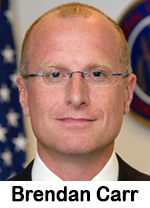 have had the privilege of working at the FCC for over a dozen years now, including serving previously as the agency’s General Counsel, and I am humbled by the opportunity to lead the FCC. The FCC has important work ahead – on issues ranging from tech and media regulation to unleashing new opportunities for jobs and growth through agency actions on spectrum, infrastructure, and the space economy. We will also advance America’s national security interests and protect consumers. I am eager to accelerate the FCC’s work on these and other fronts. I look forward to collaborating with the Trump Administration, my Commission colleagues, and the FCC’s talented staff as well as Congress to deliver great results for the American people.”
 awaiting the FCC’s blessing on the plan to complete reorganization and its Debtor-in-Possession credit facility in the aggregate principal amount of $32 million matures on August 19, 2024. (This DIP Facility allows Audacy to function during the reorganization period.) Audacy is asking the Court to extend the maturation date to September 30, 2024. Audacy stated in its second quarter 2024 financial report that it expects to receive FCC approval in the third quarter of this year.
 Under the Federal Communications Commission’s consideration is a proposal from Commander Communications Corporation that would create an FM broadcasting class known as “A10.” In addition to enhancing coverage in rural and underserved areas, it would grant power upgrades for roughly 1,400 Class A FMs, allowing a maximum of 10,000 watts. Approval would depend on a station’s geographical zone; tower height; and separation requirements. While the National Association of Broadcasters recognizes potential benefits for listeners – especially during emergencies – it urges caution owing to possible negative impacts. The NAB generally supports proposals designed to improve coverage areas, but says the “A10” proposal lacks technical analysis and information on how many stations may be upgradable. An NAB filing notes that, “While this could lead to improved service for additional listeners, it could also further squeeze the band in more markets and impact more FM services.” Also opposed is Cumulus Media, which cites an “unacceptable risk” to stations already competing against streaming services. Conversely, the Multicultural Media, Telecom & Internet Council favors the suggestion, stressing that many stations that would qualify for the upgrade are owned by minority and small-scale operators. This proposal would replace an earlier FCC one for a Class C4 FM station category. More than 100 independent and minority owners backed the idea, but it ran into opposition from larger companies and the NAB.