
TALKERS Books Drops “Speeches They Never Gave,” Richard Chemel’s Collection of 50 Imagined Addresses by Historic Figures to Modern Audiences
Veteran music promoter, new-media pioneer and former TALKERS Pop Culture Editor is available for interviews on AI, authorship and what old voices can tell a modern newsroom
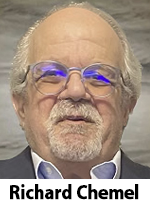
TALKERS Books has published Speeches They Never Gave: Volume One, a collection of 50 imagined speeches compiled and created by Richard Chemel. The paperback went on sale at Amazon on November 7.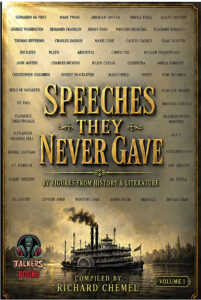
 The premise is simple but fascinating. Chemel takes a figure from history or literature, hands that person a present-day subject, and stands them in front of a specific modern audience. For example, Mark Twain talks to journalists about social media. Abraham Lincoln addresses newsroom editors on political polarization. Socrates takes on the internet and misinformation for a room of high-school students. Dracula explains fear and public relations to media executives, and P.T. Barnum has a few things to tell advertising executives about their own business.
Several of those rooms are full of people who work in this industry, and that is by design. Chemel spent his career in and around broadcasting. In the 1970s, he worked in radio promotion on behalf of musical artists including Heart, ELO, and Bob Seger. He moved into special-interest video marketing with Jane Fonda’s home-fitness series, Shirley MacLaine’s Inner Workout and WrestleMania. He was the first host of the Los Angeles Times online platform, moderated chats for MSN Money on CNBC, and served as pop culture editor of TALKERS magazine. The book began with a question he typed into a search engine: what would Al Capp have to say about the world today? The answer suggested a larger project, and each of the 50 pairings that followed started the same way – as a question Chemel wanted to hear answered.
In his author’s note, Chemel writes that broadcasting taught him that “the right voice, saying the right thing to the right room,” can move people further than almost anything else. He was a 20-year-old student at Kent State in May 1970, and he traces his conviction that listening matters back to that month.
A plain statement about AI
Chemel used AI tools in drafting the speeches and says so in the book, in a section titled, “How This Book Was Made.” He describes prompting, rejecting, rewriting and revising, and he is specific about what the tools did not do: choose the premise, the speakers, the audiences or the argument of any speech. “Tools change,” he writes. “Someone still has to have the idea, make the choices, and put a name on the result.”
That disclosure makes him a timely guest. Questions he can take on the air include:
- When a host, writer or producer uses AI, what does the audience have a right to know?
- Who is the author when a machine helps with the sentences?
- Is it fair to put new words in the mouth of Lincoln or Jefferson, and where is the line between interpretation and fabrication?
- Why does a 19th-century voice sometimes say something about social media that a contemporary one can’t?
The speeches are works of creative interpretation. None was actually delivered by the person or character depicted.
TALKERS publisher Michael Harrison states, “We are very proud to add this timely book to our growing catalogue of talk media-friendly works by authors who make great conversational guests.”
For each paperback sold on Amazon, a donation goes to the Fisher Center for Alzheimer’s Research Foundation. This is an independent promotion; Amazon is not a sponsor.
Availability: Speeches They Never Gave: Volume One is available now at Amazon. More information is at hellospeeches.com.
To book Richard Chemel for an interview, or for signed and bulk orders:hellospeeches@gmail.com
 Amazon learned that there are high volume sales for specific categories of products. High demand equals high value to the seller. Items such as diapers, printer ink, staplers, batteries, etc. Being brilliant, Amazon created “Amazon Basics.” Same products, white labeled. Amazon doesn’t manufacture batteries; they just slap their logos on what America needs most. That’s why Mr. Bezos has a bigger boat than you.
 -demand radio shows to migrate to ART19’s infrastructure that it says will allow it to “unlock new revenue opportunities and offering advertisers enhanced reach , deeper analytics, and improved ROI.” Beasley chief content officer Justin Chase says, “This partnership is an important step in our digital transformation. ART19’s platform will help us expand monetization opportunities while delivering a better experience for audiences and advertisers.”
 optimize operations, and deliver even more value to advertisers and content creators alike. Additionally, by leveraging ART19’s advanced tools for dynamic ad insertion, PodcastOne can implement programmatic advertising and direct sponsorship integrations. PodcastOne president and co-founder Kit Gray states, “We’re not only ensuring the stability of our current monetization streams but unlocking new growth opportunities by leveraging ART19’s cutting-edge technology and advertising opportunities. This move underscores our commitment to innovation and delivering exceptional value to our talent, advertisers, listeners and shareholders.”
 Welcome to the NAB edition of Pending Business.
 assets, digital audio and tentpole events. In addition, Kurland will oversee the company’s entertainment legal functions across podcasts, live events, and new media initiatives as well as its music licensing strategy, including maintaining and renewing all music industry licenses for iHeartRadio’s digital services and performance licenses through PRO agencies. iHeartMedia EVP and general counsel Jordan Fasbender says, “Jon’s vast experience and dealmaking skills in the audio industry will be incredibly valuable as we continue to innovate and expand our partnerships and opportunities that leverage and enhance iHeartMedia’s position as the leading audio company in the U.S.” Kurland joins iHeartMedia from Amazon, where he served as senior corporate counsel in the Global Media & Entertainment group.
 talk radio is the main reason why. He says, “My new book is out for 48 hours and already it’s a #1 bestseller in many categories at Amazon. And to what do I credit my success at going so quickly to #1? Talk radio. In past 48 hours I’ve been a guest on 30 talk radio shows… plus of course, I’ve promoted my book on my own national radio show. Talk radio works!” Root is an ardent Donald Trump supporter who says the former president linked to his recent opinion piece titled, “Democrats Want to Indict & Arrest President Trump. They Want a War? Let’s Give it to Them” in one of his recent posts on Truth Social.
 eliminating filled positions, we are talking about our colleagues – people whose skills, spirit and talents help make NPR what it is today. This will be a major loss.” The story goes on to state, “On an annual budget of roughly $300 million, Lansing says, revenues are likely to fall short by close to $30 million, although that gap could reach $32 million.” Folkenflik notes, “The layoffs are in keeping with an increasingly grim landscape for media companies over recent months. Vox Media cut jobs by 7%; Gannett and Spotify by 6%. The Washington Post, owned by Amazon founder Jeff Bezos, eliminated its Sunday magazine and a handful of other jobs. After becoming part of Warner Bros. Discovery, CNN cut hundreds of jobs and killed off its brand-new streaming service, CNN+.”

 On December 29, 2022, the company revealed that Courtside Group, Inc. (dba PodcastOne) has filed an S-1 with the SEC for its planned spin-out and special dividend to LiveOne’s stockholders of record on January 16, 2023. The company says that PodcastOne is expected to record revenue of $25 million for the first nine months of fiscal 2023 ending December 31, 2022.
 CMS is the platform where podcast episodes are uploaded, RSS feeds are created and distributed to listening platforms, and the listening data is analyzed and displayed in a dashboard for the creators/producers to see. This fully owned and operated enterprise CMS rivals other paid platforms such as Megaphone (Spotify-owned), Art19 (Amazon-owned) and SimpleCast (SiriusXM/Pandora-owned). The CMS’ day-to-day operation and maintenance is managed by a vendor we contract with and is constantly being updated to be a best-in-class system. LiveOne remains committed to spinning-out PodcastOne as a separate public company to be listed on a national exchange. In connection with such spin-out, LiveOne has moved the record date to Jan. 16, 2023 for PodcastOne’s special dividend to LiveOne’s stockholders of record. In addition, LiveOne intends to explore spinning-out SlackerOne as a separate public company during its 2024 fiscal year.”