By Holland Cooke
Consultant
 Unintentionally, your poorly phrased comment, dated reference, weary cliché, or offhand remark can at least subtly distance you from your listener and could undercut your credibility, offend, or even spark backlash.
Whether you’re a broadcaster, podcaster, newscaster, or you are crafting commercial or promo copy, take a fresh look at these often-overlooked pitfalls.
Dated references: Nothing can disrupt your listener’s day quicker than quickly changing weather. Being thought of as a weather source can advantage any station in any format. But you risk that currency by calling tomorrow “…a carbon copy of today.” Few under 50 have ever used carbon paper. And with weather more erratic lately, implying otherwise can make your forecast sound – forgive me – “like a broken record.” Also antique: “Rolodex,” now that listeners’ smartphones have “Contacts.” So, purge old-speak from “the radio dial.” Listeners (and advertisers) notice when we keep-up… or don’t.
Stereotyping:
— “Soccer mom in a SUV” sure is the retail super-consumer advertisers want to see pull-into the parking lot. Visualize her in programming and promotion planning and sales prospecting… OFF-air stuff. But reinforcing gender roles and class assumptions ON-air paints a narrow picture of parenting and lifestyle, potentially alienating women.
— “You know how Millennials are.” Yes – like “Generation X” – they dislike being typecast, and you sound out-of-touch and judgmental.
— Calling someone “a Karen” can alienate listeners who have felt ridiculed suffering a situation similar to whatever you’re describing. And there are millions in the potential ratings sample named… Karen.
— “Probably some college kid with no clue how to drive in the snow” implies incompetence based on age and background. This kind of dig can undermine younger listeners or newcomers to your market.
Stereotypes are lazy, often a shortcut to humor or imagery. Ask yourself: “Is this something I’d say to someone’s face?”

Insensitive Humor: “Looks like someone forgot their meds today!” can offend those quietly dealing with anxiety, or depression. Pandemic silver lining: Mental health is no longer a laughing matter. You may have seen TV PSAs by Howie Mandel, sharing how ADHD has impacted his life and asking that it not be a punchline.
“Potty-mouth:” Mom and Dad’s just-the-two-of-them vocabulary is different than the way they speak with kids in the car, and what they want to hear their children repeat after hearing on radio.
— “Pissed-off” has become unnecessarily familiar, particularly with recent inflation…with which we are “annoyed,” “fed-up,” and “frustrated.”
— Even if something sounds commonplace, origins or implications may make it unsuitable for all-audience radio. “Scumbag” began as a term for condom. “Sucks” and “screwed” also have sexual roots some consider vulgar.
Taboo red flags:
— “No offense, but…” or “I’m just saying…” often precede something offensive.
— “It’s just a joke!” often follows a crack at the expense of marginalized groups.
— “Everyone thinks that…” overgeneralizes and can alienate those who disagree.
— Mocking accents or speech patterns can come across as disrespectful rather than entertaining.
— “Real [men/women] do…” Gendered assumptions can feel exclusionary or outdated.
— “This [group] is always…” Sweeping characterizations often reinforce stereotypes.
Words have weight. In a medium where tone, timing, and trust matter, what we say – and how we say it – can either strengthen listener connection or erode it.
NEXT WEEK: Topics to Tune-IN the listeners you want most.
Holland Cooke (HollandCooke.com) is a media consultant working at the intersection of broadcasting and the Internet. Follow HC on Twitter @HollandCooke
Share this with your network

 “Gym Class” with Scott Unash and Mark Dukes (3:00 pm to 4:00 pm) did their last shows this week. The local show “Spencer on Sports” with Spencer Wagen will continue in its 4:00 pm to 6:00 pm slot. KZIA Inc. CEO Julie Hein is quoted saying, “Like a lot of media, including your, and national TV and local TV, restaurants, factories, we are experiencing some economic changes. I hope there is a rebound. Scott Unash and Mark Dukes have been legends in this market for decades and have done amazing things for sports in the Corridor. Todd Brommelkamp, to me, was a breath of fresh air and a real leader in talking about the Hawkeyes and all kinds of great things. I adore all of them and I am forever a fan of all three men.” Read The Gazette story here.
 Awards. The winners will be presented on October 21 at The Edison Ballroom, the evening before NAB Show New York. Finalists for Legendary Station of the Year include news/talk WABC, New York. Finalists for News/Talk Station of the Year are: KFI-AM, Los Angeles; WABC-AM, New York; WBAL-AM, Baltimore; WBBM-AM, Chicago; and WENG-AM, Englewood, Florida.
  sports talk KSAC-AM/K284CM, effective September 2. This comes five years after he was fired by Bonneville’s KHTK, Sacramento and the Kings after a social media exchange with former Kings player DeMarcus Cousins about the Black Lives Matter movement and used the phrase, “all lives matter.” Napear sued Bonneville and lost but is currently appealing that ruling. Napear tells the Bee, “It’s going to be the Grant Napear show that people have listened to for decades. I’m competitive. I’m not only coming back to Sacramento. I’m coming back to win.”
  “creative quality is the number one sales driver” and this is often a surprise to advertisers and media agencies who think media tactics (targeting, reach, etc.) drive the most sales. It’s for good reason that everyone wants high brand awareness. A major study from TikTok reveals the greater a brand’s awareness, the greater the purchase conversion. Brands with high aided awareness have 2.86x greater conversion rates compared to low awareness brands. But not all categories operate similarly, Podscribe says that purchase conversion varies widely by advertising category and advises that it’s important to understand the purchase conversion benchmarks for your product category.
  podcast consumption in the past week was through video.) The top five podcasts didn’t change from Q1 data. They are: “The Joe Rogan Experience,” “Crime Junkie,” “The Daily,” “Call Her Daddy,” and “This Past Weekend w/Theo Von.” Some talk radio-related podcasts of note include: NPR’s “Up First” at #22; The Daily Wire’s “Ben Shapiro Show”; Ramsey Network’s “The Ramsey Show” at #29; and Charlie Kirk’s “The Charlie Kirk Show” at #49.
  satellite radio; 2) In the second quarter of 2025, ad supported audio accounted for 64% of all listening, while in the TV landscape, 74% of viewing was done on ad supported platforms; 3) Zeroing in on the ad supported audio universe, consumers spent 64% of their daily time in the second quarter with radio, 19% with podcasts, 14% with streaming audio services and 3% with satellite radio. The study also tracks listening by format and news/talk (AM/FM and streaming) not surprisingly dominated the 35+ demo with more than a 12 share. But the format also did well with 25-54s, notching a 6.5 share (which topped all other formats except adult contemporary
 media users, and linear TV viewers. Ad-supported audio listeners are more likely to be Amazon Prime members, spend more, and were more aware of Amazon Prime Day 2025; 2) Ad-supported audio (AM/FM radio, music streaming, and podcasts) are ideal media platforms for retailers and e-commerce brands: Heavy audio listeners are more likely to shop online. Heavy AM/FM radio and podcast listeners spend more online than TV viewers; 3) AM/FM radio makes your TV better – “20 gets you 50”: A 20% shift of a TV media budget to AM/FM radio generates a +50% increase in campaign reach. Nielsen Media Impact campaign optimizations reveal shifting media weight to AM/FM radio generates significantly more reach, especially among younger 18-49 demographics. AM/FM radio does an extraordinary job in increasing campaign reach among light TV viewers who will not see retailer TV ads; and 4) Audio holiday AM/FM radio campaigns work: Consumers exposed to an Amazon holiday AM/FM radio campaign have higher brand equity (awareness, ad recall, prior purchase, and purchase intent). Nielsen sales effect studies reveal AM/FM radio campaigns for retailers generate significant return on advertising spend: $15 dollars of incremental sales for every dollar of AM/FM radio advertising.
 Why we’re already seeing TV tout its coming attractions: They understand how, after Labor Day, routines settle in. Viewers will be ready to re-engage.

 have ever consumed a podcast, 55% have consumed a podcast in the last month, and 40% have consumed a podcast in the last week, each measure being an all-time high; 2) Video podcast consumption has redefined the podcast landscape: Over half (51%) of the U.S. 12+ population has ever watched a video podcast; 37% have watched a video podcast in the last month and 26% have watched a video podcast in the last week. Those who actively watch video podcasts are younger and more diverse than those who only listen to audio-only podcasts; and 3) Podcasts offer high engagement and trust from listeners: 88% of weekly podcast consumers agree that hearing ads is a fair price to pay for free content; 68% say they don’t mind hearing ads on podcasts. You can see
  Ask any dog: The humans’ greatest invention EVER? Ice cream. Share summer’s sweetest treat with them, and listeners, during National Ice Cream Month.
 receive on our mobile phones. With underlying frameworks that are 31 and 13 years old respectively, we think it’s time to explore if structural changes to these systems are needed, with an eye towards making sure we are leveraging the latest technology to save lives. Similarly, we will also vote to initiate a review of our system for collecting real-time data on network outages and restoration during and after major disasters. Since its inception in 2007, our Disaster Information Reporting System (DIRS) has proven to be a valuable tool for collecting actionable information to help with recovery efforts. While the DIRS reports are valuable, they can be time-consuming to produce, drawing resources away from responding to an ongoing disaster. The Commission will vote on reforms to streamline DIRS to make sure that its benefits outweigh its burdens. We’ll close our August meeting by removing unnecessary regulations and injecting common sense across the Commission’s policies—critical features to streamline the implementation of our Build America Agenda.”
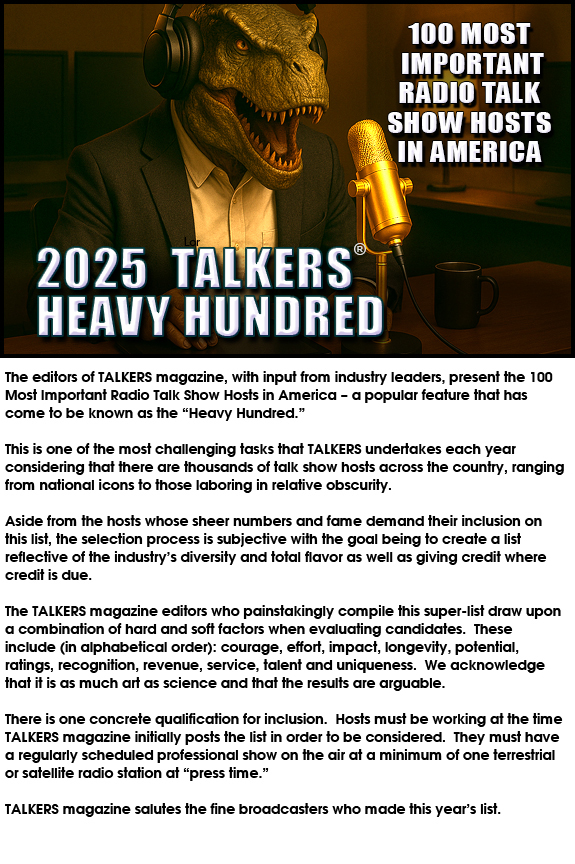
  available free of charge to the first 200 TALKERS readers who respond to the offer. This valuable resource is packed with contact information to reach Members of Congress and their key staffers.
  “Eric from Dominion saying he was going to make sure President Trump lost the 2020 election.” That was picked up and broadcast by OAN network and further repeated by the Trump campaign and Trump attorneys Rudy Giuliani and Sidney Powell. Coomer also sued MyPillow CEO Mike Lindell and won a $2.3 million judgement. Courthouse News also reports that Coomer is also suing Salem personality Eric Metaxas who recently filed with the court to settle and is awaiting approval from the court. Interestingly, Corporon – a practicing attorney – is representing Gateway Pundit owner James Hoft who is also being sued by Coomer for defamation. That case is scheduled to go to trial in April of 2026.
  -home media company JCDecaux reveals creative best practices for billboard advertising that the AM/FM radio industry can utilize to improve visual ad impact. Some of the key findings include: 1) Quu visual AM/FM radio ads on auto dashboards increase purchase intent by +89%; 2) You’ve got two seconds so brand fast: Visual logos placed at top of the frame deliver 4X higher brand recognition; 3) Beware the cost of dull: Failure to engage emotionally is the cost of creative mediocrity; 4) Be consistent with a brand’s colors, logos, slogans, and fonts that appear in other advertising; 5) Keep it short: The fewer the words, the greater the brand recognition; and 6) Create happiness: Ads that create positive emotions with happiness, surprise, or humor generate much stronger memorability, brand association, store visits, and website visits.
  How obsolete does this sound? “Newsweek magazine.” News, gathered during most-of the week, had to be frozen by week’s-end, on deadline, to roll the presses in time for hard copy to be delivered in Monday’s snail mail. Back then – picture people dressed like “Mad Men” characters – enough subscribers felt informed-enough to deliver Return On Investment for the magazine’s advertisers. Seems antique. Now, news is reported moment-to-moment, on any device. And newsweek.com is there… along with everyone else competing for attention.
 and companies seeking to hire, especially among passive job seekers who are less likely to use job sites: Nine out of 10 job seekers are reached by ad-supported audio. Over-the-air AM/FM radio reaches nearly 80% of active and passive job seekers. Six out of 10 active job seekers are reached by podcasts; 2) AM/FM radio streaming’s audience growth has surged among job seekers: Since 2021, AM/FM radio streaming has soared in usage among both active and passive job seekers. Six out 10 active job seekers are reached by AM/FM radio streaming; 3) Passive job seekers outnumber active job seekers by +50%. Active job seekers are growing: The optimal source for filling positions are passive job seekers who outnumber active job seekers by +50%. Active job seekers have surged from 15% in 2018 to 24% currently; and 4) Advertising works: There is a very linear relationship between ad spend, share of voice, ad recall, and market share. The greater the ad spend, the greater the ad recall and market share.













 last 11 years, the study has been reprised annually to track buy-side podcast advertising consideration and intention. The latest Advertiser Perceptions study, conducted in June 2025 with 302 marketers and media agencies, reveals advertiser/agency podcasting usage and interest has reached an 11-year high.” Some of the notable takeaways from this study include: 1) Nine out of 10 marketers and media agencies say they have discussed podcast advertising for potential investment; 2) Podcast advertising consideration surges to an eleven-year high: 74% of brands and agencies say they are likely to consider advertising in podcasts; 3) Podcast spending intention jumps to 69%, an eleven-year record; and 4) 78% of agencies and advertisers currently advertise in podcasts, a 5X increase since the first IAB podcast upfront in 2015.
  Are archived shows – whole hours – your station’s only on-demand offering? It’s an easy checkbox: post the aircheck, call it a podcast.
 2025. The inductees will be honored at the in-person 2025 Radio Hall of Fame Induction ceremony on October 30 at the Swissotel Hotel in Chicago. Among this year’s inductees are: Colin Cowherd, host of “The Herd with Colin Cowherd”; Mike McVay of McVay Media; and Julie Talbott, president of Premiere Networks.
  ($2.7 billion), #2 direct mail ($2.5 billion), #3 PC/laptop ($2.3 billion), and #4 TV OTA+digital ($1.6 billion). The report notes that 64% of the state’s total ad spend in done in three markets: Miami-Fort Lauderdale, Tampa-St. Petersburgh-Sarasota, and Orlando-Daytona Beach-Melbourne.
 -24 and, perhaps not surprisingly, their most preferred categories of podcasts are Comedy, Music, Entertainment, and True Crime. News/Information is far down the list with just 17% saying they watched or listened to a news/information podcast in the last month. Also noteworthy is the breakdown of delivery systems for audio for this demographic. Streaming music is the top audio source (42%), followed by YouTube (20%), and AM/FM (16%) in third place.