by Robert Pearl
Exclusive to TALKERS
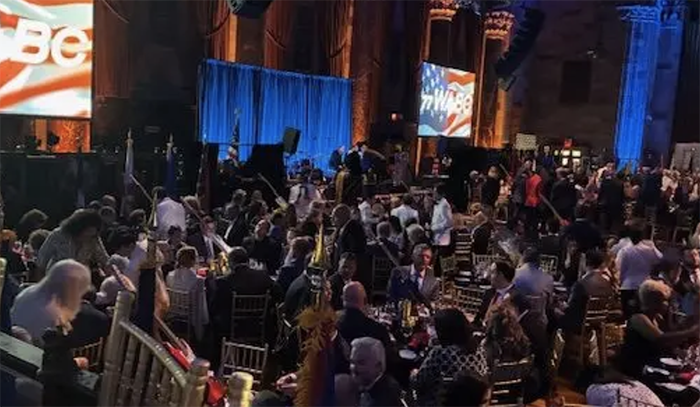
 New York’s Cipriani 42nd Street once again played host to one of radio’s most anticipated annual events of the year: the annual “77 WABC Gala,” held this past Friday (9/5). The spectacular evening blended star-studded entertainment, heartfelt tributes, and plenty of radio family camaraderie – all while raising funds for three cornerstone charities: Tunnel to Towers Foundation, the Police Athletic League, and Shriners Children’s Hospital.
The night doubled as the unofficial kickoff to America’s 250th anniversary celebrations, with patriotic spirit filling the storied hall. Guests were treated to a spectacular mix of tradition and pageantry: bagpipes opened the evening, followed by the Pledge of Allegiance and a soaring rendition of the national anthem from tenor Chris Macchio, fresh from performing at President Donald Trump’s 2025 inauguration. Later, country music legend Lee Greenwood brought the house to its feet with “God Bless the USA,” a fitting soundtrack to the night’s theme.
Radio Legend Served as Emcee
The event was emceed by “Cousin” Bruce Morrow, who set the tone with trademark warmth and humor. Featured performances by Vinnie Medugno, and Joe Piscopo with homage to Frank Sinatra classics. Fellow WABC hosts and personalities were out in force: Sid Rosenberg (with wife Danielle), Curtis and Nancy Sliwa, Dominic Carter, Greg Kelly (joined by his father, longtime NYPD commissioner Ray Kelly), Lionel and his wife Lynn Shaw (founder of Lynn’s Warriors), Brian Kilmeade, Rita Cosby, Lisa G, Anthony Cumia, news director James Flippant, and anchor Liz Ratoballi.
WABC owner John Catsimatidis and Red Apple Media president Chad Lopez anchored the front row, alongside Margo Catsimatidis, who was celebrated as the event’s “First Lady of WABC.” Longtime friend (and WOR personality) Mark Simone – dubbed “Mr. New York”- was on hand, underscoring the collegiality of the broader talk radio community. The gala also drew figures beyond radio, including Mayor Eric Adams and his electoral rival Curtis Sliwa sitting a few tables apart, economic voice Larry Kudlow, the relentless patriot and activist artist Scott LoBaido, Newsmax’s Johnny Tobacco of Wiseguys, and philanthropist Frank Siller of Tunnel to Towers.
Charity with Purpose
While the evening sparkled with entertainment and personality, its heart was rooted in the causes it championed. The Tunnel to Towers Foundation, founded in honor of fallen firefighter Stephen Siller, continues its mission of supporting first responders and veterans, promising to pay off the mortgages of the fallen. The Police Athletic League, New York City’s largest independent youth development nonprofit, provides educational and recreational programs to children in need. And Shriners Children’s Hospital, a global leader in pediatric specialty care, ensures children receive treatment regardless of a family’s ability to pay. These organizations were not just beneficiaries but central characters in a story of service, community, and giving back.
A Night of Theater and Patriotism
Beyond the music, the gala leaned into a spectacle. Impersonators dressed as George Washington, Abraham Lincoln, and Uncle Sam strolled the ballroom, taking pictures with guests. Later, Lady Liberty herself dramatically popped out of a massive birthday cake as red, white, and blue balloons cascaded from the ceiling. Guests waved WABC-branded light sticks in rhythm with the performances, further amplifying the carnival-like energy.
And as tradition dictates, September’s Virgo birthdays were honored in grand style. Joe Piscopo led a rousing “Happy Birthday” for John Catsimatidis and fellow celebrants, which seamlessly transitioned into a full-throated “God Bless America,” with the entire ballroom on its feet.
Political Undertones in a Festive Setting
While the evening was designed as a patriotic celebration, politics were never far from the surface. Just hours before the gala, Mayor Adams publicly doubled down on his mayoral campaign, brushing aside speculation of a possible exit. At Cipriani, Adams was greeted politely – but the room roared when Republican candidate Curtis Sliwa was announced, highlighting the unique political currents swirling through the city and this radio community.
Still, the prevailing message was unity and celebration. “We celebrate America together,” said Greenwood before launching into his anthem. It was a fitting capstone to an event that blended entertainment, politics, and philanthropy in a way unique to WABC.
As the gala wound down, guests departed with gift bags in hand, many still humming Greenwood’s refrain. With its mix of glamour, gravitas, and good causes, the 2025 WABC Gala set the stage not just for America’s 250th birthday, but also for the enduring influence of talk radio as a cultural and political force.
Robert Pearl is a New York City-based freelance journalist. He can be reached at pearlknows@yahoo.com.
Share this with your network



 it appears that allowing the former programmer to resign, firing half the news department, and pulling back on advertising and marketing didn’t work the ratings magic they originally had hoped for. In my opinion, KFI has seemed rudderless since Robin Bertolucci left the programming spot last November. The current programmer Brian Long, meanwhile, is also in charge of KLAC (570 AM) and KEIB (1150 AM), but with no time, a limited budget, and a decimated news department, the result is what it is. I don’t blame him at all. For his part, O’Kelly is keeping it positive, posting on Facebook, ‘All jobs end. It is not our lives or our health. Perspective is paramount. There is nothing to be sad about here. I’m genuinely excited for the future.’” Kelly is ranked #83 in the TALKERS 2025 Heavy Hundred. See the Daily News piece here.
 David Kleppinger says the school received a lot of public comments expressing concern about the loss of the station. As reported by Penn State, the new proposed transition includes commitments for WHYY to operate WPSU for at least three years after the transfer and to offer existing WPSU employees the opportunity to apply for comparable positions. Penn State also plans to transfer endowments and gifts designated for WPSU to WHYY. The story says, “Penn State will not be required to provide additional subsidy funds as previously negotiated. Rather, WHYY will first secure at least $8.36 million in outside financing. WHYY president and CEO Bill Marrazzo said that effort is already well underway and that PSU alumni are making contributions.”
 October 6, it debuted a new morning program it says is designed specifically for Milwaukee commuters. Civic Media says, “‘All News All Morning’ is hosted by veteran broadcaster Dan Hanni and features a format that syncs with the average commute time in Milwaukee. Every 20 minutes, listeners will hear local news, traffic, sports, and weather, ensuring they stay informed no matter when they tune in during their drive.” WAUK regional president and general manager Chris Moreau comments, “This is a no-frills approach to delivering what people look for in the morning. News and information that they can use to start the day without wading through padding, filler, fluff, and partisan opinion. And they can hear it all within the average commute time in Milwaukee.”
  of NBC and Hubbard Radio president and general manager Joel Oxley. The Media Mixer series is designed to “celebrate the camaraderie of the broadcasting community and bring to light the charitable mission of the BFOA to provide a lifeline to colleagues in acute need from illness or disaster.” BFoA chair Scott Herman says, “We thank the NAB for providing this impressive event space at their headquarters, and we’re grateful to Curtis, Kelly, and Joel for their support in making this event a success for all attendees. Our Media Mixers bring together junior and senior level broadcast professionals and on-air celebrities, while raising the profile of our mission to help every broadcaster who qualifies for aid.”
  market manager Steve Sinicropi says, “We are proud to launch UPSTATE RED and bring a new conservative voice to the Upstate region. ‘UPSTATE RED’ will be a premier destination for principled conversation, insightful news, and engaging talk with some of the biggest names in national talk radio, providing the most important news and information to the Upstate.” The programming lineup includes Premiere Networks’ Glenn Beck, Clay Travis & Buck Sexton, Sean Hannity, and Jesse Kelly, as well as Michael DelGiorno in mornings, Westwood One’s Rich Valdes in late nights and FOX News Radio’s Will Cain.
 As a media consultant, my team has had the privilege of being engaged extensively by members of the C-Suite. Becoming a member of the C-Suite is a common goal. To get into any group, acceptance often depends on acting and appearing like established members. Here are some of the actions observed of business masters whom we consulted: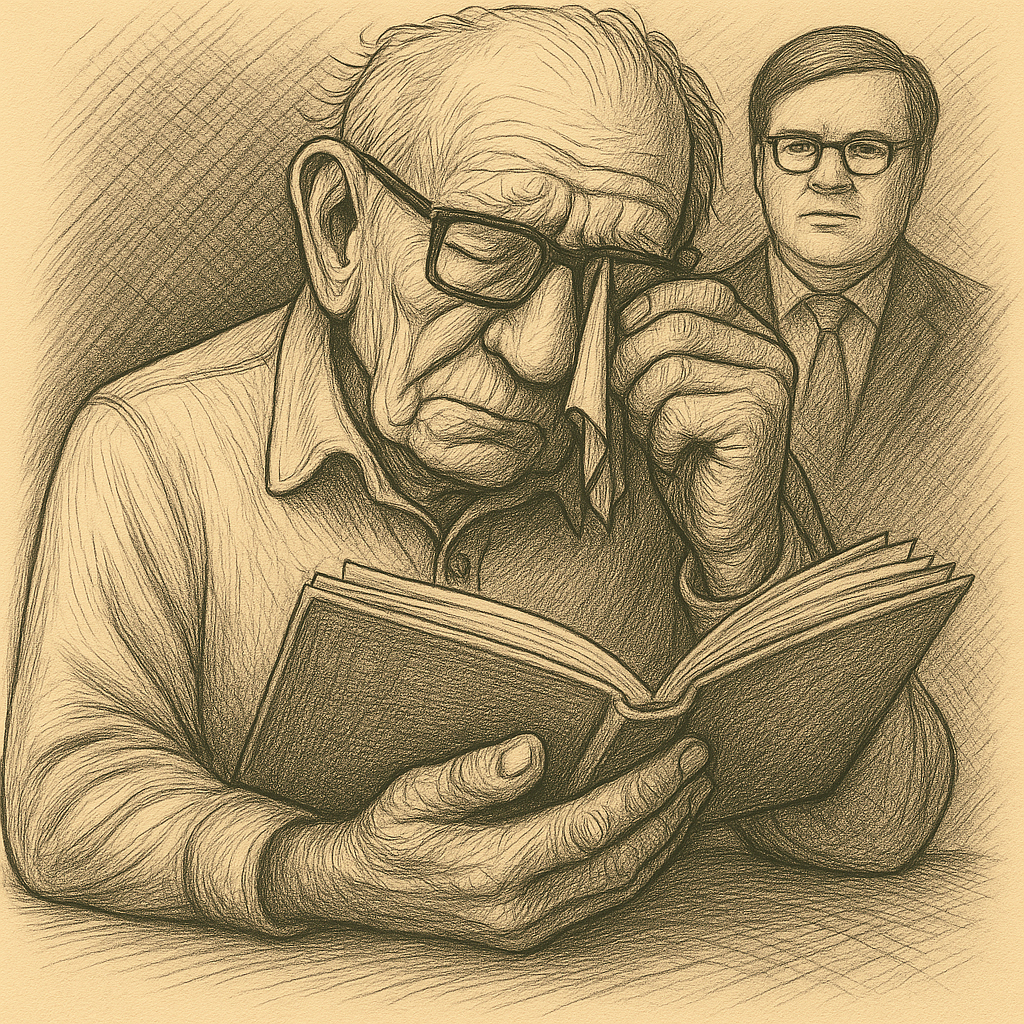
 licensed to Walton, New York – previously aired a country format and a news/talk format, respectively. Bold Gold Media Group president Vince Benedetto says, “We have a deep love and connection to the Catskill Mountains and Delaware County, and we are very much looking forward to bringing our programming to the wonderful community of Walton. For a long time, we have had the privilege serving the neighboring town of Hancock, and very much look forward to extending our local programming to include even more of the residents of Delaware County.”
 Markets broadcast operations. Salem CEO David Santrella says, “Linnae is a proven builder of teams and revenue streams. For nearly three decades she has delivered results across every part of Salem’s business, and she has the rare ability to connect vision with execution. As we move into a ‘One World’ selling environment, Linnae is exactly the leader we need to unlock new opportunities across all of our platforms and deepen our service to advertisers. Her leadership will be central to accelerating Salem’s growth.” Also, Jamie Cohen is promoted to chief digital officer, a newly created role designed to unify and oversee all digital operations across Salem Media. Cohen was most recently SVP of broadcast digital. Santrella says, “Jamie has been one of the key architects of Salem’s digital transformation. In just seven years, he took a $6 million business and scaled it to over $40 million—proof of both his vision and his execution. This new role gives him the mandate to break down silos and unify all of Salem’s digital assets under one strategy. With Jamie at the helm, Salem is positioned not just to compete in the digital marketplace, but to lead as a fully integrated media company.”
 influencers while enhancing Audacy’s cross-platform marketing capabilities.” Audacy says MOGL’s AI-powered matching system allows brands to quickly connect with athletes whose profiles align with campaign goals. Audacy chief revenue officer Bob Philips says, “Sports is where Audacy wins and sports media is evolving beyond traditional boundaries. This partnership with MOGL is a testament to our commitment to innovation, providing a powerful content-driven approach that benefits athletes, schools, and our advertising partners. Together, we’ll empower our clients to deliver authentic, high-impact campaigns that resonate with today’s fans and drive measurable brand outcomes.”
 complexities of divorce – helping people navigate every stage of the process faster, more affordably, and with far less conflict. Hello Divorce says its service “goes far beyond digitizing forms and redesigns the entire divorce experience with proprietary technology and AI to eliminate costly errors, reduce delays, and remove the bottlenecks that wreak havoc on divorce timelines.” iHeartMedia president of corporate development and ventures Joe Robinson says, “Hello Divorce offers a powerful solution for one of life’s most challenging transitions. This partnership gives them a unique opportunity to connect with people nationwide through our platforms, delivering resources and guidance that can truly make a difference.”
 that listening has grown across all demographics and time periods versus the Fall 2024 Nationwide report. Some key takeaways are: 1) Among persons 25-54, total U.S. AM/FM radio AQH has grown +6%, powered by a +19% increase in the Portable People Meter markets; 2) Weekends and nights have the greatest growth compared to Fall 2024; 3) Versus Fall 2024, Spring 2025 total U.S. audience growth is greater among men versus women and has increased in older demographics; and 4) Total U.S. Spring 2025 audience growth is up significantly among college graduates and upscale $75K+ income Americans. The blog post notes that the PPM audience growth is due to Nielsen’s three-minute qualifier modernization, which provides a significantly more comprehensive and realistic definition of AM/FM radio’s audience and their listening behavior. Nielsen found 23% of PPM listening occasions were three or four minutes. Under the old five-minute listening qualifier rule, none of this tuning would have received listening credit. Effective with the January 2025 PPM survey, Nielsen began crediting tuning occasions that are three minutes or greater.
  Amazon learned that there are high volume sales for specific categories of products. High demand equals high value to the seller. Items such as diapers, printer ink, staplers, batteries, etc. Being brilliant, Amazon created “Amazon Basics.” Same products, white labeled. Amazon doesn’t manufacture batteries; they just slap their logos on what America needs most. That’s why Mr. Bezos has a bigger boat than you.
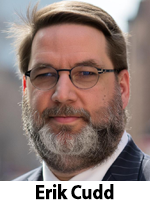 In an opinion piece for TALKERS, radio pro Erik Cudd writes, “In such a time as this, because radio is the medium I know best and love most, I write this appeal to those influential in news/talk. My hope is that you will step forward once again as the architects and innovators you have always been and raise a rallying cry for this unique moment. The freedoms and ambitions that make the format so vital also create challenges. By design, it invites sharp opinions, spirited disagreement, and cultural edge. Those qualities are its strengths. But in our current climate, they also carry the risk of drifting into tribalism and rhetoric that can spill over into something more dangerous. This is not an implication that I believe news/talk is responsible for the death of Charlie Kirk. I would like to be crystal clear. What I am saying is that a perfect storm has been gathering for many years, and no one can deny the polarized, charged landscape we now inhabit. And that storm is not radio’s sole responsibility.”
  Superman just flew into court – not against Lex Luthor, but against Midjourney. Warner Bros. Discovery is suing the AI platform, accusing it of stealing the studio’s crown jewels: Superman, Batman, Wonder Woman, Scooby-Doo, Bugs Bunny, and more.
 Hillsdal 101.7 FM – is managed by Scot Bertram, who says, “‘The Radio Free Hillsdale Hour’ is designed to bring listeners as close to the Hillsdale experience as possible without having to be on campus. You can’t get [to Hillsdale] unless you intentionally want to be here. We have many people who like Hillsdale, love Hillsdale, admire Hillsdale. The show is an attempt to allow them to be close to what we’re doing without being here on campus.” Bertram says that Vince Benedetto, president and founder of Bold Gold Media Group, airs the “Radio Free Hillsdale Hour” on two of his 15 stations and says the show gives variety to his stations, which mostly broadcast conservative talk radio focused on current events.
 Beshear will host a new series of live specials, “Andy Beshear Presents,” airing exclusively on SiriusXM Progress. The series will premiere Tuesday, September 9 at 12:00 noon ET. Beshear will be joined by fellow Progress host John Fugelsang and will take calls from listeners across the country. Governor Beshear says. “I want this podcast to be a space to bring people together – especially in such a stressful and divisive time in our country. This is a conversation with friends and we talk about things that matter to all of us: sports, politics, pop culture, our kids. I’m excited to expand this conversation with listeners across the country on SiriusXM, highlighting a wide range of voices and ideas that can help move us all forward, together.”
 significant role in shaping Salem’s growth and direction. Under his leadership, Salem launched and developed four major digital properties: Salem Web Network, Salem Church Products, Townhall Media, and Eagle Financial Publications. Salem CEO David Santrella says, “David has been an important part of Salem’s journey, and we are deeply grateful for his dedication, professionalism, and leadership over the years.” Salem co-founder Ed Atsinger adds, “David’s impact on Salem has been profound. From his early days as CFO to his leadership in building our digital media presence, his contributions have helped define who we are today. We thank him for his many years of service and wish him continued success in the future.”
 in the U.S. House of Representatives and a filibuster-proof 61 in the U.S. Senate. NAB president and CEO Curtis LeGeyt says, “We thank the growing, bipartisan group of lawmakers standing up for their constituents who depend on AM radio. This support demonstrates a deep understanding that AM radio remains an essential lifeline for emergency alerts, local news and community connection. With significant momentum behind this bill, NAB urges House leadership to bring it to the floor without delay and preserve this vital service for the American public.”
 exclude or marginalize competitors like Newsmax. Further, Newsmax alleges that FOX News, “described in the complaint as a ‘must-have’ channel for distributors, leverages its market power to impose restrictions that harm consumers, stifle competition, and drive-up costs across the pay TV ecosystem.” Specifically, Newsmax alleges that “FOX conditions access to FOX News on
  agreements by distributors not to carry or to restrict competing right-leaning news channels. If distributors carry Newsmax, FOX forces them to also carry low-demand channels like FOX Business or FOX Sports 2 in their most widely viewed tiers, triggering potentially tens of millions in extra fees. These clauses penalize distributors for placing Newsmax in basic packages by requiring simultaneous promotion of FOX less popular channels.” Also, Newsmax alleges that FOX has pressured its guests to not appear on Newsmax, as well as has run online smear campaigns and hired private investigators targeting Newsmax executives to damage the Company’s credibility. Newsmax is asking the court to: 1) Declare FOX’s conduct unlawful under federal and state antitrust laws; 2) Award monetary damages as permitted by law; 3) Enjoin FOX from continuing exclusionary contracts and monopolistic practices; and 4) Order equitable relief to restore competition in right-leaning pay TV news.
 Imagine an AI trained on millions of books – and a federal judge saying that’s fair use. That’s exactly what happened this summer in Bartz v. Anthropic, a case now shaping how creators, publishers, and tech giants fight over the limits of copyright.
 host city for FIFA World Cup 2026. “Ready, Set, Grow” happens on September 5 at the Barnes Foundation. Through the end of 2025 and into 2026, WURD will feature on-air programming, live panel discussions, and multimedia storytelling to provide entrepreneurs and neighborhood business corridors with the tools they need to thrive. WURD president and CEO Sara M. Lomax says, “Ready, Set, Grow is crafted specifically for small business owners and entrepreneurs from across the region who are seeking strategies to leverage the historic momentum of America’s 250th anniversary. We are convening a panel of the experts and decision-makers who are best positioned to share how the small business community can make the most of this moment.” Ready, Set Grow’s panel discussion will feature executives from business and tourism organizations.
 WURD, in partnership with Renee Chenault Fattah and Love Now Media, will spotlight 250 iconic Philadelphians in the 250 days leading up to July 4, 2026. The series begins at Founder’s Day with a tribute to Walter P. Lomax Jr., M.D., WURD president and CEO Sara M. Lomax says, “Freedom Journeys is a celebration of the people who have shaped Philadelphia’s culture, history, and future. This storytelling project ensures that significant Philadelphia figures are not overlooked as we mark the semi quincentennial of this nation’s founding. We’re thrilled to launch Freedom Journeys at Founder’s Day and to honor my father’s extraordinary legacy with a night of joy, music, and community.”
 women’s basketball games this season and a total of 28 episodes of the “Bruin Insider Show” on Thursdays at 7:00 pm. KABC program director Luis Segura comments, “With KABC’s powerhouse signal and UCLA’s legacy teams, Southern Californians will get some of the best in sports programming starting Fall 2025! We are tremendously excited to partner with UCLA as the new official broadcast home of Bruins football and men’s basketball and look forward to turning up the volume on Bruins coverage for our passionate 790 KABC listeners and Southern California sports fans.”
 with a spotlight on alumni pride and community connection.” The station is featuring the syndicated “Miller and Moulton Morning Show” starring Mark Miller and David Moulton. Beasley Tampa VP and market manager Ron deCastro says, “Florida Alumni Radio is more than a station – it’s a destination for Florida sports fans and alumni to come together and celebrate the teams and traditions they love. We’re proud to provide a platform that not only delivers great sports content, but also connects alumni, students, and fans across the Tampa Bay community in a meaningful way.” The station will also serve as the exclusive home for USF Athletics content.


 Imagine SiriusXM acquires the complete Howard Stern archive – every show, interview, and on-air moment. Months later, it debuts “Howard Stern: The AI Sessions,” a series of new segments created with artificial intelligence trained on that archive. The programming is labeled AI-generated, yet the voice, timing, and style sound like Stern himself.
 The station is at 104.3 FM and boasts a 100,000-watt signal. Audacy regional president Claudia Menegus says, “Miami’s sports fans have an unrivaled passion, and they deserve a destination that matches their energy. By adding this powerful FM signal, we’re not just expanding our reach – we’re solidifying WQAM’s position as the undisputed leader in South Florida sports radio.” The weekday lineup consists of “The Joe Rose Show with Hollywood” (6:00 am to 10:00 am), “Tobin & Leroy” (10:00 am to 2:00 pm) and “Hochman, Crowder & Solana” (2:00 pm to 6:00 pm).