


Industry News

Yesterday’s (11/21) Top News/Talk Media Stories

The Israel-Hamas war and the negotiations for the release of the hostages; protests and anti-Semitism; Elon Musk sues Media Matters over content-related advertiser boycott of X; former President Donald Trump’s legal battles; the 2024 presidential race; JFK assassination anniversary; the Thanksgiving holiday weekend; and the firing and re-hiring of Sam Altman at OpenAI were some of the most-talked-about stories in news/talk media yesterday, according to ongoing research from TALKERS magazine.

Industry News

Yesterday’s (11/20) Top News/Talk Media Stories

The negotiations with Hamas over release of the hostages; Elon Musk sues Media Matters over its report on X content that’s caused advertisers to leave the social media platform; OpenAI staff threatens mass exit in wake of Sam Altman ouster; President Joe Biden turns 81; a federal appeals court rules only the U.S. AG can enforce section 2 of the Voting Rights Act; the Thanksgiving holiday and the forecast that could affect travel; former President Donald Trump’s legal battles; the 2024 presidential race; and the Supreme Court rejects Derek Chauvin’s appeal of his conviction in the death of George Floyd were some of the most-talked-about stories in news/talk media yesterday, according to ongoing research from TALKERS magazine.

Industry Views

Pending Business: The Dilemma

By Steve Lapa
Lapcom Communications Corp
President

imWhat’s old is new again.

From Jonathan Swift and Mark Twain to Winston Churchill, Peter Allen and Carole Bayer Sager, historic influencers have been credited with owning that phrase as long as I can remember.

That single concept is one of the foundational principles of media sales, even today. If you have been selling or managing long enough to remember pay phones on street corners, in hotel lobbies and airports, you should have a special appreciation for what follows. Let’s start with:

1. The “Golden Choice: Ratings or Results.” Which would you rather be selling? Top-rated content, or content that generates top performance results? No, they do not necessarily go hand in hand. Just because you sell major-scale delivery, doesn’t necessarily mean your audience will meet the advertiser’s expectation of performance. Like many of you reading this column, I’ve had the privilege of representing both sides of the dilemma; top-ranked content in radio, TV, digital and social media that did not meet the Key Performance Indicator requirements and smaller scale content that delivered annual renewals, year after year. I work with content that generates millions of impressions weekly and content that does not participate in Nielsen surveys, or delivers moderate scale, yet the old dilemma of ratings or results seems new to the newer digital/social media sales teams making calls today.

2. Does the creative match the audience? This is one of my favorite questions, especially when it comes to host-reads. The greatest talents I’ve worked with are never afraid to ask for the creative freedom to tweak copy points to match their audience. Every great host knows the audience. Sometimes it pays dividends to allow for creative freedom and sometimes it becomes a fast track to a cancellation. The difference is the confidence the advertiser has in you and the talent you represent.

3. Just say no, or go with the flow? When business is soft, most sellers and managers will take the short-term test dollars. Thirteen-week minimums become two-week tests and thus a product or service is given a short-term ride on what should be a longer-term campaign. But let’s face it, we’ve all compromised somewhere to help make the cash register ring a little louder. With a respectful nod to every seller and manager, that timeless call is totally up to you.

From local radio sales and podcasts to digital and social media sales, what’s old is new again and again.

Steve Lapa is the president of Lapcom Communications Corp. based in Palm Beach Gardens, FL. Lapcom is a media sales, marketing, and development consultancy. Contact Steve Lapa via email at: Steve@Lapcomventures.com.

Industry News

WTVN, Columbus Unveils New Morning Program

iHeartMedia’s Columbus news/talk WTVN-AM launches a new 5:00 am to 9:00 am show called “Columbus’ Morning News” hosted by station program director Mike Elliott. Contributors to the program include sports director Matt McCoy, news reporter Scott Jennings, traffic reporter Johnnyim Hill, and producer Michael Campana. The station says, “Thirty-year market veteran, Elliott, who started at WTVN in 1999 as the producer for Columbus radio legend Bob Conners, will continue to serve as program director for 610 WTVN. ‘Columbus’ Morning News’ will also feature timely guests and newsmakers to wake up information-hungry listeners with the local and national news they need to start each day in Ohio’s Capital City. Elliott adds, “I’ve done everything on WTVN except host my own show, and now I get that chance. I’m grateful to be working with the most talented team in the business every morning to bring the news to the best audience out there!”

Industry News

Top News/Talk Media Stories Over the Weekend

The Israel-Hamas war, the calls for humanitarian aid in Gaza, and the rise in anti-Semitism around the world; former First Lady Rosalynn Carter dies; polls indicating Americans are not thrilled with Bidenomics; the OpenAI board fires CEO Sam Altman; the 2024 presidential race; Elon Musk threatens lawsuits after X advertisers suspend campaigns; former President Donald Trump’s legal battles; U.S. -China relations; and populist Javier Milei wins Argentina’s presidential election were some of the most-talked-about stories in news/talk media over the weekend, according to ongoing research from TALKERS magazine.

Industry News

Bjorson to Lead Audacy’s Milwaukee Cluster

Audacy names Jason Bjorson SVP and market manager for its Milwaukee market stations that include sports talk WSSP-AM “1250 AM The Fan” and four music brands. He most recently led a new business sales team for an HR tech company in the SaaS space and oversaw advertising sales teams forim Spectrum Cable. During his career he’s also served with Cox Radio in Jacksonville and the former Journal Broadcast Group at WTMJ, Milwaukee. Audacy regional president Rachel Williamson states, “I am excited to welcome Jason to lead our Milwaukee cluster. His experience across radio, video and digital combined with his deep knowledge and relationships throughout the Milwaukee market brings an increased expertise to our cluster and clients.” Bjorson comments, “I’m thrilled to join the Audacy Milwaukee team, with some of Milwaukee’s most iconic brands and an innovative broadcaster. I’ve competed with this team and tried to recruit them for years, so I know how much talent is here. I’m looking forward to working with them to win big here in Milwaukee!”

Industry News

Top News/Talk Media Stories for Week of November 13 – 17

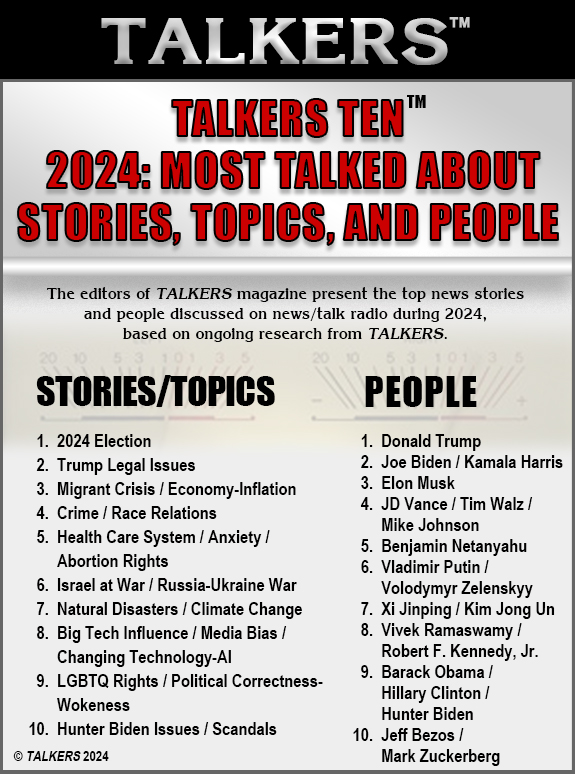
Israel’s battle against Hamas and the humanitarian crisis in Gaza was the most-talked-about story in news/talk media this week, landing atop the Talkers TenTM. At #2 this week was the campus protests over Israel’s invasion of Gaza and the rise in anti-Semitism around the world, followed by this week’s meeting between President Joe Biden and China’s Xi Jinping at #3. The Talkers TenTM is a weekly chart of the top stories and people discussed in news/talk media during the week and is the result of ongoing research from TALKERS magazine. It is published every Friday at Talkers.com. See this week’s complete chart here.

Industry Views

SABO SEZ: Seek New Story Sources and Surprise Your Listeners

By Walter Sabo
Consultant, Sabo Media Implementers
A.K.A. Walter Sterling
Radio Host, “Sterling On Sunday”
Talk Media Network

imEarlier this week, Michael Harrison published his top 10 list of suggestions for being a successful talker. Item number three really caught my eye:

“Avoid worn out talking points. Be original. Always bring something new to the table. Otherwise you DESERVE to be replaced by AI.”

 When consulting client stations, the PD and I will take the on-air team through a pragmatic brainstorm session to discover completely unused source material.

First the material should be intriguing to you and appealing to your listener (singular.) New sources mean surprises and the fastest and most economical method of generating word of mouth, phone calls and cume is to present surprises all day.

1. Close to home. Pay foreground attention to incidents at home. Your home. Events that you may view as mundane could bond you with your listener. Consider that water in the basement, check engine light, parent/teacher conference, bad bank behavior, in-law interference. If any of those experiences has happened to you, you honestly know that they are a bigger deal than speeches in Congress.

2. Search the names of locations that you never discuss. Those searches have revealed to me and my listener that the number one fear in Siberia is the vast forest fires and that as the permafrost melts, it could expose million-year-old deadly viruses. One “Siberia news” search. Try this, search “Keith Fons North Pole Alaska” You will discover a bizarre Christmas story.

3. Local morning TV shows have unique fun stories that you don’t see because you’re listening to the radio. Go to their websites and you will see all of their topics, with audio, dated. 

Take a different approach to proven topics. A trait of successful hosts is that they discuss common topics but take a very different tact. Some examples: When TV legend Ann Bishop of WPLG Miami died, fellow broadcaster Neil Rogers mourned Bishop by saying, “She did nothing for me, sir.”

On crime in Cleveland, the late Mike Trivisonno on WTAM declared, “the best thing that could happen is for the Mafia to come back to Cleveland.”

Howard Stern surprises you every time he opens his mouth. It’s the fresh topics combined with surprising POV=Star. 

Walter Sabo has an outstanding track record advising media companies wishing to increase their share of revenue. His weekly syndicated show Sterling On Sunday aims to provide three hours of completely unique topics.  Contact him at walter@sabomedia.com or 646.678.1110

Industry News

Yesterday’s (11/15) Top News/Talk Media Stories

President Joe Biden meets with Chinese dictator Xi Jinping; the U.S. Senate passes stopgap budget to prevent government shutdown; Israel’s ongoing battle with Hamas in Gaza and the pro-Palestinian protests at DNC headquarters in Washington, DC; former President Donald Trump’s legal battles; the 2024 presidential race; Bidenomics and the state of the U.S. economy; the federal weapons charges against Hunter Biden; and the FBI investigation in to New York City Mayor Eric Adams were some of the most-talked-about stories in news/talk media yesterday, according to ongoing research from TALKERS magazine.

Industry News

WPG, Atlantic City’s Harry Hurley on “Insider 100: Power” List

The publication InsiderNJ is out with its annual “Insider 100: Power” list of the most powerful politicalim figures in the state of New Jersey and WPG, Atlantic City morning drive personality Harry Hurley is ranked #55 on the list. The caption alongside Hurley’s photo in the feature states: “No other radio host show in New Jersey covers politics as hyperactively as Hurley, who has earned the trust of key players in both parties while amplifying the concerns and troubles of regular voters. An asset to the state.”

Industry News

Yesterday’s (11/14) Top News/Talk Media Stories

Israel’s ongoing invasion of Gaza, allegations of a Hamas command center under Al-Shifa  hospital, and U.S. campus protests; the planned meeting between President Joe Biden and China’s Xi Jinping; the House approves Mike Johnson’s spending bill to avoid a government shutdown; the Trump Organization trial in New York City; the investigation into New York City Mayor Eric Adams; the 2024 presidential race; the state of the economy and the Fed’s rate hike plans; and eight teens in Las Vegas face murder charges in the beating death of a fellow student were some of the most-talked-about stories in news/talk media yesterday, according to ongoing research from TALKERS magazine.

Industry Views

Ten Things You Need to Know to Be a Successful Talker (on or off the air)

By Michael Harrison
Publisher
TALKERS

im

10. Have a flight plan before taking off on a monologue.  Know where and when you intend to land the plane.  This is true of any point you’re trying to spontaneously make in the course of a conversation. There’s nothing worse than a talker bloviating in search of a point.

9. Know what you’re talking about.  Don’t just go with half-baked information for fear of being late to the party or are desperate to fill time.  You can’t be an effective talker if you are not an equally effective listener. Also be careful about assuming you are the first to notice or know something when you might actually be the last.  Respect the fact that some of the people you are addressing might be more knowledgeable than you.

8. Take an extra fraction of a second to edit yourself.  Loose lips sink careers. Especially today!  The art of being an effective talker is like being a quarterback.  Get rid of the ball quickly… but not too quickly.

7. Don’t try to be funny if you’re not. This relates to the point above.  However, humor is an effective communications tool when used properly.  The key is to use it properly with an honest assessment of your own “talent.”  Everyone needs a director.

6. Don’t pander to your target audience (too much).  The daily dance of affirmation – telling people exactly what you think they want to hear and never deviating – eventually leads to a happier but ever-shrinking audience that will eventually turn on you. Super-serving the wrong-headed beliefs (or bad taste) of the target audience can lead to slow-but-sure audience erosion.  Don’t be afraid to occasionally piss-off the core. Its good for the soul as well as the cume. Always have an exit strategy. Don’t endeavor to deceive.

5. Don’t deviate too far from the course and point of the conversation.  Tangents disrupt the flow of a meaningful conversation and make people forget what they are talking about.  (This is equally important in off air conversations.)  If mid-conversation someone asks “do you have time for a quick story,” your first impulse should be to say no.

4. Don’t interrupt.  And don’t allow anyone to interrupt you.  If you must interrupt, do so with surgical finesse. Avoid conversations with wind bags.

3. Avoid worn out talking points. Be original.  Always bring something new to the table. Otherwise you deserve to be replaced by AI.

2. Don’t waste people’s precious time. In today’s world, time is as precious as money.  There’s no such thing as “free” media.  It costs people time to listen to you.

1. Know when to keep your mouth shut.  This is one of life’s most valuable lessons, on and off the air.

Michael Harrison is the publisher of TALKERS.  He can be emailed at michael@talkers.com.

Industry News

Yesterday’s (11/13) Top News/Talk Media Stories

Israel’s ongoing invasion of Gaza, allegations of a Hamas command center under Al-Shifa  hospital, and U.S. campus protests; the Trump Organization trial; House Speaker Mike Johnson’s efforts to avoid a government shutdown; Senator Tim Scott suspends his presidential campaign; the Supreme Court adopts a code of ethics; Xi Jinping in San Francisco and President Joe Biden’s planned for Wednesday with China’s dictator; and fire closes the I-10 freeway in California were some of the most-talked-about stories in news/talk media yesterday, according to ongoing research from TALKERS magazine.

Industry Views

Pending Business: We Are Growing

By Steve Lapa
Lapcom Communications Corp
President

imSurvey says nearly half of all Americans over 13, nearly 135 million, listen to spoken word formats. The growth curve boasts an eye opening 52% jump in time spent listening at home.

Please keep in mind we are listening in 2023 via different platforms including AM/FM radio, smartphones, computer streaming, smart speakers, and smart TV. Podcasting is a major driver of this growth curve, almost tripling its share of total audio consumption. And the closer is traditional AM/FM radio is still the morning drive, in-car winner controlling 62% of listening, despite the auto industry’s attempt to shun the king of spoken word distribution – AM radio.

Audio marketers, please pound the drum a little louder when you pitch this growth story. I still haven’t seen this new validation pushed aggressively on X (formerly Twitter) among the Taylor Swift running to hug Travis Kelsey posts, have you? Anything on Instagram? Facebook? YouTube? Rumble? Are we reframing a modern version of that 1600s philosophical “if a tree falls in the forest…?”

All sellers need to take a minute to digest, discuss and integrate the findings in the Edison/NPR Spoken Word Audio report and start the drumbeat of growth, impact, engagement and influence. How else will we pushback on the taken-for-granted, same old-same old, spoken word presentation. Freshen up that media kit! Growth is an important sales point to make in any presentation and audio sellers need to keep pointing to that growth curve as competitors lean in on their own story lines.

Let’s get down to how best to answer W.I.F.A (what’s in it for advertisers) on your next presentation.

1) New. One of the most powerful words in sales and marketing. New information can drive new decisions. Let the numbers help make your point as you shape your presentation.

2) The Trend is Your Friend. Every business owner, entrepreneur, investor and CEO always want to be informed and in front of growth trends. You now have the opportunity in front of you.

3) Keep it Simple. Keep your information simple and easy to understand. Many influential newsletters use the simple technique of a bold number followed by a fast fact story line. If it works for the big boys, the technique should work for you.

4) Managers. Bring good news to your sales and marketing teams. Sellers, bring good news to your advertisers. The survey says we are growing, and positive growth is an important part of any business.

Steve Lapa is the president of Lapcom Communications Corp. based in Palm Beach Gardens, FL. Lapcom is a media sales, marketing, and development consultancy. Contact Steve Lapa via email at: Steve@Lapcomventures.com.

Industry Views

Monday Memo: How Talk Radio Imitates Lunch

By Holland Cooke
Consultant

imHere’s actual news copy, from Joe Connolly’s business report one morning on WCBS, NY: “One third of all domestic flights are now late, by an average of one hour.”

Note: That wasn’t the headline, it was the entire story. As-much-as half of Connolly’s script is one-sentence stories. Espresso, not latte. Just the factoids, ma’am. The essence. What the listener would likely retain (and quote later) from the story if copy were longer.

Here’s some HC lore – and promo language – that’ll be familiar to programmers and talent I work with:

The first 5 minutes of the hour are for facts.

The next 55 are for feelings.

Your news people, and/or your network, fuss to make 00-05 a handy digest of the-very-latest-about the stories they reckon to be relevant to your target listener. Your on-air imaging should promise accordingly. Invite busy, in-car listeners to make an hourly appointment, “THROUGHOUT YOUR BUSY DAY.”

The people with whom that benefit statement will resonate are high-TSL users who don’t want to feel “OUT-OF-THE-LOOP, WHEN YOU’RE OUT-AND-ABOUT.” And they’re the listeners your local direct retail advertisers want to meet the most. Every time they stop the car, they spend money.

im

What happens at lunch is what should happen on-air

Picture Jerry, Elaine, George, and Kramer at that coffee shop on “Seinfeld.”

Suppose Jerry heard Connolly’s report earlier that morning and mentioned that story. Because ratings are a memory test, this is a home run, even if Jerry doesn’t say “WCBS” when he repeats what Joe reported. Joe made a deposit in Jerry’s memory bank. If Jerry does say “WCBS,” it’s a grand slam.

Then, George chimes in: “AN HOUR LATE???  THAT’S NOTHING!  WAIT’LL YOU HEAR WHAT HAPPENED WHEN MY PARENTS TRIED TO FLY TO FLORIDA LAST WEEK!” Now Elaine and Kramer are engaged; and they too might have stories.

Jerry shared what he heard 00-05, information of interest, facts. George is that first caller you want the screener to put through. Elaine and Kramer are listeners who can relate, might contribute their feelings, and will at least remember.

Because ratings methodology can give you an entire Quarter Hour credit for as-little-as 5 minutes of actual listening, the-most-opportune topics are compelling stories listeners just heard on-hour, which you then offer callers your air to weigh-in-on.

Why? People believe your promos. They stopped-in for their on-hour update. Then, at 05, before an index finger can travel from the steering wheel to the “Kiss” or “Lite” or “Magic” button, engage them.

Holland Cooke (HollandCooke.com) is a consultant working at the intersection of broadcasting and the Internet. He is the author of “Close Like Crazy: Local Direct Leads, Pitches & Specs That Earned the Benjamins” and “Confidential: Negotiation Checklist for Weekend Talk Radio.” Follow HC on Twitter @HollandCooke

Industry News

Top News/Talk Media Stories Over the Weekend

Israel’s Continues its advance into Gaza in its war against Hamas; U.S. attacks on armed groups in Syria; Senator Tim Scott suspends his presidential campaign; House Speaker Mike Johnson’s attempts to avoid a government shutdown; FBI investigates NYC Mayor Eric Adams over Turkish Consulate General project; President Joe Biden to meet with China’s Xi Jinping in San Francisco; the Trump Organization fraud trial; and UK Prime Minister Rishi Sunak fires home secretary Suella Braverman over criticism of police were some of the most-talked-about stories in news/talk media over the weekend, according to ongoing research from TALKERS magazine.

Industry News

NPR and Edison Research Unveil Spoken Word Audio Report

The fifth edition of the The Spoken Word Audio Report from NPR and Edison Research was unveiled during a webinar presented yesterday (11/9). The 2023 edition concludes that spoken word audio listening time and audience size “attained record highs in the U.S.” This report places special focus on listening locations and explores spoken word audio consumption at home, at work, in-car, and other locations. Some of the key findings include: 1) Almost half (48%) — approximately 135 million people — of those in the U.S. age 13+ listen to some type of spoken word audio daily, up two percentage points (46%) from last year. Listeners in the U.S. age 13+ spend 31% of their daily audio time with spokenim word, which is a 55% increase over nine years ago (20%); 2) Spoken word listening at home has grown dramatically: 60% of the total daily audio time spent with spoken word audio is at home, 24% in the car, 13% at work, and 3% at some other location. The time spent listening to spoken word audio at home has grown to 41 daily minutes in 2023 from 27 daily minutes in 2014. Increases in at-home spoken word audio listening are seen across every hour in the listening day; 3) Spoken word listening in-car has shifted post-pandemic, but AM/FM radio remains on top: Of all the daily time spent listening to spoken word audio, time spent listening in the car has declined from 36% in 2014 to 24% in 2023. In the car, 62% of spoken word audio consumed by those in the U.S. age 13+ is to AM/FM radio content, including over the air and streams; 4) For the first time ever, the mobile device is the primary way people listen to spoken word: 39% of spoken word audio consumed daily by those age 13+ in the U.S. is on a mobile device, followed by 35% on an AM/FM radio receiver. At home, 41% of spoken word audio is consumed on a mobile device, and at work, 47% of spoken word is consumed on a mobile device. AM/FM radio receivers still dominate in-car, garnering 60% of the spoken word audio listening there; and 5) Podcasts represent a large and growing share of spoken word listening: Podcasts now represent over one-third (36%) of time spent with spoken word audio. Twenty-eight percent of time spent listening to podcasts goes to NPR/public radio. At home, 40% of spoken-word audio listening goes to podcasts. See more about the study here.

Industry News

iHeartMedia Names Angel Jarquin SVP of Programming

iHeartMedia announces that Fresno market programmer Angel “Visa” Jarquin is named SVP of programming for the Pacific Area that includes Fresno, Riverside, Monterey, Modesto, Stockton,im Bakersfield and Spokane. In his new role as SVP of programming, Jarquin will be responsible for the oversight of programming and promotions across all Pacific Area iHeartMedia stations. iHeartMedia Pacific Area president Steve Darnell says, “Angel has a successful track record programming some of the most dynamic station brands in the market. His creativity, leadership and background on-air make him perfectly positioned to lead our station programming to connect with listeners throughout the Pacific Area.”

Industry News

Top News/Talk Media Stories for Week of November 6-10

The ongoing Israel-Hamas war, including the humanitarian crisis in Gaza, was the most-talked-about story in news/talk media this week, landing atop the Talkers TenTM. At #2 this week was the protests against Israel’s Gaza invasion, the rise in anti-Semitism, and the censure of U.S. Rep. Rashida Tlaib, followed by the results of Tuesday’s elections at #3. The Talkers TenTM is a weekly chart of the top stories and people discusses in news/talk media during the week and is the result of ongoing research from TALKERS magazine. It is published every Friday at Talkers.com. See this week’s complete chart here.

Industry News

Audacy’s 2023 Q3 Net Revenue Down 5.6%

Reporting its operating results for Q3 of 2023, Audacy says net revenue for the period was $299.2 million, down 5.6% from the same period in 2022. The company reports a net loss of $234 million, up from the net loss of $141 million it reported in Q3 of 2022. The company reveals that local spot revenue was down 3%, national spot revenue declined 15% and network advertising revenue was down 5%. Digital revenue was $64.8 million, up 3% compared to the third quarter of 2022. Audacy also reports broadcast radio revenue by format and notes that news/talk format revenue was $43.35 million, a decline of 10.8% year-over-year. Sports talk revenue was basically flat at $72 million. Music format revenue wasim $145.7 million, down 7.1% year-over-year. Audacy president and CEO David J. Field states, “Audacy’s third quarter net revenues declined 5.6%, in-line with our quarterly guidance as ad market conditions have remained challenging, particularly on national business. Cash operating expenses were down 2%. We gained revenue share in the quarter, most significantly in radio in which we have achieved accelerating share growth since the start of the year. We also delivered solid gains in radio ratings share and digital audience metrics while making important progress on our tech roadmap and meaningful expense savings to improve our current and future business model. Fourth quarter is currently pacing down 9% on an as reported basis and down 4% on a same-station, ex-political basis. We expect Q4 total revenues to decline by high single digits and costs to decline by high single digits. As noted in our recent public filings, we remain in constructive conversations with our lenders to recapitalize the company’s balance sheet to establish a strong financial footing and position the company to capitalize effectively on our growth opportunities. Notwithstanding current challenges, Audacy has established a strong position as a scaled, leading multi-platform audio content and entertainment company distinguished by our exclusive premium content and top positions across the country’s largest markets. We salute our team for their strong work delivering solid growth against our key performance metrics and serving our listeners and customers with excellence.”

Industry News

Yesterday’s (11/8) Top News/Talk Media Stories

The results of Tuesday’s elections and chatter about what it means for the 2024 presidential race; Hamas and Israel are accused of war crimes by UN rights chief; the Trump Organization trial in New York City; the GOP presidential debate and the Miami Donald Trump rally; the U.S. migrant crisis; the DOJ announces investigation into high-end brothel frequented by execs, doctors and politicians; and the House Oversight Committee subpoenas Biden family members were some of the most-talked-about stories in news/talk media, according to ongoing research from TALKERS magazine.

Industry News

Yesterday’s (11/7) Top News/Talk Media Stories

The Israel-Hamas war, the dire situation in Gaza, and U.S. protests over civilian deaths; Ohio’s referendum on abortion rights & other election day races; testimony in the Trump Organization case in New York; SCOTUS hears gun bans for domestic abusers case; Russia pulls out of the Treaty of Conventional Armed Forces in Europe; China’s Xi Jinping to appear as guest of honor at Asia-Pacific Economic Cooperation conference in San Francisco; and King Charles III gives the “King’s Speech” at the opening of Parliament were some of the most-talked-about stories in news/talk media yesterday, according to ongoing research from TALKERS magazine.

Features

How News/Talk Radio Should Adapt to Attract and Retain a Younger Audience

By Bill Bartholomew
Talk Host/Podcaster/Journalist/Musician

imFolks in the Gen Z and millennial demographics are heavily engaged in political issues, care about news in their communities and the world, and are constantly bombarded with content.  So why are they less likely to tune into and interact with news/talk radio than older demographics?

Talk radio has historically skewed older, and from an ad portfolio standpoint, is often targeted at the coveted 35-54 and 55+ demographics.  However, in a world where social media influencers and podcasters supply information to millions of young consumers, news/talk radio should be able to effectively compete for the ears of younger generations in a comparable, if not expanded way.

For all of the anecdotal and hard evidence that terrestrial radio may be trending in a downward direction, the format continues to have a vast reach.  It is convenient to engage with it in automobiles, and occasionally in home or office settings.  Yet, while younger generations listen to radio, news/talk is not the format that they turn to by and large.

Unlike many digital-first content producers, radio retains a unique quality: authority.  By virtue of editorial standards, FCC regulation and brand – things that social media and podcasts often lack – radio has the unique ability to deliver credible, vetted, nuanced and universally trustworthy content that can instantaneously adapt to meet the needs of the moment.  This is true in everything from natural disasters to rapidly evolving breaking news stories, providing a channel for immediate, reactionary insight and analysis.

There are several steps that news/talk radio should pursue in earnest to adapt to the current climate of content consumption, particularly by younger listeners, that can reach, and most importantly, retain broader, younger, more diverse and more engaged audiences.

  1. Introduce younger people into the conversation.

Too often, Gen Z and millennials are skewered by older hosts, mocked for their perceived naivety, unchecked optimism and me-first approach.  While some of these qualities can be accurate, that approach reflects a disconnect between older generations and the experience of younger ones.  Millennials and Gen Z have grown up in a post-9/11 world replete with “endless wars”, the fallout from the 2008 financial crisis, runaway student debt, a massive housing crisis, the mental health stressors of social media, Covid19’s impact on traditional youth experiences, climate change, a deeply bifurcated political environment and a constantly evolving quest for social justice.  Through these experiences, younger generations offer an important perspective that should be assigned the same news value as experts from older generations.

Are you discussing shifts towards electric vehicles?  Bring on someone from Gen Z to share their perspective on why steps towards carbon neutrality are important to them.  Engaging a conversation on the president’s approval rating?  Perhaps younger conservative and leftist voices should be included in the conversation.  Discussing immigration?  How about the perspective of a younger member of a Latino organization?

By giving younger generations and more diverse guests a platform, stations can simultaneously expand their content and reach.  With consistency, the station’s brand will become more familiar to younger potential listeners who may be inclined to tune in to hear someone who shares their identity and perspective on – here’s that word again – a platform of authority.  Let the guest do the work of establishing the credibility and importance of your station or talk show to younger audiences by posting about their appearance on social media, sharing audio clips and mentioning to their peers.  It will build familiarity and trust among those generations, who in turn, will begin to tune in on a more regular basis.

Stations should also consider bringing more younger, competent voices into on-air roles, whether that be through reporting, segments, fill-in hosts, weekend shows or full-time hosts.

  1. Meet the audience where they are: their phones. 

As mentioned above, the convenience of simply turning on AM/FM radio is highly appealing in automobiles, though as Apple Carplay continues to adapt and evolve, digital-first content is likely to become as simple and convenient in the near future.

Talk radio needs to make consuming their product on smartphones as simple and direct as turning on a traditional radio.  This means no clunky websites, no lengthy pre-roll spots, a reliable stream connection and a “one touch” means of turning on and off the station.  This should also mean expanding talk shows to high-quality video livestreams, following in the footsteps of the top YouTube and Twitch performers; developing unique content for TikTok and Instagram; building podcasts that are focused on specific issues, and; providing interaction via text and chat.

Radio has the ability to be the ultimate livestreamer, social media influencer and podcaster, but rarely harnesses these platforms in a meaningful way.

It is not enough to simply strive to “expand a digital presence”; stations and shows must engage in the hard work of building platform-specific content with their brands.

  1. Music, cultural references and themes for the modern age.

A few weeks ago on a seemingly benign episode of the TV show FOX NFL Sunday, panelists Jimmy Johnson and Terry Bradshaw offered an example of the type of cultural adaptation that sophisticated writers and producers provide their brands.  While describing a fight between two football players, Mr. Johnson said something to the effect of “when it comes to these two, what’s that Taylor Swift song?”, and then in synch with Mr. Bradshaw, “bad blood!”.  It is highly unlikely that these two 70+ men listen to Taylor Swift’s music with any regularity or would simultaneously pull the “Bad Blood” reference.  Yet, with excellent preparation that played into the greater cultural moment as well as the specific, current Taylor Swift/NFL overlap, in a six-second span, FOX NFL Sunday was able to give the illusion that their panelists are contemporary, hip and plugged into “what is going on”.  Is your station or show plugged into what’s going on?  Do you use contemporary music for bumps?  Are your images – including headshots and social content – modern, interesting and engaging or are they more akin to a miscellaneous real estate agent?  You are a performer in an entertainment business that, while certainly paying homage to the past and lineage of the industry, must be contemporary in aural and visual presentation.  This goes for everything from wardrobe on video and in photo to fonts on graphic design.

How often do you or your producer read Pitchfork to learn about new music that is breaking this week?  How often do you or your producer read Variety to understand major trends that are happening in the broader entertainment industry?  What live events are you broadcasting from, covering and building partnerships with?  You should strive to be cutting edge.

  1. We need a friend now more than ever.

This is something that goes for all audiences, but particularly for younger ones.  It’s OK, in fact, great to be yourself, present yourself from your generation and retain the authoritative stance that has built your brand.  Take a look at the success that sports talker Mike Francesa enjoyed by leaning into his persona – and in turn – developing legions of younger listeners that fell in love with his dad-like delivery and frequent meltdowns.

Few things are as uncomfortable to see as a 40+ person dressing or acting like a teenager.  Younger listeners want that senior, experienced, trusted friend to entertain them, inform them, and at times, tell them that everything is going to be OK.  You can help make sense of the world for younger audiences, something that is absolutely essential in the modern era.

Through attracting younger listeners by including them in the conversation, effectively delivering content on smartphones, presenting a cutting-edge entertainment product and continuing to serve as a trusted friend, news/talk radio can greatly expand its reach, relevance and revenue.

To that point, some younger listeners who discover a radio station or show via any of the above entry points will likely work backwards to the traditional AM/FM dial.  Like the resurgence of vinyl records, AM radio in particular has the opportunity to become a hip delivery format for discerning younger listeners.

The big question is: are radio companies, stations and hosts prepared to do the hard work of reimaging their product?


Bill Bartholomew is a talk radio and podcast host/producer, journalist and musician based in Providence, Rhode Island. Email him at: william.f.bartholomew@gmail.com. 
Industry News

Dave Williams Retires from KLIF, Dallas

In a post on Facebook, KLIF, Dallas morning personality Dave Williams announces his retirement from the “DFW Morning News” program. He writes, “Three months ago I suffered a blackout seizure. I’ve been recuperating and undergoing tests since then. The medical news is as good as can be hoped: Iim didn’t have a stroke or a heart attack and I don’t have a brain tumor or anything like it. Turns out it’s just one of those unexplained things that happen and very likely will never happen again. I’ve been cleared to return to work but have decided to call it a career. I’m 72, I’ve been in radio for 54 years, and for the past 42 years, I’ve been getting out of bed in the middle of the night to go to work. I just discovered I like sleeping in a bit. I will miss the daily enjoyment of the job and especially the people with whom I worked. And, thanks most of all to those of you who listened each morning and found some informational and entertainment value mornings on KLIF. Nothing lasts forever but I’m going to try. Stay well, y’all. Love your life. This is the month for giving thanks.”

Industry News

Yesterday’s (11/6) Top News/Talk Media Stories

The Israel-Hamas war, the dire situation in Gaza, and U.S. protests over civilian deaths; former President Donald Trump’s testimony in his company’s fraud trial in New York; the poll showing Trump leads President Joe Biden in several swing states for the 2024 election; the Ohio abortion referendum and today’s other elections; and SCOTUS hears gun bans for domestic abusers case were some of the most-talked-about stories in news/talk media yesterday, according to ongoing research from TALKERS magazine.

Industry Views

Pending Business: Fall Back

By Steve Lapa
Lapcom Communications Corp
President

imWe all need to learn how to fall back. This is not about daylight saving, retreating, or backpedaling. This is about learning from the most valuable brand in tech, the oracle, and the best practices all of us in sales and management must learn to apply.

Let us start with Apple. Demand for the iPhone 15 is not lighting the tech world on fire as slow sales do not even come close to measuring up to the numbers delivered by its predecessors like the iPhone 13 when sales jumped 47% two years ago. What happened to all those Apple fanatics who would line up outside Apple stores or flood the Internet with orders ready to buy the next iPhone?

The must-have Apple loyalists were slowed down by the glitches in the iPhone 15 as we have come to expect design perfection. And why not, when you have nearly 1.5 billion users worldwide and sell nearly 100 million iPhones in the first two quarters of this year? Perfection expectations go hand-in-hand with momentum, innovation, and sales. Perhaps the challenge after 16 years of “new and improved” was too much. Tech is not Tide and Apple is not Procter and Gamble.

What are the lessons we can learn from this lower sales cycle?

— Never assume an unqualified welcome sign from your core customers. We earn the welcome sign every day. Fix the problem faster.

— Always deliver on the promise of new and improved.

— Better to delay than disappoint.

Famed Wall Street guru Warren Buffett recently dealt with losses in several of his holdings by being transparent with his stockholders about the challenges at several of his companies and navigating an unfriendly stock market. This is the same Warren Buffett who supported the Cap Cities minnow (remember that company?) swallowing the ABC Radio whale and still is a stakeholder in media.

The 93-year Oracle of Omaha is nimble enough to shift strategies and adjust his investments to maximize results for his stakeholders.

The Buffett takeaways?

— When performance is not up to expectations, adjust the plan.

— Age can be an asset when experience counts.

— When you are in hole, stop digging.

How many traditional packages and sales promotions have you counted on as sure-fire sellers that unexpectedly failed? What does your fallback plan look like?

Steve Lapa is the president of Lapcom Communications Corp. based in Palm Beach Gardens, FL. Lapcom is a media sales, marketing, and development consultancy. Contact Steve Lapa via email at: Steve@Lapcomventures.com.

Industry News

Top News/Talk Media Stories Over the Weekend

Israel’s fight against Hamas, pleas for restraint in the wake of civilian deaths, and the protests taking place in the U.S.; former President Donald Trump’s legal battles; the 2024 presidential race; Tuesday’s elections; the Russia-Ukraine war; the mass shooting in Cincinnati; and the debate over daylight saving time were some of the most-talked-about stories in news/talk media over the weekend, according to ongoing research from TALKERS magazine.

Industry Views

Monday Memo: TV Synergies

By Holland Cooke
Consultant

imI am always impressed when I see-and-hear radio and TV stations swapping product.

— The most obvious asset is weather. Many radio stations’ forecasts are voiced by local television meteorologists, often gratis because their boss assigned them to, as part of an information alliance. So, the radio station’s weather cred’ stands on the broad shoulders of the weather brand the TV station promotes so relentlessly.

— For some news/talk stations, simulcasting a television newscast is the only way they can air local news in the afternoon. Turn lemons into lemonade. Radio people who love to hate TV audio under-estimate how loyal viewers are; and how conspicuous and convenient this can make the radio station.

— Especially if the deal includes promos – on both stations – voiced by trusted local TV anchors, offering that “If you can’t be home in time to SEE us, you can HEAR us…”

— In every market where we have executed this strategy, the TV talent has remarked about how many compliments they get for being on radio.

— Deal point: During simulcast newscasts, the TV station supers “Heard live on WXXX 8:50 AM.”

How’s THIS for resourceful?  

— A radio station’s afternoon drive newscast consists of a 60-second live shot (or prerecorded live-on-tape) from a local TV newsroom, voiced by the TV anchor who ticks-off “the stories we’re following” that will be seen on evening newscasts.

— The radio station wraps it into a four-minute package, including:

— that live headline package, at the end of which

— the TV anchor hands off to radio’s traffic reporter, then…

— the traffic reporter teases weather into a radio spot, and…

— after the commercial, the weather comes on.

— And here’s the kicker…that live shot from the TV newsroom is a commercial for the TV station! To the listener’s ear, it’s a free newscast from a credible, branded source. Possibly a trade for TV time to advertise the radio station?

im

Another win-win synergy: Reciprocal excerpting, with attribution 

Translation: Each station gives blanket permission for the other to grab, from the air, whatever it wants, crediting the originating partner.

— There will be times when someone from the radio station is on-scene; or when radio scores a newsworthy interview that TV can use the audio of. More often, thinner-staffed radio will use TV sound more than vice-versa.

— When I programmed WTOP, Washington, WUSA9 let us help ourselves to their newscast audio (“And the mayor told Channel 9…”). Each day, our desk and theirs compared assignments, and we recorded every WUSA newscast.

— True story: The news director from NBC4 came to my office and said, “You can use OUR sound, and you don’t even have to say ‘Channel 4!’ Just STOP saying ‘Channel 9.’”

— It was a flattering offer, but we remained loyal to WUSA, the once-upon-a-time WTOP-TV. Decades later we were still getting mail addressed to “WTOP-TV.” And both stations being CBS affiliates contributed to the lingering impression that we were siblings, so the confusion was actually useful. Does your radio station have a long-lost TV brother? 

Radio takes TV where it otherwise can’t go: in-car

Note how aggressively TV stations are programming their apps and websites. They want to be a news brand, not just a news station.

— A smart TV station should want to give radio a ROSR (Reporter On-Scene Report) during the day (when radio audience is high and TV audience is low), because doing so serves to promote the upcoming evening TV newscast.

— WARNING, based on experience: This can be a tough sell to over-protective TV news directors, who may fret that by going-live on radio they’re alerting other TV stations to the story. Stinkin’ thinkin.’ Other TV stations could show up anyway, and they wouldn’t be as-well-known for covering the story as the TV station that’s also already reporting it on radio.

Local TV news is a hungry critter…

…with a limited budget. Which is why some TV stations toss-live to their radio partner’s host: “Gene, what are your callers saying about the congressman’s abrupt resignation?” Arrangements like this were commonplace even decades ago, when TV had to equip the radio studio with equipment more elaborate than modern day video chat requires.

The calculus is simple

Radio + TV > Radio – TV or TV – Radio

(Radio PLUS television is greater-than Radio MINUS television or television MINUS Radio.)

Even if you’re a music station that doesn’t do much news at all, these opportunities are worth exploring. At least trade spots, because neither station can afford to promote as much as it should.

Holland Cooke (HollandCooke.com) is a consultant working at the intersection of broadcasting and the Internet. He is the author of “Close Like Crazy: Local Direct Leads, Pitches & Specs That Earned the Benjamins” and “Confidential: Negotiation Checklist for Weekend Talk Radio.” Follow HC on Twitter @HollandCooke

Industry News

Sandy Maxx Hosts New Show on WTMJ, Milwaukee

WTMJ, Milwaukee air personality Sandy Maxx is hosting a new evening program on the Good Karma Brands station that airs nightly at 6:00 pm called “What’s On Tap?” Maxx says, “I’m pleased toim announce that I will be back on the air with my new show called ‘What’s On Tap?’ This hourlong show is set to air on most weeknights at 6: 00 pm barring conflicts with Bucks & Brewers games, featuring culture and creativity in Wisconsin and around the world.” The show launched last night and featured content from Maxx’s recent trip to England in which she interviewed Sue Harvey of The Beatles landmark Strawberry Field in Liverpool as well as an audio tour of the Beatles-themed Airbnb in Green Bay. Maxx most recently co-hosted the station’s late morning show with host Steve Scaffidi.

Industry News

Top News/Talk Media Stories for Week of Oct. 30 – Nov. 3

Israel’s ongoing bombardment of Gaza in its war with Hamas was the most-talked-about story in news/talk media this week, landing atop the Talkers TenTM. At #2 this week was the campus protests over Israel’s reaction to the Hamas attacks and the rise in anti-Semitism around the world, followed by the legal battles facing former President Donald Trump at #3. The Talkers TenTM is a weekly chart of the top stories and people discussed in news/talk media during the week and is the result of ongoing research from TALKERS magazine. It is published every Friday at Talkers.com. See this week’s complete chart here.

Industry Views

The Vital Element of Surprise

By Walter Sabo
Consultant, Sabo Media Implementers
A.K.A. Walter Sterling
Radio Host, “Sterling On Sunday”
Talk Media Network

Visitors to Disneyland five years ago will be given a memorable experience when they visit this month. About 50% of Disneyland has changed since 2018. The theme park constantly changes, trying new rides, exhibits, displays. Walt Disney never considered his park to be finished. Roy Disney said that Walt viewed Disneyland as a giant block of clay which could be molded and remolded constantly. Changing the park constantly gives visitors surprises, joy and the excitement of the unexpected. The unexpected at Disneyland is newness in its ideal form: Everything is new, memorable and completely safe.

Your show, music or talk, has the same power to create memorable entertainment. Wrapped in the safety of your voice, and your familiar station, you can SAY the unexpected, the surprising, the new.

Remember when the news was a radio station? Remember when a radio station generated word of mouth, talk at work, and gossip among friends? It could have been yesterday or years ago. A radio station or on-air talent was at the epicenter of the community’s conversation when it did the unexpected. 

The short list 

A station said the name of your business. Gave away an outrageous prize. Roasted a pig. Lesbian Dial-A-Date. Broke a record. Asked the caller if they were naked. Aired Amazing Mouth TV Spots. There is no top-of-mind real estate claimed by a station if it is following the format really well.

Delivering surprises is not hard, but it is essential to the medium’s growth. Today, the most recent “surprises” have been all wrong. Too often the surprise is the public shaming and forced apology of a host because of an unfortunate comment about Erin Andrews or slight of a team owner.  (BTW, the single dumbest management move is a public apology. Thousands of people learn of the incident who would never have known about it if the moment was allowed to pass.)

You may be worried that if you or an air talent break the corporate dictate format, all will be fired. No. You know where you can experiment. Your experiment could lead to a new, fresh awareness of your station and of your hard work. Do it.

WALTER SABO’s company, Sabo Media has advised the C Suite of some of America’s largest media companies including SiriusXM Satellite Radio, Apollo Advisors, Conde Nast, Wall Street Journal Radio, RKO General, and NBC. He is a member of the Nominating Committee of the national Radio Hall of Fame and on the Dean’s Advisory Board of the Newhouse School of Communications at Syracuse University.  His radio show, “Sterling on Sunday” is heard nationally.www.waltersterlingshow.com  Contact him at walter@sabomedia.com

Industry News

Salem Partners with Just The News for Podcasts

Salem Media Group announces a new partnership between the Salem Podcast Network and Just Theim News for its podcasts from John Solomon, Victor Davis Hanson, and “Bauer and Rose” on the SPN platform. The agreement allows Salem to market and sell the podcasts to its array of advertisers and provide additional promotional support. Salem SVP Phil Boyce says, “John Solomon and his team are a perfect fit for Salem and will provide an additional layer of news credibility to the stories he covers. When you add Victor Davis Hanson’s podcasts, and those of Bauer and Rose, it makes the partnership complete.” Solomon comments, “Salem Podcast Network has amassed one of the most formidable audiences and lineups in the industry. We are excited to be joining the team and introducing our news and analysis to a whole new audience.”

Industry News

Broadcasters Foundation Launches Year-End Giving Campaign

The Broadcasters Foundation of America launches its annual Year-End Giving Campaign this week. The 501c3 charity provides financial aid to broadcast radio and television colleagues who are in need due to debilitating illness, accident, or tragedy. The Year-End Giving Campaign asks for personal tax-imdeductible donations to the Guardian Fund. Corporate donations can be given to the Angel Initiative, which is also tax deductible. BFoA chairman Scott Herman states, “Life can change in a heartbeat, and exorbitant medical bills can leave one of our colleagues in broadcasting in desperate need of assistance. I’m asking everyone in radio and television to consider a donation, in any amount, so that we can continue to provide assistance to those in our industry who need it most.” Find information about the Broadcasters Foundation and donate or apply for aid here.

Industry News

Free Talk Live Continues Distribution Via GCN

The nationally syndicated talk radio show “Free Talk Live” continues to be distributed by Genesis Communications Network after that company and Westwood One were unable to come to terms on a new satellite distribution deal. FTL founder Ian Freeman says the show continues with GCN via itsim ECHO box technology. He says, “GCN’s Adam Miller explains that their ECHO Files can easily be synced with most radio automation systems for easy delay broadcast with no new hardware needed and about fifteen minutes setup time! There is no need to have staff do daily chores like pulling files manually from an FTP or website. Those days are done! For live affiliates GCN has their ECHO Box that comes pre-programmed for the shows the affiliate carries. The ECHO Box can also do delay broadcast. They are sending these out with priority to stations that take the largest number of live hours, but eventually all live affiliates will receive them as dozens more of the very small ECHO Boxes will be coming in early November.” Affiliates with questions can call Adam Miller at 612-695-5982.

Industry News

TALKERS News Notes

The Alliance for Women in Media (AWM) announces a new partnership with the International Coaching Federation Foundation (ICF) that will provide AWM members with the unique opportunity to access professional coaching at an exclusive discounted rate. Participants in the AWM Coaching program can anticipate a series of six to 10 coaching sessions with their individual ICF Coach, ensuring a productive and tailored coaching experience. The schedule and goals for these coaching sessions will be established between the coach and participant. Learn more about the program here.

Gemini XIII’s United Stations Radio Networks announces a new partnership with Yea Networks to represent the advertising sales for “The Kidd Kraddick Morning Show.” Gemini XIII CEO Spencer Brown states, “The Kidd Kraddick Morning Show is one of the most popular and successful morning shows in the country, and we are confident that sponsorships, cross-platform opportunities and activations for brands will once again be a part of the media mix for clients looking to activate with female demos in a meaningful way.”

FOX News Audio expands its partnership with Audacy to include FOX Weather, FOX News Media’s free, ad-supported streaming television (“FAST”) weather service. This deal expands FOX News Audio’s existing relationship with Audacy, which also distributes FOX News Podcasts and the FOX News Talk audio streams.

Industry News

Yesterday’s (11/1) Top News/Talk Media Stories

The ongoing Israel-Hamas war, international pleas for humanitarian pause in Gaza attacks and the increasing incidents of anti-Semitism globally; the Fed keeps interest rates at current level; former President Donald Trump’s legal battles; House Speaker Mike Johnson’s leadership; GOP frustration over Senator Tommy Tuberville’s hold on military nominees; the 2024 presidential race; Tuesday’s Ohio ballot issue on abortion access; and legendary college basketball coach Bobby Knight dies were some of the most-talked-about stories in news/talk media yesterday, according to ongoing research from TALKERS magazine.