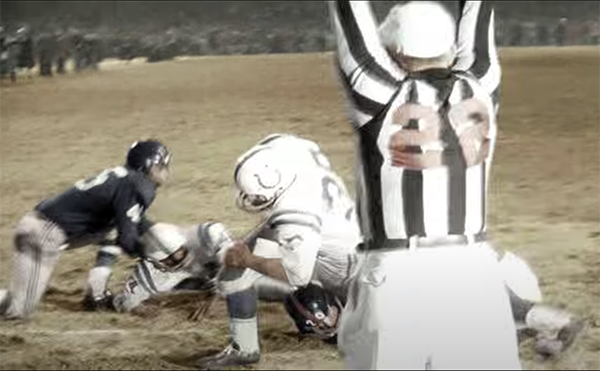
Baltimore’s Alan Ameche plunges over the goal line for the winning touchdown!(courtesy YouTube/NFL Films)
On the field? Maybe. In its impact on pro football and sports broadcasting? Absolutely!
By Mark Wainwright
 It was one of those indelible moments in sports history: The 1958 NFL Championship, played on December 28, 1958 at Yankee Stadium in New York. The Baltimore Colts defeated the New York Giants 23-17 in sudden death overtime. 65 years later, the events of that Sunday afternoon still resonate throughout pro sports and sports media.
In 1958, the National Football League was far from the huge phenomenon we see today. Americans generally had much more interest in baseball, and during the Fall, college football captured the attention of sports fans on Saturday afternoons. The annual Army/Navy and Harvard/Yale clashes were national news stories, and fans followed the exploits of powerhouses like Notre Dame and Michigan. For most fans, pro football was an afterthought. Even in cities with pro franchises, the NFL clubs often played runner-up to the local baseball teams.
Baltimore and New York were two exceptions. The Colts were upstarts — Baltimore didn’t get an NFL team until 1953 — and the city quickly fell in love with the Colts; on game days, Baltimore’s Memorial Stadium was described as “the world’s largest outdoor insane asylum.” Meanwhile, the Giants had been part of the NFL since 1925, and they were considered the league’s most glamorous team, located in the world’s media capital. Two very different teams, both with passionate fan bases, playing a nationally-televised title game in New York City… indeed, America was destined to notice pro football that day.
Seventeen Pro Football Hall of Fame inductees were in the stadium that afternoon, along with a Heisman Trophy winner (Baltimore running back Alan Ameche). The Colts were led by quarterback Johnny Unitas and defensive end Gino Marchetti. The New York offense revolved around halfback Frank Gifford, while linebacker Sam Huff anchored the defense.
There were all-stars in the broadcast booths, as well. NBC’s national telecast was assigned to Chris Schenkel and Chuck Thompson; both of these gentlemen are now legends of their industry. Joe Bolan and Bill McColgan called the game for NBC’s national radio feed, while Les Keiter did the play-by-play for WCBS Radio in New York. And Bob Wolff did the radio call for Baltimore’s WBAL. Wolff was assisted by an eager teenager who worked as his spotter… a young man named Maury Povich (yes, that guy).
The first half, frankly, wasn’t anywhere near “greatest game” territory. While both defenses played fairly well, the offenses looked sloppy and disorganized, and the two teams combined for six turnovers in the first thirty minutes. The Giants managed only a Pat Summerall field goal, while the Colts — almost in spite of themselves — took a 14-3 lead into halftime. It could have easily been 17-3, but Sam Huff blocked a Baltimore field goal attempt.
So, what was the halftime entertainment? Over the years, Super Bowl halftimes have featured performers like Lady Gaga and Michael Jackson. What 1950’s superstars would perform in the “super bowl” of 1958? Elvis Presley? Brenda Lee, maybe? Nope. It was the Baltimore Colts Marching Band, with their prancing majorettes looking quite fetching in their red leotards and reindeer antlers…
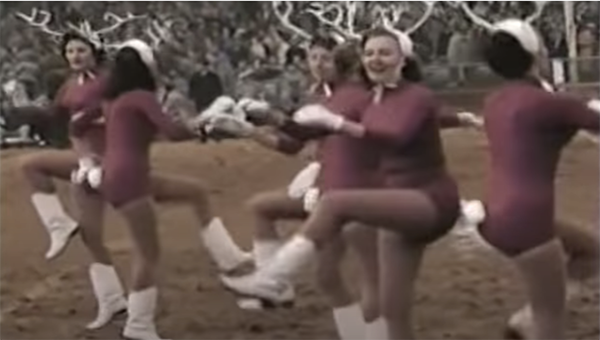
The Baltimore Colts Marching Band majorettes, in “reindeer” mode! (courtesy YouTube/NFL Films)
Baltimore’s offensive woes continued into the second half. Early on, the Colts drove the ball to New York’s 1-yard line, but Alan Ameche was stopped for no gain on third down, then Ameche was tackled for a loss when he attempted to run wide on fourth down. In an interview decades later, Baltimore’s Lenny Moore revealed that Ameche botched the play; it was supposed to be an option pass, but Ameche didn’t hear Johnny Unitas’ signals correctly, and he ran instead of throwing a short pass to a wide open Colts receiver.
That goal-line stand awakened New York’s offense, and they needed only four plays to score their first touchdown to make it 14-10. The Giants then took a 17-14 lead early in the fourth quarter on a Frank Gifford touchdown reception, and while the Colts responded with two effective drives, they came up empty on both possessions; one ended with a missed field goal, the other ended when Unitas was sacked twice, taking the Colts out of scoring range. The Giants’ offense only needed a first down or two to ice the game, but Frank Gifford was stopped on a critical third down run. For decades, Gifford insisted he made the first down; Baltimore’s Gino Marchetti suffered a badly broken ankle in the pileup, and Gifford often said that amidst the chaos and confusion of tending to Marchetti’s injury, the officials did not spot the ball properly. However, when ESPN restored the footage for a 50th anniversary broadcast in 2008, an accident reconstruction expert analyzed the images and determined that Gifford was, indeed, just short of the first down (more about that ESPN program in our Epilogue). The Giants chose to punt the ball, and the Colts took over on their own 14-yard line.
This was the moment when Johnny Unitas began his ascent to legendary status. With just two minutes left, he moved the Colts downfield quickly. While there were several misfires, he made four critical completions, including three straight passes to his star receiver Raymond Berry. Those last three plays moved the ball 62 yards to the Giants’ 13-yard line, and with just seconds remaining, the Colts rushed Steve Myhra out to attempt a tying field goal. Myhra had struggled with field goal attempts all season, and Baltimore fans held their collective breath until the ball went through the uprights. The fourth quarter ended tied 17-17.
So… what happens next? Many of the players and coaches weren’t sure. It was not unusual for football games to end in a tie, but this game was for the NFL title. Would the teams be declared co-champions? Fortunately, the NFL had recently instituted an overtime rule for championships, and it would be decided on the field. The teams would play pure “sudden death.” The first team to score in any manner would win, and they would play for as long as it took.
The Giants won the toss and chose to receive, but they were not able to mount any kind of drive, and they punted the ball back to the Colts. Unitas now had all the time in the world, and Johnny U methodically moved the Baltimore offense to the New York 8-yard line. It was first-and-goal, and then, suddenly… the NBC Television feed disappeared! Nothing but snow on the screen!
This caused immediate panic in NBC’s control room, not to mention in homes across the nation, as viewers — particularly in Baltimore — bolted from their living rooms and scrambled to find the nearest radio. It was one of the worst possible moments to lose the live feed of a TV broadcast. And then…
A fan ran onto the field! Play was halted for nearly a full minute before New York’s Finest chased him down and escorted him to the sideline. Over the years, there has been endless rumor and speculation about this incident. Photographs show the fan was well-dressed and appeared very cooperative when the cops took him away; he certainly didn’t look like a drunken lout. Who was this guy?
Whoever he was, he is now the stuff of sports broadcasting legend. More than six decades later, it is widely believed that he was an NBC employee who realized the broadcast was interrupted and ran onto the field — or perhaps was told to run onto the field — to delay the game long enough to give the TV crew enough time to find a loose cable and fix the connection. As far as I know, he was never identified and the story has never been confirmed. One hopes the fellow received a bonus and a promotion for his quick thinking!
When the game resumed, the Colts ran two plays to reach third-and-goal from just over a yard away. A field goal attempt might have been the obvious choice, but Baltimore coach Weeb Ewbank was leery of sending a struggling Steve Myhra in to kick. Meanwhile, the coach trusted Unitas completely, and he left Johnny U and the offense on the field. A routine handoff to Alan Ameche secured a 23-17 Baltimore victory.
The game was breaking news nationwide. It was a big topic of Sunday afternoon dinner conversations, and it was headline news on front pages and in sports sections the following day. NFL and television executives soon realized that professional football could become a very valuable property, and they started making plans for increasing television coverage and boosting marketing exposure for the teams, the star players, and the sport overall. And down in Dallas, Lamar Hunt — a son of oil tycoon H.L. Hunt — started thinking about owning his own football team. Those dreams eventually led to his role in establishing the rival American Football League, which merged with the NFL just over a decade later. Historians and sportswriters have studied the 1958 title game, and they generally agree that event was the start of professional football growing into the colossus it has since become. It was the aftermath and the impact — as much as the drama of the game itself — that led them to calling it “The Greatest Game Ever Played.”
*************************************************************************************************************
EPILOGUE
As I’ve mentioned in previous articles, television did not put a high priority on archiving sports events back then. There is no known videotape of the game; videotape was in its infancy, and while NBC presumably had one or two of the early machines available, it seems nobody bothered racking them up. There is no known kinescope film recording of the television broadcast, either. Fortunately, there was plenty of film footage of the game, both from overhead and from sideline views. This footage was shot by NFL Films, as well as various newsreel cameramen working for different organizations.
On the 50th anniversary of the game in 2008, ESPN produced a special documentary that used the old footage to re-create much of the action. The historic clips were colorized for broadcast, and the action was interspersed with comments and memories from players, fans, and broadcasters who were there. (Sadly, many of these gentlemen have passed away in the fifteen years since.) Most of Bob Wolff’s Baltimore radio broadcast was saved, and the NBC national radio call was saved almost in entirety. This historic audio was used in conjunction with the preserved video. Several versions of the ESPN special can be found on YouTube; here is a link to one of those.
Others have collaborated on an almost-complete reconstruction of the game, using the original newsreel and NFL footage, some of the colorized ESPN content, stock footage, and still photos. The audio portion uses the NBC national radio call by Joe Bolan and Bill McColgan (complete with vintage commercials!). There are several uploads of this project on YouTube, and there is also a version on the Internet Archive, available here. If you’ve never seen any of “The Greatest Game Ever Played,” punch it up on your laptop and enjoy!
Mark Wainwright is a long-time radio personality and voiceover performer. He was most recently the morning host at WSYR in Syracuse; he is also a Baltimore native and life-long Baltimore Colts fan (and he still hasn’t gotten over the Colts leaving town and moving to Indianapolis decades ago!). He can be reached at: markwainwright@earthlink.net




 The United Nations and its specialized agency, the United Nations Educational, Scientific and Cultural Organization (UNESCO) have given the radio industry all around the globe an invaluable gift. It’s called “World Radio Day 2024.” Now in its 13th installment, WRD takes place annually on February 13 with the purpose of spotlighting the accomplishments, importance, and ongoing relevance of the radio medium as it evolves deeper into the 21st century. This year’s theme is “Radio: A Century Informing, Educating and Entertaining.” By officially designating the platform as worthy of its own officially sanctioned UN International Day, the august world body has recognized, spotlighted, and endorsed radio’s continuing relevance and potential for being a vital force for the betterment of humanity.
 national news and entertainment. The station will play host to nationally syndicated programs like “The Ramsey Show,” “The Michael Berry Show,” “The Joe Pags Show,” “Armstrong & Getty” and “Michael DelGiorno” as well as “Bloomberg Radio.” iHeartMedia Tampa Bay SVP of programming Tommy Chuck adds, “Tampa Bay is one of the fastest-growing communities in the United States. As the region’s economy continues to grow, we are pleased to offer programming tailored to the people making that happen. Around the clock, the programming will keep listeners informed on issues affecting their everyday lives and pocketbooks.”
 tomorrow (1/4). Audacy San Diego SVP and market manager Michael Valenzuela says, “We’re excited to kick off the next era of our station’s midday
  programming with the additions of two seasoned broadcasters in Annie and Craig. We have no doubt their vast knowledge of this city’s sports scene will add extraordinary value to our local content offering and can’t wait to see them get the ball rolling.” Heilbrunn says, “I’m so excited for this opportunity and eager to contribute to the impressive lineup already established at ‘97.3 The Fan.’” Elsten adds, “I couldn’t be more excited to be partnered with someone as talented and respected as Annie. To do so on ‘97.3 The Fan’ is the perfect pairing. I know we will work hard to make middays a fun place to hang out every day and a great place to talk Padres.”
 We live in an increasingly noisy world. The accelerating advancement of media technology, with its accompanying “everybody is a star” syndrome, combine to make it increasingly difficult to get attention. By that, I mean real attention – the kind of attention that those in the professional media (and related) industries describe as “traction.”
 High Sports, the other a piece by Michael Roberts in alt-weekly Westword that analyzes the state of Bonneville’s KKFN “104.3 The Fan.” McKee (along with several others) was let go by “The
  Fan” in September after the station was beat in the ratings by Stan Kroenke’s crosstown KKSE-FM “Altitude Sports Radio.” “The Fan” PD Raj Sharan was ousted shortly thereafter, and former ESPN Radio programmer Amanda Brown was recently brought aboard as PD to right the ship. Roberts’ piece chronicles the rise of “The Fan” – as well as its recent struggles. Ironically, shortly after being let go, McKee found work at his former competitor and now co-hosts the 12:00 noon to 3:00 pm show at “Altitude Sports Radio” with former “Fan” host Tyler Polumbus and Scott Hastings.

 Books, 2022) by Dr. Murray Sabrin. The book has been an Amazon bestseller and a popular vehicle sparking conversations on political news/talk shows across America. Its author, Murray Sabrin, Ph.D. is emeritus professor of finance, Ramapo College of NJ. Dr. Sabrin – a prolific author – is considered a “public intellectual” for writing essays about the economy in scholarly and popular publications as well as being a prolific guest and “go-to” resource on hundreds of radio and TV talk shows and podcasts. According to publisher Michael Harrison, who wrote the book’s provocative foreword, “From Immigrant to Public Intellectual is a truly American story about an immigrant child’s rise from humble beginnings to forge a stellar career as an educator, author, candidate, and media influencer. Murray Sabrin explains libertarianism in plain language using his own life story set against a half-century of changing times. Talk show hosts have been tapping into this articulate scholar’s knowledge and views for more than three decades since his impressive third-party showing as the Libertarian candidate for Governor of New Jersey in 1997.” To learn more about Dr. Murray Sabrin please visit murraysabrin.com and murraysabrin.substack.com.
 Hill, and producer Michael Campana. The station says, “Thirty-year market veteran, Elliott, who started at WTVN in 1999 as the producer for Columbus radio legend Bob Conners, will continue to serve as program director for 610 WTVN. ‘Columbus’ Morning News’ will also feature timely guests and newsmakers to wake up information-hungry listeners with the local and national news they need to start each day in Ohio’s Capital City. Elliott adds, “I’ve done everything on WTVN except host my own show, and now I get that chance. I’m grateful to be working with the most talented team in the business every morning to bring the news to the best audience out there!”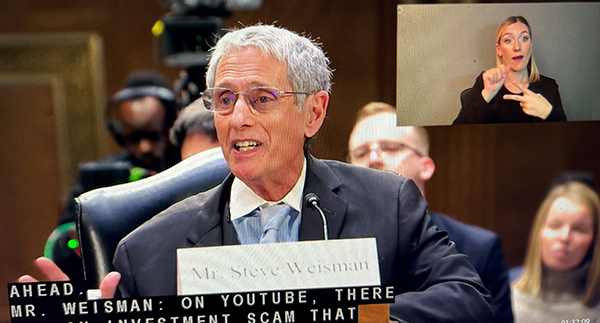
 Earlier this week, Michael Harrison published his top 10 list of suggestions for being a successful talker. Item number three really caught my eye:


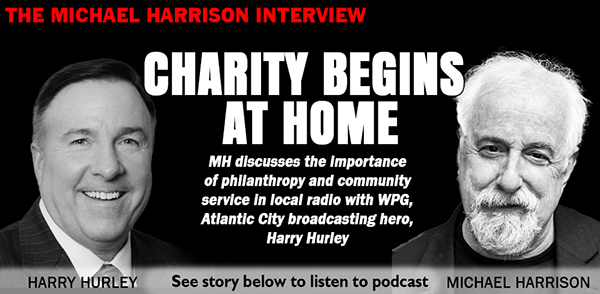
 As your friends get fired and on-air hosts are replaced with WideOrbit and Profitable Software, the mournful refrain is to unfairly blame consolidation. Consolidation has, in fact, made the medium financially viable and brought hundreds of individual stations from a river of red ink to the glow of black ink. Prior to consolidation, over half the radio stations in the U.S. lost money – year after year. Not a secret stat, those numbers were revealed annually by the NAB.