by Robert Pearl
Exclusive to TALKERS
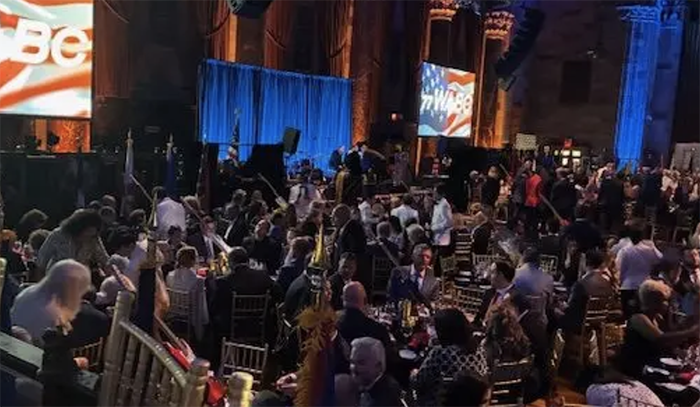
 New York’s Cipriani 42nd Street once again played host to one of radio’s most anticipated annual events of the year: the annual “77 WABC Gala,” held this past Friday (9/5). The spectacular evening blended star-studded entertainment, heartfelt tributes, and plenty of radio family camaraderie – all while raising funds for three cornerstone charities: Tunnel to Towers Foundation, the Police Athletic League, and Shriners Children’s Hospital.
The night doubled as the unofficial kickoff to America’s 250th anniversary celebrations, with patriotic spirit filling the storied hall. Guests were treated to a spectacular mix of tradition and pageantry: bagpipes opened the evening, followed by the Pledge of Allegiance and a soaring rendition of the national anthem from tenor Chris Macchio, fresh from performing at President Donald Trump’s 2025 inauguration. Later, country music legend Lee Greenwood brought the house to its feet with “God Bless the USA,” a fitting soundtrack to the night’s theme.
Radio Legend Served as Emcee
The event was emceed by “Cousin” Bruce Morrow, who set the tone with trademark warmth and humor. Featured performances by Vinnie Medugno, and Joe Piscopo with homage to Frank Sinatra classics. Fellow WABC hosts and personalities were out in force: Sid Rosenberg (with wife Danielle), Curtis and Nancy Sliwa, Dominic Carter, Greg Kelly (joined by his father, longtime NYPD commissioner Ray Kelly), Lionel and his wife Lynn Shaw (founder of Lynn’s Warriors), Brian Kilmeade, Rita Cosby, Lisa G, Anthony Cumia, news director James Flippant, and anchor Liz Ratoballi.
WABC owner John Catsimatidis and Red Apple Media president Chad Lopez anchored the front row, alongside Margo Catsimatidis, who was celebrated as the event’s “First Lady of WABC.” Longtime friend (and WOR personality) Mark Simone – dubbed “Mr. New York”- was on hand, underscoring the collegiality of the broader talk radio community. The gala also drew figures beyond radio, including Mayor Eric Adams and his electoral rival Curtis Sliwa sitting a few tables apart, economic voice Larry Kudlow, the relentless patriot and activist artist Scott LoBaido, Newsmax’s Johnny Tobacco of Wiseguys, and philanthropist Frank Siller of Tunnel to Towers.
Charity with Purpose
While the evening sparkled with entertainment and personality, its heart was rooted in the causes it championed. The Tunnel to Towers Foundation, founded in honor of fallen firefighter Stephen Siller, continues its mission of supporting first responders and veterans, promising to pay off the mortgages of the fallen. The Police Athletic League, New York City’s largest independent youth development nonprofit, provides educational and recreational programs to children in need. And Shriners Children’s Hospital, a global leader in pediatric specialty care, ensures children receive treatment regardless of a family’s ability to pay. These organizations were not just beneficiaries but central characters in a story of service, community, and giving back.
A Night of Theater and Patriotism
Beyond the music, the gala leaned into a spectacle. Impersonators dressed as George Washington, Abraham Lincoln, and Uncle Sam strolled the ballroom, taking pictures with guests. Later, Lady Liberty herself dramatically popped out of a massive birthday cake as red, white, and blue balloons cascaded from the ceiling. Guests waved WABC-branded light sticks in rhythm with the performances, further amplifying the carnival-like energy.
And as tradition dictates, September’s Virgo birthdays were honored in grand style. Joe Piscopo led a rousing “Happy Birthday” for John Catsimatidis and fellow celebrants, which seamlessly transitioned into a full-throated “God Bless America,” with the entire ballroom on its feet.
Political Undertones in a Festive Setting
While the evening was designed as a patriotic celebration, politics were never far from the surface. Just hours before the gala, Mayor Adams publicly doubled down on his mayoral campaign, brushing aside speculation of a possible exit. At Cipriani, Adams was greeted politely – but the room roared when Republican candidate Curtis Sliwa was announced, highlighting the unique political currents swirling through the city and this radio community.
Still, the prevailing message was unity and celebration. “We celebrate America together,” said Greenwood before launching into his anthem. It was a fitting capstone to an event that blended entertainment, politics, and philanthropy in a way unique to WABC.
As the gala wound down, guests departed with gift bags in hand, many still humming Greenwood’s refrain. With its mix of glamour, gravitas, and good causes, the 2025 WABC Gala set the stage not just for America’s 250th birthday, but also for the enduring influence of talk radio as a cultural and political force.
Robert Pearl is a New York City-based freelance journalist. He can be reached at pearlknows@yahoo.com.
Share this with your network

 Patriot.TV. Root says, “What an honor to join Patriot TV and their millions of conservative viewers. My weekend powerhouse TV show, ‘America’s Top Ten Countdown,’ reaches millions on Real America’s Voice TV. Now my daily video podcast WAR Zone will be on multiple dynamic platforms from Patriot TV, to serving as the official podcast of ‘The Gateway Pundit,’ reaching their 2.5 million unique daily readers, as well as livestreamed on X, Gettr, and TruthSocial. The left has tried everything to stop me, ban me, censor me, harass me, yet the popularity and reach of my shows just keeps exploding. That’s called WINNING!”
 Have you noticed a profile pattern for the mass shooters and political assassins? 20-30 years old. Living at home or close.
 the popularity of mobile devices for audio listening is the most dominant in urban communities. Within that audience segment, 40% of time is spent listening to audio on a mobile device, vs. 28% of time spent listening on an AM/FM radio receiver. The mobile device also holds a strong lead in suburban communities, with 36% of time spent listening on that device compared to 30% of time on a radio receiver. However, the radio receiver is strongest in rural communities where it matches the listening time of the mobile device, each receiving 34%.
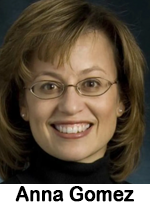 Federal Communications Commissioner Anna M. Gomez issued a statement criticizing the Commission’s threats against ABC that, in part, led to the suspension of the “Jimmy Kimmel Live!” program. Her statement is as follows: “We cannot allow an inexcusable act of political violence to be twisted into ajustification for government censorship and control. First, an ABC reporter was told that his coverage amounted to hate speech and that he should be prosecuted simply for doing his job. Then, the FCC threatened to go after this same network, seizing on a late-night comedian’s inopportune joke as a pretext to punish speech it disliked. That led to a shameful show of cowardly corporate capitulation by ABC that has put the foundation of the First Amendment in danger.
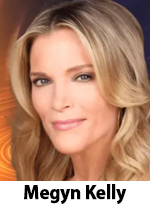 her SiriusXM podcast, former FOX News Channel star Megyn Kelly criticized FOX for, as she calls it, talking like he was theirs. “It’s really bothering me how FOX News is talking about Charlie, like he was theirs — he wasn’t. It’s a lie. Just stop.” Kelly accuses FOX of making Kirk persona non grata after the company fired Tucker Carlson because Kirk was supportive of Carlson. The story from Newsmax adds that “Kirk appeared to be completely absent from FOX News in 2023 after Carlson’s firing and early 2024 – though Kelly claimed the network would give him brief appearances to cover for their effective ban.” The Newsmax piece goes on to quote Kirk on the matter. “Since Tucker’s departure, I haven’t been on. And so we had to do an event without FOX. And that was a great thing, man, because sometimes desperation is the mother of innovation, right?”
  Carolina Senate District 12 seat – Justin Bradley, Lee Bright and Hope Blackley – will take part in the 90-minute debate in which WORD hosts Joey Hudson and Bill Frady will moderate the debate. Audacy South Carolina operations manager Mark Hendrix says, “This debate will give our listeners and the community a chance to hear directly from the candidates, understand their positions, and make informed decisions as election day approaches.”
 In the wake of Charlie Kirk’s murder, one would expect every company that owns a talk radio station, every network that syndicates conservative voices, and every corporation that employs talk radio hosts to issue a unified statement of defiance. This was not just an attack on Charlie; it was an attack on the entire industry of talk radio, on the free exchange of ideas, and on the First Amendment itself. Yet, shockingly, most of these companies have remained silent. That silence is unacceptable. At a moment like this, the industry should stand shoulder to shoulder and declare to the world: we will not be intimidated, we will not be silenced, and we will never abandon the microphone.
 Amazon learned that there are high volume sales for specific categories of products. High demand equals high value to the seller. Items such as diapers, printer ink, staplers, batteries, etc. Being brilliant, Amazon created “Amazon Basics.” Same products, white labeled. Amazon doesn’t manufacture batteries; they just slap their logos on what America needs most. That’s why Mr. Bezos has a bigger boat than you.
 Radio programmers and sales managers know the drill: The GM drops an idea, a client makes a request, or a listener offers feedback – and the reflex is to jump straight into execution. But what if the real opportunity lies not in what’s asked for, but in what’s actually needed?
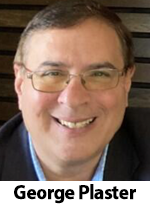 The Nashville-based “George Plaster Show,” with co-hosts Kelly Holcomb and Billy Derrick, is now heard on Saga Communications’ sports talk WKFN-AM/W281BT in Clarksville, Tennessee. Clarksville Now reportsPlaster said he’s excited for the opportunity to be here and tap into a new market of sports fans. “I’m very excited about being in Clarksville. For me, this is about adding listeners – listeners who knew me from years ago. I think we’re going to do really well here, it’s a market that has a lot of sports fans, and we just simply want to tap into it.” “The George Plaster Show” will air live from 3:00 pm to 5:00 pm Monday through Friday.
 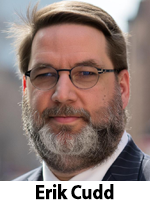 From my teenage years to today, radio has been the career of my adult life. When I first began listening in my teens, I was drawn less to the music and more to the conversation. I tuned into stations not for my favorite songs, but because I enjoyed hearing people talk, debate, and share ideas. Over my lifetime, I have seen many changes in the medium. The news/talk format, in particular, has always fascinated me for its mix of news, commentary, and immediacy.
 and the countless people whose lives he touched through his words, his work, and his unwavering commitment to faith and country.” Salem CEO David Santrella is quoted saying, “Charlie was more than a broadcaster – he was a fearless defender of truth and a faithful servant of God. This assassination was not just an attack on Charlie, it was an attack on free speech and on the values Charlie championed every day. His absence leaves a tremendous void, but his legacy of faith, courage, and conviction will continue to inspire generations.” Salem Media chief strategy officer Bradley Parscale stated, “I have had the privilege of working with Charlie for nearly a decade. He was part of the Salem family. His voice was fearless, unyielding, and relentless in the defense of faith and freedom. This heinous act of evil was meant to silence him, but as Christians, we know darkness cannot overcome the light. Charlie’s influence cannot and will not be silenced.” The company added, “Charlie’s partnership with Salem Media was defined by his uncompromising defense of biblical values, liberty, and truth. Through his nationally syndicated show and podcast, he reached millions who relied on his voice to cut through lies, honor truth, and give courage to those fighting for faith and freedom.”
 2013. Company CEO Jeff Warshaw says, “Keith’s programming expertise and leadership have been a major contributor to Connoisseur’s growth and success. As we expand our footprint, Keith is the ideal leader to develop and implement our programming strategy across the country. His passion for music, content, and his commitment to local communities will ensure that our stations continue to succeed.” Dakin comments, “It is truly an honor to move into this larger role with the newly expanded Connoisseur Media. I am extremely excited to work day-to-day with this unbelievable roster of programmers and air talent. I can’t wait to dig in and make great radio with this tremendously creative staff. Thank you so much to Jeff Warshaw who has been a true champion of mine since I started here. His leadership, vision, and commitment to real radio will hopefully give this industry the shot in the arm it needs.”
 Superman just flew into court – not against Lex Luthor, but against Midjourney. Warner Bros. Discovery is suing the AI platform, accusing it of stealing the studio’s crown jewels: Superman, Batman, Wonder Woman, Scooby-Doo, Bugs Bunny, and more.
 According to a report in Barron’s, Premiere Networks talk host Buck Sexton filing a federal lawsuit against RAD Diversified REIT, alleging they defrauded him of more than $100,000. In the complaint, Sexton alleges that RAD founders Dutch Mendenhall and Amy Vaughn solicited cash from him for investment coaching for property deals, neither of which ever happened. The story notes that this suit comes just weeks after Florida’s attorney general announced a probe into RAD saying the firm “appears to be a Ponzi scheme.” Sexton’s attorney writes in the complaint, “Despite being an experienced real estate investor, Mr. Sexton was taken in by the documents and investment returns touted by Mendenhall and his representatives. The defendants’ grand promises of sweeping returns never materialized.”
  -demand radio shows to migrate to ART19’s infrastructure that it says will allow it to “unlock new revenue opportunities and offering advertisers enhanced reach , deeper analytics, and improved ROI.” Beasley chief content officer Justin Chase says, “This partnership is an important step in our digital transformation. ART19’s platform will help us expand monetization opportunities while delivering a better experience for audiences and advertisers.”
 Media’s WABC, New York airing in the 11:00 am to 12:00 noon. Concha has been hosting the time period since Jeanine Pirro left to become the U.S. Attorney for the District of Columbia. Red Apple Media president Chad Lopez says, “Joe brings the total package, smart, sharp, and fearless. He doesn’t just analyze the news, he makes sense of it, challenges it and connects with America in a way only he can.”
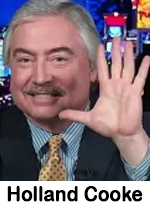 Why I love going on sales calls with station reps: Meeting retailers, who have SUCH a feel for their customers’ (our listeners’) mindset. Following-up
 Imagine an AI trained on millions of books – and a federal judge saying that’s fair use. That’s exactly what happened this summer in Bartz v. Anthropic, a case now shaping how creators, publishers, and tech giants fight over the limits of copyright.
 “Longtimers” and notes that 77% of “First-Years” are consuming podcasts while actually watching the video compared to 69% of “Longtimers” doing the same. Edison says that most new consumers and established podcast fans are actively watching while listening to video podcasts but that video is even more important for engaging with new audiences. While “Longtimers” currently have an affinity for audio only podcasts, that may change over time. Edison concludes that although podcasting is an audio-first platform, “many creators and marketers are likely missing an audience acquisition and engagement opportunity by not considering how to fit video content and video platforms into their strategic planning.”
 hosted the weekend edition of “All Things Considered” since May of 2023. He says, “I’m really excited and honored to step into this role. I’m mindful of just how important All Things Considered’s legacy is for listeners, and I also know just how much I’ve loved working with the show’s team these past two years on weekends. I can’t wait to bring listeners the news five days a week now. And at this moment where we are all focusing on strengthening the entire public media network and working together more closely than ever before, I’m proud that I started out as an ‘All Things Considered’ host at a NPR Member station, and now will be doing that job nationally.”
 pm ET. The Saturday program is called “College Football Tailgate” hosted by Wilson and Zaslow and airs at 10:00 am ET. ESPN VP of digital & audio production Justin Craig says, “College football is all about passion, tradition, and community. We’re thrilled to bring that energy directly to fans every weekend with ESPN Radio’s College Football Tailgate. Amber and Jonathan are the perfect voices to capture the excitement on campus, and this tour allows us to not only showcase the games, but also connect with the next generation of fans and broadcasters in a truly meaningful way.”
 Ninety seconds. That’s all it took. One of the interviews on the TALKERS Media Channel – shot, edited, and published by us – appeared elsewhere online, chopped into jumpy cuts, overlaid with AI-generated video game clips, and slapped with a clickbait title. The credit? A link. The essence of the interview? Repurposed for someone else’s traffic.
 “justice for the injured… Bradshaw & Bryant.” Key takeaways from the blog include: 1) Through its longterm use of AM/FM radio advertising, Bradshaw & Bryant dominates unaided brand awareness; Across all stages of the consumer journey, Bradshaw & Bryant leads the market; 2) Bradshaw & Bryant offers Madison Avenue a master class on creating future demand and how building a brand is the main driver of longterm growth and profit; 3) Every advertiser has two jobs: Creating future demand and converting existing demand; Bradshaw & Bryant excels at creating future demand; and 4) AM/FM radio advertising works: Among AM/FM radio listeners, Bradshaw & Bryant’s awareness is +19% greater than in the overall market.
  their careers who have demonstrated exceptional promise, drive, and passion for broadcasting. Honorees are selected based on their strong work ethic, eagerness to learn, and willingness to go above and beyond their daily responsibilities to create outstanding content that informs, entertains, and inspires their audiences. GAB President Randy Gravley states, “By recognizing these incredible young professionals, we’re not just celebrating their accomplishments today, we’re investing in the future of broadcasting. The Rising Stars program highlights the innovation, creativity, and passion that will drive our industry forward.”
 Imagine a listener “talking” to an AI version of you – trained entirely on your old episodes. The bot knows your cadence, your phrases, even your voice. It sounds like you, but it isn’t you.