



Worldwide News Network (WWNN) Launches Weekend Business Reports – WTOP, Washington, DC Becomes First Affiliate
 Red Apple Audio Networks’ recently launched Worldwide News Network (WWNN) is stepping into the weekend business and financial news space with the launch of WWNN Weekend Business Reports, a new series of reports delivering timely, insightful coverage of the markets, the economy and the companies driving growth. The reports debuted on Hubbard Broadcasting’s WTOP in Washington, DC, this past Saturday, August 1, marking the first affiliate partnership for the new service.
According to Red Apple, WWNN Weekend Business Reports will go beyond traditional market updates, focusing on the industries and economic sectors shaping the future, including automotive, technology and entertainment. The reports will also spotlight breakthrough companies and emerging trends driving innovation. The reports are being anchored and produced by veteran correspondents John Terrett and Jake Novak.
“WWNN is not simply filling the gap left by the demise of the CBS Radio Network,” said Lee Harris, SVP, news & programming, Worldwide News Network. “We’re building something stronger and more relevant for today’s audience. John and Jake bring extraordinary experience and credibility, and more importantly, they know how to make complicated financial and economic stories understandable, compelling, and actionable. That’s what makes these reports different.”
“Our listeners want and need insightful financial and business news they can trust, and they depend on us to deliver it every day of the week,” said Julia Ziegler, director of news and programming at WTOP. “As the industry has contracted over the last few years, it has left a void. It is exciting to work with a company like WWNN that understands the importance of providing quality reporting seven days of the week.”
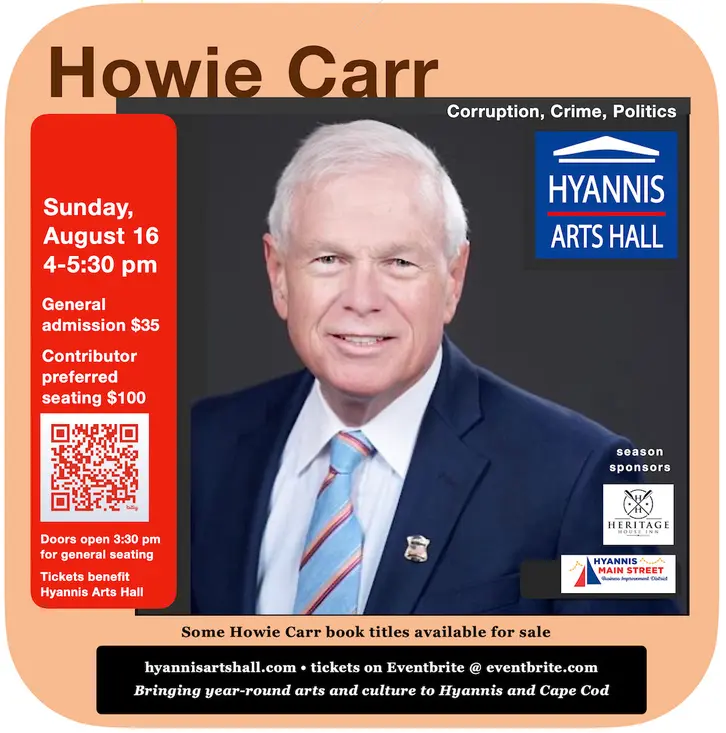 Long known as the kind of radio talk show host who can “draw a crowd,” legendary New England personality, best-selling author, newspaper columnist, and broadcasting entrepreneur


 By Matthew B. Harrison
 The Radio Hall of Fame announced today (8/3) the selection of nine 2026 Legends inductees. These individuals were selected by the Radio Hall of Fame’s 2026 Nominating Committee, which meets annually to recognize deceased individuals who made significant contributions to the radio industry. The Radio Hall of Fame is housed within the Museum of Broadcast Communications in Chicago.
 “It’s all media,” declared accomplished media executive Jack Griffin when confronted with brand new definitions of content and content distribution. Jack, for years, was president of Meredith Publishing, Time Inc., and The Tribune Company. I met Jack when he was publisher of PARADE magazine. Jack is pragmatic, won’t waste your time and spots BS faster than most humans. We were listening to discussions of the impact of online media versus traditional media, and his line was running out. Jack declared “It’s all media” and the meeting blessedly ended. The phrase haunts me and it is being proven true every second of every day.
 powerful, collective voice when negotiating with automakers, tech platforms and policymakers.” NAB president and CEO Curtis LeGeyt adds, “Radio has long been an essential part of the driving experience, delivering trusted local news, lifesaving emergency information and the entertainment Americans rely on every day. As dashboards evolve, ensuring broadcast radio remains accessible is more important than ever. By joining Radio Ready, NAB looks forward to partnering with broadcasters from across the world to ensure that free, trusted radio remains easy for drivers to find and use in the vehicles of today and tomorrow.”
 Zimmer will take over the operation of sports talk KOSP-FM “102.1 The Won” and three music brands. It currently owns news/talk KWTO/K227KO and sports talk KBFL-AM/K245CA. Zimmer Communications president John Zimmer says,
 “This is an exciting opportunity to bring together two organizations that share the same values and a deep commitment to local broadcasting. By combining our strengths, we’ll be able to offer advertisers even more effective marketing solutions while continuing to provide the trusted local content our audiences rely on.” Mid-West Family president Mike Paterson adds, “As the local radio and media landscape continues to evolve, bringing these two organizations together creates even greater opportunities for our advertising partners, our communities and especially our employees.”
  Friday, August 28. The program was created in honor of the late founder of Media Staffing Network, Laurie Kahn. MIW says Speak Up! is a year-long mentorship program designed to empower women working in small- and medium-market radio stations across all departments. One outstanding candidate will receive personalized mentorship from MIW’s network of female broadcast leaders, complemented by executive coaching from Media Staffing Network’s certified coaches.
  reorganization and is waiting for the Federal Communications Commission to finish its regulatory approval process. The court is extending the company’s filing deadline for its Chapter 11 plan to October 30.
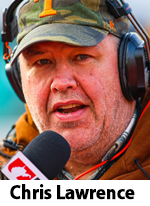 announced during a special dinner at the Edison Ballroom in New York City on October 20. While four spoken-word-formatted stations made the cut in the Legendary Station category, it’s interesting to note that just one talk host – news/talk or sports talk – is a finalist across five personality categories. That distinction goes to WCHS-AM, Charleston, West Virginia morning drive host Chris Lawrence who is a finalist in the Small Market Personality of the Year category. Go get, ‘em Chris! We’re pulling for you.
 In Full Stack Human: The Mindset Upgrade You Need to Stay Human in a World Ruled by Technology (2026, Wiley Books) Dara Simkin and Tane Hunter describe a 2026 media landscape where people face information overload, shrinking attention spans, negativity fatigue, algorithmic manipulation, and constant distraction.
 House correspondent Willie Nelson will be on-site at the U.S. Capitol Tuesday during the hours Senator Graham’s body will be lying in state and will provide interviews with lawmakers and citizens on the scene who come to pay their respects to Senator Graham. Additionally, on Wednesday SRN nationally syndicated talk host Mike Gallagher will be on-site in Columbia where Senator Graham’s life will be honored, prior to his private burial later that afternoon in Graham’s hometown of Central, South Carolina.
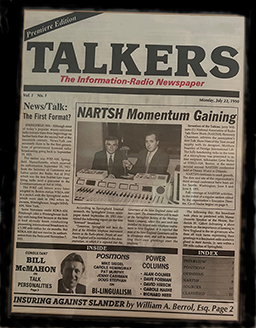 devoted to chronicling the development and growth of what he envisioned as “the coming talk radio phenomenon of the nineties.” The publication went on to publish as a newspaper on newsprint evolving into a glossy magazine and eventually an online publication fully devoted to serving the needs of talk radio and eventually a variety of spoken word platforms that have collectively become known as talk media. TALKERS also contributed to the growth of the field by producing 28 national conventions / conferences in New York and two in Los Angeles, more than 50 groundbreaking radio rows, dozens of talk show host tours of international hot spots, and thousands of hours of spoken word syndicated and online programming. Throughout its colorful history, TALKERS always maintained a neutral position regarding politics except for, as Harrison puts it, “unwavering support of the First Amendment.”
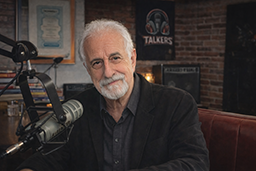 TALKERS founder Michael Harrison is this week’s guest on the National Press Club’s official podcast, Update-1, in which he tackles the topic “Predicting the Future of Media Following the Shutdown of CBS News Radio.” Interviewed by noted American University media professor Gemma Puglisi, Harrison addresses such issues as changes in the tenets of journalism and the general shrinkage of radio news. Along the way, he offers his insights into a variety of media and societal topics including the impact of clickbait and what he describes as “the daily dance of affirmation” resulting
  from the trend toward news platforms “targeting” audiences for purely marketing purposes. Harrison defends AI from critics who claim the technology lacks “heart” and that audiences will swing back to the “authenticity” being destroyed by AI slop. Harrison makes the case that what counts is the humanity behind the operation of AI which is “only a tool.” He says, “Blaming AI for shallow content is like attributing shoddy novels to the invention of the word processor.” Harrison boldly predicts that AI and modern technology will hasten the “death of Hollywood” as we know it among other insights into the future of news, entertainment, and communications. Don’t miss this!
  CEO John Catsimatidis states, “Audiences around the globe deserve the facts about what is going on in our world and that is why we created the Worldwide News Network. We’re delighted to partner with BLR and look forward to working with them as we continue to expand our reach into more European markets and around the world.” Worldwide News Network SVP of news and programming Lee Harris comments, “Expanding beyond the U.S. is an important milestone for Worldwide News Network. We’re excited to partner with BLR to bring an authentic American perspective on world events. This is the first step in building an international network of partners who value trusted, high-quality radio journalism.”
 around getting a little smoke in my lungs, then go out and live your life. I find the pandemonium about some smoky conditions in Western Pennsylvania for like 26 hours to be over the top – especially when you consider this: some of our grandparents lived like this every day here and smoked a pack a day on top of it.” The communications director for Allegheny County executive Sara Innamorato, Abigail Gardner, testily responded to Dunlap suggesting he go smoke a pack on a bridge – and then jump.” Gardner later apologized for her “lapse in judgement.”
 to SVP of revenue development after having served as president and general manager for the company’s Charleston, South Carolina cluster for the past eight years. O’Malley says, “I’m honored by the opportunity to help lead Saga’s next phase of growth by developing innovative revenue strategies, strengthening client partnerships, and working alongside our exceptional fulfillment partners and corporate team.”
 indicates that St. Louis-based Hoffman Media Group will pay Audacy $20 million for its six-station cluster that includes news/talk stations KMOX-AM/FM, KFTK-FM, and four music outlets. Hoffman Media Group is a subsidiary of Hoffman Family Companies and recently acquired the St. Louis Post-Dispatch.