



The Annual (Radio Station) Physical
By Jonathan Little
TroyResearch
President
 An annual physical is a wise idea. Doc asks, “How are you doing?”. Then he or she asks some detailed questions based on your medical history. Then “how have you been feeling? Any issues?” Doc always orders blood draws to see what might be lurking. Is the statin drug keeping your cholesterol in check? Are you getting plenty of exercise, plenty of sleep? How’s your diet? Over the years, I’ve visited about my health with at least a dozen different doctors. I’m convinced that the good ones always ask good questions and then listen carefully. Good questioner – good listener. That’s the doc I can respect and put my trust in.
If you operate a radio station, your station could benefit from an annual physical. You already know how it’s doing based on ratings, revenue, and profit. Your listeners know how you’re doing for them personally because they’re the users of your radio product. Is it pleasing, challenging, inspiring or annoying, irritating, and easily ignored with a click? If you ask them, they’ll tell you. You should ask them at least once a year.
TroyResearch has been in the business of asking listeners what they think for 27 years. We recently teamed up with Midwest Communications, Inc., in Green Bay to conduct an exploratory research project with their news/talk station WTAQ. TroyResearch’s association with MCI goes back nearly 27 years, doing music and perceptual research for the Duke Wright music stations. The WTAQ project was something new. Our goal was to discover what actionable data the opinions of loyal listeners might produce. TroyResearch worked with VP Programming Jeff McCarthy and Operations Manager Jason Hillery to develop a 25-question study.
Survey respondents were recruited over the air and were encouraged to go to the WTAQ website to take a brief survey. Clearly, we wanted to hear from P1’s, those listeners who produce 60%+ of reported listening. Their answers provided a clear picture of WTAQ loyalists – what they like, what they don’t like, their political affiliation, their listening behaviors (radio, podcasts, TV news, cable news, etc.), favorite news outlets, trustworthiness of news outlets, their thoughts about protests becoming riots, and their favorite podcasts to mention a few.
More than 200 respondents, Persons 18+, completed the WTAQ perceptual study. (32% 18-54, 68% 55+). With Jeff’s and Jason’s permission, we share some results.
Political Affiliation
1% Democrat
78% Republican
15% Independent
6% Other, like Libertarian, Socialist
In car listening
80% Local radio
10% Satellite radio
6% Streaming services like Spotify
3% Podcasts
1% Other like personal playlists
Listening to WTAQ, which simulcasts
76% FM
9% AM
8% Streaming from WTAQ app
6% Streaming from a smart device
1% Streaming from WTAQ.com
Where do you get your news? (Select all that apply)
93% Radio
46% Broadcast TV (local channels)
41% Cable news like Fox, CNN, MSNBC
29% Social Media like X, Facebook, Tiktok
16% Internet news like NY Post, Washington Post
10% Newspaper
12% Other
Your primary news source
58% Radio
15% Cable news like Fox, CNN, MSNBC
8% Broadcast TV (local channels)
7% Internet news like NY Post, Washington Post
7% Social Media like X, Facebook, Tiktok
3% Other
1% Newspaper
When does a protest/demonstration become a riot? (Select all that apply)
85%+ When protesters strike police, throw projectiles, set fires, do property damage
75% When protesters spit on police officers
60% When protesters burn the American flag
37% When protesters curse at police officers
Do you listen to podcasts?
23% Frequently
29% Occasionally
35% Rarely
13% Never
What podcast platform do you use? (Select all that apply)
32% YouTube
25% Spotify
19% iHeart
19% Apple
10% Amazon
2% Rumble
1% The Blaze
1% Daily Wire
As a broadcaster that reports news and information, WTAQ is interested in knowing how trustworthy you consider the reporting presented by these companies. (1 = very untrustworthy, 5 = very trustworthy)
4.43 WTAQ Radio, Green Bay
3.78 Fox News
3.59 Fox 11, Green Bay
2.92 WBAY, Channel 2, Green Bay
2.83 WFRV, Channel 5, Green Bay
2.77 WHBY Radio, Appleton
2.71 NBC 26, Green Bay
2.22 Green Bay Press Gazette
2.01 Wisconsin State Journal
1.99 Milwaukee Journal Sentinel
1.46 MSNBC
1.37 CNN
WTAQ asked the 0-10 Customer Endorsement Score question – “On a scale of 0-10 how likely would you be to recommend WTAQ to a friend or colleague?” Those scores reflect the listeners’ opinions of how the station is doing and it’s a forecast of WTAQ’s future. As a rule, a CES of 50 or higher indicates a healthy and sustainable product. WTAQ scored a strong 73 Customer Endorsement Score.
VP Jeff McCarthy and OM Jason Hillery are pleased with the results of this exploratory study. The WTAQ Sales Team is delighted with the data.
Good questioner … Good listener! WTAQ asked good questions. And now their leadership team is “listening” to the answers and determining what adjustments, if any, may result in improved ratings, revenue, and profit, on the way to an 80 Customer Endorsement Score with the next WTAQ study.
Jonathan Little is president of TroyResearch. He can be phoned at 608-219-1077 or emailed via: jlittle@troyresearch.net
 would go their separate ways when his current contract ends later this year. The Yahoo story says, “A source affirmed that everything is a done deal in this regard, and all previous reports of him exiting the company were pure fallacy, per RadarOnline. The man of the hour himself also dropped a big hint on his social media, teasing an answer to all the questions hovering around his career very soon.” Stern’s own Instagram account posted the following: “Now we can reveal that all the questions will be answered. All the truths will be told by the one man truly on the inside: Howard Stern will speak. Tuesday, September 2.”
  Newsmax were defamatory. However, Newsmax is not admitting guilt; just the opposite. “Newsmax believed it was critically important for the American people to hear both sides of the election disputes that arose in 2020. We stand by our coverage as fair, balanced, and conducted within professional standards of journalism.” The company says Delaware Court Judge Eric Davis would not provide a fair trial wherein the company could present standard libel defenses to a jury. Newsmax CEO Christopher Ruddy says, “The Delaware Court under Judge Davis effectively enforced a confiscation of our property because our reporting was not always sympathetic to Joe Biden. The actions taken against Newsmax, and earlier against FOX News, represent a direct attack on free speech and a free press.”
 The problem with technocrats is they believe computer programs and machines solve all problems. A technocrat in charge of a business will it kill it, for sure. For example, once a movie theatre is automated, not requiring a pesky projectionist or even a snack counter attendant, you and I would still not buy a ticket – unless the theater was showing an actual MOVIE!
 Artificial intelligence now makes it possible to replicate a human voice with striking accuracy. For broadcasters, podcasters, and content creators, the central question is: When does using or imitating a voice become a legal problem? The answer depends on the person being imitated, the purpose of the use, and the rights attached to that voice. Below is a six-bucket framework to help evaluate the risk.
 The program is hosted by U.S. Senator Ted Cruz and Premiere Networks-syndicated radio personality and podcaster Ben Ferguson who break down the most important news stories of the week and what they mean for Americans. “Verdict with Ted Cruz was first launched as a podcast in January 2020. Premiere Networks expanded the podcast into a weekly one-hour radio program for talk radio stations, which debuted on 100 stations in April 2025.

 role in the decision-making journey, often sparking the craving before any digital ad or social scroll can. In fact, the survey shows a measurable lift in intent: consumers targeted by radio campaigns were 4% and 7% more likely to visit, reinforcing radio’s power to drive foot traffic.” Further, the study shows that “89% reported making last-minute meal decisions while in the car—right in radio’s sweet spot. Additionally, 84% believe it’s smart for fast food restaurants to use radio advertising to inform customers about menu items and deals. And notably, 82% admitted that simply hearing ads about food can make them feel hungry, highlighting radio’s unique ability to trigger cravings and drive immediate action.”
  for the quarter to $22.2 million compared to the same period last year. For the quarter, operating income was $1.4 million compared to $2.1 million for the same quarter last year and station operating income decreased 6.4% to $6.0 million. Saga reports net income of $1.1 million for the quarter compared to the net income of $2.5 million it reported in the second quarter of 2024.
 football and men’s basketball games broadcast on WGN and he’ll also serve as a fill-in anchor on the WGN-TV sports desk. Eanet says, “Can’t believe it’s been 41 years since I first set foot in the WGN studios. As I close this chapter of my career,
  the word that comes to mind is ‘grateful.’ I’m so thankful to the entire WGN family for their friendship and support over the years. It’s not just the names you know, but the entire crew on and off the air. I’m forever indebted to the managers, engineers, producers, newspeople, sales team, and all the others who have made WGN such a special place to work. Most of all, I’m thankful to the listeners who have a special relationship with this station.” WGN Radio VP and general manager Mary Sandberg Boyle says, “I am thrilled to share that our own Andy Masur will assume morning show sports duties going forward. Andy is a talented broadcaster who has built a rapport with the WGN Radio audience as a regular fill-in for Dave and as our weekend sports anchor. We are lucky to have him.”
 sports talk KSAC-AM/K284CM, effective September 2. This comes five years after he was fired by Bonneville’s KHTK, Sacramento and the Kings after a social media exchange with former Kings player DeMarcus Cousins about the Black Lives Matter movement and used the phrase, “all lives matter.” Napear sued Bonneville and lost but is currently appealing that ruling. Napear tells the Bee, “It’s going to be the Grant Napear show that people have listened to for decades. I’m competitive. I’m not only coming back to Sacramento. I’m coming back to win.”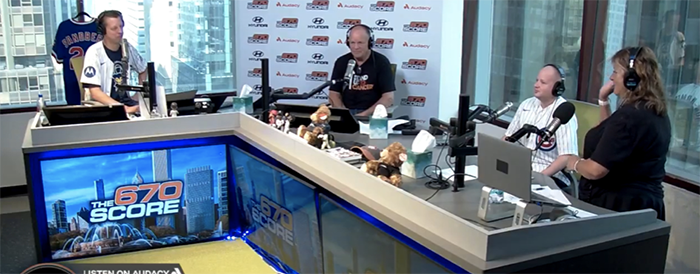
 place. This new data fusion will integrate the industry-leading Edison Podcast Metrics into Nielsen’s widely used media planning tool, Nielsen Media Impact
  (NMI).” Nielsen adds, “As podcast listenership continues to grow, it is critical for advertisers to have sophisticated tools and data to effectively plan, measure and optimize their audio investments. Nielsen Podcast Fusion in NMI will provide an even more holistic view of media planning and help users uncover valuable insights and demonstrate the effectiveness of their campaigns. NMI users will also be able to optimize media plans by specific podcast networks and genres, as well as top podcast programs.” NPR and Ocean Media are among the charter subscribers at launch.
 saying Stern is mulling retirement and that he might consider a shorter-term deal than the usual five-year pacts he’s been signing. Still other sources say Stern isn’t the draw he once was, and a renewal of his current $500 million deal is not going to happen. Another report indicates SiriusXM may make a bid for his library of shows instead of a renewed contract for new content.
  “creative quality is the number one sales driver” and this is often a surprise to advertisers and media agencies who think media tactics (targeting, reach, etc.) drive the most sales. It’s for good reason that everyone wants high brand awareness. A major study from TikTok reveals the greater a brand’s awareness, the greater the purchase conversion. Brands with high aided awareness have 2.86x greater conversion rates compared to low awareness brands. But not all categories operate similarly, Podscribe says that purchase conversion varies widely by advertising category and advises that it’s important to understand the purchase conversion benchmarks for your product category.
  You did everything right – or so you thought. You used a short clip, added commentary, or reshared something everyone else was already posting. Then one day, a notice shows up in your inbox. A takedown. A demand. A legal-sounding, nasty-toned email claiming copyright infringement, and asking for payment.
 the program “continues to build a powerful platform that champions American values, highlights critical national security issues, and gives voice to law enforcement, veterans, and grassroots advocates.” Letts adds, “I’m honored to bring our message to listeners in Los Angeles and Portland. Now more than ever, we need open, honest dialogue on the challenges facing our country – and we’re doing just that, one conversation at a time.”
 Unintentionally, your poorly phrased comment, dated reference, weary cliché, or offhand remark can at least subtly distance you from your listener and could undercut your credibility, offend, or even spark backlash.
 group and sales operations, effective September 1. Licata has been serving as EVP of sales operations and client success. Other changes include
  She brings to the microphone more than two decades of experience in communications and marketing across both commercial and political sectors, with commentary featured on FOX News Channel and Univision, as well as published opinion pieces in The Baltimore Sun. She grew up attending Maryland schools while her father served as an Army officer and returned home after graduating from the University of South Florida.” Aviles comments, “As WBAL celebrates its 100th year on the air, I’m incredibly honored to join this legacy of broadcasting and to bring my voice to Maryland’s afternoon drive. This show will be about real conversations – local, national, cultural – I’m excited to connect with listeners every day.”
 Salzone to operations manager for the 10-station cluster. Salzone will take over for Chris Allinger who is retiring at the end of August. Cayuga Media Group president and GM Chet Osadchey says, “Joe is an incredibly hard-working and knowledgeable broadcast professional. He will be a guiding force in our continued evolution as a local media source.”