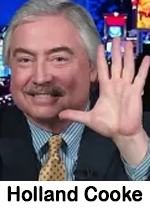
By Holland Cooke
Consultant
It is now the ultimate competitive advantage, and for broadcasters it’s a survival strategy. In The Five-Year Century: Bold Leadership and Accelerated Outcomes in the Age of AI, Mihir Shukla and Nancy Hauge explain how—as artificial intelligence accelerates change and demographics reshape the audience—trust becomes the only durable asset radio and television can bank on.
The book describes a 2026 world where the “twin engines” of growth—population and productivity—have stalled. Birth rates are plunging, workforces are shrinking, and productivity has flatlined across most industries. Meanwhile, AI is compressing decades of innovation into months. This collision creates what the authors call “The Five-Year Century,” in which the pace of change overwhelms institutions built for slower times—broadcasting, for instance.
Radio and television were built on industrial-era assumptions: mass audiences, standardized programming, rigid schedules, and hierarchical decision-making. Those assumptions worked when the audience was broad, predictable, and captive. On February 9, 1964, the Beatles tripled Ed Sullivan’s ratings. Back to the future…
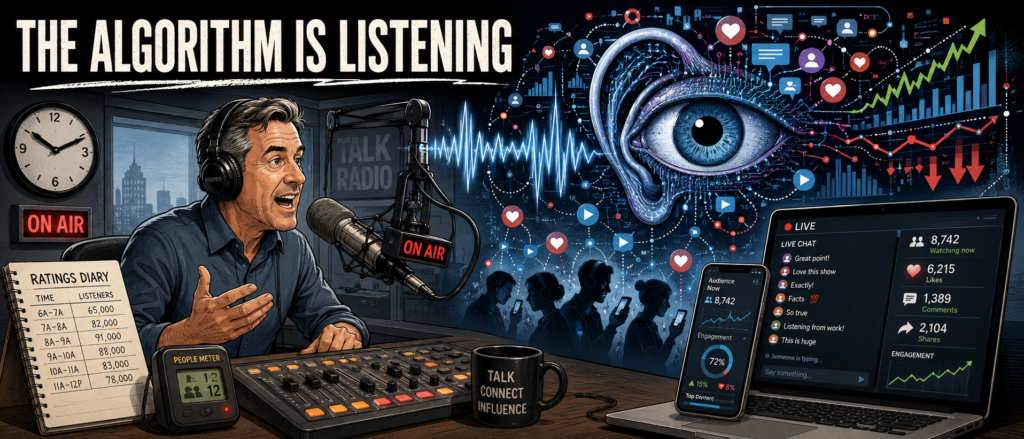
AI is rewriting the rules of content creation, distribution, and consumption. Personalized news feeds, customized ad loads, and algorithmic programming are expectations. Younger audiences don’t wait for a newscast; they expect a feed. They don’t tune in; they scroll. They don’t accept one-size-fits-all; they demand one-size-fits-me.
In this environment, trust becomes the new currency because it’s the one thing AI cannot manufacture.
Broadcasting’s advantage has always been credibility. When a storm hits, people still turn to local radio. When a shelter-in-place alert hits their phone, they still switch on local TV. That instinct is powerful, but it’s not permanent. Trust must be earned continuously, especially as AI-generated misinformation floods the ecosystem.
The book’s chapter on the “Trust Economy” makes a critical point: trust accelerates outcomes. High-trust organizations move faster, innovate more boldly, and adapt more effectively. For broadcasters, trust accelerates audience loyalty, advertiser confidence, and community relevance. But trust now requires new behaviors.
It requires transparency about how AI is used in newsrooms. It requires clarity about what is human judgment and what is machine assistance. It requires authenticity as AI-generated talent becomes increasingly commonplace—and increasingly convincing.
Trust requires broadcasters to lean into what humans do best: context, empathy, moral reasoning, and community connection. The book reminds us that “work worthy of human potential” is work that machines cannot replicate. For broadcasters, that means storytelling, accountability journalism, and the human presence that makes local media local.
By all means, assign AI the routine tasks: editing, logging, transcription, versioning, and production. Then reinvest the human time you save in the relationship between a station and its community. In The Five-Year Century, trust isn’t just a virtue. It’s a conspicuous differentiator. It’s the currency that will determine which broadcasters thrive and which fade into the noise of an algorithmic world. As our industry suffers workforce cutbacks, we risk downsizing trust.
To read two sample chapters and watch a short video interview with the authors, click here.
Holland Cooke is a consultant working at the intersection of broadcasting and the Internet. Follow HC on Twitter @HollandCooke and connect on LinkedIn.


 Beasley Media Group’s 97.5 The Fanatic (WPEN-FM), Philadelphia’s announced a new weekday on-air lineup highlighted by the promotion of current midday host Jon Marks to the station’s morning drive program. Beginning Monday, August 17th, Marks will join Andrew Salciunas as co-host of the weekday morning show from 6:00 to 10:00 am, following the departure of John Kincade. Marks, who currently hosts the station’s popular “Middays with Marks” program, will transition to mornings alongside Salciunas, who has been part of the morning show for the past two-and-a-half years. The move pairs one of Philadelphia’s most recognized sports radio personalities with one of the market’s emerging voices while maintaining a strong local focus during the station’s highest-profile daypart. The programming changes also create new opportunities across the station’s weekday schedule. Ray Dunne, who previously served as producer of the station’s midday program, moves into an on-air hosting role and will join Sean Brace to lead the midday show from 10:00 am to 2:00 pm. Meanwhile, “Unfiltered with Ricky Bo and Bill Colarulo” will continue in afternoon drive from 2:00 pm to 6:00 pm. “Jon Marks has earned the trust of Philadelphia sports fans through years of outstanding work on the air, making him a natural choice to drive our morning show” said Paul Blake, Vice President and Market Manager, Beasley Media Group Philadelphia. “Along with Andrew, Sean, Ray, Ricky and Bill, we’re confident this lineup reflects the depth of talent at The Fanatic and reinforces our commitment to delivering the best local sports talk in Philadelphia.”
 By Matthew B. Harrison
 The Radio Hall of Fame announced today (8/3) the selection of nine 2026 Legends inductees. These individuals were selected by the Radio Hall of Fame’s 2026 Nominating Committee, which meets annually to recognize deceased individuals who made significant contributions to the radio industry. The Radio Hall of Fame is housed within the Museum of Broadcast Communications in Chicago.
 WTLP-FM (licensed to Braddock Heights) at 103.9 FM and the company will begin leasing it to the Christian music network K-LOVE on August 1. WTOP general manager Joel Oxley states, “Our main signal on 103.5 FM covers most of Frederick County’s population and with the advent of streaming, listeners can get us anywhere in the country.” WTOP began simulcasting on 103.9 FM in 2007.
 WRMR-FM, Jacksonville, NC; WMFD-AM, Wilmington, NC; WKXB-FM, Boiling Spring Lakes, NC; WILT-FM, Wrightsville Beach, NC; WAZO-FM, Southport, NC; and translators W269DF-FX and W240AS-FX, Wilmington, NC. KALIL & CO., INC. was the exclusive broker for this transaction.
 end. My job was eliminated Friday, July 24th. I was at Salem for a total of 25 years. I worked there twice. I assisted getting KNTH on the air as the latest news/talk station in November 2004. I met many great people while there. I had great staff, too. One of the biggest thrills was producing the Sam Malone Show, as well as his sidekick. JP Pritchard along with Tom Fontaine contributed to the success of the show. Good times; great oldies.”
 Zimmer will take over the operation of sports talk KOSP-FM “102.1 The Won” and three music brands. It currently owns news/talk KWTO/K227KO and sports talk KBFL-AM/K245CA. Zimmer Communications president John Zimmer says,
 “This is an exciting opportunity to bring together two organizations that share the same values and a deep commitment to local broadcasting. By combining our strengths, we’ll be able to offer advertisers even more effective marketing solutions while continuing to provide the trusted local content our audiences rely on.” Mid-West Family president Mike Paterson adds, “As the local radio and media landscape continues to evolve, bringing these two organizations together creates even greater opportunities for our advertising partners, our communities and especially our employees.”
  Friday, August 28. The program was created in honor of the late founder of Media Staffing Network, Laurie Kahn. MIW says Speak Up! is a year-long mentorship program designed to empower women working in small- and medium-market radio stations across all departments. One outstanding candidate will receive personalized mentorship from MIW’s network of female broadcast leaders, complemented by executive coaching from Media Staffing Network’s certified coaches.
 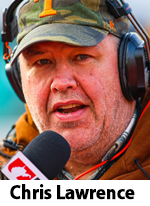 announced during a special dinner at the Edison Ballroom in New York City on October 20. While four spoken-word-formatted stations made the cut in the Legendary Station category, it’s interesting to note that just one talk host – news/talk or sports talk – is a finalist across five personality categories. That distinction goes to WCHS-AM, Charleston, West Virginia morning drive host Chris Lawrence who is a finalist in the Small Market Personality of the Year category. Go get, ‘em Chris! We’re pulling for you.
 “another major milestone in JFMN’s strategic vision of building the nation’s premier independently owned News-Talk-Sports media network.” JFMN co-founder John Fredericks says, “As we continue to grow across America, Tennessee is a key market for our future. Our mission is simple: deliver compelling News-Talk-Sports programming that people can’t get anywhere else. We’re building platforms that serve our audience – not shareholders – and this expansion is another major step in that vision. We’re proving that News-Talk and Sports belong together. Our audience wants breaking news, honest opinion, and the teams they love – all from one trusted source. That’s exactly what we’re delivering.”
  Veteran journalist, author, political commentator, and 77WABC Radio personality Dominic Carter was honored with the American Heritage Award at the Kings County Conservative Party’s Annual American Heritage Reception on July 23 at the Knights of Baron DeKalb in Sheepshead Bay, Brooklyn. The event celebrated Carter’s more than four decades in broadcast journalism, recognizing his distinguished career as a radio host, television commentator, author, and one of New York’s most respected media voices.
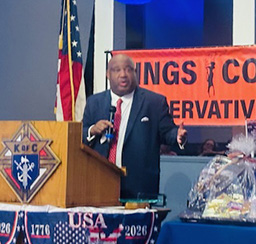 Frances Vella Marrone, the reception brought together elected officials, candidates, community leaders, and supporters to recognize Carter’s professional achievements while celebrating the values of perseverance, public service, and the American Dream.