 LOS ANGELES – As students, enthusiasts and caretakers of this wonderful medium, we’re keenly aware that radio’s “Golden Age” boasted an incredible array of entertainers and broadcasters.
With lifestyles, technology and society being what they are today, it’s almost inconceivable to imagine that families would actually gather around the radio and attentively listen – and indeed hang onto – each and every word that emanated from that mysterious entertainment-laden box sitting in the living room.
Fundamentally important back then, of course, was a concept known as “Theater Of The Mind.”
No one embodied and personified it better than one of the bigger-than-life talents of that era: Orson Welles.
Most are familiar with his epic “War Of The Worlds.”
Pictures Set In Songs
The list of other outstanding “Mercury Theater” presentations Welles was responsible for is much too lengthy to cite here, but his legendary “Theater Of The Mind” mystique lived on nightly in Los Angeles, where Jim Ladd was a welcome guest for Southern California listeners dating back to 1969 and hosted a regular show on SiriusXM’s Deep Tracks channel the past 11 years.
Theater Of The Mind so perfectly describes what Ladd tried to do, although it’s not radio drama in the pure sense. “What I [attempt] at night is to show you pictures and do that by playing sets of songs,” the (then) highly popular KLOS-FM, Los Angeles 10:00 pm – 2:00 am personality remarked to me. “If you follow the lyric content of each song, as well as the song’s emotional feel, it should tell you a story with a beginning, middle and end. Thus, it’s theater.”
Throwback To Creativity
In addition to providing his special spin to Theater Of The Mind, Ladd was also responsible for keeping another bit of radio history on life-support.
Most air personalities are required to adhere to strictly enforced music lists, but Ladd’s nightly, four-hour, Los Angeles air-shift was a throwback to the days of “free-form” radio.
The result was similar to what existed in April 1967, when a new phenomenon started taking shape. “That was the beginning of FM and this multi-billion dollar industry,” Ladd recalled. “[Free-form] started on a station [KMPX, San Francisco] where the phone was literally disconnected, because they couldn’t pay the bill. [Tom Donahue] had an idea; he went there and it took off. For a while before deregulation, that’s what all FM radio did in any market. Free-form worked great, until they killed the golden goose.”
Right Place, Right Time
Southern California native Ladd was extremely fortunate to have been able to launch his radio career in the country’s second-largest market. “Part of it was timing,” he admitted. “I was at a little station in Long Beach [KNAC-FM] that decided it was going to try this new, hippie, underground thing. They didn’t know what it was, but [the feeling was to] hire some hippies and see if they could make some money with it. I happened to be right there at that time.”
A frustrated musician, who wanted to be a songwriter, Ladd recounted a life-altering conversation he and a buddy had in a car. “My friend said that I should be in radio. I was 19 or 20 at the time and your friends at that age seldom notice anything but themselves. For some reason, that stuck with me. Thank God, FM was in its infancy and they’d take complete novices like me off the street and give us shows. Owners didn’t know anything about the Grateful Dead or The Who, but we did.”
Check Mate
Instead of walking into a studio and following a computer-generated music log, Ladd was given freedom to use his imagination. His only preparation was what was happening in life.
Resulting sharp, clever music sets he composed weren’t written out in advance. “The way I work is to turn the music up loud and get the song working on me,” he commented. “Once [that happens], it keys in my mind what will fit next.”
Such an intricate process included a mental checklist. “I’ve figured out the lyrics will work, but I need to know how the song I’m playing ends and how the next song begins,” he explained. “If I’m playing a balls-out rocker, I can’t go into some acoustic piece. In that way, it’s really like a chess game. I have to plan these things to start every single segue as I’m doing it. That’s the way that works best for me.”
There were nights, however, that Ladd knew that he “[didn’t] have it,” but as he maintained, “I’ve been doing it long enough to put on a good professional show. Sometimes, I don’t have what I’m striving for, which is to make a connection with the audience. Without having to prompt them or explain anything, my audience lights up the phones. They call because they get what I’m doing. Once that connection is made, then look out, because the rocket is taking off.”
Gracefully Handling The Tragedy
Recalling the horrific September 11, 2001 “Attack On America,” Ladd noted that although it was one of the country’s greatest tragedies, “It was easy to immerse myself into something like that. It so moved me that I had no problem thinking of songs to play or what I wanted to say.”
Judy Collins’ version of “Amazing Grace” was the first song he played when he went on the air that night. “Believe it or not, it set the tone for what I did for … the next two weeks.”
As it usually did, the audience – even or perhaps especially in this painful period – stepped up to the plate. “This is the thing about free-form radio that’s so precious to me,” Ladd emphasized. “Nobody called me on 9/11 with an idiot request. When I played sets of 9/11 songs, everybody was calling in with [appropriate] suggestions. Second only to dealing with the tragedy, the hardest part was to know when I could play groups like AC/DC again. I found that very difficult; you can only feel your way through it.”
Loyal Listeners
In his third tour of duty at (then ABC-owned) classic rocker KLOS, Ladd was a legitimate cult figure in the Southland for his work at legendary cross-town rocker KMET.
Southern California listeners were stunned on Valentine’s Day 1987 when the “The Mighty Met” (now Audacy smooth AC KTWV) – became smooth jazz “The Wave.”
Also on Ladd’s impressive resume were stints at Los Angeles outlets KLSX and KEDG.
The notion of an air personality “connecting” with the audience is both elementary and elusive. Ladd was a rare case of a non-drive time music personality who amassed a loyal, vocal following.
Grateful for such audience allegiance, Ladd didn’t take it for granted. “My audience has been that loyal from KMET to KLOS and all the [other] stations in between. My part of the bargain is that I won’t lie to them or let them down by doing a format. I was off the air twice in my career for two years each. That was very difficult, but because I did that, I’ve earned the right to do this and I think the audience responds to that.”
Offered jobs by stations that wanted the “Jim Ladd” name, he opined, “They didn’t understand what that meant. They thought they could just plug in my name, not let me do what I did and it would be the same thing.”
Your Attention Please
Evenings and nights were Ladd’s domain throughout his career. “I wouldn’t want to do middays or afternoon drive,” pointed out the personality known for his “Lord have mercy” exclamations. “Listening habits are such that you can’t sit and listen like you can at night. People are working, picking up the kids and doing life.”
Much like Welles’ Mercury Theater, Ladd’s show required attention. Otherwise, it was just like playing one song after another, without making that all-important connection. “The audience’s side of the bargain is that they have to bring their attention to the show,” he insisted. “I’ve done [6:00 pm – 10:00 pm] in my career and that worked out very well. The show is a bit different, in that, it’s not quite as eclectic. I don’t know if I’d be playing Judy Collins and Johnny Cash in [that time]; maybe – but maybe not.”
Convinced his free-form style could be utilized elsewhere, Ladd, nevertheless, pondered that to his knowledge, “I’m the Alamo – the last guy standing. That’s certainly the case in a major market. The big tragedy is that there are so many talented [personalities] who, although they wouldn’t do the same show that I do, could do free-form radio. We’re losing all that talent. I’m not the only guy in the world who can do it. I’m the one who was stubborn enough to say that I won’t follow a list – I just won’t do it.”
Powerful Trinity
Among those who influenced Ladd’s on-air style were former MTV personality and ex-KEDG program director J.J. Jackson; veteran Los Angeles air talent Raechel Donahue, who went on to do 7:00 pm -12:00 midnight in Denver at KQMT “The Mountain”; longtime KMET personality the late B. Mitchel Reed; KMET’s Pat Kelley; Cynthia Fox; Jack Snyder; and the late, underrated Mary Turner. “The wonderful, beautiful part of free-form radio – and most importantly – at KMET was that it wasn’t about being a star,” Ladd asserted. “What we were doing was our part of the ‘social revolution’ at the time. It was like a triad: The people on the street, the music, and us. We took the message of Dr. [Martin Luther] King and combined it with the music of Bob Dylan.”
One highly significant aspect in noting those former KMET staffers was that they’d each listen to everyone else’s show and it elevated their own game. “I’d hear Cynthia do a great segue, or Mary would do a great segment and that would inspire me,” Ladd enthused. “What I miss most is that kind of camaraderie – it’s just me now. I can’t tune in to hear someone else’s great segue. When I heard one of my colleagues do something that touched me, the first thing I wanted to do was to call them and tell them it was great. The second thing was that – from their subject matter – I got 15 different ideas to use when I got to work that night. That was the beauty of it.”
Role Model
National audiences became aware of the iconic Los Angeles talent through shows such as “Innerview,” “Headsets,” and “Jim Ladd’s Living Room.”
Considerably more than someone who voiced a script for a syndicated show, Ladd spent a great deal of time scrutinizing the fine art of interviewing. “I ripped off just about everything I know about interviewing people from Elliot Mintz,” he confided to me. “Elliott was my role model. He’d interview the Shah of Iran one week and John Lennon & Yoko Ono the following week. He’d talk with everyone in a warm, low-key and intelligent manner. It was completely unlike anything [else] I’d heard at the time and that really impressed me.”
The “Innerview” show had an 11-year run and was carried by 160 stations. “It was the first of its kind,” boasted Ladd, whose other syndication work involved voiceovers for an overseas television show. “I’m very proud of the work we did [on ‘Innerview’]. I did 99% of the interviews in the front room of my house in an artistic community in Laurel Canyon. People would immediately be put in a very comfortable place. It’s not a studio – it’s my home.”
The Work Is The Key
Another reason why people felt at ease was that, instead of focusing on a person’s life, Ladd addressed their work. “They loved that. Rather than talking about how many girls they had, what kind of drugs they did and life backstage, I studied every word of every lyric of the new album they wanted to talk about and grilled them about their songs on the environment. It would require six to eight hours of preparation. Then there was another 20 – 25 hours to write the one-hour show; it was a lot of work.”
Writing became such a worthwhile experience that, in 1991, he penned “Radio Waves: Life And Revolution On The FM Dial.”
As a result of these syndicated projects, this immensely respected rock personality diversified himself; the book became a big hit. “I guess I’m a radio guy who learned how to become a writer,” Ladd mused. “In order to get up enough courage to write my book, I read authors I like. I was required to do a great deal of writing for ‘Innerview’ and would write out what I’d say – which is something I never do [on my live show]. You’d also end up with two hours of tape and pick out what the person was going to say, how I was going to introduce it and what song would follow it.”
A Distant Second
Whenever anyone asked Ladd to name his favorite band, he qualified his answer by separating the Beatles.
The quartet, he stressed, had to be placed in a completely different category.
After that’s been done, he named the Doors as his favorite.
The same applied to his most memorable radio experiences, with KMET being the Beatles’ equivalent. “We were at the right place at the right time with the right people. We loved each other and there’s never been anything else like it.”
Nonetheless, he quickly stated that his favorite time is the next time he was able to sit behind a microphone. “The reason for that is [KLOS’-then program director] Rita Wilde,” he proclaimed. “I don’t know how I got so lucky to have a boss who was [such a great on-air personality] and so supportive. If it weren’t for Rita Wilde, I wouldn’t be on the air – that’s just a fact. I want to keep free-form radio alive for the audience, but I also owe her to make this happen. She’s under a lot of pressure [when it comes to my show]. When I go in at 10:00 pm, the format literally stops. I can’t think of another boss in the world who would understand that.”
Numbers Game
His multi-decade Los Angeles track record and loyal following notwithstanding, Ladd still realized that ratings played a role in dictating his employment; however, as he declared, “Rita is one of the first people I’ve ever worked for in this business I trust when she says the numbers are up or down. Sometimes in my career I’ve found out from people who didn’t work at the station that my show was doing great. When there’s a down book, [management is usually] right there.”
Ultimate People Skills
Certain managers and programmers, he claimed, kept good books a secret from him; however, “Rita calls immediately when I have an up book. If I have a down book, I don’t hear from her; I have to call her. That says volumes to me. We’ll deal with a problem, but she doesn’t want to get me upset. She might tell me that I’m playing too much of this or not enough of that, but she never says anything [threatening]. It’s always from a helpful and suggestive [stance]. When the numbers are good, she leaves me totally alone. From my perspective, you can’t ask for more than that. Her people skills are unbelievable.”
In addition to have wanted to keep free-form radio alive as long as possible, Ladd disclosed that he wanted “to walk away before I can no longer do my job. I don’t know when it will happen, but the next stage in my life will probably be to write fulltime – I’m working on it.”
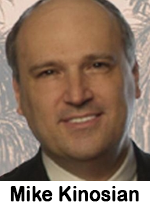
Contact TALKERS Managing Editor Mike Kinosian at Mike.Kinosian@gmail.com



 from the full year of 2022. Cumulus reported net income of $16.2 million for 2022, while posting a net loss of $117.9 million for the full year of 2023. Cumulus president and CEO Mary G. Berner says, “While 2023 was a tough year across the media landscape, we were able to offset some of the effects of the weak national advertising climate through strong execution in our key focus areas. Specifically, we grew our digital businesses, meaningfully reduced fixed costs, and improved our balance sheet. Looking ahead, though national advertisers are expressing interest in increasing their radio buys, as of yet, ad demand remains choppy, reducing our visibility into the rest of 2024. That said, our industry-leading performance during similarly weak macro environments gives us significant confidence in our ability to navigate through this one and rebound strongly when the advertising market improves.” Looking at Cumulus’ business segments, the digital segment to which Berner refers was up 5% in Q4 of 2023 to $39.6 million, but total broadcast revenue during the quarter was down 18.2%. Spot revenue declined 18.3% and network revenue was off 17.9% in Q4 2023 compared to the same period in 2022.
 When reviewing our industry’s awards such as the Crystals or Marconis there are two categories missing. They are: “Best New” and “Best Innovation.” Imagine if winners were announced for these prizes:
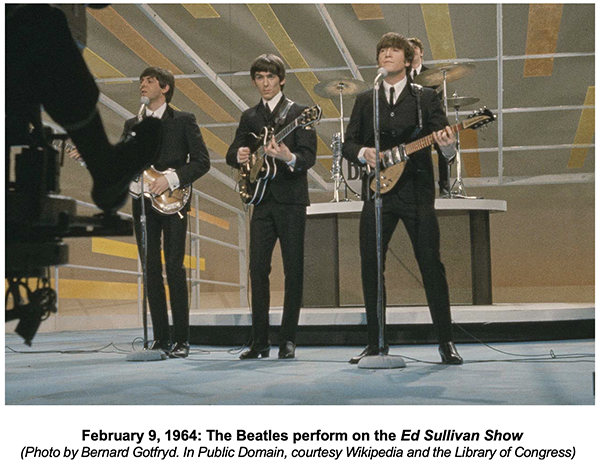
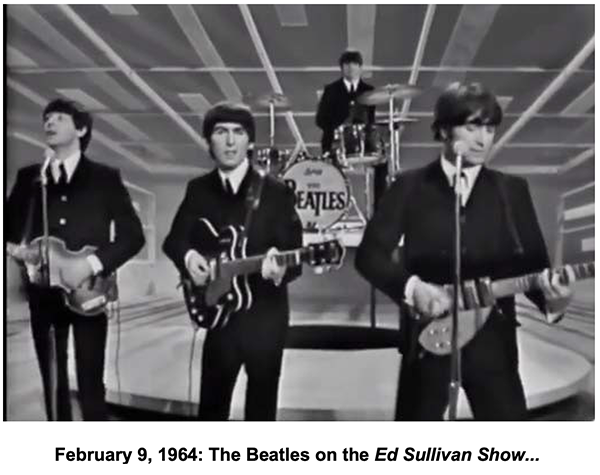
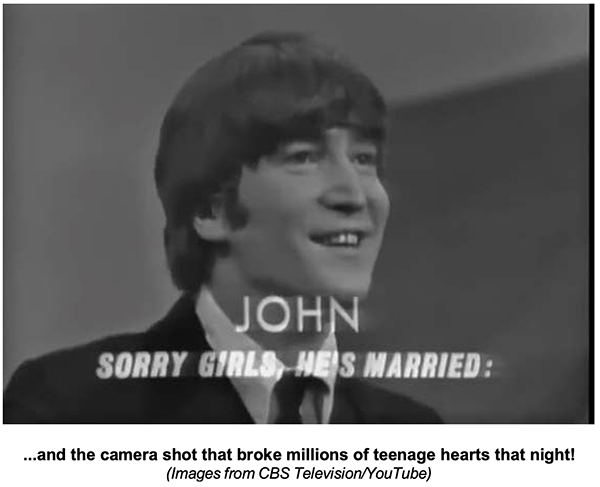
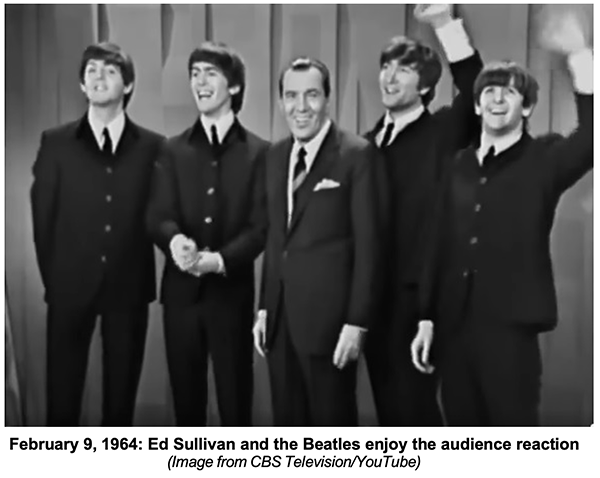
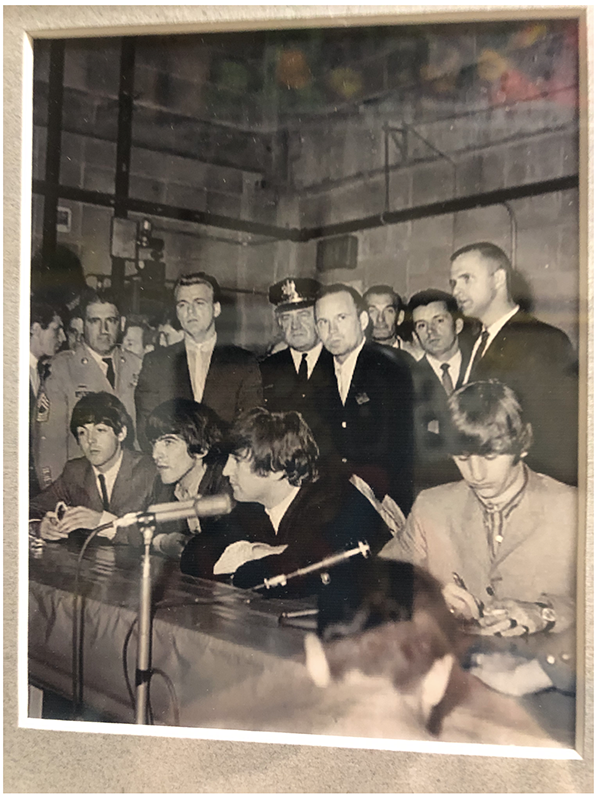
 In early December 1963, America was a very gloomy place. The assassination of President John F. Kennedy on November 22 brought the country to a virtual standstill for four days, and the emotional and psychological hangover lingered for weeks. The nation needed a dose of uplifting energy and fun, and the Beatles were the ideal remedy.
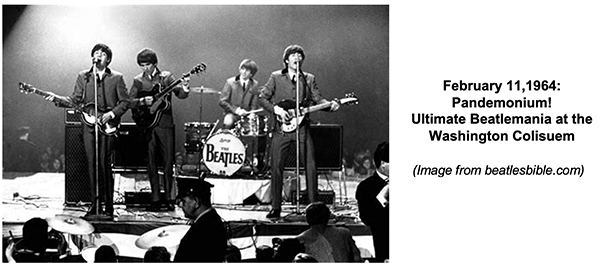
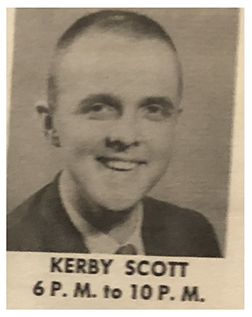 1964 WCAO Promotional Material: “Kerby Scott photo
 and politics (78%) shows. In addition, 89% of news-focused podcasts (across topics) brought on at least one guest in 2022; 2) Most podcasts aren’t bringing the same guests on over and over. More than 99% of all guests only appeared once on any top podcast in 2022. In addition, about half (49%) of top podcasts brought on at least one guest more than once, and 23% hosted more than five different people more than once. The most common guests represent a range of professional backgrounds, including entertainment figures, scientists, journalists and political commentators. Pew senior computational social scientist Galen Stocking comments, “Our research has shed light on the variety of topics and approaches within the podcasting landscape. Here, we found that most top-ranked podcasts are bringing on guests, and often from a wide range of professional backgrounds. This can add to the perspectives heard on each podcast.”
 Other notable findings: 1) Older Americans and women are listening to podcasts at a faster rate, with a 22% increase in listeners over the age of 55 and a 19% increase in female listeners 18+ over the past two years; 2) Top podcast genres of 2023 were News (22% of downloads), True Crime (18%), and Comedy (15%). Of True Crime podcast listeners, 67% were female, of Comedy podcast listeners 62% were male, and of News podcast listeners 58% were male; 3) The top sales networks of 2023 in the Triton U.S. Podcast Ranker were SiriusXM Podcast Network at #1, NPR at #2, and Wondery at #3. The top podcast of the year was “NPR News Now.” Triton Digital SVP measurement products & strategy Daryl Battaglia says, “2023 was another year of significant growth for the podcast industry, and with increasing female and over 55+ audiences, we can expect more content production to serve those groups in the coming year. As podcast listenership continues to rise and reach new audiences, we’ll continue to provide our customers with in-depth insights around podcast consumption and listener habits in the coming year.”
 I’m no expert, but I do have a theory.
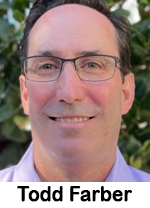 sales division. Farber was most recently an executive director in sales at The Walt Disney Company and ABC. iHeartMedia SVP of sales Joe Donnarumma says, “Nicole’s extensive expertise and Todd’s strategic acumen, paired with their
 proven leadership in navigating the Bay Area’s competitive landscape, make them ideally suited to lead our sales teams toward greater success.” iHM San Francisco region president AJ Punjabi adds, “Bringing Nicole and Todd on board reinforces our mission to innovate and excel. Their fresh approaches are key to elevating our position as a leader in the evolving landscape of audio and digital media.”
 Despite his seemingly nonchalant, bad boy on-air persona, David Letterman is exceptionally respectful of broadcasting and its history.
 Acknowledging that this publication is fiercely non-partisan and that I – in my role as a broadcaster – am basically the same, I offer the following, not as a political opinion piece, but rather a personal observation based on experience that might shed light on the deeper nature of a large segment of the American population prone to listen to talk radio.
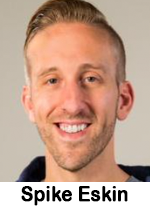 re-join WIP once a successor is named. Audacy says a nationwide search is currently underway. The WIP co-host position opened after Jon Marks announced his exit from the station for personal reasons in December. Audacy Philadelphia SVP and market manager David Yadgaroff says, “We’re very excited to bring Spike home to Philadelphia and SportsRadio 94WIP. This is a unique opportunity to add a great talent with a long history in our marketplace to one of our most popular dayparts, and we’re looking forward to having Spike reunite with his longtime friend and colleague Ike Reese and Jack Fritz to shape the future of afternoon drive at WIP.” Eskin comments, “I am thrilled to be able to work with Ike and Jack in afternoons at 94WIP. It’s now the third job of a lifetime I’ve had the opportunity to do. Leaving WFAN and CBS Sports Radio is an incredibly difficult decision. I’m surrounded by talented, great people, and it’s been an amazing experience. I’d like to thank David Yadgaroff, Jeff Sottolano and Rod Lakin for this opportunity, and Chris Oliviero for my time in New York.”
 After 4G enabled Uber and other apps now-common, inventors are flexing 5G. And grab-the-armrest for what 6G and 7G will bring. Just when we’re blasé about Wi-Fi, we are told that Li-Fi will use light to transmit data.
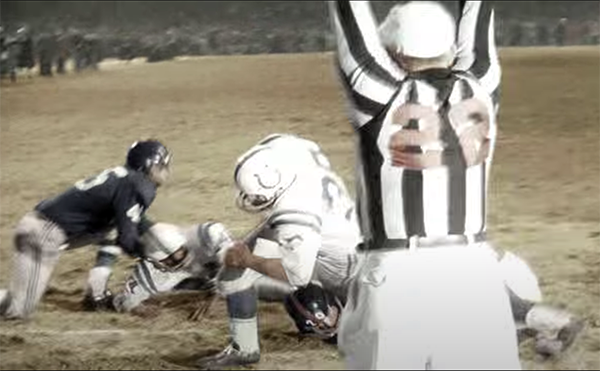
 It was one of those indelible moments in sports history: The 1958 NFL Championship, played on December 28, 1958 at Yankee Stadium in New York. The Baltimore Colts defeated the New York Giants 23-17 in sudden death overtime. 65 years later, the events of that Sunday afternoon still resonate throughout pro sports and sports media.
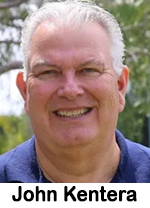 told by Audacy management he’s being let go as the company is looking for a change in middays and wants a “less caller-driven show.” Kentera adds, “I prepare like crazy, I think my show is good, well-received, so I was stunned when I was told I was being fired.” The 65-year-old Kentera has been in radio for 40 years, the last four with KWFN-FM and says he does not plan to retire. “I’m going to look for an opportunity in sports… in or out of the radio business. I’m not done yet.”
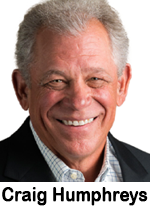 more than 30 years. The 71-year-old Humphreys has planned to retire for some time, and he tells the paper that he and his wife Bev, who’s battling cancer, want to spend more time together. Humphreys’ career in OKC sports talk is one that parallels the growth of sports radio in the U.S. Interestingly, he and FOX Sports’ Skip Bayless are boyhood friends who remain close to this day.
 It’s massive, it’s mind-boggling, and we-the-workin’-press are under strict instructions NOT to call it “The Consumer Electronics Show.” Lotsa luck. 100 thousand+ of us from 150+ countries will descend upon the sprawling Las Vegas Convention Center and other venues up-and-down The Strip.
 with the success of its daytime programming, positions it as the number one network in cable news. FNC says it had the largest share of the audience in total day (46%) and primetime (48%), capturing nearly half of the cable news landscape. In primetime, FNC delivered nearly 2 million viewers and 214,000 in the 25-54 demo, topping CNN and MSNBC combined in total viewership. On a 24-hour total day basis, FNC averaged over 1.2 million viewers and 150,000 in 25-54, with a 153% advantage over CNN in viewers. FOX News Media CEO Suzanne Scott says, “During yet another unprecedented news cycle, cable viewers continued to choose FOX News Channel. From moderating debates to reporting in war zones and many stories in between, I am honored to work alongside this unrivaled team of journalists and opinion hosts as they continue to exceed expectations.”