Industry Views

Are Your AI Logos Actually Kryptonite?

By Matthew B. Harrison
TALKERS, VP/Associate Publisher
Harrison Media Law, Senior Partner
Goodphone Communications, Executive Producer

imgSuperman just flew into court – not against Lex Luthor, but against Midjourney. Warner Bros. Discovery is suing the AI platform, accusing it of stealing the studio’s crown jewels: Superman, Batman, Wonder Woman, Scooby-Doo, Bugs Bunny, and more.

At first glance, you might shrug. “That’s Warner Bros. vs. Silicon Valley – what does it have to do with my talk media show?” Here’s the answer: everything. If you or your producer are using Midjourney, DALL·E, or Stable Diffusion for logos, promos, or podcast cover art, you’re standing in the same blast radius.

AI Isn’t Neutral Paint

The romance of AI graphics is speed and cost. Need a logo in five minutes? A flyer for a station event? A podcast cover? Fire up an AI tool and you’re done.

But those images don’t come from a blank canvas. They come from models trained on copyrighted works – often without permission. Warner Bros. alleges that Midjourney not only trained on its characters but knowingly let users download knockoff versions.

If Warner wins – or even squeezes a settlement – AI platforms will clamp down. Suddenly, the “free” art you’ve been posting may not just vanish; it may become a liability.

Too Small to Matter? Think Again

Here’s the legal catch: infringement claims don’t scale by size. A podcaster with a Facebook page is just as liable as a network if the artwork copies protected content.

It’s easy to imagine a rival, competitor, or ex-producer spotting an AI-made graphic that looks “too much like” something else – and firing off a takedown. Once that happens, you’re judged not by intent but by what you published.

Unlike FCC guardrails for on-air speech, there’s no regulator to clarify. This is civil court. You versus the claimant – and the billable hours start immediately.

Even Elon Musk Just Got Burned

Neuralink – Elon Musk’s brain-computer startup – just lost its bid to trademark the words “Telepathy” and “Telekinesis.” Someone else filed first.

If Musk’s lawyers can’t secure simple branding terms, what chance does your station or company have if you wait until after launch to file your new show name? Timing isn’t just strategy; it’s survival.

The Playbook

  1. Audit Your AI Use. Know which graphics and promos are AI-generated, and from what platform.
  2. File Early. Register show names and logos before the launch hype.
  3. Budget for Ownership. A real designer who assigns you copyright is safer than a bot with murky training data.

The Bottom Line

AI may feel like a shortcut, but in media law it’s a trapdoor. If Warner Bros. will defend Superman from an AI platform, they won’t ignore your podcast artwork if it looks too much like the Man of Steel.

Big or small, broadcaster or podcaster – if your AI Superman looks like theirs, you’re flying straight into Kryptonite.

Matthew B. Harrison is a media and intellectual property attorney who advises radio hosts, content creators, and creative entrepreneurs. He has written extensively on fair use, AI law, and the future of digital rights. Reach him at Matthew@HarrisonMediaLaw.com or read more at TALKERS.com.

Industry News

Shelli Sonstein Shares Loss of Adult Daughter

Q104 New York morning personality Shelli Sonstein reveals that the reason she was off the air last week was due to the death of her daughter Dina Sonstein Berman, who they believe intentionally overdosed at age 38. Sonstein asked that her message be shared with our industry and beyond. You can read it here.

Industry News

TALKERS News Notes

Salem and D’Souza to Release New Film. Salem Media Group and D’Souza Media release the official trailer for the film, The Dragon’s Prophecy. This film is based on the book by Jonathan Cahn that explores the October 7 terror attacks in the Middle East and their connection to ancient battles between the Israelites and the Philistines as recounted in the Bible. It features exclusive interviews with major world leaders and Christian voices, including Israeli Prime Minister Benjamin Netanyahu, Mike Huckabee, Erick Stakelbeck, and Eric Metaxas.

NFL Podcast Network Adds New Shows. The National Football League and iHeartMedia announce the NFL Podcast Network’s fall programming lineup for the 2025 NFL season that includes new programs “Late-Round Fantasy Football Podcast with JJ Zachariason” and “NFL Cover Zero with Matt Jones and Drew Franklin.” All shows on the NFL Podcast Network are distributed by iHeartPodcasts.

Industry Views

Fair Use in 2025: The Courts Draw New Lines

By Matthew B. Harrison
TALKERSVP/Associate Publisher
Harrison Media Law, Senior Partner
Goodphone Communications, Executive Producer

imgImagine an AI trained on millions of books – and a federal judge saying that’s fair use. That’s exactly what happened this summer in Bartz v. Anthropic, a case now shaping how creators, publishers, and tech giants fight over the limits of copyright.

Judges in California have sent a strong signal: training large language models (LLMs) on copyrighted works can qualify as fair use if the material is lawfully obtained. In Bartz, Judge William Alsup compared Anthropic’s use of purchased books to an author learning from past works. That kind of transformation, he said, doesn’t substitute for the original.

But Alsup drew a hard line against piracy. If a dataset includes books from unauthorized “shadow libraries,” the fair use defense disappears. Those claims are still heading to trial in December, underscoring that source matters just as much as purpose.

Two days later, Judge Vince Chhabria reached a similar conclusion in Kadrey v. Meta. He called Meta’s training “highly transformative,” but dismissed the lawsuit because the authors failed to show real market harm. Together, the rulings show that transformation is a strong shield, but it isn’t absolute. Market evidence and lawful acquisition remain decisive.

AI training fights aren’t limited to novelists. The New York Times v. OpenAI case is pressing forward after a judge refused to dismiss claims that OpenAI and Microsoft undermined the paper’s market by absorbing its reporting into AI products. And in Hollywood, Disney and Universal are suing Midjourney, alleging its system lets users generate characters like Spider-Man or Shrek – raising the unsettled question of whether AI outputs themselves can infringe.

The lesson is straightforward: fair use is evolving, but not limitless. Courts are leaning toward protecting transformative uses of content—particularly when it’s lawfully sourced – but remain wary of piracy and economic harm.

That means media professionals can’t assume that sharing content online makes it free for training. Courts consistently recognize that free journalism, interviews, and broadcasts still carry market value through advertising, sponsorship, and brand equity. If AI systems cut into those markets, the fair use defense weakens.

For now, creators should watch the December Anthropic trial and the Midjourney litigation closely. The courts have blessed AI’s right to learn – but they haven’t yet decided how far those lessons can travel once the outputs begin to look and feel like the originals.

Matthew B. Harrison is a media and intellectual property attorney who advises radio hosts, content creators, and creative entrepreneurs. He has written extensively on fair use, AI law, and the future of digital rights. Reach him at Matthew@HarrisonMediaLaw.com

Industry Views

SABO SEZ: What You Need to Know About the “Law of 200”

By Walter Sabo
a.k.a. Walter Sterling, Host
WPHT, Philadelphia, “Walter Sterling Every Damn Night”
and TMN syndicated, “Sterling on Sunday”

imgThe risk is real. Suggesting that a technique used with great success in the recent past might be beneficial to the present is a perilous course. Is the idea out of touch with today’s reality? Is the author ignoring current trends?

A factual current event from which our industry and our lives suffer: Sales are down. Sales for the radio industry are down every quarter.

Hard research-and-math-people will point to the usual causes. Add to that list the fact that the same dollars that bought spots priced at X for the big morning show are being fed into podcasts for 10 percent of X. But podcasts are digital! Therefore, they are sexy to Wall Street. The result of that dollar transfer is quarterly investor calls featuring CEOs declaring that “digital is a sweet spot.” Actually, “digital” is a cheap whore but back to the topic:

Methods deployed to sell radio today are not working. Salespeople work hard, but the strategies they are given are weak. That’s why sales are down – every quarter. Spreadsheets, ROI, CPP, programmatic are elegant math-major systems. But our product is not math. Our product is emotion. Match sales techniques to the product. Tap the power of emotion.

Everything is ultimately purchased from our emotions. Everything.  Case in point: Joe Girard* understands cars better than anyone in history. No, no, don’t be dismissive of Joe because he was a car salesman; cars are very expensive. Cars have impacted you and your family for years. Cars make you feel great or awful. Powerful purchase.

Happy Birthday! One month a year, Joe would mail out a birthday card to all of his past customers and all of his prospects. All of them. In the same month. One out of 12 recipients were thrilled that Joe remembered their birthday! The other 11 would call Joe and tell him that he had their birthday date wrong. They called Joe. A car salesman.

Joe gave all of them information on the phone about the latest models and deals for… a new car. They called Joe.

The Law of 200. Catholic funeral masses hand out prayer cards featuring a photo of the deceased. Ask a priest how many cards are printed. The answer is 200. Caterers will tell you that the standard number of wedding guests is… 200!

Seems we know 200 people who will come to our wedding and our funeral. Major life events. Buying a car is a major, emotional life event. Joe realized that if he sold a good car, 200 people would learn that the customer was satisfied.

OR 200 were not happy. He gave all car buyers a box, a box of his business cards. 200 cards. He urged customers to hand out Joe’s cards to their friends.

Do those 22-year-old time buyers still want concert tickets, merchandise, meals, autographs, meet and greets? Before the power point presentation starts, book the good seats.

Yes, our product is emotion driven. How many arguments have you had about music repetition? New music? Controversial topics? Borderline morning show jokes? Those are emotional not intellectual discussions. There’s our power – in the center of the rink. Put the commercial on the mat.

How to Sell Anything to Anybody by Joe Girard https://a.co/d/fTpuzoZ

Walter Sabo has been a C Suite action partner for companies such as SiriusXM, Hearst, Press Broadcasting, Gannett, RKO General and many other leading media outlets. His company HITVIEWS, in 2007, was the first to identify and monetize video influencers.. His nightly show “Walter Sterling Every Damn Night” is heard on WPHT, Philadelphia. His syndicated show, “Sterling On Sunday,” from Talk Media Network, airs 10:00 pm-1:00 am ET, and is now in its 10th year of success. He can be reached by email at sabowalter@gmail.com.

Industry Views

Could Your Own Podcast Become Your AI Competitor?

By Matthew B. Harrison
TALKERS, VP/Associate Publisher
Harrison Media Law, Senior Partner
Goodphone Communications, Executive Producer

mattybharrisonImagine a listener “talking” to an AI version of you – trained entirely on your old episodes. The bot knows your cadence, your phrases, even your voice. It sounds like you, but it isn’t you.

This isn’t science fiction. With enough content, it’s technically feasible today. A determined developer could transcribe archives, fine-tune a language model, and overlay a cloned voice. The result wouldn’t be perfect, but it would be recognizable.

Whether that’s legal is another question – one circling directly around fair use.

Why It Matters

For most content creators, archives are their most valuable asset. Yet many contracts with networks, distributors, or hosting platforms quietly grant broad rights to use recordings in “new technologies.” That language, once ignored, could be the legal hook to justify training without your permission.

Fair use is the fallback defense. Tech companies argue training is transformative – they aren’t re-broadcasting your show, only using it to teach a machine. But fair use also weighs market harm. If “AI You” pulls listeners or sponsors away from the real thing, that argument weakens considerably.

Not Just Theory

Other industries are already here. AI has generated convincing tracks of Frank Sinatra singing pop hits and “new” stories written in the style of Jane Austen. If that can be done with a few books or albums, thousands of podcast episodes provide more than enough material to train a “host model.”

Talk media is especially vulnerable because its product is already conversational. The line between “fan remix” and “AI imitation” isn’t as wide as it seems.

What You Can Do

This isn’t about panic – it’s about preparation.

— Review your contracts: confirm you own your recordings and transcripts.
— Register your work: enforceable rights are stronger rights.
— Decide your stance: licensing your archives for training might be an opportunity – if you control it.
— Emphasize authenticity: audiences still value the human behind the mic.

The Takeaway

Could your podcast be turned into your competitor? Yes, in theory. Will it happen to you? That depends on your contracts, your protections, and the choices you make.

Fair use may ultimately decide these battles, but “fair” is not the same as safe. Consider this example a reminder: in the AI era, your archive is not just history – it is raw material.

Matthew B. Harrison is a media and intellectual property attorney who advises radio hosts, content creators, and creative entrepreneurs. He has written extensively on fair use, AI law, and the future of digital rights. Reach him at Matthew@HarrisonMediaLaw.com or read more at TALKERS.com.

Industry Views

The Annual (Radio Station) Physical

By Jonathan Little
TroyResearch
President

imgAn annual physical is a wise idea. Doc asks, “How are you doing?”. Then he or she asks some detailed questions based on your medical history. Then “how have you been feeling? Any issues?” Doc always orders blood draws to see what might be lurking. Is the statin drug keeping your cholesterol in check? Are you getting plenty of exercise, plenty of sleep? How’s your diet? Over the years, I’ve visited about my health with at least a dozen different doctors. I’m convinced that the good ones always ask good questions and then listen carefully. Good questioner – good listener. That’s the doc I can respect and put my trust in. 
If you operate a radio station, your station could benefit from an annual physical. You already know how it’s doing based on ratings, revenue, and profit. Your listeners know how you’re doing for them personally because they’re the users of your radio product. Is it pleasing, challenging, inspiring or annoying, irritating, and easily ignored with a click? If you ask them, they’ll tell you. You should ask them at least once a year. 

TroyResearch has been in the business of asking listeners what they think for 27 years. We recently teamed up with Midwest Communications, Inc., in Green Bay to conduct an exploratory research project with their news/talk station WTAQ. TroyResearch’s association with MCI goes back nearly 27 years, doing music and perceptual research for the Duke Wright music stations. The WTAQ project was something new. Our goal was to discover what actionable data the opinions of loyal listeners might produce. TroyResearch worked with VP Programming Jeff McCarthy and Operations Manager Jason Hillery to develop a 25-question study. 

Survey respondents were recruited over the air and were encouraged to go to the WTAQ website to take a brief survey. Clearly, we wanted to hear from P1’s, those listeners who produce 60%+ of reported listening. Their answers provided a clear picture of WTAQ loyalists – what they like, what they don’t like, their political affiliation, their listening behaviors (radio, podcasts, TV news, cable news, etc.), favorite news outlets, trustworthiness of news outlets, their thoughts about protests becoming riots, and their favorite podcasts to mention a few. 

More than 200 respondents, Persons 18+, completed the WTAQ perceptual study. (32% 18-54, 68% 55+). With Jeff’s and Jason’s permission, we share some results. 

Political Affiliation

1% Democrat
78% Republican
15% Independent
6% Other, like Libertarian, Socialist

In car listening

80% Local radio
10% Satellite radio
6% Streaming services like Spotify
3% Podcasts
1% Other like personal playlists 

Listening to WTAQ, which simulcasts

76% FM
9% AM
8% Streaming from WTAQ app
6% Streaming from a smart device
1% Streaming from WTAQ.com

Where do you get your news? (Select all that apply)

93% Radio
46% Broadcast TV (local channels)
41% Cable news like Fox, CNN, MSNBC
29% Social Media like X, Facebook, Tiktok
16% Internet news like NY Post, Washington Post
10% Newspaper
12% Other 

Your primary news source

58% Radio
15% Cable news like Fox, CNN, MSNBC
8% Broadcast TV (local channels)
7% Internet news like NY Post, Washington Post
7% Social Media like X, Facebook, Tiktok
3% Other
1% Newspaper

When does a protest/demonstration become a riot? (Select all that apply)

85%+ When protesters strike police, throw projectiles, set fires, do property damage
75% When protesters spit on police officers
60% When protesters burn the American flag
37% When protesters curse at police officers

Do you listen to podcasts?

23% Frequently
29% Occasionally
35% Rarely
13% Never

What podcast platform do you use? (Select all that apply)

32% YouTube
25% Spotify
19% iHeart
19% Apple
10% Amazon
2% Rumble
1% The Blaze
1% Daily Wire 

As a broadcaster that reports news and information, WTAQ is interested in knowing how trustworthy you consider the reporting presented by these companies. (1 = very untrustworthy, 5 = very trustworthy)

4.43 WTAQ Radio, Green Bay
3.78 Fox News
3.59 Fox 11, Green Bay
2.92 WBAY, Channel 2, Green Bay
2.83 WFRV, Channel 5, Green Bay
2.77 WHBY Radio, Appleton
2.71 NBC 26, Green Bay
2.22 Green Bay Press Gazette
2.01 Wisconsin State Journal
1.99 Milwaukee Journal Sentinel
1.46 MSNBC
1.37 CNN 

WTAQ asked the 0-10 Customer Endorsement Score question – “On a scale of 0-10 how likely would you be to recommend WTAQ to a friend or colleague?” Those scores reflect the listeners’ opinions of how the station is doing and it’s a forecast of WTAQ’s future. As a rule, a CES of 50 or higher indicates a healthy and sustainable product. WTAQ scored a strong 73 Customer Endorsement Score. 

VP Jeff McCarthy and OM Jason Hillery are pleased with the results of this exploratory study. The WTAQ Sales Team is delighted with the data. 

Good questioner … Good listener! WTAQ asked good questions. And now their leadership team is “listening” to the answers and determining what adjustments, if any, may result in improved ratings, revenue, and profit, on the way to an 80 Customer Endorsement Score with the next WTAQ study. 

Jonathan Little is president of TroyResearch. He can be phoned at 608-219-1077 or emailed via: jlittle@troyresearch.net

Industry News

Starnes Address Gun Owners of America

Independent (Starnes Media Group) nationally-syndicated radio host and KWAM, Memphis owner Todd Starnes delivered a keynote address at the 2025 Gun Owners of America Summit in Knoxville, Tennessee. Some 6,000 gun owners and defenders of the Second Amendment attended. GOA also hosted a signing for Starnes. His latest book is titled Star-Spangled Blessings: Devotions For Patriots.

Industry Views

Monday Memo: Topics That Tune-Them-In

By Holland Cooke
Consultant

imgBaby Boomers (born 1946–1964) are some 20% of the U.S. population, but control more than 50% of all household wealth. They hold $70+ trillion in assets and spend an estimated $548 billion annually. They are lifelong AM/FM listeners, and they’re redefining what life after 60 looks like. Are you into what they’re up to?

Some are having the time of their lives. Others are confronting new realities. All are seeking relevance, respect, and real-world information. Consider these issues for call-in topics and guest interviews and podcasts. Possibly a sponsored series?

Lifestyle & Purpose

— “How to Make Your Bucket List Actually Happen”
— “Finding Purpose Beyond the 9 to 5”
— “Encore Careers That Start with a Volunteer Gig”

Health & Wellness

— “Sleep After 60: What Changes and What Helps”
— “The Foods That Fight Brain Fog”
— “Fitness Without the Injuries: Smarter Workouts After 50”

Financial Confidence

— “How Much is Enough? Retirement Planning Backwards”
— “Social Security Myths That Could Cost You”
— “Turning Your Home into Income” (downsizing, ADUs, Airbnb)
— “Helping Without Hurting: When Adult Kids Need Financial Help”

im

Freedom & Adventure

— “How to Travel More for Less”
— “National Parks Over 60: Hidden Gems and Senior Pass Tips”
— “Cool Day Trips”

Home & Relationships

— “Downsize Without Drama”
— “Living With – or Near – Your Kids: Pros, Cons & Boundaries”
— “Home Safety Upgrades You’ll Be Glad You Made”
— “The Second Time-Around Marriage: Legal & Emotional Realities”
— “Grandparenting Without Overstepping”

Learning & Creativity

— “The Science of Lifelong Learning: Why Your Brain Craves It”
— “It’s Never Too Late to Learn an Instrument (or a Language)”
— “Turning Your Life Story Into a Book – Or a Podcast”
— “Digital Detox: How to Stay Connected Without Feeling Glued”

Holland Cooke (HollandCooke.com) is a media consultant working at the intersection of broadcasting and the Internet. Follow HC on Twitter @HollandCooke

Industry Views

Just Because You Found It Online Doesn’t Mean You Can Use It

By Matthew B. Harrison
TALKERS, VP/Associate Publisher
Harrison Media Law, Senior Partner
Goodphone Communications, Executive Producer

imgA New Jersey radio station thought they were just being clever online. They scanned a photo from New Jersey Monthly, cropped out the photographer’s credit line, and posted it on Facebook – inviting listeners to edit and reshare it for fun. ying to engage listeners to interact with the station with more than just their ears.”

But that station, WKXW 101.5, ended up in federal court.

Photographer Peter Murphy sued for copyright infringement and removal of attribution. The Third Circuit ruled against the station – finding that the image was used without permission, credit removed, and the photographer’s ability to license his work damaged.

It wasn’t fair use. It was infringement.

Fair Use Won’t Save You from Getting Sued

Fair use isn’t a free pass – it’s a defense. That means someone’s already accused you of infringement, and now it’s on you to justify it.

Even when it works, fair use still costs time and money. In the WKXW case, the station used the entire photo, failed to transform it, and encouraged widespread online sharing. The court saw that as market harm – one of the most important fair use factors.

And don’t assume you’re safe just because it wasn’t part of the broadcast. Courts have made clear that even social media posts by broadcasters can undermine the value of the original and trigger liability.

Don’t Ignore It Just Because It Feels Small

In my own experience with clients fending off these kinds of claims, sometimes it’s obvious. Other times it’s a bluff. But even bogus claims can cost you if you don’t take them seriously from the beginning.

License It, Link to It, or Leave It

If you didn’t create it or license it, don’t assume it’s fair game. Look for content with clear reuse rights. Better yet – link to the source instead of copying it.

Because if a copyright holder comes after you, your intentions won’t matter. Only your rights will.

Matthew B. Harrison is a media and intellectual property attorney who advises radio hosts, content creators, and creative entrepreneurs. He has written extensively on fair use, AI law, and the future of digital rights. Reach him at Matthew@HarrisonMediaLaw.com or read more at TALKERS.com.

Industry Views

SABO SEZ: Top 40 is Always the Answer

By Walter Sabo
a.k.a. Walter Sterling, Host
WPHT, Philadelphia, “Walter Sterling Every Damn Night”
And TMN syndicated, “Sterling on Sunday”

imgReviewing radio’s challenges:

— Trouble attracting and growing younger demos
— Trouble appealing to youth-oriented advertisers
— Trouble generating excitement in our culture
— Trouble owning a seat in the news media
— Trouble attracting out of college/high school employees
in sales, management on air.

The answer is: Top 40 or, if you must, CHR. The answer has always been Top 40.

The brilliant Allen Shaw, president ABC FM Radio, CEO Beasley Broadcasting, CEO/owner Centennial, said, “And Top 40 will always have an important place in radio because it plays the most popular music therefore it will always have an audience.”

In reviewing Spring Nielsens, it is hard to find a Top 40 station that is #1 6+ in any city. Consider how odd that is. Since 1955 there have been hundreds of Top 40 stations that attracted dominant shares of audience.

No, not audience: fans. Passionate fans because music is passion. New music is more passion. Cultural pebbles between the songs dropped by passionate radio stars compel even more passion.

Big contests. Big promotions. Breaking music trends. Huge voices. Pounding jingles. Prizes: Trips to see Taylor Swift in the studio – in England. A week off from school, on us! Free pizza for 50 of your friends – for a year. A new red, customized Z-93 car in your driveway on your birthday. Ed Sheeran plays your prom! A limo to school on opening day. Big Time Rush sings at your street fair.

Alex Warren writes a song for you – and performs it for you. Gift certificates for CAMEO. The Apple package… an iPhone, iPad and MacBook Air.

Media Buyer: Hop on the station yacht this summer, let’s go for a sunset party cruise. One buyer wins this custom Mustang. Wherever you go on vacation, tab’s on us.

Excited? Radio is good at contesting, better than any other medium. Excitement in thin air is what radio does… well, used to do.

Of course radio is a low choice among fresh grads, 18-24s, and media buyers. Radio stopped making the best radio, stunning, pulsing, sexy, unpredictable. We stopped rolling out the red carpet: Hot, current, daring, dangerous… Top 40.

You were drawn to radio because of Top 40. Make that.

Walter Sabo has been a C Suite action partner for companies such as SiriusXM, Hearst, Press Broadcasting, Gannett, RKO General and many other leading media outlets. His company HITVIEWS, in 2007, was the first to identify and monetize video influencers.. His nightly show “Walter Sterling Every Damn Night” is heard on WPHT, Philadelphia. His syndicated show, “Sterling On Sunday,” from Talk Media Network, airs 10:00 pm-1:00 am ET, and is now in its 10th year of success. He can be reached by email at sabowalter@gmail.com.

Industry News

Date and Details Set for 10th Annual Music Industry Reunion in SoCal

img

Many readers and subscribers of TALKERS trace their radio industry roots back to the golden days when the radio programming and record promotion businesses were so symbiotic that the major trade publication serving this two-headed conglomeration was actually called Radio & Records: “The Industry’s Newspaper.”

On September 10, 2025, music and radio industry veterans from across the USA will come together at the 10th Annual Music Industry Reunion. The event will again take place at the Sagebrush Cantina in Calabasas, CA. Doors open at 6:30 pm. The Music Industry Reunion prides itself on bringing together the best of the music business from around the world for this special evening of memories, laughter, and hugs. Past reunions in New York and Los Angeles have reunited over 500 industry influencers, industry legends and icons as well as the brightest radio, music, management, publicity, and marketing professionals in the business. Attendees can enjoy hot hors d’oeuvres as well as chips and salsa, along with $5 tequila shots. Additionally, the Sagebrush Cantina’s full menu will be available to purchase.

According to TALKERS publisher Michael Harrison, “For those of us who were lucky enough to be a part of that wild and crazy chapter of pop culture biz history – especially as it played out in Southern California – this is one of the greatest, most beloved industry events of the year… pure history, nostalgia, and fun!”

Advance tickets are $35 (+Eventbrite service processing fee) and available at this link: https://tinyurl.com/mir10th

The luxurious Anza Hotel has King Suites available at a special Music Industry Reunion rate of $118, which includes access to the hotel’s bar, pool, gym, and free parking. It’s just a few minutes’ walk to the event. Use Code: 250911LA10 at 818.222.5300 or follow this link: https://tinyurl.com/mir10hotel

Connect with The Music Industry Reunion: https://www.facebook.com/groups/MusicBusinessReunion The 10th Annual Music Industry Reunion is coordinated by legendary music biz promoters Jon Scott and Kenny Ryback. Jon Scott 818.601.1283 jonpaulscott@gmail.com Kenny Ryback 747.666.5465 kenny.ryback@gmail.com

Industry News

“The Big 89” Returns (for Two Hours): WLS, Chicago to Pay Tribute to its Music Radio Glory Days

Graphic

Tomorrow night 7/26) listeners can hear “WLS Unwound: Personalities of the MusicRadio Years.” A gathering of air talent from the legendary days of top 40 radio will get-together in the WLS, Chicago lakefront studios to talk about the glory days of when WLS was the Midwest powerhouse for hits and known as “The Rock of Chicago!”  Scheduled to appear: Tommy Edwards, Chuck Knapp, Catherine Johns, Chuck Buell, Jim Kerr and others who may just happen to drop by. This exciting radio event will be hosted by WLS historian Scott Childers, who literally wrote the book on the legendary radio station, now a major talk outlet. Art Vuolo will be archiving the show on video, while Ted Gorden Smucker, Bill Shannon, Tim Larson, Travis Bravo, and Kipper McGee make it all work in harmony. The broadcast will take place Saturday night (tomorrow) on WLS-AM 890 at 10:00 pm CDT

WLS is also available online at wlsam.com.

Lots of great audio clips will also be included. Click below to hear one of the many great promos that WLS is featuring this week. https://app.box.com/s/zyu3elud2u11zrlqy8gxdq3zyy5g80du

Industry Views

When One Clip Cuts Two Ways: How Copyright and Defamation Risks Collide

img

By Matthew B. Harrison
TALKERS, VP/Associate Publisher
Harrison Media Law, Senior Partner
Goodphone Communications, Executive Producer

imgA radio (or video podcast) host grabs a viral clip, tosses in some sharp commentary, and shares it online. The goal? Make some noise. The result? A takedown notice for copyright infringement – and then a letter threatening a defamation suit.

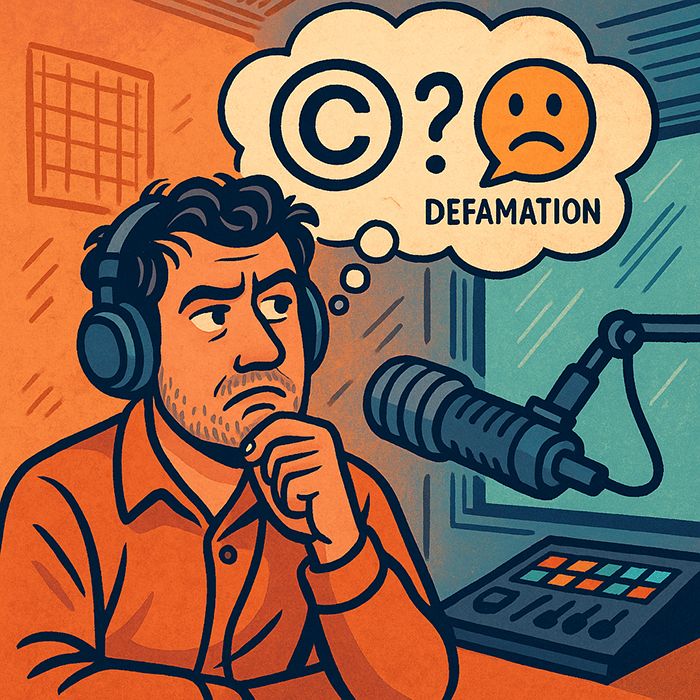
Sound far-fetched? It’s not. In today’s media world, copyright misuse and defamation risks often run on parallel tracks – and sometimes crash into each other. They come from different areas of law, but creators are finding themselves tangled up in both over the same piece of content.

Copyright Protects Ownership. Defamation Protects Reputation

It’s easy to think of copyright and defamation as two separate beasts. One guards creative work. The other shields reputation. But when creators use or edit someone else’s content – especially for commentary, parody, or critique – both risks can hit at once.

Take Smith v. Summit Entertainment LLC (2007). Smith wrote an original song. Summit Entertainment slapped him with a false DMCA takedown notice, claiming copyright they didn’t actually own. Smith fought back, suing not just for the bogus takedown but also for defamation, arguing that Summit’s public accusations hurt his reputation. The court said both claims could go forward.

That case shows just how easily copyright claims and defamation threats can pile up when bad information meets bad behavior.

Murphy v. Millennium Radio: A Close Call with a Clear Message

In Murphy v. Millennium Radio Group LLC, a New Jersey radio station scanned a photographer’s work – with his credit – and posted it online without permission. That alone triggered a copyright claim. But the hosts didn’t stop there. They mocked the photographer on-air, which sparked a defamation lawsuit.

Even though the copyright and defamation claims came from different actions – using the photo without permission and trash-talking the photographer – they landed in the same legal fight. It’s a reminder that separate problems can quickly become one big headache.

Why This Double Threat Matters

Fair Use Isn’t a Free Pass on Defamation. Even if you have a solid fair use argument, that won’t protect you if your edits or commentary twist facts or attack someone unfairly.
Public Comments Can Double Your Trouble. The second you speak publicly about how you’re using content – whether you’re bragging about rights you don’t have or taking a shot at someone – you risk adding a defamation claim on top of an IP dispute.
Smart Lawyers Play Both Angles. Plaintiffs know the playbook. They’ll use copyright claims for takedown leverage and defamation claims for reputational damage – sometimes in the same demand letter.
FCC Rules Don’t Cover This. It doesn’t matter if you’re FCC-regulated or a podcaster on your own. These risks come from civil law – and they’re coming for everyone.

The Takeaway

The overlap between copyright and defamation isn’t just a legal footnote – it’s a growing reality. In a world of viral clips, reaction videos, and borrowed content, creators need to watch how they frame and comment on what they use, just as much as whether they have permission to use it in the first place.

Because when one clip cuts two ways, you could take a hit from both directions.

Matthew B. Harrison is a media and intellectual property attorney who advises radio hosts, content creators, and creative entrepreneurs. He has written extensively on fair use, AI law, and the future of digital rights. Reach him at Matthew@HarrisonMediaLaw.com or read more at TALKERS.com.

Industry News

FCC Continues Deregulation Campaign

The Federal Communications Commission announces its latest effort to remove outdated and unnecessary rules and regulations as part of its “Delete, Delete, Delete” initiative. Specifically, the action will remove from its regulations approximately 2,991 words and 41 rules or requirements concerning utility-style burdens on theimg Internet adopted under the Biden Administration and network interconnection. FCC chairman Brendan Carr says, “We’re continuing to clean house at the FCC, working to identify and eliminate rules that no longer serve a purpose, have been on our books for decades, and have no place in the current Code of Federal Regulations. Today’s action is just the latest step the FCC is taking to follow the Trump Administration’s effort to usher in prosperity through deregulation.  And it’s just one of many, with more on the horizon, so stay tuned.”
Industry News

2025 TALKERS Heavy Hundred Posted

img

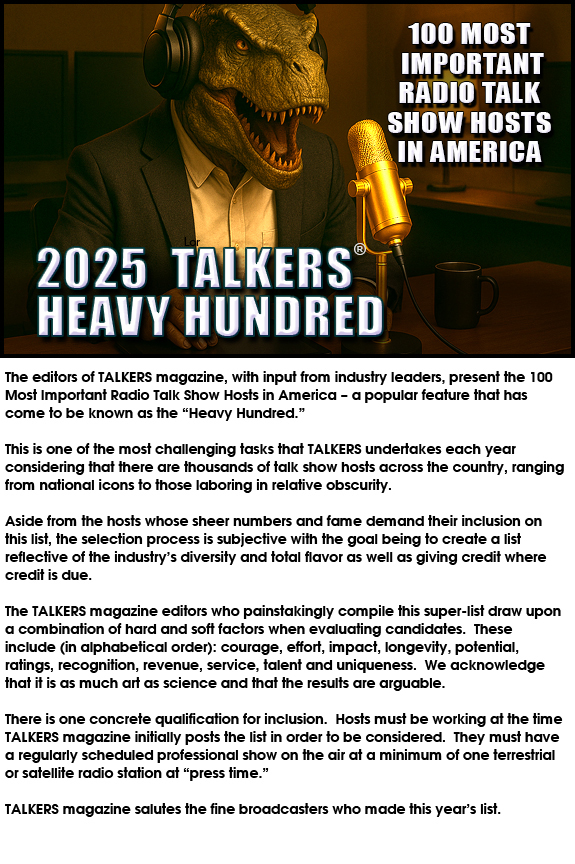
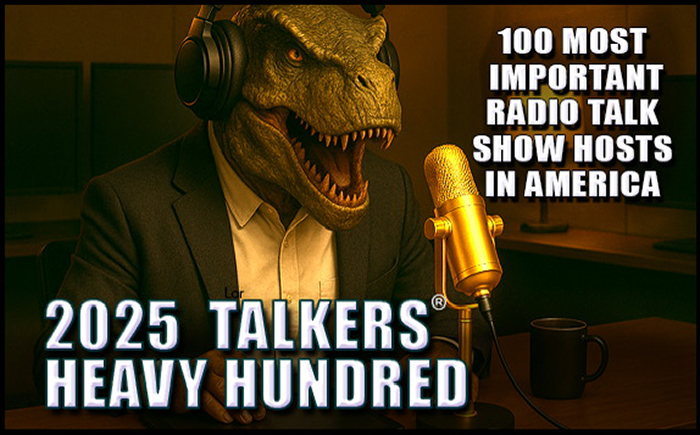
The editors of TALKERS magazine, with input from industry leaders, present the 2025 edition of “The 100 Most Important Radio Talk Show Hosts in America” – a popular feature that has come to be known as “The Heavy Hundred.”

Debuting in 1996, this marks the 29th consecutive year of the TALKERS Heavy Hundred existing as an iconic radio industry standard. It actually launched one year earlier in 1995 but only focused on 25 hosts in that first installment.

The criteria used to determine the individual broadcasters included in the list are clearly detailed in a disclaimer posted at the beginning of the feature. According to TALKERS VP/executive editor Kevin Casey, “In addition to the standard 11 factors considered – which include [in alphabetical order] courage, effort, impact, longevity, potential, ratings, recognition, revenue, service, talent and uniqueness – the editors strongly considered the quality of entrepreneurship for 2025 which has become increasingly important as the industry hurtles deeper into the digital era and faces emerging challenges which require an expanded set of business skills and layers of emotional fortitude.”

Casey continues, “A number of this year’s inductees have ‘put their money where their mouth is’ and own their own stations or syndication businesses. In 2025, we see that as a deeply personal commitment to the future of the radio medium.”

This year’s list is sponsored by GuestBooker.com and co-sponsored by C. Crane Radio for which TALKERS is grateful.

To see the 2025 TALKERS Heavy Hundred, please click here.

Industry News

FCC Chairman Carr Promotes Build Agenda in Sioux Falls

FCC Chairman Brendan Carr was in Sioux Falls, South Dakota yesterday (7/2) to promote the FCC’s “Build America Agenda.” Carr said, “Our ‘Build America Agenda’ will focus on delivering on a number of core objectives. We will unleash high-speed infrastructure builds. We will restore America’s leadership in wireless. We will boost the U.S. space economy. We will advance our national security. And we willimg strengthen America’s tower and telecom workforce.  We will deliver on all of this by implementing smart policies while carrying out a massive and comprehensive deregulatory agenda. As we do so, we will be guided at the agency by a few simple ideas. For one, we will keep the Gretzky test front and center. We want to keep our eye on where the proverbial puck is going, not where it has been. For another, we are going to take a first principles approach. Just because a regulation has been on the books for 30 years, we are not going to keep it there simply out of a sense of inertia. For still another, we will focus on competition as it exists today. The old regulatory silos have been breaking down for quite some time, so the agency must move forward with a keen understanding of today’s converged markets.  We are going to focus on outcomes, rather than process to nowhere. We are going to have a bias towards action. After all, delay has an unappreciated economic and social cost. We are going to push for simple, clear rules, rather than complex and bespoke frameworks. And we are going to support U.S. businesses and domestic onshoring.”

Industry News

TALKERS News Notes

Beasley Sells Tampa Signal to EMF. Beasley Media Group is entering into a definitive agreement to sell WPBB‑FM, Tampa “98.7 The Shark” Educational Media Foundation. The transaction will mark EMF’s official entry into the Tampa Bay market. Beasley Media Group has owned and operated the 98.7 FM signal since acquiring the station as part of a swap agreement with CBS Radio in 2014, when Beasley officially took ownership of WHFS‑FM, along with five other Tampa Bay stations.

Starnes Delivers Keynote Addresses. Newsmax host and nationally syndicated radio host Todd Starnes was the keynote speaker at the recent National Right to Life Conference and the Kansas Republican Party Convention in Kansas City. He was also a keynote speaker at the Faith & Freedom Coalition’s Road to the Majority Conference in Washington, D.C. Starnes is currently on a nationwide tour promoting his new book, Star-Spangled Blessings.

Industry News

“Covino & Rich” Celebrate 20 Years

img

FOX Sports Radio personalities Steve Covino and Rich Davis celebrated the 20th anniversary of the “Covino & Rich” show with an exclusive listener event in Las Vegas this past weekend. More than 300 listeners traveled to Las Vegas to enjoy a live broadcast of the show. The weekend also featured a mixer at Circa’s Legacy Club Rooftop Cocktails to watch the fireworks show, an afternoon of golf at Atomic Golf Las Vegas, and dinner at Circa Sportsbook. The weekend concluded with a night of karaoke at Cat’s Meow, where Covino and Davis joined listeners on stage to perform a few songs. Pictured above are (l-r) are: Rich Davis, show executive producer Christian Sorge, and Steve Covino.

Industry Views

Monday Memo: Stepping-Up and Sounding Solid

By Holland Cooke
Consultant

imgWith so many of us taking vacation time soon, guest hosts are often local somebodies who are not career broadcasters and don’t share our second-nature performance routines. For their benefit, these tips, based on my experience on both sides of the mic:

Get right into it. When I used to fill-in for Jim Bohannon, I figured that – to his listeners – who-the-heck was I? Lacking the back-story of “a name,” I simply, succinctly, told the truth, “I’m Jim’s pal, Holland Cooke.” Skip the biographical blah-blah-blah that devalues a show by emphasizing that the familiar host is absent. Just tee-up what the show is about this hour… why it matters to those listening… how they will benefit from not wandering-off… and how to join-in.

Make the phone ring. When “FOX Across America” host Jimmy Failla is off, my client Paul Gleiser – owner of affiliate KTBB/Tyler-Longview TX – often fills-in. Paul asked Jimmy for advice. Ever in-character, Failla quipped, “Drive it like you stole it!” So Gleiser is all about call count, teeing-up TWO tempting propositions, one topical, the other a softer “Bonus Question.” As new employment numbers were announced, “The WORST job you ever had?” got callers telling great stories.

“Know what the show was about yesterday,” Paul urges, because political topics tend to change little day-to-day. Avoid this trap: The guest host’s outspoken narrative is a point that’s already been talked-to-death BUT this is HIS shot on a big show, so this is HIS turn to me-too the unison. Better approach: Come up with a new wrinkle.

im

Invite participation multiple ways. Many listeners would rather text than call. Welcome them and you’ll sound accessible and at-the-speed-of-life. Note how effectively SiriusXM’s Michael Smerconish polls listeners via social media.

Establish a relationship with the producer “BEFORE the show” Gleiser advises: “Don’t just show up.” Ascertain who-does-what. In some cases, the producer will have booked guests and may suggest or assign call-in topics. Or if – in Jimmy Failla speak – you’re driving, the producer is simply call-screening and running-the-board… which you should NOT attempt if you’re not an experienced broadcaster or if you are unfamiliar with the station’s setup.

Keep re-setting – succinctly, “matter-of-factly,” introducing yourself and your guest-or-topic — going-into and coming-out-of breaks, and at the beginning of each hour. Listeners are constantly tuning-in.

Always and only announce the call-in number immediately after you tell them WHY to call. Most common mistake I hear, even from experienced hosts: They give-out the phone number at the very beginning of the show or hour or segment, then (eventually) they tell you why to call, possibly minutes later (an eternity in live radio). So, they’re haunted by those dreaded “regulars” who already have the number memorized. Make announcing the number your punch line, whether you’re asking opinions on topic du jour or offering access to a guest they’ll want to interact with. Seems like a little thing, but this can make a big difference in how popular you make the station sound.

Holland Cooke (HollandCooke.com) is a consultant working at the intersection of broadcasting and the Internet. Follow HC on Twitter @HollandCooke

Industry News

The American Miracle Premieres at the Kennedy Center

img

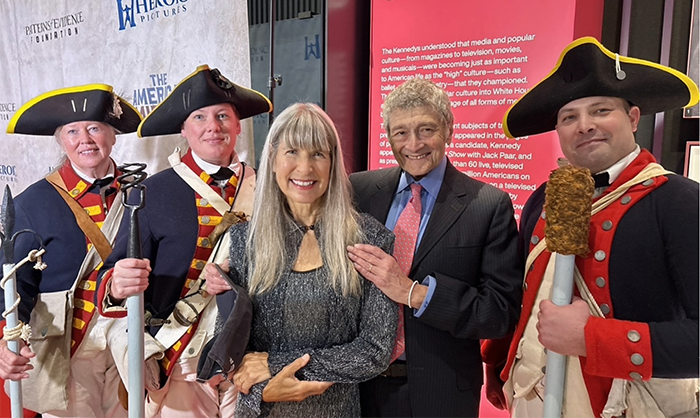
On June 4, Heroic Pictures and Patterns of Evidence Foundation hosted an exclusive VIP red carpet premiere at the John F. Kennedy Center for the Performing Arts in Washington, D.C. for the new film, The American Miracle: Our Nation Is No Accident. The film was inspired by talk radio host Michael Medved’s bestselling book of the same name and portrays the successful American Revolution as happening due to the intervening hand of God. The movie was produced and directed by Timothy Mahoney and stars Pat Boone and Kevin Sorbo, among numerous others. Pictured above is Michael Medved with his wife Diane and actors in period costumes.

Industry News

WWO: Reach Helps Build “Mental Availability”

This week’s blog post from Cumulus Media | Westwood One’s Audio Active Group looks at the effects of reach on and advertiser’s “mental availability.” The piece quotes authors Les Binet and Sarah Carter from their book, 66 Ways To Screw It Up: How Not to Plan, “The single most important factorimg driving brand preference is ‘mental availability’: how well known a brand is, and how easily it comes to mind. Brands with low mental availability tend to struggle, rejected in favor of more familiar rivals. Or not considered in the first place. Brands with high mental availability don’t have to push so hard to sell, so tend to have higher market shares and better margins.” The authors also advise, “Always aim to get more customers from all segments of the market. It’s the main way brands grow.” The blog post concludes that AM/FM radio makes your media plan better by increasing reach. One example is illustrated as follows: Edison’s “Share of Ear” study of ad-supported audio reveals the combined persons 18+ daily reach of Pandora and Spotify is only 12% of Americans. Adding podcasts causes reach to surge to 29%. The introduction of AM/FM radio lifts daily reach to 74%. See the full blog post here.

Industry News

New York Festivals Storytellers Gala Announces 2025 Radio Awards Winners

New York Festivals announces the Radio Awards winners during its 2025 Storytellers Gala. NYFestivals says, “Exceptional storytelling and audio innovation were celebrated during the 2025 Storytellers Gala virtual event, highlighting the achievements of global creators in radio andimg podcasting. Captivating audio entries from storytellers around the world engaged listeners and earned top honors from the 2025 Radio Awards Grand Jury. Winning entries from 26 countries span podcasts and audiobooks, entertainment and music specials, dramas, documentaries, and breaking news coverage all created by some of the world’s most respected audio content creators.” Winners of note include CBC/Radio-Canada taking home the Broadcaster of the Year honor with the following organizations being recognized: NPR, Gold Tower Award, Culture & The Arts; BBC, Gold Tower Award, Drama Special; Bloomberg Podcasts, Gold Tower Award, Business Podcast; CBC/NPR, Gold Tower Award, Sports Podcast, Audacy, Gold Tower Award, Narrative/Documentary; NZME/iHeartRadio, Gold Tower Award, Investigative Journalism Podcast; and more. See all the winners here.
Industry News

Conservative Groups Petition FCC for Regulatory Relief

More than 20 conservative groups, led by Heritage Action for America, sent a letter Federal Communications Commission Chairman Brendan Carr voicing their support for the agency’s efforts to modernize what they call outdated ownership regulations that they say negatively impact local TV and radio stations. The letter puts forth the argument that digital media is at an advantage over analogue media due to these regulations. “The FCC’s television and radio ownership rules date back to theimg 1940s, when broadcast dominated mass communications in the U.S. Since then, the media marketplace has changed drastically – from widespread deployment of cable and satellite television networks to the rise of social media, podcasts, and streaming. Local broadcasters compete directly with Big Tech, streaming services, and social media platforms in the marketplace of consumer content. Yet, unlike their competitors such as YouTube and Facebook, broadcasters are limited by the ownership rules in how many households and consumers they can reach. This is an inherent disadvantage.” The letter adds, “By eliminating the national television cap, local TV duopoly restrictions, and local radio ownership caps, broadcasters can better achieve the scale and efficiencies necessary to compete – and to attract vital investment – in a fragmented and rapidly evolving information market.” See the complete letter here as posted by NAB.

Industry News

Kayla Anderson Exits WGFX-FM, Nashville

Sports media personality Kayla Anderson exits Cumulus Media’s sports talk WGFX-FM, Nashville 104.5 The Zone, where she was part of the morning show with Ramon Foster and Will Boling sinceimg 2022. Prior to joining WGFX-FM, Anderson was a sports anchor, reporter, and digital contributor at WKRN-TV, Nashville. While this sounds like a budget move on the station’s part, Anderson didn’t mention the reason she’s out in her X post: “First and foremost, thank you so much to our loyal listeners, you made my time in radio here so amazing. You all are so passionate about your teams here in Middle Tennessee and I love that. I’m gearing up for the next chapter of my book to write itself. All I’ve ever known is to keep navigating it to the best of my ability.”
Industry News

Top News/Talk Media Stories This Past Week (May 12 – 16, 2025)

Here are the most talked about stories of the past week (5/12-16) on news/talk radio and related talk media according to TALKERS:

Stories

1. Trump’s Middle East Trip
2. Big, Beautiful Bill / Medicaid Cuts
3. Birthright Citizenship Case / Universal Injunctions
4. Alien Enemies Act / Deportations / WI Judge Case
5. Tariffs / U.S.-China Trade War
6. Russia-Ukraine Peace Talks
7. Tapper & Thompson’s Biden Book
8. Air Traffic Control Troubles
9. Diddy Trial
10.Menendez Brothers Case

People

1. Donald Trump
2. Mike Johnson
3. Clarence Thomas / Brett Kavanaugh / Amy Coney Barrett
4. Hannah Dugan
5. Xi Jinping
6. Volodymyr Zelensky / Vladimir Putin
7. Joe Biden / David Plouffe
8. Sean Duffy
9. Sean “Diddy” Combs / Cassie Ventura
10.Erik and Lyle Menendez

To see the full TALKERS Stories, Topics, and People Charts, please click HERE.

Industry Views

SABO SEZ: Give Credit

By Walter Sabo

a.k.a. Walter M. Sterling
Host, “Sterling Every Damn Night”
WPHT, Philadelphia
Host, “Sterling On Sunday,” TMN

imgRight now, dozens of well-suited, over-priced, unpleasant lawyers are fighting in Hollywood over the title credit their client should receive on a movie, TV show, or book cover. Placement within the credit roll at the end of a show is a battleground of egos and legalities. Part of the process of securing proper credit is governed by multiple union rules negotiated by multiple unions and corporate dictates of corporate masters. (You don’t get to be CEO of Paramount by being a nice guy.)

In most mass media, getting credit for the hard work of creating mass media is a very serious matter. What’s the “title slide” credit for you and your colleagues?

To your listener, you are a star. For no cost, you, your station, and our industry would benefit from building a credit roll at the end of each of your shows. Radio has a first class array of production software, processing and SFX libraries. Use those assets to create on air credit rolls for talent, PAs, anyone who touches a show.

The result: Credited employees will grow prouder of their work. They will be recognized by their friends. Advertisers will know their messages are part of a “big thing” and invest with confidence. Subliminally running credits for your station’s team puts radio on the same plateau as movies, TV, print. For free.

Consider every opportunity to elevate the stature of radio stars. When you have a substitute host or DJ please don’t say, “filling in for…” say, “guest starring.” How does your talent present themselves away from the station on remotes or appearances? KMART rack or Dress for Success? Fact: Management of other media say that radio executives and sales people “dress poorly.” Really, that’s their view of radio personnel. Lousy dressers. Easy fix.

Kudos to George Noory. At the end of each show, he credits his predecessors; all-night radio stars who, through the decades, explored UFO’s and non-traditional topics. George’s humble announcement celebrates radio’s robust history and places Noory in an all-hit lineup.

Walter Sabo has been a C Suite action partner for companies such as SiriusXM, Hearst, Press Broadcasting, Gannett, RKO General and many other leading media outlets. His company HITVIEWS, in 2007, was the first to identify and monetize video influencers. His nightly show “Walter Sterling Every Damn Night” is heard on WPHT, Philadelphia. His syndicated show, “Sterling On Sunday,” from Talk Media Network, airs 10:00 pm-1:00 am ET, and is now in its 10th year of success. He can be reached by email at sabowalter@gmail.com