


Industry Views

When Your Voice Becomes the Product
img

By Matthew B. Harrison  
TALKERS, VP/Associate Publisher
Harrison Legal Group, Senior Partner
Goodphone Communications, Executive Producer

imgFor years, Harrison Legal Group has informed media creators about the legal risks of using copyrighted clips, songs, images, and broadcasts without permission. The issue became central enough to inspire my book, Playing the Clip: The Definitive Digital Media Creator’s Guide to Fair Use (TALKERS Books, 2026). The premise was straightforward: modern media runs on borrowed material, but borrowing comes with legal exposure.

Now the fight is shifting toward something more personal.

The voice itself.

Not the recording. Not necessarily the script. The identity embedded in the sound.

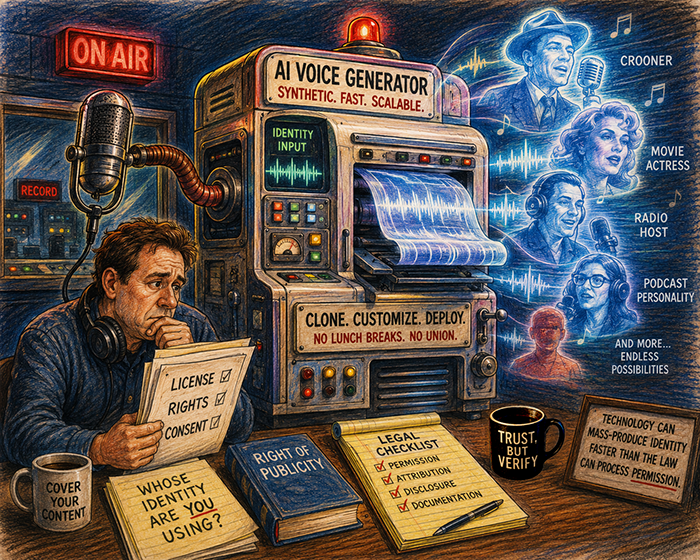
That distinction is becoming increasingly important as AI voice systems improve to the point where listeners can recognize a performer even when the company insists it used a “different actor” or synthetic generation. The Scarlett Johansson dispute with OpenAI may become the defining example. Johansson alleged that OpenAI created a voice assistant that sounded “eerily similar” to her after she declined the company’s request to license her actual voice. OpenAI denied intentionally imitating her and stated the voice belonged to another actress but still paused what they branded the “Sky” voice after backlash intensified.

The case matters because it exposes a legal gray area many creators misunderstand.

A voice is generally not protected by copyright law in the same way a song recording is. But a recognizable voice may still trigger claims involving the right of publicity, false endorsement, unfair competition, or misappropriation of identity. In other words, the legal risk is often not “you copied audio.” The risk is “you exploited identity.”

That distinction matters for broadcasters, podcasters, advertisers, and AI companies experimenting with synthetic hosts, cloned announcers, or celebrity-style narration.

If listeners reasonably believe a celebrity endorsed, participated in, or authorized the content, the legal exposure changes dramatically.

Read more….

Another recent example involves Dua Lipa and Samsung. According to reports, Lipa alleges Samsung used her image on television packaging without authorization, creating the impression she endorsed the product. Samsung reportedly claims the image came from a third-party provider that assured the company all rights were cleared.

That defense may sound familiar to media professionals.

“We got it from somebody else.”

Legally, that is often not enough.

A broadcaster cannot avoid defamation liability merely because a guest made the statement. A publisher cannot automatically avoid infringement exposure because a freelancer supplied the material. And a company may not avoid publicity-rights claims simply because a vendor promised the paperwork existed.

The underlying legal theme is the same: delegation is not immunity.

The AI layer complicates things further because modern systems do not necessarily reproduce exact copies. Instead, they generate approximations that may still evoke a specific person strongly enough to create marketplace confusion.

Courts have dealt with similar issues before. Bette Midler and Tom Waits both successfully sued over soundalike performances used in advertising after declining to participate themselves. The principle is not new. AI simply makes imitation faster, cheaper, and easier to distribute.

That should concern media creators who assume these disputes only affect billion-dollar tech companies.

They do not.

A local station, podcast producer, YouTube creator, or advertiser can now generate celebrity-adjacent voices in seconds. The barrier to entry collapsed. The liability did not.

The safest question is no longer merely “Do we own the audio?”

It is: “Whose identity does this remind people of?”

That answer may determine whether the next lawsuit is really about technology at all.

Or simply old-fashioned commercial exploitation wearing futuristic clothing.

Get your copy of “Play the Clip: The Definitive Digital Media Creator’s Guide to Fair Use” by filling out the request form at HarrisonMediaLaw.com.

Matthew B. Harrison is a media and intellectual property attorney who advises radio hosts, content creators, and creative entrepreneurs. He has written extensively on fair use, AI law, and the future of digital rights. Reach him at Matthew@HarrisonLegalGroup.com or read more at TALKERS.com.
Industry News

Audacy and TuneIn Renew Distribution Agreement

Audacy announces it is extending its digital distribution deal with TuneIn that provides streaming of its 250-plus stations and entire podcast library to the content aggregator. Audacy says the partnership expands the reach of its content to more than 200 additional platforms and connected vehicles and devices, including Tesla, Rivian,im Lucid, Bose, Samsung and Xbox, as well as on the TuneIn mobile app and TuneIn.com. The agreement also gives Audacy access to TuneIn’s advertising supply and brings select TuneIn original content to the Audacy digital platform. Audacy chief digital officer J.D. Crowley imcomments, “Streaming of AM/FM Radio is one of the fastest growing segments of all digital audio today. As consumer demand for Audacy’s best-in-class local audio content continues to increase, we’re committed to meeting the listener wherever they wish to consume, and we’re delighted to expand the availability of our unique live sports, news, and personality-driven audio content to over 200 new TuneIn-supported platforms. We’re equally thrilled to welcome TuneIn’s premium exclusive content to the Audacy digital platform.”




Front Page News Industry News

Tuesday, January 4, 2022

Good Karma Brands to Sell Wisconsin Signals. Two Southeastern Wisconsin radio signals will change hands, pending FCC approval, and will air a news/talk format. Wisbusiness.com reports that Good Karma Brands is selling WAUK-AM, Waukesha and FM translator W266DR  at 101.1 FM to New WTTN, LLC, led by Wisconsin broadcaster and company CEO Michael Crute. The terms have not been announced. The signals are currently airing sports talk but will flip to news/talk when New WTTN takes control. Crute is co-host of the Madison-based “Devil’s Advocates” program heard on the company’s WTTN-AM/W224EG, Madison “Devil Radio 92.7.” WAUK will be branded “The ‘SHA” and will “broadcast Waukesha-first news, sports, traffic, and weather in 2022 and beyond.” Initially, the station will simulcast the Madison programming that includes: “Matt Flynn Direct” from 6:00 am to 8:00 am; WYD Media’s “Thom Hartmann Program” from 11:00 am to 2:00 pm; “Dueling Tangents with Luke Mathers and Bryan Kelly” from 2:00 pm to 3:00 pm; “The Devil’s Advocates” from 3:00 pm to 5:00 pm; and “The Earl Ingram Show” from 5:00 pm to 6:00 pm. It intends to add locally hosted programming in the spring. Bryan Kelly will serve as operations manager for the station. WAUK has leased an office space and will immediately build a studio location in downtown Waukesha. Crute says, “We are excited to serve Waukesha, a community lacking a locally focused news/talk commercial radio station. WAUK Radio will immediately offer $50,000 total in ‘Good Neighbor’ small business or non-profit grants to help serve the Waukesha community from day one. The grants are for advertising on WAUK. They will be awarded throughout January to locally owned, Waukesha businesses. We will begin accepting applications for our Good Neighbor grants on January 3, 2022.”

Westwood One Blog: Strategies for Successfully Advertising in Local Radio. This week’s CUMULUS MEDIA | Westwood One Audio Active Group blog outlines what it calls “five strategies to help build a successful local audio plan.” Stating that due to the “shift of TV audiences to advertising-free video platforms, local advertisers are turning to audio to build their brands and drive sales,” the Audio Active Group proposes the following: 1) Allocate the budget to align with how people use audio: A well-balanced audio campaign puts 63% of the budget into over-the-air AM/FM radio and 11% into AM/FM radio streaming. 26% of the budget goes to a combination of pureplay streaming and podcasts; 2) Determine the monthly campaign objective (minimum, maintenance, high impact, or launch/grand opening) and budget accordingly: To determine the monthly budget, multiply the market cost per point against the GRP levels. In a market with a $10 cost per point, the minimum monthly campaign would be $2,000. The grand opening campaign would be $5,000 per month; 3) Align impressions and media weight with listening by time period to get the largest possible campaign reach: Per Nielsen, 60% of AM/FM radio listening occurs outside of morning and afternoon drive. Spread media weight across all days and dayparts. About a quarter of media weight should run in middays. Place 20% of the budget respectively into weekends, mornings, and afternoons. 8% goes to nights and 5% to overnights; 4) Find the right audience with AM/FM radio programming formats: While the audience composition of TV shows can vary widely, AM/FM radio station programming formats are very cohesive, appealing to the same audience around the clock. Find the AM/FM radio programming formats that match your target using either median age, total reach, gender skew, presence of children, or household size; and 5) Based on the marketing objective, determine the weekly number of ads to run on a station from four types of schedules (very light, light, medium, or heavy): A very light station schedule reaches one-third of a station’s audience an average of 1.4 times. A light schedule reaches half of a station’s audience two times. A medium schedule reaches two-thirds of a station’s audience three times. A heavy schedule reaches 78% of a station’s audience 4.3 times. See more here.

KIRO-FM, Seattle Unveils ‘Leaving a Legacy’ Podcast. A new podcast from Bonneville’s KIRO, Seattle “News Radio 97.3 FM” launches today (1/4). KIRO-FM late morning personality Gee Scott hosts the “Leaving a Legacy Podcast” in which he “takes listeners on a journey to discover how some of our most influential public figures want to leave their legacy on this world, and how his own experience can be contributed to the shoulders of giants that came before him.” Scott says, “My father always talked about legacy, and this podcast connects me to him now that he’s gone. I’m so excited to learn from these powerful influencers to see what they’re passionate about and what they want their legacy to be. It’s a powerful question, and one that truly puts into perspective our why during the short time we’re all here on Earth.” The inaugural program features former Seattle Seahawks wide receiver and current “CBS Mornings” host Nate Burleson. Other guests include author, activist and journalist Amanda Knox, the ‘King of Twitter’ Josiah Johnson, and Gravity Payments CEO Dan Price, who famously decided to pay all his employees a $70,000 minimum salary.

CES 2022: 5G, 4 Wheels, 3Days. This year’s show wraps a day early, on Thursday, “as an additional safety measure” and COVID concern has scared-off major exhibitors and what TALKERS contributor Holland Cooke estimates is “less than half of 2020’s 170,000-some.” But he says “there’s still lots to see (if not touch)” and that he is “among longtime attendees who appreciate the elbow room.” Read more here.

Audacy Announces Deal with Samsung for Podcast Distribution. A new content partnership between Audacy and Samsung will make Audacy’s entire podcast library available on Samsung platforms, including the Samsung Free platform that comes on Galaxy smartphones. Users will have access to content from Audacy’s Cadence13, Pineapple Street Studios and 2400Sports podcast studios, along with hundreds of other Audacy podcast titles. Audacy EVP of strategy and corporate business development Tim Murphy says, “We’re delighted to expand the reach of our robust podcast library to Samsung Free users across the country and put our award-winning titles on more devices for more consumers.”

TALKERS News Notes. After 12 years of leadership under Gordon Smith, the National Association of Broadcasters has a new president and CEO as Curtis LeGeyt assumed the role on January 1. NAB Joint Board of Directors chairman David Santrella (CEO of Salem Media Group) says, “The broadcasting community is extremely grateful to Gordon for his many years of service as an influential advocate for our industry. We are excited to now have Curtis at the helm to guide the organization into its next chapter. He is a proven leader and skilled fighter on behalf of broadcasters, and we are thrilled to have him serve as our voice in Washington and around the world.”…..Later this month, Newsweek will build on its in-depth coverage of the British Royal Family with a new podcast. “Royal Report” will be hosted by Newsweek’s British royal correspondent Jack Royston and American culture critic, royal watcher and author Kristen Meinzer. New episodes will appear every two weeks and will provide American royal watchers with fresh reporting and analysis of the House of Windsor…..The board of directors of New England Public Media announces that Matt Abramovitz is named the new president of NEPM.  “In his role as president, Abramovitz will be responsible for leading NEPM’s efforts across radio, television, and digital media platforms, furthering its mission of serving the people of western New England by providing trustworthy journalism, cultural content, events and initiatives, educational services, and community engagement.” Abramovitz has been serving as vice president of programming for New York Public Radio‘s classical station WQXR-FM.

USA Radio’s Brad Bernards Passes. Sad news from USA Radio Networks as the organization reports that USA Radio night and weekend anchorman Brad Bernards has died.  USA Radio COO Janet Porter Bro says Bernards was a key component of USA’s quality broadcast team. He was a school teacher in the Valentine, Texas school district who launched an internet radio station to cover local news in Presidio County, teaching the broadcast business to student interns. Bro adds, “It has been a very trying four months for the USA Radio Networks family. We lost CEO Fred Weinberg in September and long-term Christian interest news anchor John Clemens last month.”

COVID-19, January 6 Investigation, Trump Family Subpoenas, Filibuster-Voting Rights Battle, Epstein Fallout, Holmes Verdict, and Southeastern Snow Storm Among Top News/Talk Stories Yesterday (1/3). The fast-spreading Omicron variant and battles over school attendance policies; the investigation into the January 6 Capitol attack; the New York attorney general subpoenas Donald Trump Jr. and Ivanka Trump in the investigation into the Trump Organization; Senate Democrats threaten to change floor rules regarding the filibuster if it doesn’t take up voting rights legislation; Prince Andrew’s battle with U.S. courts over his relationship with Jeffery Epstein and Virginia Giuffre; Elizabeth Holmes is found guilty of three of 11 charges in the Theranos case; and the Southeastern U.S. is pounded by rare snow storms were some of the most-talked-about stories on news/talk radio yesterday, according to ongoing research from TALKERS magazine.