By Matthew B. Harrison
TALKERS, VP/Associate Publisher
Harrison Media Law, Senior Partner
Goodphone Communications, Executive Producer
 In radio and podcasting, editing isn’t just technical – it shapes narratives and influences audiences. Whether trimming dead air, tightening a guest’s comment, or pulling a clip for social media, every cut leaves an impression.
But here’s the legal reality: editing also creates risk.
For FCC-regulated broadcasters, that risk isn’t about content violations. The FCC polices indecency, licensing, and political fairness – not whether your edit changes a guest’s meaning.
For podcasters and online creators, the misconception is even riskier. Just because you’re not on terrestrial radio doesn’t mean you’re free from scrutiny. Defamation, false light, and misrepresentation laws apply to everyone — whether you broadcast on a 50,000-watt signal or a free podcast platform.
At the end of the day, it’s not the FCC that will hold you accountable for your edits. It’s a judge.
1. Alex Jones and the $1 Billion Lesson
Alex Jones became infamous for promoting conspiracy theories on Infowars, especially his repeated claim that the Sandy Hook shooting was a hoax – supported by selectively aired clips and distorted facts.
The result? Nearly $1 billion in defamation verdicts after lawsuits from victims’ families.
Takeaway: You can’t hide behind “just asking questions” or “it was my guest’s opinion.” If your platform publishes it – over the airwaves or online – you’re legally responsible for the content, including how it’s edited or framed.
2. Katie Couric and the Gun Rights Group Edit
In “Under the Gun,” filmmakers inserted an eight-second pause after Katie Couric asked a tough question, making it seem like a gun rights group was stumped. In reality, they had answered immediately.
The group sued for defamation. The case was dismissed, but reputations took a hit.
Takeaway: Even subtle edits – like manufactured pauses – can distort meaning and expose creators to risk.
3. FOX News and the Dominion Settlement
FOX News paid $787 million to Dominion Voting Systems after airing content suggesting election fraud – often based on selectively edited interviews and unsupported claims.
Though FOX is (among other things) a cable network, the impact shook the media world. Broadcasters reassessed risks, host contracts, and editorial practices.
Takeaway: Major networks aren’t the only ones at risk. Radio hosts and podcasters who echo misleading narratives may face similar legal consequences.
4. The Serial Podcast and the Power of Editing
“Serial” captivated millions by exploring Adnan Syed’s murder conviction. While no lawsuit followed, critics argued the producers presented facts selectively to build a certain narrative.
Takeaway: Even without a lawsuit, editing shapes public perception. Misleading edits may not land you in court but can damage trust and invite scrutiny.
Whether you’re behind a radio microphone or a podcast mic, your editing decisions carry weight – and legal consequence.
The FCC might care if you drop an indecent word on air, but they won’t be the ones suing you when a guest claims you twisted their words. That’s civil law, where defamation, false light, and misrepresentation have no broadcast exemption.
There’s one set of rules for editing that every content creator lives by – and they’re written in the civil courts, not the FCC code.
Edit with care.
Matthew B. Harrison is a media and intellectual property attorney who advises radio hosts, content creators, and creative entrepreneurs. He has written extensively on fair use, AI law, and the future of digital rights. Reach him at Matthew@HarrisonMediaLaw.com or read more at TALKERS.com.
Share this with your network


 exploring the audio strategies behind real business success to provide behind-the-scenes insights, creative inspiration, and tips from brands that are scaling with sound. Topics being addressed include: 1) What makes audio such an effective channel for performance and brand-building. 2) How local advertisers are using radio to stand out and win more wallet share. 3) Why podcast hosts have become some of the most trusted voices in advertising. And 4) Lessons learned: real-world advice from brands turning listeners into loyal customers. You can register here.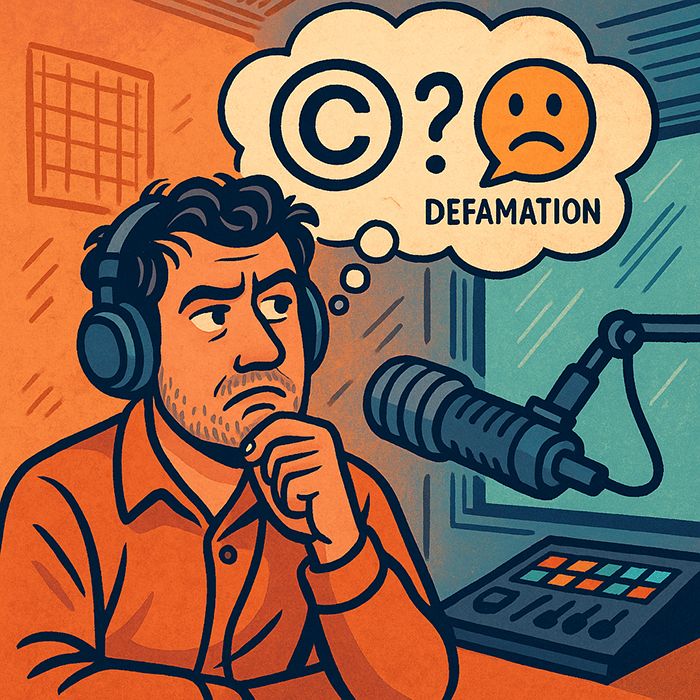
 A radio (or video podcast) host grabs a viral clip, tosses in some sharp commentary, and shares it online. The goal? Make some noise. The result? A takedown notice for copyright infringement – and then a letter threatening a defamation suit.
 marketers about perceived media effectiveness in which radio came in last place, behind all measured traditional and digital media types. According to Nielsen’s global ROI benchmarks, radio delivers the second highest return for advertisers, second only to social media. Nielsen’s ROI benchmarks show radio delivers higher returns for advertisers than all other other traditional media. While radio is perceived to be less effective than digital media, it delivers an ROI +30% higher than video and display, and +70% higher than search and CTV.
  KPIs and lower CPMs can be misleading, and a channel’s ability to claim conversion credit doesn’t necessarily translate to real value. This bias can lead to underinvestment in traditional channels, like radio, which, despite being perceived as less effective, can deliver substantial ROI.” The perceived effectiveness of radio by marketers puts it dead last in ROI. But a weighted average shows that radio is second only to social media in ROI. The study also found that “podcasts demonstrate strong ROI, comparable to TV and digital display, yet they are often overlooked or undervalued.”
  radio.” Nielsen says delineating between total listening (or viewing) and the ad supported universe is vital in today’s burgeoning media landscape where consumer choice grows by the day and marketers are looking at every available opportunity to cut through. In the first quarter of 2025, ad supported audio represented 64% of total listening. This is similar to TV, where 72% of total viewing was spent on ad supported platforms, in Q1 according to Nielsen’s recently launched Ad Supported Gauge report. Looking at ad-supported audio, consumers spent 66% of their daily listening time with radio, 19% with podcasts, 12% with streaming audio services and 3% with satellite radio. Radio accounts for anywhere from 47% of daily ad supported audio time among people 18-34 to 73% among 35+. Meanwhile, podcasts are the inverse, representing 15% of daily audio time for people 35 and older compared with 32% among those 18-34.
 hold the seat through the end of the year. However, he faces a June primary and, if successful, then a November general election to remain in office into 2026. Morano tells TALKERS, “We have another election in June, but I’m hoping to stay on the radio, whether it’s in my current time slot or another. I’m determined to stay on radio, even while doing the people’s work.”
 hosting a one-hour show airing Saturdays from 4:00 pm to 5:00 pm. Sterling spent 35 years as the voice of the Yankees prior to retiring last spring. Sterling says he is no stranger to sports talk radio having hosted a show on WMCA, New York during the 1970s.
  increasing 19.2% YoY to $62.1 billion, now accounting for 24% of total ad revenue, and that Podcast advertising revenues show a strong YoY growth of 26.4%, a significant acceleration from 5.5% last year. IAB adds, “This growth was fueled by shifting consumer media habits, with cord-cutting driving greater engagement with on-demand audio, and podcasts emerging as a key platform for political advertisers seeking to connect with voters ahead of the election.” Overall, digital audio – including podcasting – has continued to grow, earning $7.6 billion in revenue with an 8.5% YoY growth from FY23 which is a slowdown in growth compared to last year’s 18.9% rate. Podcasting however saw
  their business objectives through effective broadcast and digital advertising. The ideal candidate will possess excellent communication skills, have an enthusiastic and outgoing personality, along with a drive to succeed. Most importantly, we are looking for hard-working salespeople who want to have FUN at work, make money, and help local businesses grow.”
  Radio sells advertisers our listeners’ attention. For a hundred years, our inventory has largely been commercials. Now, as our wandering audience leads us to more revenue channels, are we hooked on spots?
 During my tenure at NBC, once a month the division heads would meet at the behest of the CEO to report on their progress and trends in their sector. As the executive vice president of the FM division, I took a seat in that formidable group and tried to keep my remarks as brief as possible. What could I possibly say that would be more damn important than the words of the president of NBC News or the NBC Television network? In addition to NBC’s CEO, the CEO of owner RCA would often join the fun.
 platforms that emphasize conversation and create a sense of connection. To win with this community who wields $2 trillion in buying power, brands must prioritize engagement strategies that center diverse Black experiences and cultural nuances.” The study notes that social media apps have become a haven for Black consumers – Black adults overall spend more time scrolling than their peers. Black millennials (between 18 and 34-years-old) spend the most time on social media among all adults by almost an hour per week. Black adults also have high engagement with radio and podcasts. Radio averages the same as TV in weekly reach with Black adults – each medium reaches 27 million Black adults on average.
  which is 19.6% of adults planning a new vehicle purchase. Among heavy radio listeners (those that listen more than 3 hours a day), that number jumps to 30%. That’s 53% stronger than the general market.” Forester says that podcasts are also a good genre for auto advertising. He says, “The multi-media analysis by The Media Audit revealed podcasts captured the interest of 30.1% of adults 18+ planning to buy a new vehicle in the next 12 months… 53% higher than the general market. Audio streaming does well at 22.7%… 16% higher than the general market” Forester concludes, “Automotive advertisers have a tremendous opportunity to leverage radio’s ability to connect with ready-to-buy consumers. Our data shows that radio not only drives awareness but also inspires action, making it an essential part of any automotive advertising strategy.”
 that partner with Audacy’s own sports talk stations. Some of the key takeaways from this study include: 1) Sports fans are 4x more likely to trust brands that support their teams; 2) Listeners are 4x more likely to catch a brand’s message on sports radio than on TV; 3) 73% of fans spend more time following their favorite teams on sports audio than sports-related digital media; and 4) Brands that advertise on Audacy sports stations enjoy a 40% lift in usage.
  Wall Street investors do not put up money for traditional radio and television stations.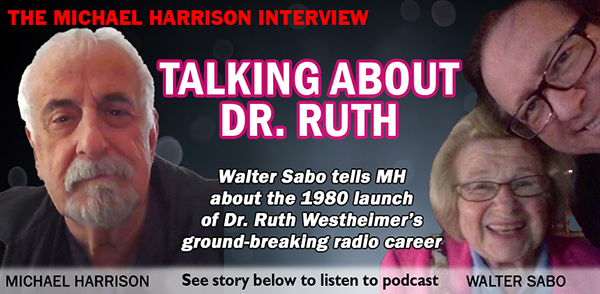
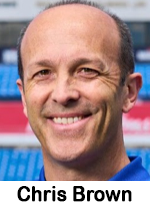 announcer last season, will continue as Bills Insider for the station, co-hosting “One Bills LIVE,” weekdays at 1:00 pm and simulcast on MSG Western New York. Audacy Buffalo SVP and market manager Tim Wenger says, “Chris is best suited to carry on the long tradition of informative, passionate and entertaining Bills play-by-play announcing. His decades-long knowledge of the organization will be invaluable as he assumes the play-by-play microphone.”
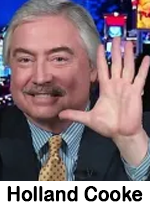 We – inside-the-box – live and breathe radio. Listeners have their hands full just living and breathing. Their day is time crunched and financially challenging, and we want to be its soundtrack.
 43% of spoken word listening, and podcasts 36%. Keep in mind that for Edison’s purposes spoken word content includes news, sports talk and play-by-play, audiobooks, talk shows, and “personalities.” Edison states, “Podcasting’s share of spoken word will almost surely surpass that of AM/FM within a few more years. There is one more thing to note – the advantage for AM/FM is coming entirely from those age 65 and older. Among those ages 13-64, podcasting has already passed AM/FM listening by, 41% to 39%. Meanwhile, among the oldest Americans age 65+, AM/FM radio continues to dominate, with a 66%-13% advantage. Curiously, that 66%-13% difference among the oldest Americans is the exact same difference we recorded for all Americans 13+ in 2017.”
 Got young local radio news talent? CONGRATULATIONS, for five reasons:
 Almost everything I know about pricing strategy I learned from domestic airlines. Guess what? Airlines are at it again and I hope you are watching and learning.
 reach. “Republicans listen to more AM/FM radio than other groups, with an index of 109 (or 9% more listening than average). The ad-supported spoken-word channels on SiriusXM are a particularly efficient place to find Republicans, with an index of 146. Meanwhile, podcasts stand out as the more efficient platform for reaching Democrats, indexing at 121. And what about those elusive Independents, who often tip an election? Both streaming music, and in particular music videos on YouTube, over-deliver for these potential voters, with indexes of 103 and 123 respectively.” Edison adds, “Regardless of the party that buyers are trying to reach with political ads, audio stands out as a superior pathway to reaching voters. Audio provides enormous audiences and often a far less cluttered political environment than other ad channels.”
 What happened to us? Unless we move quickly, the radio business stands to lose the final frontier: in-car listening.
 AI-generated content in political ads; 2) Proposing to apply the disclosure rules to both candidate and issue advertisements; 3) Requesting comment on a specific definition of AI-generated content, and 4) Proposing to apply the disclosure requirements to broadcasters and entities that engage in origination programming, including cable operators, satellite TV and radio providers and section 325(c) permittees. Chairwoman Jessica Rosenworcel says, “As
  artificial intelligence tools become more accessible, the Commission wants to make sure consumers are fully informed when the technology is used. Today, I’ve shared with my colleagues a proposal that makes clear consumers have a right to know when AI tools are being used in the political ads they see, and I hope they swiftly act on this issue.” However, Republican Commissioner Brendan
 Carr opposes the move, saying, “There is no doubt that the increase in AI-generated political content presents complex questions, and there is bipartisan concern about the potential for misuse. But none of this vests the FCC with the authority it claims here. Indeed, the Federal Election Commission is actively considering these types of issues, and legislators in Congress are as well. But Congress has not given the FCC the type of freewheeling authority over these issues that would be necessary to turn this plan into law. And for good reason. The FCC can only muddy the waters. AI-generated political ads that run on broadcast TV will come with a government-mandated disclaimer but the exact same or similar ad that runs on a streaming service or social media site will not? Consumers don’t think about the content they consume through the lens of regulatory silos. They just view content on screens. Will they conclude that the absence of a government warning on an online ad means that the content must be real? I don’t see how this type of conflicting patchwork could end well. Unlike Congress, the FCC cannot adopt uniform rules.”
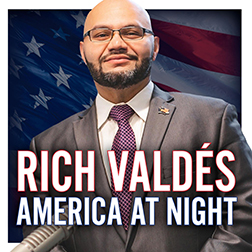 be able to alter the course of established radio stations and the marketplace of ideas before the 2024 election or even soon thereafter. Harrison told “America at Night” host Rich Valdés last night (5/22) that radio is far too idiosyncratic an industry – already run by too many people who don’t understand how it really operates – for someone (who also doesn’t really have first-hand experience in the field) to just step in and make drastic alterations to entrenched stations, formats, audiences and sponsors just to make a political statement. Harrison states, “There are more
  expedient uses of his money if that is his main purpose. After all, not all Audacy stations are conservative news/talkers… many are music, sports and a variety of formats. How inefficient such a move would be!” Harrison went on to say that radio is still an extremely powerful and potentially lucrative medium if only its present owners and operators believed in it and invested in its programming and marketing. He encouraged radio broadcasters to understand and believe in the “esthetic of ‘radio’ and not be so anxious to bail out into the utilitarian term ‘audio.’” Harrison and Valdés tied the discussion into the current news about the AM for Every Vehicle Act currently making its way through Congress stating that radio is still a lifeline for service to the community as a place for information, education, and entertainment and that eliminating it from automobile dashboards would be about “five to 10 years premature.”
  Because you can? Because you aren’t doing AM/FM radio? Because you are on radio, but can’t-do-there what you can-do podcasting? Because you are making money podcasting?