


Monday Memo: Occasions, Not Duration
By Holland Cooke
Consultant
 For 100 years, radio programmers have tried to keep listeners listening longer. “Coming up next…”
Another few minutes? Yes! Ask! And do so as-seductively-as-possible, saying “you” and “your.” But there’s very little you can say to keep someone sitting in a parked car after they’ve turned the engine off.
A more realistic opportunity?
Life is fragmented. Audio is everywhere. Listeners move among broadcast radio, podcasts, streams, satellite, YouTube and whatever their phones serve up next. Oh, and off-air promotion – billboards, TV, direct mail – remember them – cost money.
Sales 101: Say it with me: “Your best prospect is…?” An existing customer! Sell ‘em again, in this case inducing an existing listener to listen again later – specifically later-today, and same-time-tomorrow. You can’t win by earning TSL when they’re not listening. So, seem useful-enough that they’ll want to come back again.
- First thing in the morning…
- Before leaving home…
- During the commute…
- At lunch…
- Before the drive home…
- When weather threatens…
- When big news breaks…
- When the game will air…
All-news stations have understood this for decades. The very first one – 1010WINS/New York, to-this-day #1 in morning drive – said, “Give us 22 minutes and we’ll give you the world.” The product was designed for repeat use.
This also changes how we use digital tools
Too many stations treat the app, stream, and social media as separate products. They should be pathways back to useful content. A push alert can invite immediate listening when something important happens. A social clip can preview what the morning show will develop tomorrow. A podcast can serve someone who missed the original conversation while promoting the next live one.
The objective is not to trap listeners. It is to accompany them. Try this…
- Map your target listener’s day. Identify five moments when your station could be helpful, entertaining or reassuring. Then ask yourself…
- Do we offer something worth returning for at each moment?
- Do listeners know we offer it?
- Do we remind them when to return?
And when they do return, do we deliver immediately? Or make them wait through clutter?
Duration still matters. Every unnecessary word still spends attention. So, program at-the-speed-of-life. But focusing only on longer listening per-occasion overlooks how people actually live. You can’t keep someone sitting in a parked car. You can earn more visits.
Holland Cooke (HollandCooke.com) is a consultant working the intersection of broadcasting and the Internet. Follow HC on Twitter @HollandCooke and connect on LinkedIn
 engagement, and performance – the Index reveals where NFL fandom is strongest, how the most passionate fans express that fandom, and what it means for brands trying to reach them.” Audacy says the data show avid sports fans gravitate to radio shows and podcasts: 82% of avid NFL fans listen to sports podcasts; 81% listen to sports talk radio; 81% listen to sports play-by-play – spending more time with those programs than they do with TV highlights, social media, and live game TV. Audacy says that for advertisers, NFL super fans are a gold mine as those exposed to radio ads show Awareness at 56%, Consideration at 49%, Purchase at 51%, and Loyalty at 41%.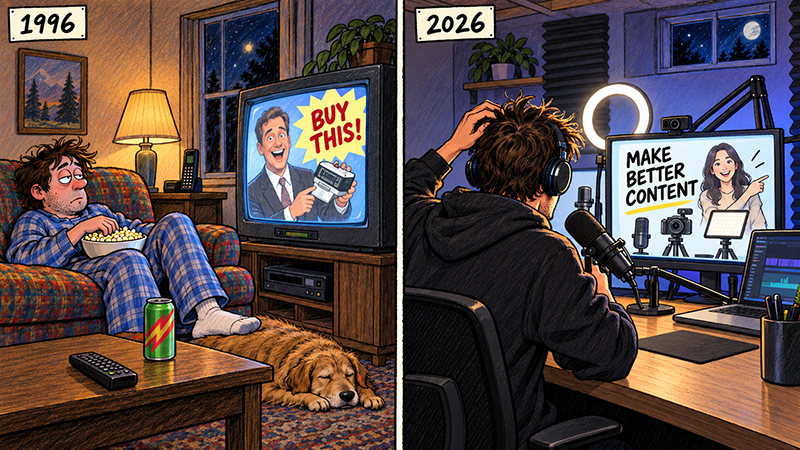
 My father recently called my attention to something hiding in plain sight. He was watching YouTube and noticed ads for StreamYard, Riverside, Sprizzy and other companies selling tools and services to people who want to produce, distribute, or promote their own media. “They are advertising on consumer venues!” he told me. That was the part that caught his attention.
 platforms, AM/FM radio, including over-the-air and radio streams, accounts for 70% of the time spent with ad-supported audio sources in the car. Edison says, “Podcasts rank a distant second, accounting for 11% of ad-supported in-car audio time. Streaming music accounts for a significant amount of in-car audio time, but most of that listening is ad-free. When we filter consumption by ad-supported platforms, streaming music comes in third at 10%. Music and music videos on YouTube close out the fourth slice of the pie at 7%. Note that Share of Ear captures listening by everyone in the car, not just the driver.”
 If your station is outside the top 50 markets, you already know the pressure points. A mature workforce stretched thin. Fewer applicants for on air and production roles – specifically the younger creators who don’t see radio as their first creative outlet. And a competitive landscape where streaming, satellite, and podcasts divert attention with the gravitational pull of a black hole.
 owned-and-operated digital inventory both locally and nationally, including digital, audio, podcasts and creator-led content, creating a more unified path for advertisers to activate multi-platform campaigns at scale. iHeartMedia chief business officer Lisa Coffey comments, “Advertisers are increasingly looking for media solutions that combine scale, intelligence and simplicity across channels. By combining Amazon Ads’ shopping insights and advertising technology with iHeart’s audio leadership, we’re creating a more seamless, data-informed way for brands to create more effective campaigns across sound and sight.”
 podcasts reach consumers throughout their daily routines, creating repeated exposure and strong recall. Audio also commands our attention in ways many formats can’t.” Additionally, radio personalities do something other formats can’t: “When our favorite hosts vouch for a brand, it feels personal. And that built-in influence doesn’t just capture attention — it sparks action.” 74% of radio listeners polled say they have purchased a brand after hearing an ad from their radio host. Finally, Nelson says the intersection of audio and digital marketing is where consumers are reached. “Audio builds awareness, attention, and trust. Digital marketing captures intent and drives action lower in the funnel. Together they drive measurable results with double digital increases in performance.”
  of Americans listen to AM/FM radio as part of their daily audio consumption. Podcast listening gets 20% with ad-supported streaming getting 16%, and ad-supported satellite radio accounting for 2%. The report also indicates that the news/talk radio format maintained its position as the top format with 10.9% share of total radio listening (P18+), a slight uptick from the 10.8% it captured in Q4 2025. All-news listening also increased, climbing from 2.7% to 2.9%.
  provocative podcasts, unexpected live experiences, and new research, tools and planning solutions, Bubbler is designed to get brands into the conversation in fresh ways.” As part of its launch, Bubbler announces a partnership with iHeartMedia to develop and distribute a slate of original business and marketing podcasts, with more than 10 original podcasts slated for this year. President of iHeartPodcasts Will Pearson says, “The iHeartPodcast Network has always been focused on the new genres and audiences we can reach through this incredible medium – and the ‘business-to-business’ space is a perfect example of that. Creating a slate in podcasting for marketing executives to have meaningful, deep conversations with each other about the world of business and advertising will have immense value for our listeners and brand partners alike.”
 radio (including AM/FM streams), the historic spoken-word listening leader. Edison adds, “Spoken-word listening time among Americans 13-34 is dominated by podcasts, with 53% of time being spent with that specific platform, versus 23% of time going to AM/FM radio. Radio does rebound among 35–54-year-olds but still falls short with 47% of their spoken-word listening time going to podcasts and 35% going to AM/FM radio. Our story completely changes among Americans ages 55+, who spend the majority of their spoken-word listening time with AM/FM radio, at 55%, and less than one-quarter of their time with podcasts at 22%. The dominance of podcast listening among younger age cohorts can certainly be attributed to their preference for on-demand content that also includes visual elements, qualities specific to podcasts and not radio. AM/FM radio carries a wide variety of spoken-word offerings, ranging from sports play-by-play and sports talk, NPR programming, news and entertainment talk shows, to political talk.”
 year, generative AI adoption among American consumers.” Some of the key findings include that online audio consumption has hit an all-time high: 1) 81% of Americans age 12+ (233 million) listened to online audio in the last month, and 76% (219 million) listened in the last week; 2) Americans age 55+ are driving the most recent increases. Monthly online audio listening among this group jumped from 52% in 2024 to 70% in 2026, a gain of nearly 20 percentage points in just two years; 3) 80% of Americans age 12+ (230 million) have ever listened to or watched a podcast, an all-time high; and 4) 58% of Americans age 12+ (167 million) have consumed a podcast in the last month, also an all-time high.
  breathe talk radio? We’re looking for a program director to lead our talk radio stations to the next level.
 dominant spoken-word audio listening platform, but it was fully sixty-five percentage points higher than podcasts, which accounted for 10% of listening time back then. Quarter by quarter and year over year, time spent using AM/FM radio to listen to spoken-word audio has declined significantly and shifted to time spent with podcasts. As of Q4 2025, 40% of time spent listening to spoken-word is now spent with podcasts and 39% of time is spent with AM/FM radio. Not only does radio not beat podcasts by a significant margin, it now trails the on-demand platform for spoken-word audio listening.”
 “Podcasting’s momentum strengthened in 2025, with audio remaining the foundation of the medium while video helped bring in new audiences. What’s most compelling is the diversity podcasting now delivers across content, platforms, and consumers. Triton’s report highlights where new listeners are engaging and how their evolving behaviors – including shopping and purchase intent – are creating a highly engaged audience that is increasingly attractive for brand investment.” One key finding from the study is that “consumption preferences vary sharply by genre. Categories primarily consumed via audio are Science (58%), History (56%), Fiction (54%), Arts (51%), and True Crime (50%), while Music (34%), Sports (32%), Kids & Family (31%), Comedy (30%), News (30%) skew more heavily toward exclusive video consumption. This emphasizes a need for differentiated content and monetization strategies.”
  report include: When it comes to audio’s value versus TV, diehard fans are 1.4 times more likely to tune into pre- and post-game shows on radio than on TV; Local voices matter as 79% of fans say sports make them feel part of a community. Many mute national broadcasts to follow local radio calls that capture their city’s emotion and history. Audacy adds that it now ranks #1 in sports talk reach across radio and television, surpassing ESPN and FS1; When it comes to reaching Gen Z, younger fans aren’t disengaged, they follow personalities, podcasts, and audio creators instead of networks; It’s a myth that only marketing beer and betting works on sports audio: sports audio drives measurable results beyond traditional categories, with web traffic lifts on air days vs. off-air days: +105% for financial services, +42% home improvement, +22% grocery, +10% automotive.
  Streaming radio and podcasts don’t just add reach. They double down on impact by warming the audience before they ever click.” The company adds, “Audio brings something no other channel can touch. It’s literally in your audience’s ears. It’s personal. It’s focused. And it shows up during moments where screens aren’t competing for attention, like commuting, working, cooking, unwinding. That’s when messaging sticks. Audio builds familiarity and trust early in the journey, so when someone sees your display ad, social post, or paid search result later, they’re not meeting your brand for the first time. They already recognize you. And recognition drives response.”
  iHeartMedia’s studios in South Florida and airing in the 3:00 pm to 5:00 pm slot being vacated by Doug Gottlieb. iHeartMedia says, “Designed as a live radio extension of his popular podcast ‘Stugotz and Company,’ the show will bring together his regular crew along with a rotating cast of guest co-hosts, blending old friends and new voices.” Additionally, the Stugotz Podcast Network will launch with iHeartPodcasts, featuring “Stugotz and Company” and “God Bless Football,” plus more content to be launched later. Weiner says, “There was a ton of interest and a lot of great conversations, but it became obvious to me rather quickly that iHeart and FOX Sports Radio were going to be the landing spot. I miss doing live radio, and I was looking for a partner to grow my two existing podcasts and help us build out a network. To be able to partner with the biggest and best digital company on the planet – and host a daily, two-hour live radio show with two Hall of Famers, Dan Patrick and Colin Cowherd, as lead-ins – is a place, quite frankly, I never imagined arriving at, and an opportunity I wasn’t going to pass up.”
 2) Marketers and media agencies significantly overestimate audience shares to Pandora/Spotify and massively underestimate AM/FM radio audiences; and 3) Interestingly, as older demographics flock to podcasts, the median age of the podcast audience ages sharply from 29 in 2017 to 39. The study notes that “in 2017, podcasts’ daily reach was greatest among 18-24s. Eight years later, podcasts’ daily reach has surged, especially in older demographics. The older the age group, the greater the growth in the podcast daily audience. Today, podcasts’ greatest reach centers on 25-44s, with significant growth among 45-64s.”
  Running a successful radio station, hosting a show, or producing a podcast is a lot like hosting Thanksgiving dinner. You need a plan. You need to deliver something satisfying to a crowd with varying tastes. And most of all – if you get it right – you’ll have leftovers you can turn into even more value long after the main event.
 exclusive sales rep for the Australian market. With this deal, Australian advertisers will be able to access Audacy’s titles as part of their audio campaigns. The partnership broadens the breadth of available content for LiSTNR audiences and increases the reach for clients, with access to a range of titles including “Office Ladies with Jenna Fischer and Angela Kinsley,” “Fly on the Wall with David Spade and Dana Carvey,” “Search Engine,” “The Moth” and dozens of podcasts from CBS Sports and CBS News & Entertainment.
 -demand radio shows to migrate to ART19’s infrastructure that it says will allow it to “unlock new revenue opportunities and offering advertisers enhanced reach , deeper analytics, and improved ROI.” Beasley chief content officer Justin Chase says, “This partnership is an important step in our digital transformation. ART19’s platform will help us expand monetization opportunities while delivering a better experience for audiences and advertisers.”
 The risk is real. Suggesting that a technique used with great success in the recent past might be beneficial to the present is a perilous course. Is the idea out of touch with today’s reality? Is the author ignoring current trends?
 place. This new data fusion will integrate the industry-leading Edison Podcast Metrics into Nielsen’s widely used media planning tool, Nielsen Media Impact
  (NMI).” Nielsen adds, “As podcast listenership continues to grow, it is critical for advertisers to have sophisticated tools and data to effectively plan, measure and optimize their audio investments. Nielsen Podcast Fusion in NMI will provide an even more holistic view of media planning and help users uncover valuable insights and demonstrate the effectiveness of their campaigns. NMI users will also be able to optimize media plans by specific podcast networks and genres, as well as top podcast programs.” NPR and Ocean Media are among the charter subscribers at launch.
 streams) make up 34% of the daily audio time of U.S. consumers ages 13+. Looking at what makes up the other 66% of daily audio time it’s interesting to note that media platforms that didn’t exist (or were very new) 20 years ago make up a combined 54% of daily audio time. Those media platforms are streaming music (23%), YouTube (14%), podcasts (10%), and SiriusXM (7%).
  at how iHeartMedia handled the process of using AI to translate and voice-clone the original podcast hosts. iHeartPodcasts president Will Pearson is quoted saying the AI translations faced two main challenges: ensuring accuracy and preserving each show’s unique tone. iHeartMedia worked with the company Speechlab to clone the voices of the hosts use them to read the show’s transcript in multiple languages. Pearson also says about a quarter of his company’s downloads come from outside the U.S.