

The Advertiser Gave It To Me. Isn’t That Enough?
By Matthew B. Harrison
TALKERS, VP/Associate Publisher
Harrison Legal Group, Senior Partner
Goodphone Communications, Executive Producer
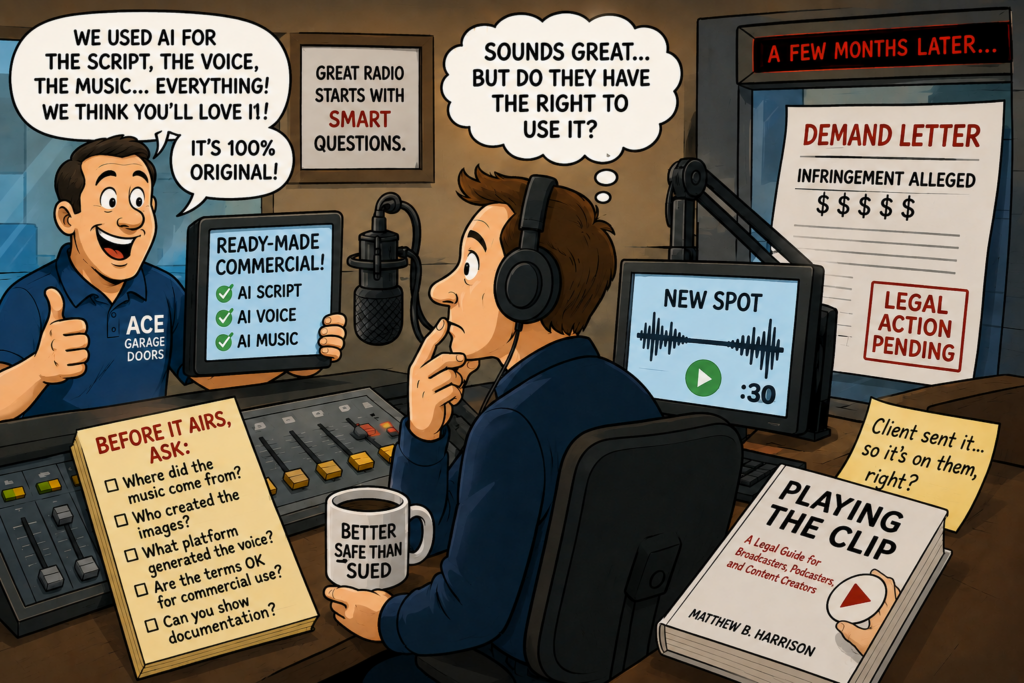
 A local advertiser sends over a ready-made commercial. The music is catchy. The script is polished. The production value is surprisingly good for a company that spends most of its day installing garage doors.
The salesperson approves it. Traffic schedules it. The spot airs.
A few months later, somebody else’s lawyer hears it too.
Many media professionals assume that when an advertiser supplies content, the advertiser has already secured whatever permissions are necessary to use it. Sometimes that’s true. Sometimes it isn’t.
If a commercial contains copyrighted music, photographs, video, artwork, or other protected material, the fact that it came from a client does not automatically end the discussion. The advertiser may have obtained the rights. The advertiser may have assumed someone else obtained the rights. The advertiser may never have asked.
Artificial intelligence is creating new versions of the same problem.
Recently, I was asked about a commercial generated almost entirely through AI. The advertiser used one platform to create the script and another to generate the voice. Everything sounded original. No famous song. No movie clip. No obvious red flags.
Yet one question remained:
How do you know the advertiser had the right to use it?
That question can lead in several directions. Did the AI platform permit commercial use? Was the voice modeled after a real person? Does it sound enough like a celebrity to create endorsement concerns? Can the advertiser demonstrate where the content came from and what rights accompany it?
Fortunately, the solution is usually simple. Ask the advertiser.
Most legitimate advertisers are happy to explain how the content was created and what rights they possess. The conversation often takes only a few minutes.
Broadcasters, podcasters, streamers, and digital creators all face the same reality. Before a commercial airs, someone should know where the content came from and whether the necessary rights exist.
The technology may change. The question remains remarkably durable: How do you know you had the right to use this?
Matthew B. Harrison is a media and intellectual property attorney who advises radio hosts, content creators, and creative entrepreneurs. He has written extensively on fair use, AI law, and the future of digital rights. Reach him at Matthew@HarrisonLegalGroup.com or read more at https://harrisonlegalgroup.com.