By Holland Cooke
Consultant
 Hello from Las Vegas, ever-changing yet timeless. Here this week the NAB Show is “Powering the Next Era of Storytelling.” And it’s about time. While there is now a filibuster-proof U.S. Senate majority to require that cars include AM receivers, some AM stations are being shut off. Over the weekend millions took to the streets and this morning Wall Street braced for more. So, the vibe here is positively rejuvenating.
“If you’re here, you’ve already defied the odds.”
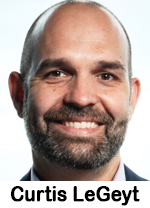
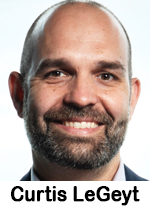
National Association of Broadcasters president & CEO Curtis LeGeyt congratulated attendees at a perennial event that – on its own – paid for the trip, the NAB Show Small and Medium Market Radio Forum. As big corporate owners make big trade press headlines in big markets, the mojo in the minor leagues is downright invigorating.
Picture speed-dating for great ideas. The room is set up with roundtables. Each half-hour, attendees share what’s working back home, then rotate. Table topics included, “The Secret to Radio’s Digital Ad Success is Being Local First,” and “Podcasting Strategies for Radio,” and “Monetizing High School Sports,” and there were heartwarming stories about “Developing Your Community with Events and Social Media.” And, yes, THE most popular table – to which participants dragged chairs from elsewhere: “AI’s Use Throughout Your Station.”
Did you know that May is National Small Business Month? And National Small Business Week is May 4 to 10? Plan now to do what these plucky broadcasters shared ideas for doing: Use your broadcast and digital assets and your local engagement to, in NAB Show speak: “Unlock the Power of the Creator Economy.”

“A connection on LinkedIn is worth a hundred on Instagram.”
As corporate cost cuts continue, I’ve been collecting and sharing opportunities. In a recent column here, I described 18 non-radio career options for which your skill set as a broadcaster could qualify you. And in last week’s column I recommended and demonstrated some valuable and FREE tools.
Now – courtesy of ThinkTAP’s Richard Harrington – a road map for selling your services. Here’s the deck from his super-useful session “Working with Brands: How to Get Your Foot in the Door and Stay There.” And don’t let the term “brands” scare you. Think local businesses.
Sampler:
— Your prospects crave the sort of engagement that successful on-air people have accomplished. “Build your Email list!” Harrington urges.
— Then, take every opportunity to engage. Important: “Reply to people who replied” to something you have posted. “Such a small percentage do reply that this makes their day.”
— “Do what you can to pull audience into a place you can control.” Anyone working in the industry we used to call “radio” now needs to be facile with social media and podcasting and video. So, use those skills and tools to “create content that can be used by the brand.”
— Especially opportune: demonstrate how to use what your client sells.
New to selling your services? Generous with his experience, Harrington’s deck will suggest lots of transactional technique.
Our industry, like ‘Vegas, is ever-changing yet timeless.
Holland Cooke (HollandCooke.com) is a consultant working the intersection of broadcasting and the Internet. Follow HC on Twitter @HollandCooke and connect on LinkedIn
Share this with your network
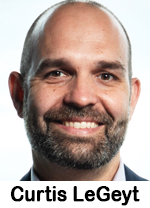 field with global technology platforms.” He underscored broadcasters’ unique and essential role in public safety, civic engagement and strengthening local democracy. Additionally, broadcasters heard from key policymakers shaping broadcast policy, including Sen. Ed Markey (D-MA), who spoke about the enduring value of broadcast radio and his leadership on the bipartisan effort to pass the AM Radio for Every Vehicle Act… and U.S. Rep. Richard Hudson (R-NC), chairman of the House Energy and Commerce Subcommittee on Communications and Technology, who spoke about the need for broadcast ownership rules to reflect today’s landscape and the importance of keeping AM radio in cars.
 competition local radio stations today face for audiences and vital advertising revenues from online and satellite content providers and digital ad platforms not subject to any comparable restrictions on their scale and scope; the dire negative effects that consumer and advertiser substitution of competing digital audio content and advertising for traditional radio has had on the listenership and advertising revenues garnered by local radio stations, including in mid-sized and small markets; and how the retention of asymmetric ownership restrictions has prevented radio broadcasters from gaining local scale to take advantage of important economic efficiencies, obtain investment capital, and better compete for audiences and advertising revenues, and thus enhance – or even maintain – their provision of news, emergency information, and valued entertainment and sports programming in local communities across the country at no cost to the public.” Responding to testimony from musicFirst Coalition and the Future of Music Coalition – referred to as the Coalitions – NAB writes, “First, the fact that the Coalitions continue to hold themselves out as protectors of small, local independent broadcasters not just borders on the absurd but crosses over into full-blown absurdity. The Coalitions represent the interests of the music industry, which is dominated by three consolidated international record labels. Compared to even the largest radio station groups, the giant record labels are the 800-pound gorillas of the music world. Those three labels earn billions more in revenue than the approximately 11,000 full-power commercial AM/FM stations combined. As NAB earlier reported, the three major music companies jointly generated about $2.9 million per hour in 2023. In remarkable contrast, in 2023 and 2024 the vast majority of radio stations garnered less – and often much less – than $2.9 million per year in advertising revenues. Needless to say, the Coalitions have never explained how local radio stations earning such low levels of revenue (and even lower, if any, profits) are supposed to keep talented employees and provide high quality programming, including popular music, sports, and informational programming, such as weather updates and emergency information, OTA and free to the public without achieving increased local scale, greater economic efficiencies, and more robust ad revenues.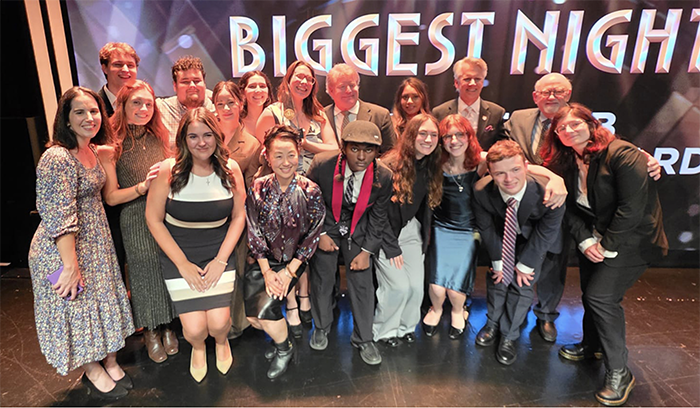
 the past year (October 1, 2024 – September 30, 2025). A panel of judges representing the broadcast industry and community service organizations will review applications and select 50 finalists and 10 winners. Stations must submit an online entry through My NAB detailing their community service efforts from the past year. The deadline for entry submissions is October 31. Finalists will be announced in February.
 our airwaves free from government influence. The First Amendment affords our stations – and all Americans – this fundamental right, and the mere perception that broadcasters acted because of undue pressure is a problem for our credibility and the trust we have built with our audiences.
 radio spots across 192 media markets, generating more than 1 billion impressions and $43 million in airtime from TV and radio stations. NAB president and CEO Curtis LeGeyt says, “Local stations are serving communities with live sports, trusted local news and life-saving emergency coverage – all available for free to every American. But outdated rules are shackling these stations from growing and innovating at a time when Big Tech operates with limitless scale and zero public interest obligations. Consumers deserve more – not fewer – local journalists on the ground and live sporting events accessible without a subscription. The FCC must act quickly to level the playing field so broadcasters can continue investing in the content communities rely on most.”
 in the U.S. House of Representatives and a filibuster-proof 61 in the U.S. Senate. NAB president and CEO Curtis LeGeyt says, “We thank the growing, bipartisan group of lawmakers standing up for their constituents who depend on AM radio. This support demonstrates a deep understanding that AM radio remains an essential lifeline for emergency alerts, local news and community connection. With significant momentum behind this bill, NAB urges House leadership to bring it to the floor without delay and preserve this vital service for the American public.”
 his remarkable contributions to the radio industry over the past four decades. Mike’s deep expertise, creative vision and unwavering commitment to excellence have shaped countless careers, inspired new generations of broadcasters and driven innovation in every corner of the audio industry. His ability to nurture talent and create programming that resonates with audiences makes him a most deserving recipient of this year’s National Radio Award.” McVay is president of McVay Media and recently served as EVP of content and programming for Cumulus Media and the Westwood One radio network. NAB says the celebrated media strategist, programmer, talent coach and industry leader will receive this prestigious accolade during the NAB Marconi Radio Awards at the 2025 NAB Show New York.
 Awards. The winners will be presented on October 21 at The Edison Ballroom, the evening before NAB Show New York. Finalists for Legendary Station of the Year include news/talk WABC, New York. Finalists for News/Talk Station of the Year are: KFI-AM, Los Angeles; WABC-AM, New York; WBAL-AM, Baltimore; WBBM-AM, Chicago; and WENG-AM, Englewood, Florida.
  Act and underscores AM radio’s enduring value to the American people. For more than a century, AM radio has been a lifeline, delivering trusted news, local sports, crop reports and emergency information when and where it matters most. From rural communities to urban centers, from first responders to everyday commuters, over 80 million Americans rely on this free, local service to stay informed and safe every month.
  chairman and chief executive officer of Nexstar Media Group, who will remain on the executive committee as immediate past joint board chair. Also, Chris Ornelas, EVP and general counsel for Beasley Media Group, was elected chair by the NAB Radio Board. Leonard Wheeler, president of Mel Wheeler, Inc was elected first vice chair while Allen Power, president, Broadcast Media for Salem Media Group, was elected second vice chair. Eddie Harrell, co-president, Audio Division of Urban One was elected to the major group representative seat on the NAB Radio Board.
 regulatory framework, beginning with long-overdue reforms to the national television ownership cap and the local radio and TV ownership rules. NAB president and CEO Curtis LeGeyt states, “This is a moment for bold ideas, and NAB is proud to lead the charge. The FCC’s rules should reflect today’s media landscape, not one from decades past. Our filing lays out a clear, actionable path to modernize regulations and empower local radio and TV stations to better serve their communities. We appreciate the Commission, especially Chairman Carr, for launching this important effort. Reforming outdated ownership rules is the essential first step to strengthening local journalism and ensuring broadcasters can continue to survive.”
  NAB says, “Local radio stations provide trusted news, sports and entertainment to their communities free of charge, but stations’ ability to do so would be greatly threatened if faced with a new performance tax, on top of the hundreds of millions of dollars local stations already pay each year in copyright and streaming fees.” The second resolution calls on legislators to support the AM Radio for Every Vehicle Act that would ensure the continued availability of AM in all newly manufactured vehicles. NAB president and CEO Curtis LeGeyt comments, “On the heels of an incredibly successful State Leadership Conference, where over 560 local TV and radio broadcasters traveled to Washington, DC to meet with lawmakers on Capitol Hill, congressional support for local radio is strong. State broadcaster associations play a pivotal role in our advocacy efforts, and I am proud to see the collective unity behind these resolutions.”
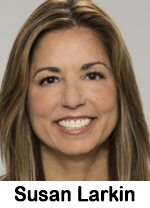 Larkin leads Audacy’s portfolio of markets, revenue and content teams, overseeing the company’s extensive audio platform, which includes broadcasting, podcasting, digital, network, live events, music, sports and news. She is also a board member of the Radio Advertising Bureau and has served on the boards of the Florida Association of Broadcasters and Ronald McDonald House Charities.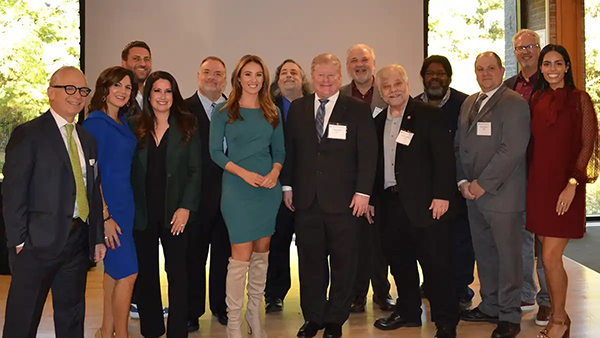
 Under the Federal Communications Commission’s consideration is a proposal from Commander Communications Corporation that would create an FM broadcasting class known as “A10.” In addition to enhancing coverage in rural and underserved areas, it would grant power upgrades for roughly 1,400 Class A FMs, allowing a maximum of 10,000 watts. Approval would depend on a station’s geographical zone; tower height; and separation requirements. While the National Association of Broadcasters recognizes potential benefits for listeners – especially during emergencies – it urges caution owing to possible negative impacts. The NAB generally supports proposals designed to improve coverage areas, but says the “A10” proposal lacks technical analysis and information on how many stations may be upgradable. An NAB filing notes that, “While this could lead to improved service for additional listeners, it could also further squeeze the band in more markets and impact more FM services.” Also opposed is Cumulus Media, which cites an “unacceptable risk” to stations already competing against streaming services. Conversely, the Multicultural Media, Telecom & Internet Council favors the suggestion, stressing that many stations that would qualify for the upgrade are owned by minority and small-scale operators. This proposal would replace an earlier FCC one for a Class C4 FM station category. More than 100 independent and minority owners backed the idea, but it ran into opposition from larger companies and the NAB.
 intended it be a deregulatory exercise. NAB says, “The Local Television and Radio Rules retain and even tighten decades-old restrictions on which – and how many – television and radio stations broadcasters may own in a particular geographic market. The rules are premised on the notion that broadcasters could exert disproportionate influence by shaping news and entertainment options. But that idea is a relic from a bygone era – before the emergence of the Internet, smartphones, social media, and streaming. In reality, broadcasters today struggle to keep pace with rapidly proliferating audio and video platforms that are steadily taking audience share and advertising dollars. Instead of making it harder for broadcasters to compete, the Commission should have modernized its outdated rules because they are no longer justified. Given the significance of the Commission’s rules, the size of the regulatory record, and the number of parties involved, Petitioners respectfully submit that oral argument would be beneficial.”
 Media and president, Westwood One, was elected radio board chair by the NAB radio board. Kevin Perry, president and CEO of Perry Publishing and Broadcasting Company, was elected radio board first vice chair, and Leonard Wheeler, president of Mel Wheeler, Inc., was elected radio board second vice chair. Chris Ornelas, executive vice president and general counsel of Beasley Media Group, was reelected to the radio board’s major group representative seat on the NAB board’s executive committee. Perry Sook continues the second year of his role as joint board chair. The position is elected every two years. The elections took place at the NAB Board of Directors meeting, held June 3-4.
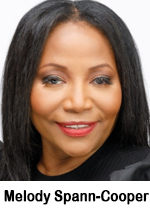 National Association of Broadcasters. She said, “AM Radio is important to communities across the country not only because it is a cultural, news and sports oasis that educates the public, but also because it is a resilient lifeline during public safety emergencies. To put it as simply as I can, the foremost reason that Congress should care about AM radio is that it is a lifesaver. No other communications medium has the reach or resiliency of AM radio. A single station can be heard as far as 700 miles away. The signal cuts through buildings and mountains. In remote areas where no cell signal or FM station can be found, AM
  is there. When the power goes out, radio stations can still be found on battery or crank radios, or in your car.” She argued that cell phone notifications alone in emergency situations are unreliable as power outages can affect cell service.
  senior adviser at the U.S. Department of Health and Human Services, will serve as a spokesperson for the association and will help develop and execute messaging strategies to advance broadcasters’ policy agenda before Congress and the Federal Communications Commission. NAB EVP, public affairs and chief of staff Michelle Lehman says, “Gaby is a seasoned policy communicator whose years of government service have equipped her with a profound understanding of effective and strategic communications. Broadcasters will benefit from Gaby’s deep expertise in shaping messaging on the most important issues facing our industry, and we are thrilled to have her on the team.”
 the report as momentum grows in Congress for legislation to ensure AM radio is accessible to the public in all vehicles. NAB president and CEO Curtis LeGeyt states, “When disaster strikes, AM radio has proven time and again its invaluable role as a source of factual, authoritative, up-to-the-minute information that saves lives. It is also a home to a diversity of programming that is often unavailable on other mediums and particularly important to otherwise underserved communities. It is critical that Congress address the need for AM radio capability in vehicles to ensure Americans can turn to local AM stations when they need them the most.”
 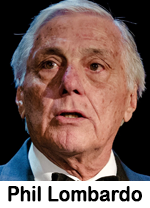 dedication and service to the broadcasting industry and to the Foundation’s charitable cause. BFoA chairman Scott Herman says, “The Broadcasters Foundation and the broadcast industry lost a great man. As chairman of the Broadcasters Foundation for many years, Phil left an indelible mark. He was passionate about our mission and one of our biggest donors, giving both time and money to helping colleagues in need.” To honor his longstanding dedication to the Broadcasters Foundation, in 2000 the Board passed a near unanimous vote to rename the annual golf tournament and fundraiser, held during the NAB Show in Las Vegas, to the Philip J. Lombardo Charity Golf Tournament. The one ‘no’ vote was cast by Lombardo. The majority of Lombardo’s storied career was focused on buying, turning around, and selling TV stations for his privately held company, Citadel Communications. In 2003, Lombardo was elected to serve as joint board chairman of the National Association of Broadcasters. He was inducted into the Broadcasting + Cable Hall of Fame in October 2015.
 funded to analyze the potential effects of the AM Radio for Every Vehicle Act on the auto industry reveals the cost to the industry would be minimal, but that AAI “misrepresents, distorts and spins the results of the report it paid for to advance its position” in opposition to the legislation.
  Association of Broadcasters and the Canadian Association of Broadcasters strongly urge lawmakers to support legislation that enables news providers to negotiate with dominant digital platforms for fair terms and conditions when our content appears on their platforms. Meta – a nearly trillion-dollar company – repeatedly chooses to restrict news content for its users to avoid compensating news producers for the value it gains on their vital journalism. These retaliatory tactics demonstrate Meta’s monopolistic dominance over the advertising marketplace and its ability to dictate how radio and TV broadcasters, newspapers and others can reach audiences online. Rather than working to ensure its users have access to trusted news and information, Meta is holding news content on its platform hostage. Policymakers should not reward Meta’s coercive behavior. At a time when misinformation, disinformation and AI-generated content proliferate online, the future of democracy relies on the accessibility of fact-based, trustworthy journalism.”
 talkers Boomer Esiason and Gregg Giannotti of Audacy’s WFAN, New York and George Dunham, Craig Miller and Gordon Keith of Cumulus Media’s KTCK, Dallas-Ft. Worth are finalists in the Major Market Personality of the Year category. WDBZ, Cincinnati’s Lincoln Ware is a finalist in the Large Market Personality of the Year category and Kayla Blakeslee of Pathfinder Communications’ news/talk WOW, Ft. Wayne and Kevin Miller of Townsquare Media’s KIDO-AM, Boise are finalists in the Medium Market Personality of the Year category. Winners will be announced on October 25 at the Marconi Radio Awards Dinner during NAB Show New York.
  streaming platforms. Attendees will discuss the latest radio and automotive trends and how AM operators can prepare their stations for the future. Senators Ed Markey (D-MA) and Deb Fischer (R-NE) will also offer insight into recently introduced legislation aimed at preserving AM radio in automobiles and representatives from the Federal Emergency Management Agency will discuss AM radio’s critical role in the National Public Warning System. Following the conference, attendees will travel to Capitol Hill to speak with lawmakers about the importance of in-vehicle AM radio, especially during times of emergency and they will encourage congressional passage of the AM Radio for Every Vehicle Act.