By Holland Cooke
Consultant
 Radio sells advertisers our listeners’ attention. For a hundred years, our inventory has largely been commercials. Now, as our wandering audience leads us to more revenue channels, are we hooked on spots?
“We’re still in the same business. What’s changed is the tool box.”
Salem Media Group EVP, operations and revenue development Linnae Young was among panelists exploring “The Local Advertising Buying Landscape: What are Clients Buying, and how are Radio Sellers Succeeding or Missing Out?” Her laser-like focus is on the client’s need: “The HVAC company has two trucks and wants six.”
Ditto from session moderator Mike Hulvey, the Radio Advertising Bureau’s president & CEO. He called pitching a multi-store McDonald’s franchisee, who heard-him-out, then asked “Will that idea sell a hamburger?”
We sure have ideas. Researcher Gordon Borrell reckons that “the biggest mistake radio stations are making is underestimating the potential [of digital].” Many now sell video advertising. Prospects “don’t have any questions about radio, other than ‘Can you lower the price?’ They have lots of questions about digital.” Be their guide.
And obsess on outcomes. “Stop with the tactics,” urges Marketron senior director of digital strategy Dustin Wilson. “It’s all about solutions-based selling.”
“As radio has encountered increased pressure on revenue, it has often increased spot loads.”
Ad nauseam, in the view of Edison Research co-founder & president Larry Rosin, whose Ted Talk-type session “Considering Spot Loads” was plainspoken.
Radio has violated what Larry calls “The Commercial Broadcast Bargain” – the unspoken deal that content is worth the time spent listening to ads. “We’ve tilted the bargain in an unfair way,” he said, pointing to “fewer, but much longer breaks; and many, many [music] stations now loading all their spots into two interminable breaks per hour.”
Rosin’s team has long tracked listening habits through its Infinite Dial series, and the trend is clear: Radio’s “Share of Ear” never fully recovered after the pandemic; and commercial loads went up during that time.
“The real problem” is not understanding how ‘Infinite’ today’s ‘Dial’ is, “ignoring the fact that there are other things to listen to.” Ad loads tend to be shorter in podcasts and in non-paid streams. These ad-supported competitors never run more than two spots back-to-back. And increasingly, Americans are paying for ad-free content, via SiriusXM, Spotify, YouTube Premium, and others.
Solutions? Larry was clear: “What I’m NOT saying: ‘cut the load and charge more’ in today’s low-demand environment.”
— Even if you can’t lower total inventory, consider more shorter breaks. “Listeners have, or at least had, an internal clock: song (3 minutes) – song (3 minutes) – song (3 minutes) – break (3 minutes). When you ask music radio consumers, a break should be the length of a song. The two long breaks clock simply can’t be the best we can do for advertisers.”
— Bonus on Rating, not Share, which would “reorient radio programmers to consider ALL competitors, not just other local stations. Radio’s insular world hurts it.”
— Don’t demonize commercials – “a disservice to advertisers” – the way we seem to when we call the stop set “a break;” or tout commercial-free hours to pump-up a daypart (then overdose the load in adjacent hours).
— Improve the quality of commercials.
Holland Cooke (HollandCooke.com) is a consultant working the intersection of broadcasting and the Internet. Follow HC on Twitter @HollandCooke and connect on LinkedIn

 powerful, collective voice when negotiating with automakers, tech platforms and policymakers.” NAB president and CEO Curtis LeGeyt adds, “Radio has long been an essential part of the driving experience, delivering trusted local news, lifesaving emergency information and the entertainment Americans rely on every day. As dashboards evolve, ensuring broadcast radio remains accessible is more important than ever. By joining Radio Ready, NAB looks forward to partnering with broadcasters from across the world to ensure that free, trusted radio remains easy for drivers to find and use in the vehicles of today and tomorrow.”
 the endorsement of President Donald J. Trump and backing from first responders, emergency managers, public safety organizations and community leaders nationwide. NAB president and CEO Curtis LeGeyt says, “The time for Congress to act is now. Hundreds of broadcasters from across the country alongside nearly one million AM radio listeners have reached out to their members of Congress to support the AM Radio for Every Vehicle Act and protect this essential public safety resource. We are grateful to our congressional champions who have led this bipartisan effort every step of the way. Congress has everything it needs to act. It is time to finish the job and send this bill to the president’s desk.”
 This bill, if passed, would: 1) Hold individuals or companies liable if they produce an unauthorized digital replica of an individual in a performance; 2) Hold platforms liable for hosting an unauthorized digital replica if the platform has actual knowledge of the fact that the replica was not authorized by the individual depicted; 3) Exclude certain digital replicas from coverage based on recognized First Amendment protections; and 4) Largely preempt State laws addressing digital replicas to create a workable national standard.
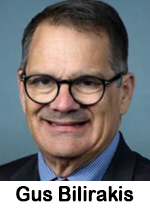
 Radio for Every Vehicle Act in its surface transportation reauthorization package. We thank Chairmen Brett Guthrie and Gus Bilirakis and Ranking Member Frank Pallone for their continued leadership on this critical issue and for creating another path to pass this overwhelmingly bipartisan legislation. As lawmakers consider policies affecting America’s transportation infrastructure, ensuring continued access to AM radio in vehicles remains essential for public safety. Leaders on both sides of the aisle recognize AM radio’s unique and indispensable role in keeping Americans informed, especially in times of emergency. We appreciate the support of the Act’s nearly 380 House and Senate cosponsors and urge Congress to take swift action to advance this legislation into law.”
 could not have anticipated today’s streaming options. This resolution reflects growing concern that sports programming is increasingly fragmented across exclusive digital platforms, forcing fans to purchase multiple subscriptions, maintain reliable broadband access and navigate a maze of services just to follow their favorite teams. It calls on congress to assess whether these evolving distribution practices are covered under the law, serve the public interest and preserve broad fan access to sports programming.” NAB president and CEO Curtis LeGeyt says, “We commend the state broadcasters associations for their leadership and engagement on this important issue. Local television remains the only universally available video platform in America, delivering live sports, trusted local news, emergency information and essential public service to every community. Policymakers should put fans first and ensure that the future of sports distribution preserves broad access through free, local broadcast television.”
 recent trends towards fragmentation facilitate or inhibit the ability of local broadcast television stations to meet their public interest obligations, including their production of local news and reporting? In what ways is the marketplace continuing to evolve and how will future changes impact consumer access to free over-the-air news and information, including public safety information?”
 competition local radio stations today face for audiences and vital advertising revenues from online and satellite content providers and digital ad platforms not subject to any comparable restrictions on their scale and scope; the dire negative effects that consumer and advertiser substitution of competing digital audio content and advertising for traditional radio has had on the listenership and advertising revenues garnered by local radio stations, including in mid-sized and small markets; and how the retention of asymmetric ownership restrictions has prevented radio broadcasters from gaining local scale to take advantage of important economic efficiencies, obtain investment capital, and better compete for audiences and advertising revenues, and thus enhance – or even maintain – their provision of news, emergency information, and valued entertainment and sports programming in local communities across the country at no cost to the public.” Responding to testimony from musicFirst Coalition and the Future of Music Coalition – referred to as the Coalitions – NAB writes, “First, the fact that the Coalitions continue to hold themselves out as protectors of small, local independent broadcasters not just borders on the absurd but crosses over into full-blown absurdity. The Coalitions represent the interests of the music industry, which is dominated by three consolidated international record labels. Compared to even the largest radio station groups, the giant record labels are the 800-pound gorillas of the music world. Those three labels earn billions more in revenue than the approximately 11,000 full-power commercial AM/FM stations combined. As NAB earlier reported, the three major music companies jointly generated about $2.9 million per hour in 2023. In remarkable contrast, in 2023 and 2024 the vast majority of radio stations garnered less – and often much less – than $2.9 million per year in advertising revenues. Needless to say, the Coalitions have never explained how local radio stations earning such low levels of revenue (and even lower, if any, profits) are supposed to keep talented employees and provide high quality programming, including popular music, sports, and informational programming, such as weather updates and emergency information, OTA and free to the public without achieving increased local scale, greater economic efficiencies, and more robust ad revenues.
  $12.54 billion – with $10.15 billion from over-the-air revenue and $2.39 billion from digital revenue. NAB president and CEO Curtis LeGeyt comments, “No other industry gives more to Americans for free. Local stations provide trusted journalism, life-saving emergency alerts and the sports and entertainment that bring our communities together. This report reinforces that broadcasters are not only essential to our democracy and daily lives, but to the strength of our economy, as well.” The study goes on to reveal that “local broadcasting’s economic ripple effect extends deep into other sectors — from construction to retail — adding another $134 billion in GDP and supporting nearly 776,000 additional jobs.” LeGeyt adds, “Broadcasting is more than a business model; it is a civic model. This industry stands alone in its mission to inform, protect and uplift every community in America, regardless of zip code or income level.”
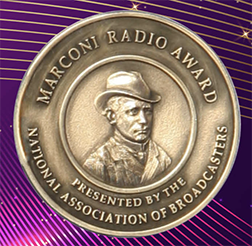 Ballroom on the eve of NAB Show New York. Some of the winners in spoken-word radio formats include: Premiere Networks’ Colin Cowherd for Network/Syndicated Personality of the Year; WJR, Detroit’s Mitch Albom for Large Market Personality of the Year; WHIO-AM/FM, Dayton’s Larry Hansgen for Medium Market Personality of the Year; WWNC, Asheville’s Mark Starling for Small Market Personality of the Year; WBAL-AM, Baltimore for News/Talk Station of the Year; and WXYT-FM, Detroit for Sports Station of the Year.
 station ownership. NAB president and CEO Curtis LeGeyt issued a statement expressing his pleasure with that move but said he’s disappointed the Court didn’t do the same for radio. LeGeyt says, “At the same time, we are disappointed that the court stopped short of addressing the decades-old radio ownership restrictions that defy economic reality and weaken broadcasters’ ability to compete, invest in local journalism and serve their communities. Fortunately, FCC Chairman Brendan Carr has long been a champion for empowering local stations, and we look forward to working with this FCC to modernize its local radio ownership rules and ensure local broadcasters can thrive in the communities they serve across the nation.”
 president and CEO Curtis LeGeyt commented on the ruling saying, “Today’s decision affirms what local broadcasters and other publishers have long known: Google has used its dominance in the online advertising marketplace to disadvantage content creators and tilt the playing field. We commend the Department of Justice for taking on this critical case. As policymakers and regulators consider the implications of this ruling, we urge them to recognize that the same Big Tech dominance harming digital publishers is also undermining the advertising revenue local broadcasters rely on to serve their communities. We are encouraged that the FCC, under Chairman Carr’s leadership, is taking steps to modernize its rules and look forward to swift action that begins to level the competitive playing field.”
 “NAB congratulates President-Elect Trump and the new and returning members of Congress. Local television and radio stations are committed to working with the next administration on policies that will enable increased investment in local journalism, emergency information, sports and entertainment on which our communities rely. NAB will continue its bipartisan work with policymakers to strengthen this free, local service that is essential to our democracy.”
 Under the Federal Communications Commission’s consideration is a proposal from Commander Communications Corporation that would create an FM broadcasting class known as “A10.” In addition to enhancing coverage in rural and underserved areas, it would grant power upgrades for roughly 1,400 Class A FMs, allowing a maximum of 10,000 watts. Approval would depend on a station’s geographical zone; tower height; and separation requirements. While the National Association of Broadcasters recognizes potential benefits for listeners – especially during emergencies – it urges caution owing to possible negative impacts. The NAB generally supports proposals designed to improve coverage areas, but says the “A10” proposal lacks technical analysis and information on how many stations may be upgradable. An NAB filing notes that, “While this could lead to improved service for additional listeners, it could also further squeeze the band in more markets and impact more FM services.” Also opposed is Cumulus Media, which cites an “unacceptable risk” to stations already competing against streaming services. Conversely, the Multicultural Media, Telecom & Internet Council favors the suggestion, stressing that many stations that would qualify for the upgrade are owned by minority and small-scale operators. This proposal would replace an earlier FCC one for a Class C4 FM station category. More than 100 independent and minority owners backed the idea, but it ran into opposition from larger companies and the NAB.
 witnesses about the importance of having a robust emergency alert and public safety communications infrastructure. Further, rural and underserved Americans still enjoy listening to AM radio broadcasts for their diverse viewpoints. Given AM radio’s significant reach as a medium, much of it taking place in vehicles, we
  must ensure it remains a readily available option for all Americans, particularly as we approach hurricane season.” In response NAB president and CEO Curtis LeGeyt states, “NAB applauds today’s markup and passage of the ‘AM Radio for Every Vehicle Act.’ This critical legislation ensures that the 82 million Americans who rely on AM radio each month will continue to have access to diverse programming, local news and essential emergency information. AM radio is the backbone of our Emergency Alert System, providing timely alerts and information during disasters and emergencies, ensuring that critical communication remains available even when cell and broadband services fail.”
 “Draft Legislation to Preserve Americans’ Access to AM Radio” is the title of a legislative hearing that House Energy and Commerce Committee chair
  senior adviser at the U.S. Department of Health and Human Services, will serve as a spokesperson for the association and will help develop and execute messaging strategies to advance broadcasters’ policy agenda before Congress and the Federal Communications Commission. NAB EVP, public affairs and chief of staff Michelle Lehman says, “Gaby is a seasoned policy communicator whose years of government service have equipped her with a profound understanding of effective and strategic communications. Broadcasters will benefit from Gaby’s deep expertise in shaping messaging on the most important issues facing our industry, and we are thrilled to have her on the team.”