


NAB Show: Competing on the Omnimedia Landscape
By Holland Cooke
Consultant
 “We are competing in an attention economy,” and Magid COO Jaime Spencer reckons that “the playing field is massive.”
For decades, Magid has been known as a TV news research and consulting firm. But its newest Omnimedia work widens the lens – and radio should be paying close attention. Because the consumers Magid describes aren’t “viewers” or “listeners.” They’re attention grazers, moving across platforms, devices, and dayparts without ever thinking in “TV” or “radio” terms. And that shift changes our game.
Magid’s core point lands hard: We no longer operate in a content economy. We operate in an attention economy. Radio isn’t competing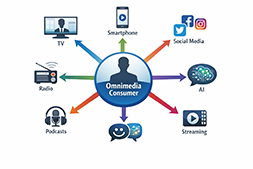 with the station across town anymore. It’s competing with 50,000 news brands, nearly half a million podcasts, and an infinite scroll of feeds that never sleep.
And here’s the kicker: the audience doesn’t distinguish platforms – only relevance. They follow whatever captures attention in the moment. If your brand can’t travel across social, smart speakers, mobile, and on air with a consistent voice and value, you could be invisible to the modern consumer.
Spencer also flags a new disruptor: AI as a news gateway. “17% of people now discover news first on AI platforms – higher than push alerts and newsletters. Considering that platform didn’t exist two years ago, that’s a big number.” That’s also a flashing red light for radio. If AI becomes the first stop for facts, radio must become the first stop for context, clarity, and humanity – the things AI can’t localize, empathize with, or improvise.
“Consumers are overwhelmed.” They’re juggling nearly six streaming services and still feel behind. That’s an opening. Radio’s superpower has always been curation – a trusted voice cutting through the noise. In an Omnimedia world, that skill becomes a premium product.
Finally, Magid’s emotional driver research reinforces what great programmers already know: passion beats function. Utility alone (i.e., “Breaking News”) won’t hold audience. Emotional gravity will. “Consumers are looking for comfort and affirmation.” Per Magid’s Trust Index research: Public media outlets like NPR perform strongly, while polarizing figures such as Glenn Beck, Rachel Maddow, and Sean Hannity also rank in the top quartile, skewed by affirmation of audience beliefs.
The bottom line? The Omnimedia consumer is already here. Radio wins by being the most human, most local, most emotionally resonant voice in a chaotic media diet – not by being “radio,” but by being essential wherever the audience happens to be.
See Jaime Spencer’s deck here.
If you missed yesterday’s NAB Show update, click here. And if you are here in ‘Vegas this week, look for me. Maybe we can grab a cuppa cawfee. If you aren’t here, look for my NAB Show update here tomorrow.
Holland Cooke (HollandCooke.com) is a consultant working the intersection of broadcasting and the Internet. Follow HC on Twitter @HollandCooke and connect on LinkedIn
 solutions organization Magid, the RTDNA examines trust in journalism among younger news consumers in 2025. It published the findings earlier this summer. Now, news pros can watch a recording of the webinar that the two organizations conducted to walk journalists through the findings and help them understand how they can improve trust among the next generation of news consumers.
  journalists “ask tough, but respectful questions to get answers,” and 61% say it is very important they fact-check those candidates. RTDNA president and CEO Dan Shelley comments, “In our highly polarized society, Americans need to rely on their trusted local sources of news to get the facts about candidates, campaigns and other political issues. These findings offer a clear roadmap to ensure local reporters and news managers are providing voters with the information they crave to make critical decisions in the voting booth.” Other data from the study reflects news consumers’ attitudes about news organizations, finding that 47% of those surveyed said they were in strong agreement that the information they get from local news sources is accurate and correct. That number drops to 41% when local news outlets cover political issues. It also found that just 39% of people were in strong agreement that local news sources were balanced and represented all sides of an issue.