The Audience Has an Audience
By Matthew B. Harrison
TALKERS, VP/Associate Publisher
Harrison Media Law, Senior Partner
Goodphone Communications, Executive Producer
“Everybody’s a dreamer / And everybody’s a star.”
Ray Davies, “Celluloid Heroes,” 1972
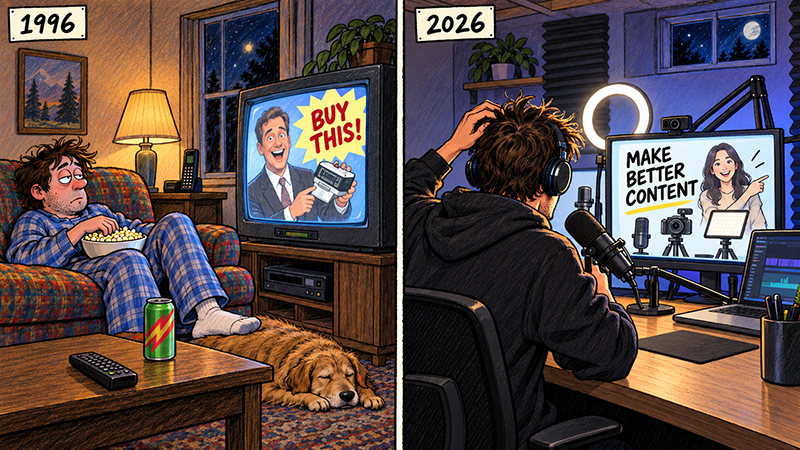
 My father recently called my attention to something hiding in plain sight. He was watching YouTube and noticed ads for StreamYard, Riverside, Sprizzy and other companies selling tools and services to people who want to produce, distribute, or promote their own media. “They are advertising on consumer venues!” he told me. That was the part that caught his attention.
It sounds obvious until you think about what it means. These companies are not merely advertising to viewers, listeners, and readers. They are advertising to viewers, listeners, and readers who also make things: podcasts, videos, livestreams, newsletters, books, music, and shows. The consumer audience now contains an enormous population of producers.
My father, TALKERS founder Michael Harrison, has a phrase for this: “The audience has an audience.” In a July interview about the modern media landscape, he put it even more plainly: “Everybody has a show.” That does not mean everybody has a large show, a profitable show, or even a particularly good show. It means that access to the means of publishing and broadcasting, once scarce and expensive, has become ordinary.
That change created an entire business layer around the aspiring and semi-professional media producer. StreamYard and Riverside sell production capability. Podbean sells hosting, distribution, and monetization tools. Sprizzy sells YouTube promotion. Beyond them are editing platforms, newsletter companies, self-publishing services, PR firms, audience-development businesses and companies willing to help almost anyone build, package and promote a media product.
The money moving around this ecosystem is no longer trivial. The Interactive Advertising Bureau reported that U.S. creator-economy advertising grew from $29.5 billion in 2024 and projected it to reach about $43.9 billion in 2026. In its September 2026 advertising outlook update, IAB reported that 54% of buyers said they were increasing their focus on creator and influencer advertising and partnerships.
For traditional broadcasters, that should change how we think about the people on the other side of the microphone. The butcher, the baker and the candlestick maker may still be members of the audience, but now the butcher has a cooking channel, the baker has a podcast, and the candlestick maker has an Etsy store, a newsletter and 14,000 followers. They may be competitors for attention, but they can also be customers, advertisers, guests, sources, affiliates, and future talent.
This does not erase the distinction between professional media and someone experimenting in a spare bedroom. Scale still matters. Skill matters. Editorial judgment matters. Broadcasters also operate under legal and regulatory obligations that do not simply transfer to someone uploading a video from a phone. But the old wall separating “the media” from “the audience” has become remarkably porous.
That may be the bigger lesson behind all those advertisements. Companies that once would have bought trade advertising to reach broadcasters, publishers or recording professionals can now advertise on consumer platforms and find millions of people with, as Michael puts it, “a toe in showbiz.” The consumer venue has become a trade venue because a meaningful portion of the consumers are also in the trade.
So where exactly is the line between our audience, our competition and our customers? Increasingly, there isn’t a very clean one. When the audience has an audience, the media business is no longer just about reaching consumers. It is about reaching people who are themselves trying to reach somebody else.
Matthew B. Harrison is a media and intellectual property attorney who advises radio hosts, content creators, and creative entrepreneurs. He has written extensively on fair use, AI law, and the future of digital rights. Reach him at Matthew@HarrisonMediaLaw.com or read more at TALKERS.com.
 ‘entertainment,’ ‘sports,’ ‘travel’ etc., in accordance with Interactive Advertising Bureau (IAB) standards. With this capability, Audacy will dynamically insert ads into podcasts more precisely than ever.” Audacy chief revenue officer Brian Benedik adds, “The promise of Audacy’s cross-platform audio campaigns to deliver unprecedented reach coupled with powerful precision targeting becomes even more pronounced with the integration of contextual podcast advertising into our Ad Tech stack. Our clients are realizing better returns on their advertising investments and better outcomes for their business when they leverage our holistic audio strategies, which is why Audacy boasts one of the highest renewal rates in audio and digital media.”
 advertising. In 2016 and 2017, direct response represented the vast majority of podcast advertising. From 2018 to 2021, the proportion of podcast ad spend was equally split between brand and direct response.” The post says there are four major implications of the shift to podcast brand advertising: 1) Targeting will become much broader: Wide campaign reach will become the priority with a goal of “being known before you’re needed”; 2) Creative will shift to become more entertaining and emotion based: The objective will be to stir passions and create positive feelings and associations with ads that people find interesting and enjoyable; 3) Brand safety and suitability measurement will become more crucial: Firms like Barometer will become powerful resources to help marketers find the right context for their campaigns with nuanced data; and 4) Measurement will focus on how well campaigns build memories to ensure brands are “easy to mind and easy to find”: Key performance indicators are brand awareness, brand consideration, and brand preference.