


Monday Memo: Occasions, Not Duration
By Holland Cooke
Consultant
 For 100 years, radio programmers have tried to keep listeners listening longer. “Coming up next…”
Another few minutes? Yes! Ask! And do so as-seductively-as-possible, saying “you” and “your.” But there’s very little you can say to keep someone sitting in a parked car after they’ve turned the engine off.
A more realistic opportunity?
Life is fragmented. Audio is everywhere. Listeners move among broadcast radio, podcasts, streams, satellite, YouTube and whatever their phones serve up next. Oh, and off-air promotion – billboards, TV, direct mail – remember them – cost money.
Sales 101: Say it with me: “Your best prospect is…?” An existing customer! Sell ‘em again, in this case inducing an existing listener to listen again later – specifically later-today, and same-time-tomorrow. You can’t win by earning TSL when they’re not listening. So, seem useful-enough that they’ll want to come back again.
- First thing in the morning…
- Before leaving home…
- During the commute…
- At lunch…
- Before the drive home…
- When weather threatens…
- When big news breaks…
- When the game will air…
All-news stations have understood this for decades. The very first one – 1010WINS/New York, to-this-day #1 in morning drive – said, “Give us 22 minutes and we’ll give you the world.” The product was designed for repeat use.
This also changes how we use digital tools
Too many stations treat the app, stream, and social media as separate products. They should be pathways back to useful content. A push alert can invite immediate listening when something important happens. A social clip can preview what the morning show will develop tomorrow. A podcast can serve someone who missed the original conversation while promoting the next live one.
The objective is not to trap listeners. It is to accompany them. Try this…
- Map your target listener’s day. Identify five moments when your station could be helpful, entertaining or reassuring. Then ask yourself…
- Do we offer something worth returning for at each moment?
- Do listeners know we offer it?
- Do we remind them when to return?
And when they do return, do we deliver immediately? Or make them wait through clutter?
Duration still matters. Every unnecessary word still spends attention. So, program at-the-speed-of-life. But focusing only on longer listening per-occasion overlooks how people actually live. You can’t keep someone sitting in a parked car. You can earn more visits.
Holland Cooke (HollandCooke.com) is a consultant working the intersection of broadcasting and the Internet. Follow HC on Twitter @HollandCooke and connect on LinkedIn
 Too often, for too many in radio, it has been a Blue Christmas in recent years. If you have been displaced – or if you are working, and, shall we say, “assessing your options” – don’t underestimate what you have to offer.
 About those commercials… which pay for you. When a prospective client says, “We tried radio. It didn’t work,” I ask to hear the commercial. Within seconds I can tell why.
 As TV is touting its coming attractions, take a step back. We – inside the box – live-and-breathe radio.
 Radio stations used to announce the present temperature at the end of the weather forecast, empowering listeners who are heading out to dress accordingly. It’s the ultimate live-N-local information.
 No two summers have been alike since the pandemic upended listeners’ lives and retailers’ businesses. So, we’ve seen this movie before. To sound relevant and relatable and helpful, connect the dots:
 …I’m sharing promo copy now airing on my client stations, which addresses listeners’ – and advertisers’ — 2026 apprehensions:
 If you are doing talk radio, much of your programming is syndicated. If you do music radio, your most formidable competitors are robotic streams that live in the cloud. Either way, YOU, being local, can make friends — and money — if you plan now to exploit these occasions.
 Jason Reddick’s The Complete Guide to AI Side Hustles is aimed at beginners trying to build passive income. But read it through a broadcaster’s lens and it suggests a blueprint for how radio talent and podcasters can leverage AI to expand their influence, diversify revenue, and stay indispensable in a media economy that rewards relevance and speed.
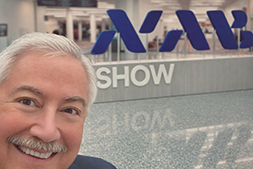 My notes from a real useful session with Amazon’s Andy Slater, Audacy’s Michael Biemolt, and YouTube’s Neha Taleja, moderated by WTOP’S John Wardock.
 As a newly minted program director (remember them?), I found the 1980 “NAB Radio Programming Conference” downright enchanting. New-tech cart machines (remember them?) would FIND the splice! And after the cart played, a flashing light saved careless DJs from accidentally playing it again.
 Time Spent Listening to podcasts has now surpassed TSL with spoken word radio. And both are fraught.
 Good News/Bad News: Fender‑benders, slip‑and‑falls, and other “injuries caused by the negligent, careless, or reckless actions of others” will always happen. That’s the good news…for personal injury attorneys. Their bad news is that supply WAY-exceeds demand, and their advertising reflects it.
 Small businesses often underestimate their greatest competitive edge. It’s not price. It’s not selection.
 Unless you live in Hawaii and Arizona (except the Navajo Nation) or American Samoa, Guam, the Northern Mariana Islands, Puerto Rico and the U.S. Virgin Islands, your clocks will change when we “Spring Forward” on Sunday 3/8.
 Your prospect – or, worse, an existing advertiser with cold feet – says “We tried radio. It didn’t work.” Often, the copy is the culprit, because it’s inside-out.
 If you work in radio, you’ve heard every flavor of AI anxiety. Some fear it will wipe out jobs. Others treat it like a super shortcut – cranking-out spots, promos, and proposals faster and cheaper. Kate O’Neill’s “
 If you’re on-air, it’s an important part of your job. Here’s what I see and hear working:
 Linear broadcast media have never been more challenged. Internet video now commands far more viewing time than over-the-air TV. And their own networks are hijacking viewers! Your local NBC station tells you to watch Peacock. ABC points you to Disney+. CBS pushes Paramount+. Affiliates are effectively forced to promote their own competition.
 Notice how often you see one in TV commercials, even when the product has nothing to do with pets? I see spots for a local building supply outlet, in which the owner’s dog ambles through every shot, then plops down – seeming to smile – among employees in the closing shot.
 Evidence that your correspondent is a nerd: my airplane read for my CES back-N-forth was Successful AI Product Creation: A 9-Step Framework by Shub Agarwal (Wiley). If you haven’t got time for all 307 pages, here’s what I gleaned, pertinent to radio: