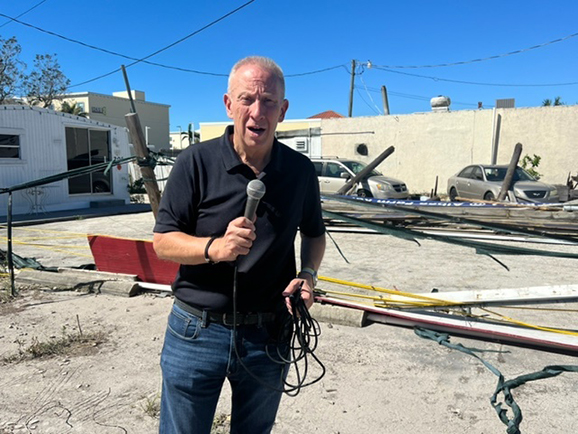
By Holland Cooke
Consultant
 Local news sponsorship is an opportunity to “fish for whales,” institutional advertisers who can associate with something special. And, well-done, local news sure is special, because:
New-tech audio competitors don’t do it, and most AM/FM broadcast hours are now robotic.
Newspapers are in a tailspin swapping print dollars for digital dimes; and their – and TV stations’ – websites aren’t as portable as radio.
And it’s easier to add occasions of listening than to extend duration-per. Translation: There’s very little we do can keep someone in a parked car with the key on Accessories.
First things first: Plan NOW for The Big Story. In a recent column here I outlined the “break the glass” plan you should prep.
As for day-to-day local news:
Who are you talking to? Habitual radio users – especially news/talk – are older-than-younger. Think Baby Boomers (born 1946-1964), who control most retail spending. And report information that matters to people with children of any age living at home (super-spenders) and people driving (what’s happening right now, and what threatens to block their path). Think “car radio” for busy people and you won’t turn-off anyone sitting-stiller.
What: INFLATION, health and safety, “survival information” (weather = news). Jim Farley, my successor managing WTOP, Washington, hung a sign in the newsroom: “WGAS,” his litmus test for relevance, “Who Gives A Shit?”
Where: What’s happening within your signal pattern? And when everyone’s buzzing about a big story elsewhere, localize by asking pertinent sources “if it happened here?” and Man-on-the-Street interviews (local accents) reacting.
When: What JUST happened…what’s happening right NOW…what happens NEXT. When you’re wall-to-wall, do frequent resets, because people believe your promos, and are tuning-in to know. Other times, specific goal: Each newscast sounds different than the last.
Why it matters to your listener: News people I coach will chisel this onto my tombstone: Report consequence, not process. Don’t give me the minutes of the City Council meeting, tell me how what-was-discussed will impact me. Rewrite press releases, which aren’t easy on the ear (“The public is asked…”), tend to be process-laden, and are often self-congratulatory.

Longtime ABC News executive Av Westin, one of two industry icons we lost in 2022: “I believe the audience at dinner time wants to know the answers to three very important questions: Is the world safe? Is my hometown and my home safe? If my wife and children are safe, what has happened in the past 24 hours to make them better off or to amuse them?”
Tips:
— Emulate your network’s writing style.
— HIGHLY recommended reading: “Writing Broadcast News: Shorter, Sharper, Stronger” by Mervin Block.
— Rewrite to favor The Magic Words “you” and “your” and avoid third-person-plural (words like “residents”). Instead of “Business owners interested in applying for these loans should contact…” say “If you’re a business owner…”
— Arrange with a local TV station (“our news partner NBC28”) to use their sound, in exchange for attribution (which will enhance their standing and serve to promote their newscasts).
I am encouraged by how much 2022 work sought me out, asking that I review stations’ local news copy, and work with the local newscasters whose work can habituate listeners and make money.
Make your work count twice.
— When you’re covering a meeting or event, ask people there something else too. “How are YOU feeling inflation?”
— Say WHERE you gathered comments. “We spoke to shoppers leaving Star Market in West Springfield.”
— Al Primo, inventor of “Eyewitness News,” who also passed away last year: “People can tell their stories better than we can write them.”
Holland Cooke (HollandCooke.com) is a consultant working at the intersection of broadcasting and the Internet. He is the author of the E-book and FREE on-air radio features “Inflation Hacks: Save Those Benjamins;” and “Spot-On: Commercial Copy Points That Earned The Benjamins,” a FREE download; and “Multiply Your Podcast Subscribers, Without Buying Clicks,” available from Talkers books. Follow HC on Twitter @HollandCooke
Share this with your network



 dominant spoken-word audio listening platform, but it was fully sixty-five percentage points higher than podcasts, which accounted for 10% of listening time back then. Quarter by quarter and year over year, time spent using AM/FM radio to listen to spoken-word audio has declined significantly and shifted to time spent with podcasts. As of Q4 2025, 40% of time spent listening to spoken-word is now spent with podcasts and 39% of time is spent with AM/FM radio. Not only does radio not beat podcasts by a significant margin, it now trails the on-demand platform for spoken-word audio listening.”
 audience over indexes for a slew of major purchase categories.” Some of the key findings in the study include: 1) The number of sports-formatted AM/FM radio stations has grown +14% over the last decade, while revenue shares increased +38%; 2) According to Nielsen, the sports format ranks an astonishing number one in streaming shares among 25-54s and 18-34s, while in-car listening is the dominant location of listening among over-the-air sports AM/FM radio listeners; 3) Advertising on sports AM/FM radio is more effective than TV sports because the AM/FM radio audience is far more attentive and sports engaged; and 4) Ranked third in income of twenty-four AM/FM radio formats, the sports format has seen household incomes grow 17% since 2020.
  The plague of pessimism about the future of radio is fueled internally by radio employees. Doomsayers are logically found in the sales department. All day, salespeople meet with buyers. A buyer’s job is to negotiate a lower price by arguing radio’s negatives. The wall of negativity thrives within the work environment of a seller. Tough. But there is little or no reason for pessimism.
 platforms like radio, podcasts, streaming music services and satellite radio, with ad-supported audio representing 64% of total listening.” Breaking that down further, the study reveals that within the ad-supported audio universe,
  consumers spent 62% of their daily time with radio, 20% with podcasts, 15% with streaming audio services and 3% with satellite radio. Among 18-34 year-olds radio accounted for 43% of daily ad-supported audio time, where podcasts accounted for 31%. And adults 35+ spent 69% of daily ad-supported audio time listening to radio and only 16% listening to podcasts. Looking at listening based on radio formats (Nielsen PPM Cross-Market AQH Share. Q3 2025. Mon-Sun 6a-Mid), news/talk garnered a 10.6 share for Persons 18+ and a 12.0 share for Persons 35+, and a 6.1 share in the 25-54 demo.
  number of issues based on data from Edison Research’s ongoing Share of Ear study. One aspect of AM/FM radio’s strength is its ability to reach the country’s political segments. The post notes, “Among registered voters, AM/FM radio has a 67% share of ad-supported audio, followed by podcasts (20%). Whether the target is Independents, Republicans, or Democrats, AM/FM radio shares are in the mid-60s to low 70s.”
  the popularity of mobile devices for audio listening is the most dominant in urban communities. Within that audience segment, 40% of time is spent listening to audio on a mobile device, vs. 28% of time spent listening on an AM/FM radio receiver. The mobile device also holds a strong lead in suburban communities, with 36% of time spent listening on that device compared to 30% of time on a radio receiver. However, the radio receiver is strongest in rural communities where it matches the listening time of the mobile device, each receiving 34%.
 The Cumulus Media | Westwood One Audio Active Group unveils an audio planning guide based on data from Edison Research and Nielsen data. Saying that there are incorrect assumptions among strategists and media planners about which audio media have the most listeners, chief insights officer Pierre Bouvard underscores that AM/FM radio is still the dominant ad-supported audio platform with a 66% share. Podcasting is second with a 20% share and this is true across all demographics. For those who are all-in on digital audio only, Bouvard says they are missing 70% of the potential audience as ad-supported Spotify, Pandora and podcasts reach only 30% of the U.S. in a typical day. Further, Bouvard says the data suggests an optimal allocation of audio ad spend: “The ideal allocation for a 25-54 audio plan is 62% AM/FM radio, 24% podcasts, 12% music streaming (Pandora, Spotify, Amazon Music, and YouTube Music), and 2% SiriusXM satellite radio.”
  satellite radio; 2) In the second quarter of 2025, ad supported audio accounted for 64% of all listening, while in the TV landscape, 74% of viewing was done on ad supported platforms; 3) Zeroing in on the ad supported audio universe, consumers spent 64% of their daily time in the second quarter with radio, 19% with podcasts, 14% with streaming audio services and 3% with satellite radio. The study also tracks listening by format and news/talk (AM/FM and streaming) not surprisingly dominated the 35+ demo with more than a 12 share. But the format also did well with 25-54s, notching a 6.5 share (which topped all other formats except adult contemporary
 study of 303 media agencies and marketers conducted in August 2024 found the perceived combined audience share of Pandora/Spotify is 43%, much greater than the perceived share of AM/FM radio (27%). In reality, “According to the Q1 2025 Share of Ear, AM/FM radio’s persons 18+ share of ad-supported audio (68%) is 14 times larger than ad-supported Pandora (5%) and ad-supported Spotify (5%).” The data also reveals that podcasts take the second-place spot with a 20% share. Ad-supported Pandora (5%), ad-supported Spotify (5%), and ad-supported SiriusXM (3%) lag distantly.
  TALKERS publisher Michael Harrison introduced the term in the 1990s, inviting us to think-beyond the real-time audio we were sending up those towers. What he described seemed conceptual, even futuristic, back then, when we were still logging-onto AOL via dial-up (screech).
 Radio is an intimate, one-to-one medium; so “you” and “your” – speaking to one person – will resonate more than addressing “all of you.” There’s only one of me.
 reveal that AM/FM ads far outperform most social media ads. For example, the firm Adelaide found that for revery $1,000 spent on AM/FM ads it would require spending $2,635 on Facebook ads for the same amount of attentiveness. However, it also found that just $698 of YouTube ads would yield the same degree of attentiveness as $1,000 of AM/FM advertising. The blog post also addresses the myth that video ads are necessarily more effective than audio ads.
  ideal medium platforms for retailers and e-commerce brands: Heavy audio listeners are more likely to shop online. Heavy AM/FM radio and podcast listeners also spend more online than TV viewers. AM/FM radio listeners and heavy podcast listeners over-index on Amazon Prime membership and purchase intent; 2) AM/FM radio makes your TV better – “20 gets you 50”: Nielsen Media Impact optimizations reveal shifting more media weight to AM/FM radio generates significantly more reach, especially among younger demographics 18-49. AM/FM radio does an extraordinary job increasing campaign reach among light TV viewers, who are far less likely to see retailer TV ads. The rule of thumb is “20 gets you 50”: a 20% shift of a TV media budget to AM/FM Radio generates a 50% increase in reach; and 3) Audio holiday AM/FM radio campaigns work: Consumers exposed to an Amazon holiday AM/FM radio campaign have higher brand equity (awareness, ad recall, prior purchase and purchase intent). Nielsen sales effect studies reveal AM/FM radio campaigns for retailers generate significant return on advertising spend: $15 dollars of incremental sales for every dollar of AM/FM radio advertising.
  43% of spoken word listening, and podcasts 36%. Keep in mind that for Edison’s purposes spoken word content includes news, sports talk and play-by-play, audiobooks, talk shows, and “personalities.” Edison states, “Podcasting’s share of spoken word will almost surely surpass that of AM/FM within a few more years. There is one more thing to note – the advantage for AM/FM is coming entirely from those age 65 and older. Among those ages 13-64, podcasting has already passed AM/FM listening by, 41% to 39%. Meanwhile, among the oldest Americans age 65+, AM/FM radio continues to dominate, with a 66%-13% advantage. Curiously, that 66%-13% difference among the oldest Americans is the exact same difference we recorded for all Americans 13+ in 2017.”
 Got young local radio news talent? CONGRATULATIONS, for five reasons:
 reach. “Republicans listen to more AM/FM radio than other groups, with an index of 109 (or 9% more listening than average). The ad-supported spoken-word channels on SiriusXM are a particularly efficient place to find Republicans, with an index of 146. Meanwhile, podcasts stand out as the more efficient platform for reaching Democrats, indexing at 121. And what about those elusive Independents, who often tip an election? Both streaming music, and in particular music videos on YouTube, over-deliver for these potential voters, with indexes of 103 and 123 respectively.” Edison adds, “Regardless of the party that buyers are trying to reach with political ads, audio stands out as a superior pathway to reaching voters. Audio provides enormous audiences and often a far less cluttered political environment than other ad channels.”
 Because you can? Because you aren’t doing AM/FM radio? Because you are on radio, but can’t-do-there what you can-do podcasting? Because you are making money podcasting?
 and podcasts are all a part of what we do, so show us what you’ve got. The successful candidate will be responsible for all aspects of programming including scheduling content, coaching on-air staff, station and AM/FM cluster strategy, development of on-air/online promotions and generating associated revenue, oversight and content creation for digital extensions (including streams, websites and podcasts), and have a strong customer service approach towards listeners, staff, & sales. Additionally, the candidate will act as the program director for Legendary News Radio KKOB and KNML The Sports Animal.
  devotion to Internet radio broadcasting, we are launching ‘The Mike Church Show’ into terrestrial radio syndication! The launch date of ‘The Mike Church Show’ will be March 1 and the show will begin its repatriation of AM/FM radio in Atlanta, Georgia’s #7 U.S. radio market on WXKG “The King”! Church adds, “We’ve always known that terrestrial radio was going to play a part in our industry leading development of Internet radio, we just didn’t know in what way. Over the last two years, that role began to materialize with the dearth of quality talk shows and the opportunities to fill that gap left by the wrecking ball that was consolidation’s march through local radio properties.” The program airs live from 7:00 am to 10:00 am ET.
  largest share of listening, accounting for more than one-third of daily time with audio among those age 13+. The vast majority of that listening (31%) is to AM/FM over-the-air signals.” (The other 5% comes from radio streams.) Behind AM/FM in listening is streaming music (20%), YouTube (14%), podcasts (11%), SiriusXM (8%), owned music (4%), TV music channels (3%), audiobooks (3%) and other (1%).
  As The Beatles sang, “It’s been a long, cold, lonely winter.” ‘Still is, eh?
 a host-read ad on a podcast or AM/FM radio show drives powerful brand impact and sales effect and positive emotional impact is what measures a successful campaign. System1 studied host-read ads and devised a rating system that correlates creative quality with long-term share growth – in layman’s terms, “the more you feel, the more you buy.” But the study found that only 17% of the ads tested rated high enough to have the sufficient emotional impact necessary to lift long-term brand share by between 1% and 3%.
  2018, Nielsen’s Total Audience Report reveals the 18-49 weekly reach of live and time-shifted TV has dropped -26%. Over the same period, TV’s daily time spent is down -59%; 2) cord-cutting is a major driver of TV’s audience collapse: The MRI Simmons January 2023 “How Americans Watch TV” report reveals 51% have cut the cord; 3) While a huge number of Americans have abandoned traditional TV for streaming, AM/FM radio remains the dominant audio platform: According to Edison Research’s Q2 2023 “Share of Ear,” AM/FM radio has a massive 69% share of U.S. ad-supported audio. AM/FM radio audience shares are over 17 times larger than ad-supported Pandora and ad-supported Spotify.
  The stations I work with make big money with live endorsement spots delivered by familiar local on-air personalities. Remember them? With most AM/FM broadcast hours now robotic or non-local, your relationship with the listener is precious and can be leveraged… carefully.
 Lucid, Bose, Samsung and Xbox, as well as on the TuneIn mobile app and TuneIn.com. The agreement also gives Audacy access to TuneIn’s advertising supply and brings select TuneIn original content to the Audacy digital platform. Audacy chief digital officer J.D. Crowley
  comments, “Streaming of AM/FM Radio is one of the fastest growing segments of all digital audio today. As consumer demand for Audacy’s best-in-class local audio content continues to increase, we’re committed to meeting the listener wherever they wish to consume, and we’re delighted to expand the availability of our unique live sports, news, and personality-driven audio content to over 200 new TuneIn-supported platforms. We’re equally thrilled to welcome TuneIn’s premium exclusive content to the Audacy digital platform.”
 for listening for 60% of consumers. According to a study by MARU/Matchbox, there are a number of reasons listeners gravitate to AM/FM. First is comedic relief: 90% strongly or somewhat agree that their favorite DJs make them laugh. Second is local feel: 73% say personalities understand what makes my city/town unique. And third is thought-provoking: 64% agree that they make them think. Additionally, Magna and Vox Media surveyed 2,028 weekly podcast listeners and asked, “Whose influence matters most?” A stunning 75% cited podcast hosts while only 15% named social media influencers or TV/movie celebrities (10%).
  I asked ChatGPT, “What IS ChatGPT?”
 In last week’s column,