


The Advertiser Gave Us an AI Commercial… Isn’t that Enough?
 By Matthew B. Harrison
TALKERS, VP/Associate Publisher
Harrison Legal Group, Senior Partner
Goodphone Communications, Executive Producer
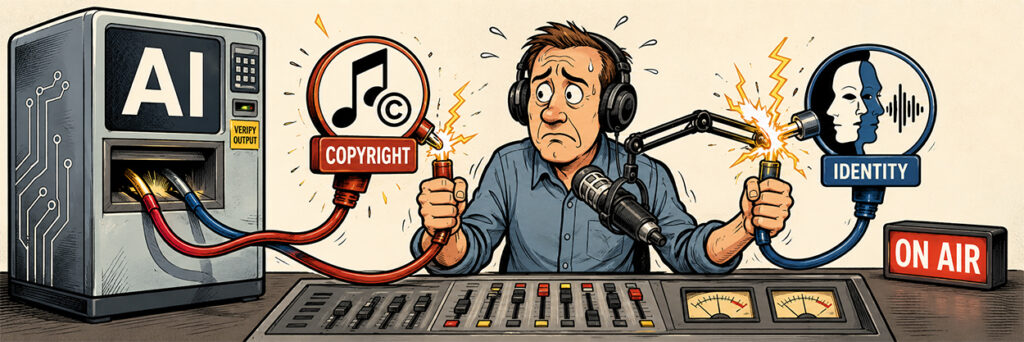
A conventional infringing commercial may misuse a song, recording, photograph, or written copy. An AI commercial can create the same copyright problem while adding another: the unauthorized commercial use of a recognizable person’s identity. One file can therefore produce two entirely different claims.
Copyright protects original expression, including scripts, music, and sound recordings. It generally does not give anyone a copyright in the sound of a natural voice. That does not make a distinctive voice free for advertisers to imitate.
Tom Waits established the distinction decades before generative AI. After Waits declined to participate in a Frito-Lay campaign, the company used a singer who imitated him in a radio commercial. Waits successfully pursued claims for voice misappropriation and false endorsement. AI now makes that imitation faster, cheaper, and potentially more convincing. Waits v. Frito-Lay
The rights do not travel together
There is another wrinkle. The AI company may possess defenses that do not travel with the finished audio. In Walters v. OpenAI, ChatGPT falsely accused radio host Mark Walters of embezzlement. OpenAI defeated the defamation claim because the recipient encountered warnings that the system could be inaccurate, did not believe the accusation, verified that it was false, and did not republish it. Walters also failed to prove the necessary fault or damages. Walters v. OpenAI case summary
That ruling did not grant AI companies blanket immunity. It does suggest an uncomfortable result for broadcasters. A provider’s warning that its output requires verification may help protect the provider while making it harder for a station to argue that airing the output without checking was reasonable. The company that generated the problem may have a better defense than the broadcaster that delivered it to the public.
California’s AI Transparency Act, operative August 2, 2026, now requires certain large AI providers to offer detection tools and place provenance disclosures in generated audio, images, and video. Those tools may help identify origin. They do not establish copyright clearance, consent, accuracy, or authority to imitate someone. California AI Transparency Act
Stations should require advertisers to warrant both ownership and permission for identifiable voices or likenesses, backed by indemnification. AI has not replaced the old clearance problem. It can place a second problem beside it, then leave the broadcaster holding both.
Matthew B. Harrison is a media and intellectual property attorney who advises radio hosts, content creators, and creative entrepreneurs. He has written extensively on fair use, AI law, and the future of digital rights. Reach him at Matthew@HarrisonLegalGroup.com or read more at TALKERS.com.
 The Radio Hall of Fame announced today (8/3) the selection of nine 2026 Legends inductees. These individuals were selected by the Radio Hall of Fame’s 2026 Nominating Committee, which meets annually to recognize deceased individuals who made significant contributions to the radio industry. The Radio Hall of Fame is housed within the Museum of Broadcast Communications in Chicago.
 “It’s all media,” declared accomplished media executive Jack Griffin when confronted with brand new definitions of content and content distribution. Jack, for years, was president of Meredith Publishing, Time Inc., and The Tribune Company. I met Jack when he was publisher of PARADE magazine. Jack is pragmatic, won’t waste your time and spots BS faster than most humans. We were listening to discussions of the impact of online media versus traditional media, and his line was running out. Jack declared “It’s all media” and the meeting blessedly ended. The phrase haunts me and it is being proven true every second of every day.
 Zimmer will take over the operation of sports talk KOSP-FM “102.1 The Won” and three music brands. It currently owns news/talk KWTO/K227KO and sports talk KBFL-AM/K245CA. Zimmer Communications president John Zimmer says,
 “This is an exciting opportunity to bring together two organizations that share the same values and a deep commitment to local broadcasting. By combining our strengths, we’ll be able to offer advertisers even more effective marketing solutions while continuing to provide the trusted local content our audiences rely on.” Mid-West Family president Mike Paterson adds, “As the local radio and media landscape continues to evolve, bringing these two organizations together creates even greater opportunities for our advertising partners, our communities and especially our employees.”
 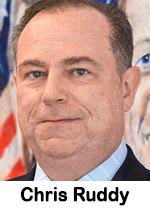 dangerous and would allow two or three corporations to dominate local television news, reducing competition, independent journalism, and threatening religious broadcasters.” He noted that conservative organizations including CPAC, the National Religious Broadcasters, and the Zionist Organization of America oppose lifting these ownership limits. Ruddy also took the opportunity to address how broadcasters view the American people, saying, “Polling consistently shows Americans are far more center-right than portrayed by the legacy media. There is a growing disconnect between public opinion and media narratives.”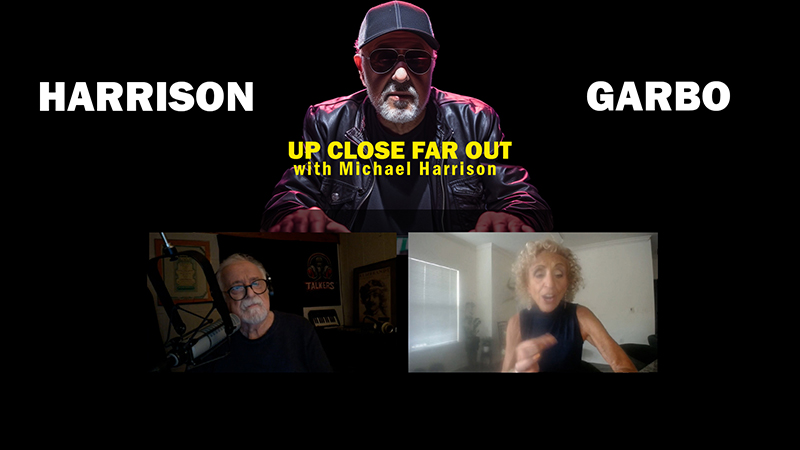
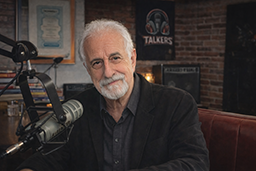 TALKERS founder Michael Harrison is this week’s guest on the National Press Club’s official podcast, Update-1, in which he tackles the topic “Predicting the Future of Media Following the Shutdown of CBS News Radio.” Interviewed by noted American University media professor Gemma Puglisi, Harrison addresses such issues as changes in the tenets of journalism and the general shrinkage of radio news. Along the way, he offers his insights into a variety of media and societal topics including the impact of clickbait and what he describes as “the daily dance of affirmation” resulting
  from the trend toward news platforms “targeting” audiences for purely marketing purposes. Harrison defends AI from critics who claim the technology lacks “heart” and that audiences will swing back to the “authenticity” being destroyed by AI slop. Harrison makes the case that what counts is the humanity behind the operation of AI which is “only a tool.” He says, “Blaming AI for shallow content is like attributing shoddy novels to the invention of the word processor.” Harrison boldly predicts that AI and modern technology will hasten the “death of Hollywood” as we know it among other insights into the future of news, entertainment, and communications. Don’t miss this!
  The key takeaways include: 1) AM/FM radio’s “big data” moment has arrived with massive sample sizes that grow each month: TV has long had cable set top data and smart TV data to generate large samples of tuning data. It’s now radio’s turn! Just like cable set top data, there are no demographics but all markets have large samples. Overall, sample sizes are 5-10X bigger than current ratings samples; 2) Overnight ratings in over 300 markets: In an industry first, every market now has audience shares from yesterday. See your station’s daily audience trends refreshed each day; 3) All listening occurs with humans present: 25% of TV viewing occurs to an empty room but AM/FM radio listening in traveling vehicles always has humans present!; 4) Large samples mean stable listening trends: In all sized markets and for all sized stations, daily share trends are stable and consistent; and 5) AM/FM radio now has modern, cutting edge, timely measurement, which does not rely on a consumer’s memory or require a consumer to do something (like wear a gizmo).
  tickets were nonexistent, he had to find more investors to pay off the earlier debts. He served time from 2021 to 2023. That case involved eight investors and about $1.5 million. This latest conviction involved four investors and a little more than $1.5 million. Prosecutors say he diverted most of the funds to pay off earlier investors and used the rest for gambling and personal expenses. Tirrell will be sentenced at a later date and could get up to 20 years on each count. During his days on the air in Iowa, Tirrell hosted shows at KXNO, KXLQ, and KBGG in Des Moines, as well as KJJC, Osceola, Iowa.
 Other key findings include: Sports content acts as a unique bridge between listening and watching experiences, drawing the closest parity between listeners and viewers across top genres; Format choice signals entirely distinct consumer mindsets: the highly structured, utility-driven “Pragmatic Listener” versus the entertainment-seeking, visually focused “Interactive Watcher.”; and Conversion mechanics differ by format, with audio consumers acting as direct digital responders and video watchers acting as high-intent brand translators and social amplifiers.
  agencies, reveals advertiser/agency podcasting discussion and spending intention has hit a 12-year high. Some of the key takeaways include: 1) Nine out of 10 marketers and media agencies say they have discussed podcast advertising for potential investment; 2) Podcast advertising consideration surges to a 12-year high: 75% of brands and agencies say they are likely to consider advertising in podcasts; 3) Podcast spending intention jumps to 74%, a 12-year record; 4) 76% of agencies and advertisers currently advertise in podcasts, a 5X increase since the first IAB podcast upfront in 2015; and 5) “Arnie Semsky’s 5% solution”: It is time for brands to get serious and allocate 5% of digital budgets to podcasting.
  program “Tyler & Cainer,” alongside Tyler Ivens (left) beginning Monday (7/13). Cain fills the spot vacated by Will West who is leaving the program for a digital sales manager position with the company. According to Knox News, Cain has been a regular contributor, producer and host on the station in addition to being host of the “Locked on Vols” podcast and a writer and podcast host for Volquest.
  in the early 1960s. WCNC-TV reports that local radio fan Johnny Caudle has launched a Change.org petition to save some of the history. He tells WCNC-TV, “I heard the land was for sale and knowing the radio background industry the way I do, I know that that probably means the towers are going down and the place is going to be bulldozed and redeveloped. So, I started thinking we need to save something.” Caudle says he’s not trying to kill any deal that would see the land developed but just wants “to preserve something.” The story indicates the property has an assessed value of $3.5 million. Urban One has not made a public statement about the future of the property.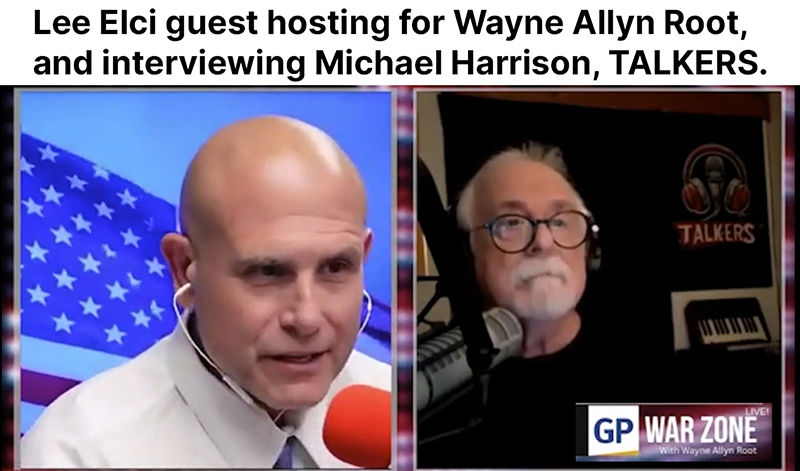
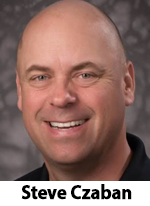 hour-long morning program with Josh Albrecht. The Milwaukee Journal-Sentinel reports the program will also air across Audacy’s Wisconsin Sports Radio Network in markets including Greeb Bay-Appleton, Wausau, Madison, and Duluth-Superior. Czaban previously hosted a morning program on iHeartMedia’s then-sports WRNW-FM “97.3 The Game” that iHeartMedia flipped to AC last fall.
 to KSDK-TV, St. Louis, Hoffman Media Group recently took majority ownership of Lee Enterprises, which owns the St. Louis Post-Dispatch. David Hoffman said in a statement to
 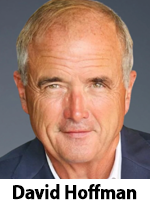 largest print and digital news organizations in the United States. With our planned acquisitions, combined with our existing portfolio of 154 newspapers and our expansion into radio, we expect to become the second-largest media company in the United States by year-end.” Audacy president and CEO Kelli Turner reportedly issued a memo to staff revealing the deal (in which the terms were not disclosed) and stated that Audacy will continue to own and operate the stations until the deal closes and that listeners, advertisers, partners and employees should expect “business as usual” during the approval process.
  November to co-host “The Morning Drive with Dan & Cole” alongside Dan Mathews, who continues to host mornings solo.