


TALKERS News Notes
Pew Study: Newsmax among Top U.S. News Brands.  The ratings competition for eyeballs and eardrums between multi-platform news content providers has grown increasingly fierce as burgeoning interest in politics – especially during this remarkably heated 2024 election cycle – has driven huge audiences to information venues seeking the latest data and ideological affirmation. The correlation between MSNBC’s notable ratings declines after the “Morning Joe” visit to Mar-a-Lago illustrated the sensitivity of branding and audience expectations within this volatile arena. So, what media outlets did Americans turn to for political news during the heated 2024 presidential election? Pew Research did some digging to find out and Newsmax has earned bragging rights for being among the top U.S. news brands for Americans seeking political news. The Pew survey for September of 2024 asked close to 10,000 Americans: “What news source do you turn to most often for political news?” The question was open ended — with Pew giving no possible responses as respondents gave their own answers. The Pew Study found Newsmax ranked among the top news outlets and networks and tied with media giants X (formerly Twitter) and YouTube — as respondents’ go-to source for citizens seeking political news. Newsmax even ranked ahead of the Associated Press and local news, and was just one percentage point behind NBC, CBS, MSNBC, and The New York Times. Major established news outlets FOX News, CNN, and ABC News led the pack. “Multiple studies continue to show Newsmax is a major news player, and we are continuing to rise,” Newsmax Inc. CEO Chris Ruddy tells TALKERS. “The credit belongs to our team here and our viewers who are tired of old media and want the quality journalism we’re providing.” The Pew study confirms a recent Reuters Institute study that found Newsmax was one of the top 12 U.S. news brands for Americans. The Reuters study found 8% of Americans — about 25 million Americans — turn to Newsmax on cable TV for their news at least weekly. Starting as a conservative website, Newsmax was launched as an entrepreneurial initiative in 1998 by then-independent journalist Ruddy and expanded to include a TV network in 2014 . Today, Newsmax estimates it reaches more than 40 million Americans through its television channels, online websites, and social media. The company has raised over $100 million for its Preferred Share Offering in its pre-IPO plan and expects to close soon.
Bloomberg Audio Renews Multi-Year Deal With Audacy.  Radio syndication firm, Key Networks and Bloomberg Audio, a leading provider of radio business news in the U.S., announce that Bloomberg Audio and Audacy have renewed their agreement to deliver Bloomberg Audio business and consumer news programming across the majority of Audacy’s 26 all-news and news talk stations. Audacy owns and operates many of the most influential news and news talk stations in America, including 92.3 FM and 1010 WINS in New York, News KNX-FM 97.1 and 1070 AM News Radio (KNX-AM/FM) in Los Angeles, WBBM Newsradio (WBBM-AM/WCFS-FM) in Chicago, and more.
  Bloomberg Audio has been Audacy’s primary business and consumer news provider for several years. Under the new multi-year agreement, Bloomberg Audio will continue to provide Audacy stations with access to its world-class radio news content, including live, customized reports, “Bloomberg Money Minutes,” and specialty features including: “Bloomberg Business of Sports,” “Bloomberg Business of Entertainment,” “Green Report,” “Small Business Report,” “Real Estate Report,” and more. “We’re thrilled to extend our partnership with Bloomberg Radio, a trusted leader in business news, to continue delivering top-tier, timely financial and consumer content to our listeners,” said Jeff Sottolano, chief programming officer, Audacy. “This collaboration strengthens our commitment to providing unparalleled business news coverage across our all-news and news talk stations, ensuring our audiences have access to the insights and information they need.”
Rumble Will Host the Uncensored Fourth Season of “Surviving Barstool.”  Rumble, the high-growth video platform and cloud services provider, announced that the much-anticipated fourth season of “Surviving Barstool” will move to Rumble, unedited and uncensored, beginning today (12/2). Rumble users and Barstool fans can subscribe to the Barstool Sports Rumble channel here and tune in to watch this season here. YouTube will only carry the censored version of “Surviving Barstool.” “Surviving Barstool” follows 24 of the biggest Barstool employees competing against each other for a $250,000 prize while trapped in the office. The final winner will be decided by the employees who were voted out along the way.
 Legendary journalist and all-around local media hero in Western Massachusetts, G. Michael Dobbs, is this week’s guest on the award-winning PodcastOne series, “The Michael Harrison Interview.” Harrison states, “Western Mass is a special place I’ve called home for the past 40 years. Although I have had several simultaneous homes in different parts of the country during this stretch of time, the Springfield, Massachusetts area has played a very important role in my life. And in this beautiful, ‘salt of the earth’ segment of America, my guest is well-known to just about all its civically, socially and politically active citizens. His half-century career has been a testimony to the power and importance of local media… which, as we all know, is rapidly becoming an endangered species.” After decades of service, the recently retired executive editor of Reminder Publishing, continues his multi-faceted career in mass communications. Harrison comments, “I’m not sure he understands the meaning of the word retirement.” In his no-frills-down-to-the-basics career, Dobbs has worked as a newspaper reporter and editor, freelance writer, radio talk show host, college instructor and was the editor of two nationally distributed magazines about animation. He has written seven books to date and continues to write as well as appear as a host for Focus Springfield cable television. Harrison adds, “He has covered hundreds of school board and city council meetings; conducted thousands of interviews with local leaders; knows just about everything involved in how local government operates; and is an expert on cigars, brandy, old films, cartoons, comics, and even strippers. He’s an amazing guy and a quintessential example of the tremendous importance of local, grassroots journalism in sustaining and preserving American freedom and democracy.” The conversation with Dobbs started out with Harrison appearing as a guest on the media practitioner’s local podcast titled, “The Ink-stained Wretch with G. Michael Dobbs.” But, according to Harrison, “The conversation went deep into some very meaty material, so I decided to dip into it and extract some content for my own podcast.” To listen to the podcast in its entirety, please
 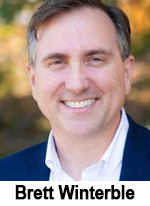 RNC Chair Michael Whatley Credits WBT Listeners with Delivering NC to Trump. WBT, Charlotte afternoon drive star Brett Winterble was joined by Republican National Committee chairman, Michael Whatley, yesterday (11/25) to talk about the GOP’s election victories. During the conversation in which Whatley discussed the election’s immediate impact on issues ranging from wars in the Middle East and Central Europe to immigration and the economy, Whatley credited Radio One’s WBT listeners with helping secure the victory for Donald Trump in North Carolina. Winterble is a rising star in the talk radio industry currently ranked at # 41 on the 2024 TALKERS “Heavy Hundred” list of the 100 Most Important Radio Talk Show Hosts in America. To listen to the conversation between Winterble and Whatley please
 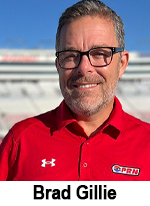 The Performance Racing Network (PRN) Taps Brad Gillie to Assume Role of Lead Anchor Alongside Mark Garrow beginning with the 2025 NASCAR season. Gillie will be replacing longtime lead anchor Doug Rice who has retired after a distinguished 36-year career left a void few could fill. “The obvious choice to succeed me is Brad Gillie,” Rice tells TALKERS. “He has been an integral part of our broadcast team for decades. He is an excellent broadcaster that our fans trust and are very familiar with, which I know will make this a smooth transition.” Gillie has spent more than two decades working in motorsports. His career started in 1998 at Texas Motor Speedway where he spent 16 years in a variety of positions. In 2006, Gillie began broadcasting live NASCAR events with PRN, where he could be heard in any broadcast position. “I am truly grateful to PRN and Speedway Motor Sports for the opportunity to continue building on a long legacy of exceptional broadcasts,” said Gillie. “It is an honor to move up to the anchor chair and, along with our great team, deliver the excitement of NASCAR to our listeners and affiliate stations. I also want to thank Doug Rice for his friendship and mentorship. His values and commitment to excellence have made PRN an elite network recognized throughout the motorsports and radio industries.”
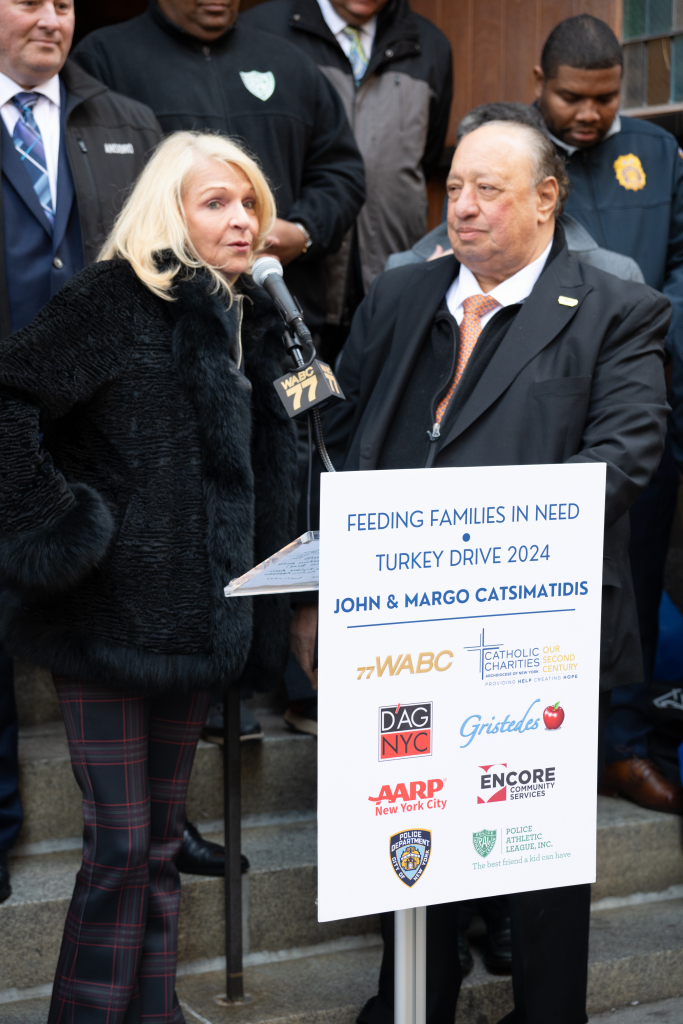 FOLLOW UP TO YESTERDAY’S STORY: 77WABC, New York Partners with AARP NY, Gristedes and D’Agostinos Supermarkets, and Catholic Charities for Annual 10,000-Turkey Giveaway During Holiday Season. WABC Radio continues its self-stated “commitment to the community” with its annual 10,000-Turkey Giveaway, in collaboration with AARP New York, Gristedes and D’Agostinos Supermarkets, and Catholic Charities of the Archdiocese of New York. The first 5,000 turkeys will be handed out before Thanksgiving, and the remaining 5,000 will be distributed before Christmas and the Holiday Season. The annual Turkey Giveaway kicked off at 10:00 am yesterday morning (11/25) when turkeys were handed out by John and Margo Catsimatidis, Curtis Sliwa, Sid Rosenberg, and other WABC Radio and New York celebrities from the 77WABC Trolley at St. Malachy’s Roman Catholic Church on W. 49th St. in New York City. “WABC Radio is an emergency broadcast station, a responsibility that extends to helping people in the greater New York City community year-round,” said John Catsimatidis, owner of Red Apple Media, 77WABC, and Gristedes and D’Agostinos Supermarkets. “Working with AARP New York and The Catholic Charities of the Archdiocese of New York, we are bringing much-needed help, and hopefully joy, to those in our community who are in need and deserve happiness and a good meal for the Holiday Season.” Pictured above, John and Margo Catsimatidis participating in the holiday initiative.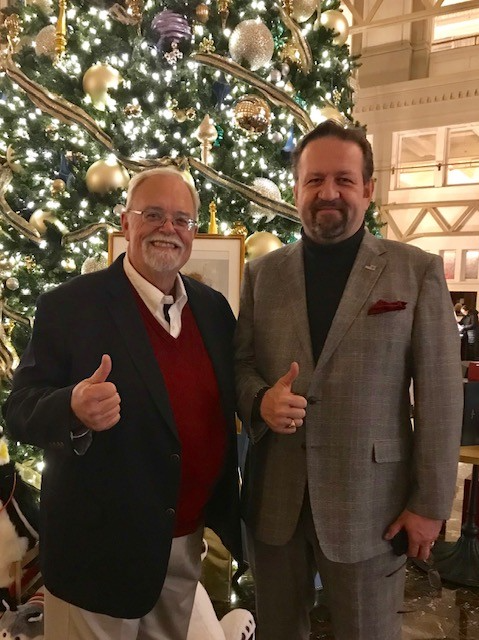
 By Andy Gladding, Ed.D.
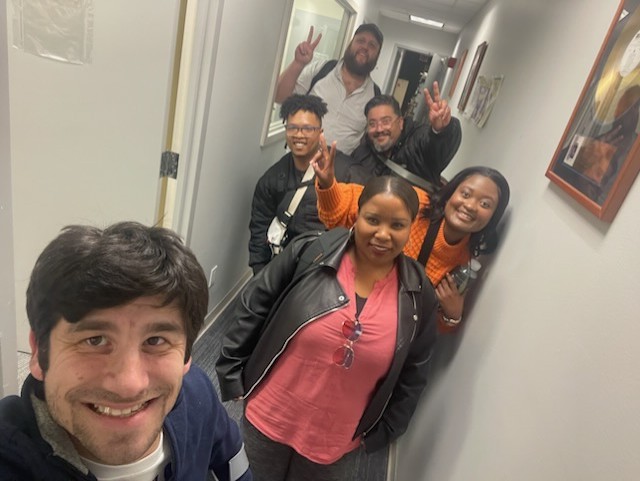 Bush Radio journalists Jasnine Roberts, Lydia Marwanqana, Renato Van Schalkwyk, and Adrian Louw tour the Salem Radio New York facilities with chief engineer Andy Gladding (pictured in rear) and assistant production manager Alex Garrett (pictured in front).
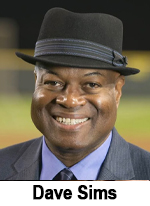 Audacy’s WFAN 101.9 FM / 660 AM announces Emmy Award-winning broadcaster Dave Sims as the new lead play-by-play announcer of its flagship broadcasts of the New York Yankees. Sims replaces recently retired broadcasting legend John Sterling, who held the position from 1989 until his retirement this past season. Dave Sims will join Suzyn Waldman to form the franchise’s new radio broadcast team. “The radio voice of the Yankees is a storied position in the history of baseball,” said Chris Oliviero, Audacy New York Market president. “From [Mel] Allen and [Red] Barber to [Phil] Rizzuto to Sterling, the names are synonymous with the pinstripes. Dave Sims is a worthy successor to that lineage. We are honored to have Dave join the incomparable Suzyn Waldman in the booth in the Bronx.” “It’s great to be home,” said Sims. “What an honor to be part of the iconic Yankees franchise. New York is where it all started for me, and I can’t wait for Opening Day and to work with my good friend Suzyn!” Sims is a Ford Frick Award Baseball Hall of Fame nominee and Emmy Award-winning broadcaster and has spent the last 18 seasons as the lead TV play-by-play voice of MLB’s Seattle Mariners. Sims previously hosted talk shows at WNBC-AM, WFAN-AM and the Madison Square Garden Television Network in New York and also spent time at WCBS-TV and the New York Daily News. Beyond baseball, Sims has covered the NFL for Westwood One and college basketball for ESPN. He also launched the “Hey Now! Podcast” with his two sons in July 2024. WFAN has served as the flagship station of the Yankees since 2014. From 2002 to 2014, games were heard on Audacy’s WCBS 880 (WCBS-AM). Games can be heard on WFAN and streamed via the free Audacy app and website within the team’s geographic region.
 been serving the company as market president for the Salisbury, Maryland operations. iHeartMedia Mid-Atlantic Area president Brit Goldstein says, “Katie has done incredible work in Salisbury, consistently demonstrating exceptional leadership and creativity. By adding the Wilmington market to her purview, she will bring her outstanding approach to partnership and innovative solutions to the entire Delmarva Peninsula. I’m excited to see Katie and the team flourish in her expanded leadership role.”
 The Broadcasters Foundation of America has launched its annual Year-End Giving Campaign, which seeks to raise donations from tax-deductible personal contributions to the Guardian Fund and corporate contributions to the Angel Initiative. The Broadcasters Foundation, a 501c3 charity, is the only charity devoted exclusively to helping colleagues who are in dire need of monthly or emergency financial assistance due to life-altering illness or a disaster. “We are devoted exclusively to providing aid to colleagues in broadcasting who are suffering from extreme illness, or hardship from a devastating disaster,” stated Tim McCarthy, president of the Broadcasters Foundation. “We also take care of colleagues who have retired. Grants are supported solely by contributions from individuals and companies within our industry and offer a ‘hand-up’ to our colleagues during trying times. We’re asking everyone in broadcasting to please consider including the Broadcasters Foundation in your 2024 charitable giving.” Over the past 20 years, the Broadcasters Foundation has distributed over $15 million in aid to colleagues nationwide, across all states and territories, who need it most. “Requests for aid continue to grow exponentially as more of our peers and their families are affected by severe illness or disasters, such as the recent flurry of destructive hurricanes,” explained Scott Herman, chairman of the Broadcasters Foundation. “Whether it’s a monthly grant or one-time aid in response to an emergency, the Broadcasters Foundation is often a refuge and beacon of hope for colleagues whose lives have been upended by unforeseen and tragic circumstances. Please consider a donation. Donations go directly to helping our colleagues who are in desperate need.” For more information about the Broadcasters Foundation, including how to apply for aid or make a donation, visit
 Toucher, who now co-hosts “Toucher & Hardy“ on 98.5 The Sports Hub, WBZ-FM, Boston took some time on this morning’s show (11/5) to address ”the elephant in the room.” Shertenlieb‘s new show on local classic rock outlet WZLX had been canceled after five months, and Toucher didn’t seem to have any sympathy for his former partner. In a story by reporter Nick O’ Malley posted on the news site MassLive.com, “I hate him,” Toucher said. “So, I was happy yesterday when I heard about this. But I was a little disheartened that he still carries none of the responsibility and takes none of the blame and still just can’t be honest.” Toucher and Shertenlieb co-hosted the “Toucher & Rich” show from 2009-2023, working together to produce one of Boston’s most popular morning shows. However, the show ran into issues in 2023. Toucher missed time due to personal and physical issues, including a stretch of time at an alcohol detox facility. In November, parent company Beasley Media said in a statement that Shertenlieb declined to accept a new contract. On Monday, Shertenlieb announced that he was “disappointed” that his show was being canceled after just five months. The radio host complained that management forced him to “alter the format” of the show by adding music. However, Toucher noted Tuesday that Shertenlieb’s show was a “ratings disaster.” “He not only did not bring in a new audience to that show, he alienated – based on ratings – their entire existing audience,” Toucher said. “He had like a third of the ratings that they got jockless in the morning … Yeah, management might have been a little concerned.” Toucher said that critics can paint the picture of his reaction however they like. But he did note that he and co-host Jon Wallach say they weren’t alone in celebrating the demise of Shertenlieb’s show. To see the complete article in MassLive.com, please
  As media creators in radio and podcasting explore ways to legally incorporate external audio, the fair use factor of “purpose and character” is crucial. This factor assesses whether the use is “transformative”—adding new expression or meaning—or merely reproduces the original’s essence, potentially infringing on copyright.
 WURD Radio Endorses Kamala Harris for President. For the first time in its 20+ year history, Philadelphia’s only Black-owned radio station, WURD Radio has endorsed a political candidate — Kamala Harris for President of the United States. Prompted in part by the decision from owners of the Los Angeles Times and The Washington Post to overrule planned endorsements by their editorial boards, sources at the station tell TALKERS, this decision underscores the importance of independent media ownership. From the endorsement: “Our founder, Walter P. Lomax Jr., M.D., understood that the media has the power to shape perceptions, images, narratives and, most importantly in this election, to tell the truth. He understood that the media can demonize or humanize, destroy or exalt, diminish or elevate. Dr. Lomax knew that mainstream media often marginalizes, caricatures and maligns Black people. WURD is in a unique position to speak honestly and emphatically about what matters most to our community because we are independently owned.” To read the entire text of the endorsement, please
  SiriusXM Tips Off College Basketball Coverage with 74 Games on Opening Night, November 4. SiriusXM will deliver college basketball fans an extensive schedule of live games throughout the 2023-24 college basketball season, starting with a slate of 74 women’s and men’s matchups to choose from when the season tips off this Monday (11/4). The men’s schedule includes all 19 teams from the Associated Press Top 25 that are in action on Monday night, including the season’s first matchup of Top 25 ranked teams – #8 Baylor @ #6 Gonzaga (11:30 pm ET). The opening day schedule of women’s games on SiriusXM includes 12 teams from the Associated Press Top 25 and features a couple of Top 25 matchups – #20 Ole Miss @ #3 USC (noon ET) and #5 UCLA @ #17 Louisville (2:30 pm ET). Throughout the season SiriusXM listeners will get access to dozens of game broadcasts each week involving teams from the SEC, Big Ten, Big 12, ACC, Pac-12, Big East and more.
 Newsmax Launches in France on Molotov. Newsmax TV, one of America’s most popular news channels, just launched on Molotov, one of France’s leading TV platforms, as U.S. voters go to the polls to pick their next president. The Newsmax channel went live on Molotov’s platform on October 24, 2024, expanding its global footprint with 19 million Molotov users in France and French-speaking territories. Molotov is one of France’s main TV services offering streaming television to internet users across the nation and its territories. Molotov subscribers can tune to Newsmax via the platform’s free tier.


 Andrea Mitchell to Receive Prestigious Award. Alliance for Women in Media (AWM) has announced that Andrea Mitchell, NBC News chief foreign affairs correspondent and chief Washington correspondent, will be honored with the prestigious Gracies Icon Award at the 2024
 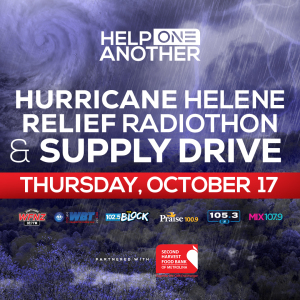 Radio One Charlotte, in partnership with Second Harvest Food Bank of Metrolina, is presenting an all-day radiothon today (10/17) to support those affected by Hurricane Helene. This event is taking place from 6:00 am to 7:00 pm across Radio One Charlotte stations: WOSF, WFNZ, WLNK, WPZS, WOSF-HD2 and heritage news/talk WBT. Marsha Landess, Radio One Charlotte regional VP, tells TALKERS, “We are focusing the power of our six radio stations to help raise funds for the relief efforts for our neighbors in the western part of our state. We know their lives have been turned upside down, and we want to do our part to assist them in rebuilding and recovering. Our goal is to raise a substantial amount to help them begin to put their lives back together. Every dollar counts, whether large or small.” Kay Carter, CEO of Second Harvest Food Bank of Metrolina, adds, “Everyone at Second Harvest Food Bank of Metrolina is so grateful to Radio One for all their efforts to assist us as we work to help the many victims of Hurricane Helene. The needs are great, and we want to thank all the radio stations and their listeners for considering a donation to the Radiothon. We promise to use the donations wisely to provide food and other supplies throughout the affected areas.”
 Even as its stations were airing hundreds of hours of continuous live news and storm coverage during hurricanes Helene and Milton, Cox Media Group (CMG) was raising nearly $1 million and providing food, water and necessities for impacted people and communities. That includes taking mobile charging stations into communities for people to charge their phones and other devices. Hurricane relief efforts took place across CMG’s southeast TV and Radio stations. “These efforts by our CMG family highlight the indispensable role of our stations – and our entire broadcasting industry – as we work together to make a powerful and positive impact on the communities we live in and serve,” said Dan York, CMG’s president/CEO. “As importantly, none of this would have been possible without the incredible support from our local partners and audiences. The response of our viewers and listeners has been nothing short of remarkable.” CMG radio stations include news/talker WDBO 107.3 / AM 580 in Orlando.
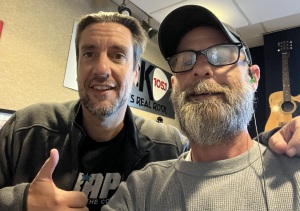 Premiere Networks personality Clay Travis co-hosted “The Clay Travis and Buck Sexton Show” live from affiliate News Radio 570 WWNC in Asheville, NC (10/11). Travis toured the area via helicopter to witness the extensive damage from Hurricane Helene in an effort to continue raising awareness, funds and volunteers for hurricane relief that will be needed for months to come. During the visit, WWNC morning host/news director Mark Starling joined the broadcast for a powerful conversation about the devastation the community has experienced. He detailed how the station covered Hurricane Helene, providing vital information to the Asheville community including coordinating rescue efforts and reuniting families. Starling, who stayed at the station for 14 days straight during the hurricane, said: “…when TV couldn’t do it, the newspaper couldn’t do it, there was nothing online, the only thing left was AM/FM radio. All seven stations stayed on the air simulcasted… we were wall-to-wall…what we wanted to do here at the radio station, at iHeart Asheville, was we wanted to show the community that we can get through this. And we’ve been kind of repeating this line: ‘community is the answer to this crisis.’ …what we have seen is the absolute best in humanity in an absolute horrific, horrific time.” Listen to their full conversation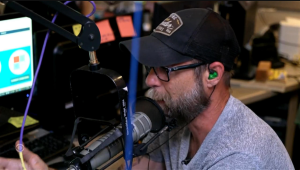
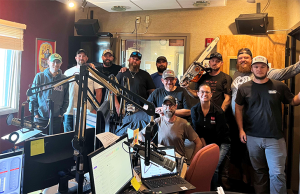
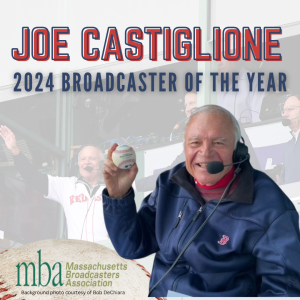 Castiglione, who announced his retirement prior to the conclusion of the 2024 Red Sox season spent 42 seasons in the Red Sox booth, making him the longest tenured radio broadcaster in Red Sox history. A native of Hamden, CT, he began his career calling Colgate University football and baseball games while earning a B.A. from the university. He would later graduate from Syracuse University’s prestigious Newhouse School with a master’s degree in Radio and Television. Castiglione’s Red Sox legacy started in 1983 when he was paired with another Red Sox legend in Ken Coleman. In his 40+ years with the Red Sox, Castiglione was the voice for millions during the lowest lows and highest highs of the franchise. He’s maybe most famous for his call at the end of the 2004 World Series which ended an 86-year World Series drought for the Sox, exclaiming “for the first time in 86 years, the Red Sox have won baseball’s world championship. Can you believe it?” The phrase would become a signature call. Joe Castiglione was inducted into the Red Sox Hall of Fame in 2014, the Massachusetts Broadcasters Hall of Fame in 2015, and was named the Baseball Hall of Fame’s Ford C. Frick Award winner, presented annually by the Hall of Fame for excellence in broadcasting, in 2024.
 WOR, New York morning co-host Michael Riedel returned to the airwaves yesterday morning (10/1) after a camping trip to North Carolina that turned into a rather harrowing experience due to Hurricane Helene.
 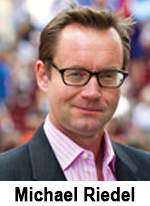 Riedel arrived in North Carolina last Tuesday and learned from his group’s guide that the forecast was rain for the entire duration of their trip. At that point, no one connected the rain with the hurricane, however. When their time on the mountain first began, Michael and his fellow hikers may have thought their near run-in with a bear was going to be the craziest part of their trip, but after two days of near-steady rain, Riedel’s group’s guide made the decision to end the hike and come down the mountain to seek safety. “The guide said if we don’t get down to the road…the river is going to flood and we will be trapped,” Riedel told his co-host Len Berman and morning news anchor Larry Mendte. “[But] all of the little streams and the creeks that we crossed on the way up…were now raging torrents of water, and we had to find places to cross. And when we crossed the streams, we all had to, like, hold on to each other to form a chain so that the water wouldn’t wash us away…and we had to do that three times.” Even though they were without electricity, internet, or phone service and had virtually no food and were down to just four bottles of water to share among 10 group members, Riedel and his group found a bed and breakfast in downtown Asheville that despite calls for evacuation was willing to take them in. “You know, I have to say I was very lucky,” Riedel reflected. “There was a woman who worked [there who] took water from the Creek behind the B&B and… made vegetable soup [using vegetables from their garden]…to feed us.” Ultimately, after three days of being stranded, Riedel was able to share a ride to the airport with another guest at the bed and breakfast and landed back at LaGuardia airport Monday evening (9/30). Talk about home sweet home. To hear more about Riedel’s adventure,