

“Ladies and Gentlemen… THE BEATLES!”
On a February night in 1964, a veteran TV host and four young musicians from England changed music, broadcasting, popular culture… they changed everything.
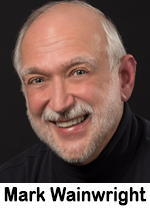
By Mark Wainwright
 In early December 1963, America was a very gloomy place. The assassination of President John F. Kennedy on November 22 brought the country to a virtual standstill for four days, and the emotional and psychological hangover lingered for weeks. The nation needed a dose of uplifting energy and fun, and the Beatles were the ideal remedy.
The Beatles were hardly newcomers. They had already been a successful act in the UK and mainland Europe (especially in Germany) for several years; oddly, they never got much traction in the United States. They had released a handful of songs in the US on smaller, independent record labels as far back as 1962, but they received little attention.
“She Loves You,” one of their early signature songs, was a failure when it was first released here in 1963. Dick Clark tried to feature it on “American Bandstand,” but the young dancers on his show didn’t know what to make of it and rated it poorly. But as the year went on, their popularity in England dramatically turned into a phenomenon that featured wildly enthusiastic crowds of screaming teenage girls. No one seems to be able to pinpoint what the catalyst was, but their already established popularity quickly grew into what became known as “Beatlemania.”
The Beatles first appeared on American TV on network news broadcasts. NBC’s “Huntley-Brinkley Report” aired a segment about the Beatles and Beatlemania in England on November 18,1963. Edwin Newman was the correspondent, and he and his colleagues were rather dismissive of the group, their music, and their young fans. Meanwhile, over at CBS, Walter Cronkite’s take was more generous. Their reporter in London, Alexander Kendrick, was pretty condescending as well, but Cronkite liked the segment when he saw it on the “CBS Morning News” on November 22 and planned to run it on his evening newscast. Sadly, what happened in Dallas hours later preempted everything.
A few weeks later, Cronkite thought his viewers could use a lift from the gloom that had descended upon the country, and he thought that segment would be a nice diversion. He ran it on his newscast on December 10, and that story really got the nation’s attention.
Young America was soon clamoring for everything Beatles. Radio stations dug up the records that hadn’t been successful and started playing them constantly. Beatles paraphernalia was heavily marketed and sold well. Capitol Records released “I Want to Hold Your Hand” in the United States on December 26 — the boys finally had a deal with a major record company in the US — and by New Year’s Eve, it was already a hit. It was the first of six Beatles’ songs that reached #1 on the Billboard “Hot 100” chart in 1964.
Meanwhile, Ed Sullivan was the host/master of ceremonies of a long-running CBS variety show that dominated the Sunday night ratings for years. Unlike most of his contemporaries, he was happy to present many of the early stars of rock-and-roll; Elvis Presley, Buddy Holly, and Jackie Wilson were among the pioneering artists of the new music genre who got their first major television exposure on Sullivan’s program.
Sullivan heard about the Beatles, saw them receive a tumultuous reception at Heathrow Airport in London, saw the CBS news segment, and was determined to present them on his show. Whatever he thought of their music, he respected talent and knew a hot act when he saw one.
A deal was quickly arranged between Sullivan and Brian Epstein, the Beatles’ long-time manager. Sullivan would bring them to the United States for three consecutive Sunday night shows. The February 16 performance would be broadcast live from the Deauville Hotel in Miami Beach, the third appearance on February 23 would be taped in advance. But the first of the three, a live performance on the Ed Sullivan Show February 9, was the one most anticipated. The two New York shows would be presented at the studio venue now known as the “Ed Sullivan Theater.”
When word got out, the demand for tickets was insane. CBS received more than 50,000 ticket requests (the tickets were free) for a studio theater that held 728. Getting one of the tickets was largely a matter of luck. Numerous notables and VIPs called upon favors owed and contacts at CBS to get tickets for their daughters (or granddaughters). Only a few succeeded.
When the Beatles arrived in New York on a Pan Am 707, they were greeted by a near-hysterical crowd of teenage girls (this had become a routine occurrence). They needed a police escort to get into Manhattan, and they needed a phalanx of New York cops to get them in and out of their hotel. All of this, of course, was breathlessly reported in the news media.
They arrived at the theater on Saturday, February 8, for a lighting and sound check and a brief rehearsal. George Harrison was recovering from a throat infection and was still tired and feverish, so he stayed at the hotel to rest, while a member of their entourage and a CBS production assistant took turns as stand-ins for George.
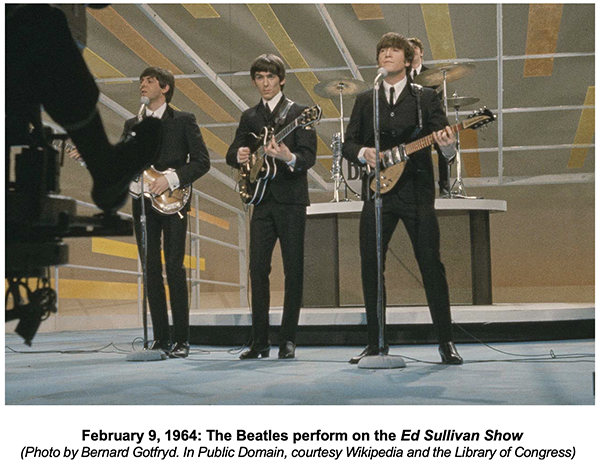
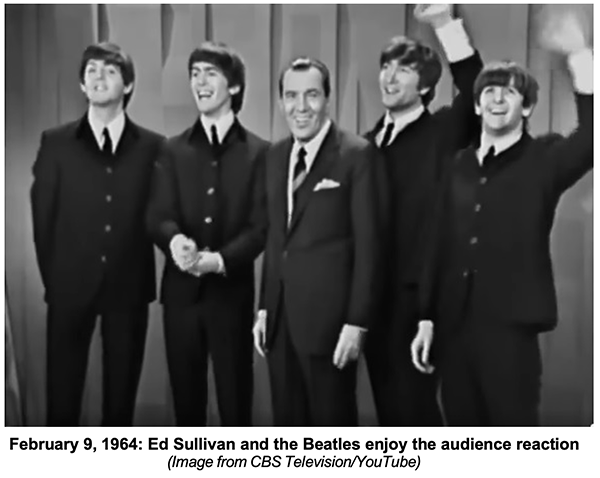
The following evening, at 8:00 pm Eastern Time, the “Ed Sullivan Show” went on the air, and shortly after the opening credits, Sullivan came on stage and offered a few brief remarks about the Beatles and their spectacular overnight success (“overnight” at least as far as Americans were concerned). Then… “Ladies and Gentlemen… THE BEATLES!” The theater erupted.
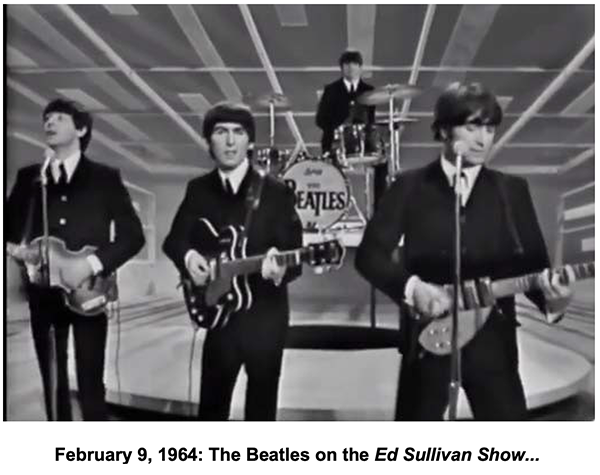
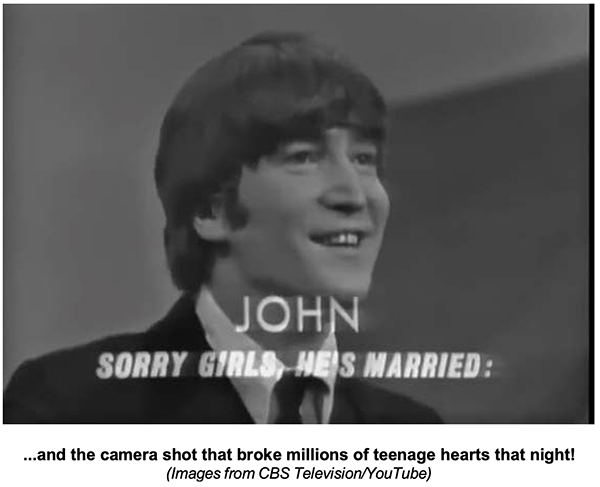
This moment led to one of the enduring music/broadcasting history trivia questions: What was the first song the Beatles performed live on their first “Ed Sullivan Show” appearance? No, it wasn’t “She Loves You” or “I Want to Hold Your Hand” (although they did those later in the show). Hint: while it was one of their most popular early songs, it was never officially released as a single. Okay, it was “All My Loving,” track #6 on side one of their iconic Meet the Beatles! album.
The ratings for the show were unprecedented. More than 73 million viewers – 39% of the country’s population – saw the performance. The broadcast drew a 60 share, which meant that 60% of American TV households were tuned in. Ed Sullivan always had pretty good ratings, but this was more than triple the size of his usual audience.
The Beatles were far from finishing their first American visit. Brian Epstein had managed to squeeze a couple of concert appearances into their tight schedule. One of those took place in Washington, DC two nights later, at the old Washington Coliseum. The old barn had seen some big events in its history, but nothing like this. The folks who owned and managed the building had barely heard of the group, but a concert promoter in the region convinced them to book a show. There was minimal promotion and advertising, but it wasn’t necessary. The tickets sold out in only a few hours.
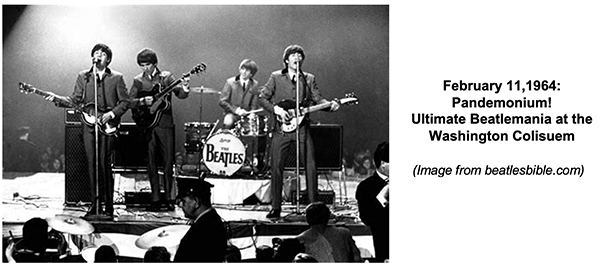
It turned out to be one of the most intense and intimidating concert environments ever seen, and is still regarded as such. The Beatles performed one of their few (maybe their only?) concerts “in the round,” on a small stage at the center of the arena, placed where the boxing ring would normally be situated. The building was packed with 8,092 ticket holders, most of them (as usual) screaming teenagers, with the front rows only a few feet from the stage. Imagine the frenzy in Ed Sullivan’s studio theater, now multiplied by a factor of ten. Fortunately, nothing really serious occurred, and the band handled the situation flawlessly, even making adjustments on the fly to handle audio and microphone issues…although it’s hard to believe they could even hear themselves amidst the screaming. They returned to New York to perform at Carnegie Hall the following day, then flew to Florida to spend a few days before returning to England. They returned for a North American concert tour in late summer. That tour was much better organized and promoted, although Beatlemania had not subsided at all, and the receptions they received were just as frenzied as their earlier appearances.
Typically, in an article like this, you would see links to various sources on the web. It would be superfluous here. There are countless sources of audio, video, photographs, and text of all these events and many others relating to that weekend in 1964. They are easily accessed on YouTube and other online locations. You can use one of the popular search engines or simply type a few key words into the YouTube search bar. All sorts of material will pop up; you’ll never run out of stuff to enjoy. If you are looking for maximum available audio and video quality, there are many downloads and DVD’s available from Amazon and other merchants.
The Beatles’ first weekend in America – particularly that first appearance on the “Ed Sullivan Show” – is widely regarded as a sort of cultural watershed that ignited Beatlemania here and opened America to other performers of the “British Invasion” era… artists like the Rolling Stones, the Dave Clark Five, Dusty Springfield, and many others. Many sociologists and cultural historians have opined that the Beatles coming to the United States was (at least in a pop culture sense) the beginning of the era that we now commonly view as “The Sixties.” Indeed, a veteran television host and four young musicians from the UK changed everything that night.
EPILOGUE
If their first “Ed Sullivan Show” performance was the “penthouse suite” of their first visit to America, the foundations of that structure were the countless radio stations around the United States that highlighted the band and played their music incessantly. There are endless stories about the big AM Top-40 stations of that era, their star disc jockeys, and their various encounters with the Beatles, both on and off the air.
I was a youngster in Baltimore at that time, and I was already hooked on radio and everything about it. I was a big fan of AM Top-40 powerhouse WCAO. The “Big 60” was the radio station for young Baltimore in that era, and their on-air staff were all celebrities in the community. Noted radio entrepreneur Kerby Confer was a WCAO disc jockey then, using the name “Kerby Scott” on the air.
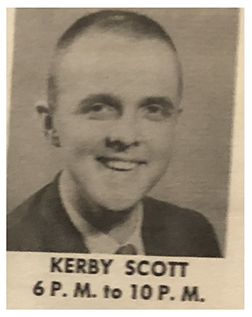 1964 WCAO Promotional Material: “Kerby Scott photo
(Photo courtesy Kerby Confer)
I recently spoke with Kerby Confer (almost two hours on the phone!) and reminisced about that era and WCAO’s role in it. When the Beatles took the train from New York to their gig in Washington, one of Kerby’s colleagues, veteran WCAO newsman Frank Luber, managed to board the train when it stopped at Pennsylvania Station in Baltimore and recorded an interview with the Beatles. The tape was brought back to the station and aired.
If WCAO was already immersed in Beatlemania, that episode had the station and its staff absolutely swimming in it. Kerby Confer told me that moment influenced his life and his career in ways he didn’t fully appreciate at the time. He said he was just another guy doing pretty well on the air in Baltimore, but that moment led to him becoming Baltimore’s “Fifth Beatle.” Wait, what? Baltimore’s “Fifth Beatle?”How did that come about?
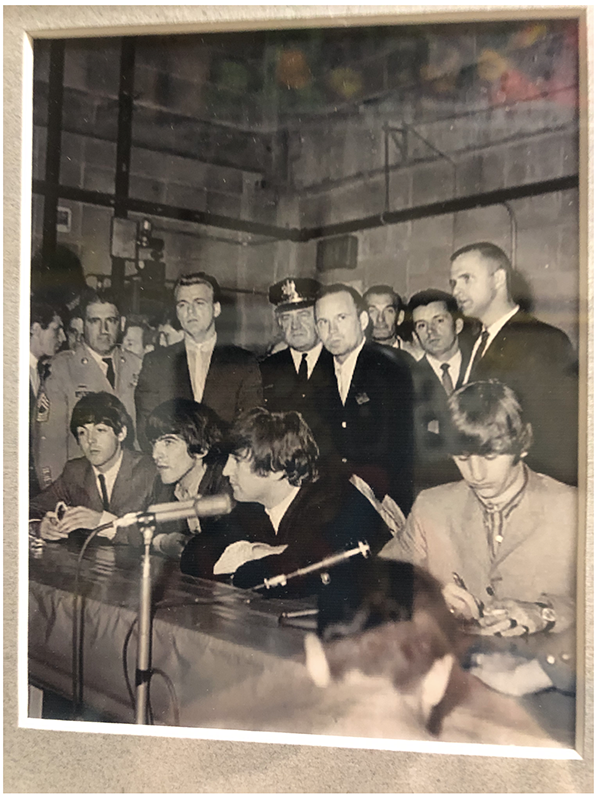
September, 1964: The Beatles and Baltimore media. “Kerby Scott” Confer is at the far right, directly behind Ringo (Photo courtesy Kerby Confer)
As it turned out, Kerby Scott soon became the host of WCAO’s “Liverpool Hour,” an evening program in conjunction with his regular on-air work at the station. The program featured the music of the Beatles and the many other artists who came out of the UK at that time.
Kerby usually wore his hair short in a buzz cut, but Paul Rodgers – his lifelong friend, WCAO colleague, and business partner later – convinced him to grow his hair out enough to solidify the “Fifth Beatle” persona. Kerby eventually sported a very restrained Beatles-style haircut to complete the image (I don’t think he kept the haircut for very long). He was an obvious choice to emcee one of the Beatles’ shows when they performed at the Baltimore Civic Center in September of 1964, and he later hosted “The Kerby Scott Show” on WBAL-TV; it was a dance party program, Baltimore’s version of Dick Clark’s show “American Bandstand,” and I believe it was eventually syndicated elsewhere. Before long, Kerby Confer moved over to the business side of radio in management and ownership. He was very successful in that endeavor, and still owns and operates many radio stations today.
So, Kerby Scott Confer and Mark Wainwright were just two more young radio guys whose lives and careers were influenced by that first Beatles weekend in the United States. It bears repeating: a veteran television host and four young musicians from England changed everything on the night of February 9,1964.
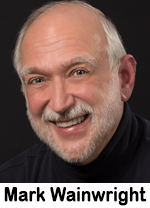
Mark Wainwright is a long-time radio personality, talk show host, and voiceover performer who has worked on the air at numerous respected radio stations around the United States. He was most recentlythe morning host at WSYR in Syracuse, New York. A Baltimore native, Mark currently resides inSaratoga County, New York. He can be reached at: markwainwright@earthlink.net
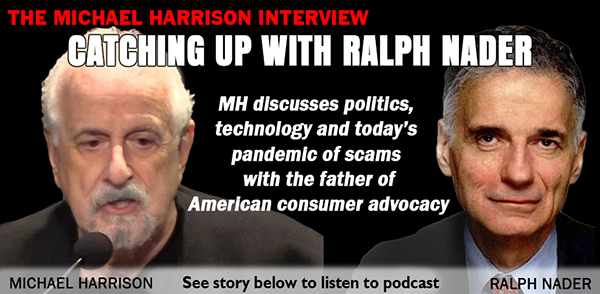
 other members of our unit. First and foremost, we denounce layoffs in their entirety; we believe this form of ‘cost cutting’ is fundamentally avoidable, and we don’t think innocent, hardworking staff should ever lose their livelihoods over mismanagement at the highest levels of a company. As previously reported, our parent company, Audacy, filed for bankruptcy at the beginning of this year after racking up $1.9 billion in debt. This same company also gave out at least $3.2 million in executive bonuses just months prior… Today, our union began the bargaining process where we will be fighting for the severance that our colleagues deserve — compensation that honors the immense time, skill, and creativity that each of them dedicated to the company over the years.”
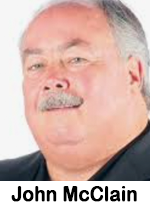 talk KILT-AM “SportsRadio 610.” McClain’s role with the station included appearing on the station’s programs, writing stories for its website and co-hosting a podcast with station personality Sean Pendergast. The 72-year-old McClain tells the Chronicle that he’s not ready to leave the Houston radio market, adding, “I’ll see if people are interested. I’m a free agent now.”
 network across both total day and primetime with total viewers and the 25-54 demographic. FNC continued its ratings dominance for the month of January and grew its primetime audience in total viewers versus January 2023. Additionally, FNC was the only cable news network to show year-over-year growth in the younger 18-34 demo, growing 18% in total day and 25% in primetime, while MSNBC and CNN are experiencing double-digit declines.” FOX News Media CEO Suzanne Scott comments, “Marking another historic feat is a true reflection of the unwavering dedication and outstanding talent that we have throughout the entire organization of FOX News Channel.”
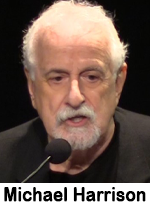
 During his CBS career, he appeared on every CBS News program including “CBS Morning News,” the “CBS Evening News with Dan Rather” and the “CBS Sunday Night News.” For almost 46 years he produced his nationally syndicated radio feature, “The Osgood File,” from which he signed off with his signature phrase, “I’ll see you on the radio.” As Osgood was preparing to retire from “CBS Morning News” in 2016, he was a guest on TALKERS magazine founder Michael Harrison’s podcast.
 Despite his seemingly nonchalant, bad boy on-air persona, David Letterman is exceptionally respectful of broadcasting and its history.
 Scott will lead a discussion with analysts, financial planning experts, real estate specialists, and college planners. He adds, “So many New Jersey residents fear they will never be able to afford to retire. This program will help New Jersey residents make smart decisions and ask the right questions as they plan for their future.” The station will broadcast online streamed live available for embedding at facebook.com/nj1015/live as well as via nj1015.com, the New Jersey 101.5 YouTube channel, or the New Jersey 101.5 app.
 Sears used to sell everything. Tractors, tires, insurance, investments, chickens. In 2004, Sears was the dominant retailer in America. By the end of the decade, it was feverishly closing stores and dying.
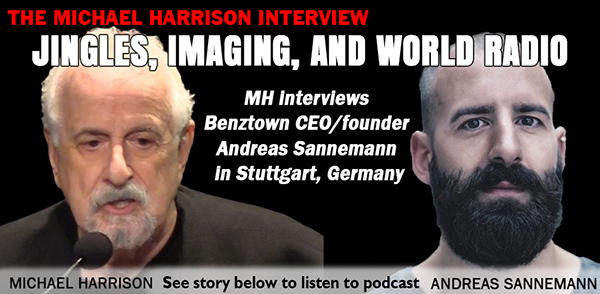
 The United Nations and its specialized agency, the United Nations Educational, Scientific and Cultural Organization (UNESCO) have given the radio industry all around the globe an invaluable gift. It’s called “World Radio Day 2024.” Now in its 13th installment, WRD takes place annually on February 13 with the purpose of spotlighting the accomplishments, importance, and ongoing relevance of the radio medium as it evolves deeper into the 21st century. This year’s theme is “Radio: A Century Informing, Educating and Entertaining.” By officially designating the platform as worthy of its own officially sanctioned UN International Day, the august world body has recognized, spotlighted, and endorsed radio’s continuing relevance and potential for being a vital force for the betterment of humanity.
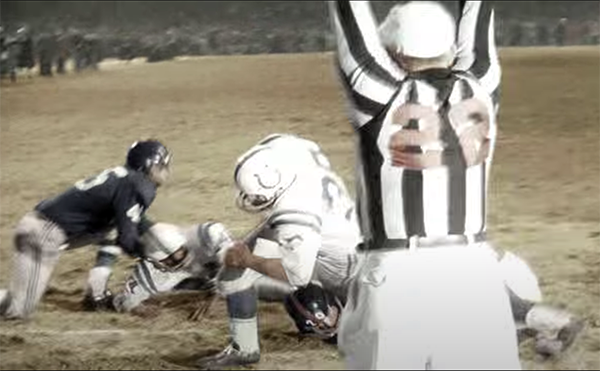
 It was one of those indelible moments in sports history: The 1958 NFL Championship, played on December 28, 1958 at Yankee Stadium in New York. The Baltimore Colts defeated the New York Giants 23-17 in sudden death overtime. 65 years later, the events of that Sunday afternoon still resonate throughout pro sports and sports media.
 sales. Castor served with then-Entercom Wichita in 2005. Most recently he served as VP of sales and marketing for the ECHL’s Wichita Thunder. Audacy Wichita SVP and market manager Becky Domyan states, “Tommy has an incredible knowledge of the digital space that will help take our revenue to the next level. He has an energy and enthusiasm that is contagious.” Castor who succeeds the recently retired Lisa Crider, also serves as co-host of the “Sports Daily” program on KFH, Wichita.
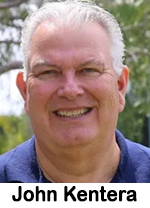 told by Audacy management he’s being let go as the company is looking for a change in middays and wants a “less caller-driven show.” Kentera adds, “I prepare like crazy, I think my show is good, well-received, so I was stunned when I was told I was being fired.” The 65-year-old Kentera has been in radio for 40 years, the last four with KWFN-FM and says he does not plan to retire. “I’m going to look for an opportunity in sports… in or out of the radio business. I’m not done yet.”
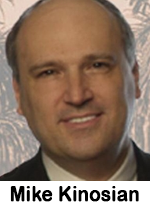 As TALKERS magazine reported yesterday, rock radio personality Jim Ladd died over the weekend at age 75 after suffering a heart attack. In remembering Ladd and his contributions to the radio industry, TALKERS magazine managing editor Mike Kinosian presents a profile piece on Ladd that he wrote years ago while serving as special features editor for Inside Radio.
 Services, Division of Family & Children Services, The Society of St. Vincent de Paul Georgia, and Walmart, has undertaken the mission of ensuring that every child in the Georgia foster care system has at least one gift on Christmas day. This year the program raised over $1,440,000 which will provide over 24,400 gifts to children in Georgia. 95.5 WSB program director Ken Charles says, “The 95.5 WSB audience is just amazing! For the 33rd year they’ve shown up with an incredible spirit of generosity to make sure the kids have a very merry Christmas. Our entire team supports Clark’s mission to make sure every foster child has at least one toy for Christmas and I’m so thankful our listeners come through every year!”
 How many times will we research the same subject and come to the same conclusion?
 WHAT WOULD YOU DO? A very good major market DJ murders his wife and injures her lover upon catching them in the marital bed. An 11-year-old girl was in the house – a witness. The murderer is convicted (second-degree murder/“situational crime”) sent to prison, does his time and is released after a few years for good behavior while incarcerated.