


International Radio Exchange Program Offers New Perspectives on Media and Democracy
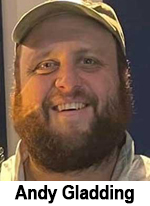 By Andy Gladding, Ed.D.
WMCA 570 / WNYM 970 Radio, NY
WRHU 88.7 FM, Hofstra University
Chief Engineer
Following the 2024 election cycle, there has been a flurry of conversation and speculation over the diminishing role linear media played in deciding the outcome of high-profile national races. With both the Trump and Harris teams choosing to heavily engage with social media influencers, digital media outlets and podcasters, campaign operatives have demonstrated that they are willing to shift their political ad spending into newer forms of broadcast messaging. This has called into question just how much influence and effectiveness legacy media has over audiences in the current media market.
However, not every country shares this perception. In 2020, WRHU Radio Hofstra University in New York formed an alliance with 89.5FM Bush Radio in Cape Town, South Africa. Bush Radio is the oldest community radio station in South Africa, having long been an established voice for the Cape Town area since the early 1990s. With programming in three languages and a highly diverse staff, the station is deeply ingrained in the fabric of the Cape Town media space. The parallel goals of WRHU and Bush Radio, specifically emphasis on local journalism, community programming and educational radio training, provided a strong foundation for the stations to build this joint venture. The purpose of this partnership was to explore the power and reach of community radio in each station’s respective broadcast area. Since the inception of this relationship, both stations have enjoyed a continuous flow and exchange of ideas, goals and programming, even co-producing a weekly show called “1World Radio,” which highlights news, talk and music content featured WRHU and Bush Radio.
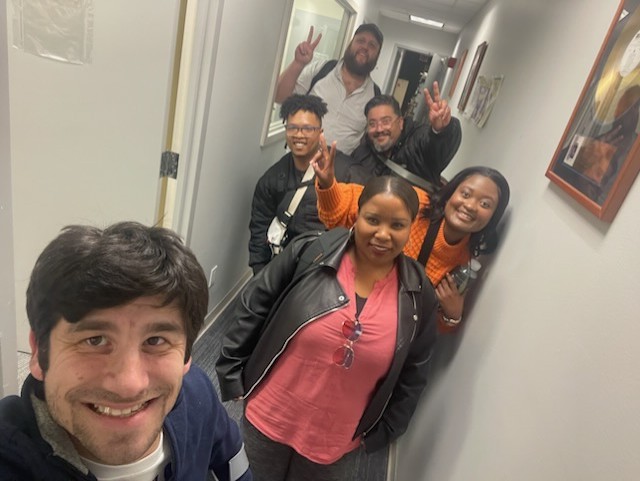
Bush Radio journalists Jasnine Roberts, Lydia Marwanqana, Renato Van Schalkwyk, and Adrian Louw tour the Salem Radio New York facilities with chief engineer Andy Gladding (pictured in rear) and assistant production manager Alex Garrett (pictured in front).
As part of this alliance, the stations were able to engage in a radio exchange program commencing just before the 2024 U.S. elections. With monies gained from a cultural grant, Bush Radio sent five radio journalists abroad to New York and Washington, DC to cover the national elections. The purpose of this trip was for the Bush Radio journalists to have the opportunity to see the American democratic process up close and later report their findings back to the Cape Town listening audience.
During the New York leg of their journey, I had the pleasure of offering our colleagues from WRHU’s “sister station” an up close and personal look at some of the New York’s finest broadcast institutions. The Bush Radio journalists, using WRHU as their base of operations, had the chance to visit New York Public Radio, Salem Media of New York, Long Island News Radio and fellow NCE broadcasters at WHPC and WCWP. Bush Radio members had the opportunity to interview local politicians, interface with student journalists and even participate in some radio broadcasts, including AM970’s “The Arthur Aidala Power Hour” “The One Leg Up Podcast” with Alex Garrett and WRHU’s Hofstra’s Morning Wake Up Call.
At the beginning of their visit, the Bush Radio team had a number of pre-conceived notions about the American electoral process, national media and cultural ideals. They were all aware of the large impact that American media has had on the rest of the world, with most of their impressions of the USA generally rooted in older idioms of American pop culture, specifically things they had seen on MTV, NBC, ABC and other international network programming originating from the United States. They believed the American elections were similar to the south African cycle, with campaigns lasting only for a few months and a generally receptive population to the post-election outcomes.
However, after spending some time in New York City, Washington, D.C. and Long Island conducting interviews and analyzing news reporting during their visit, their perspective was much different. The Bush Radio journalists were amazed at the drastic differences in reporting they saw across different news outlets. They observed that different stations were geared to provide favorable reporting to targeted audiences, which was something they noted didn’t happen back in South Africa. They were also surprised at how divided and polarized Americans were, summing the experience to how people would choose sides as if they were rooting for a favorite football or soccer team. Finally, they noticed that while the national media seemed to be coalescing around Harris as their preferred candidate, the polling was pointing towards a Trump victory. The stark differences between the bias of the media verses the national momentum was also surprising to them.
According to the Bush Radio journalists, they felt that linear network and community broadcasting carried a much larger influence back home than it did in the United States. They believed that this was partially because much of their domestic population does not have access to broadband internet, which meant that many still relied on terrestrial broadcasting to receive their information. However, they also observed that many people they spoke to had developed a distrust of the media. The South African journalists believed that much of this sentiment stemmed from apparent media bias, since the national reporting didn’t seem to accurately reflect the polling trends. They also pointed out that due to the wide array of media outlets and digital content providers that were available to the public, there seemed to be a dilution of credibility across all media sources, as the sheer volume of stories made it difficult for people to fact check all of the decentralized information.
However, the Bush journalists also observed that many Americans held the First Amendment in high regard. Freedom of speech and expression is a relatively young concept in post-apartheid South Africa. The journalists were amazed at the confidence and accessibility Americans presented when it came to sharing personal opinions or thoughts. This, according to the Bush Radio journalists, was not a widely accepted practice back home.
Many of the journalists were also amazed at the willingness of different groups to cross “traditional cultural lines” to vote for candidates that were from different ethnic backgrounds. They noted that back home, voters from specific racial backgrounds would generally align with candidates that were of a similar race. According to the journalists, this demonstrated that the idea of being “American” alongside the marketing of a candidate was a unique force that could work against ingrained or learned racial stereotypes and biases.
Despite the contentious nature of the elections and the high level of emotion generated by the outcome, the Bush Radio folks believed that the American democratic process was indeed intact and that their role as community radio journalists was now more important than ever. They noted that if they could be the “standard-bearers” of the news and produce reliable and credible content, it would draw greater listenership to their linear programming. According to the journalists, credibility was the most important element a radio station could have, especially as people around the world look for new ways to consume information. They acknowledged the fact that regardless of our cultural differences, they saw a similar passion for broadcasting and community service among their radio counterparts in New York, especially after interfacing with the students at WRHU. They also learned a very valuable lesson during their visit, specifically that New York pizza has the power to bring opposing groups together, as it was their observation this celebrated cuisine seemed to be served at every management meeting that required uncomfortable discussions or decision making. As one of the Bush journalists exclaimed after enjoying his first slice, “this pizza could solve all of the world’s problems.”
As a continuation of the WRHU-Bush Radio partnership, members of WRHU have been invited to travel to Cape Town in February and participate in the reporting on the results of the South African elections. Based on the feedback from the South African journalists, I am confident that this experience will be just as rewarding and exciting as it was for the Bush Radio participants.
1World Radio airs every Tuesday between 4:00 pm and 5:00 pm on WRHU, Radio Hofstra University.
Dr. Andrew Gladding is the chief engineer of the Salem Media stations in New York City – WMCA 570 / WNYM 970 – as well as WRHU 88.7 FM, Hofstra University, where he also serves as a lecturer on communications. He can be reached at 516-527-0764 or andyg@nycradio.com.

 This presidential election cycle provided a number of insights, revelations, and takeaway lessons for news/talk radio. And by using the term “news/talk radio” I mean all spoken word platforms on the AM/FM dial including commercial, public, educational, and ethnic outlets that provide news, politics, and commentary. They are all RADIO.
 Let’s continue our ongoing series of articles about fair use. A recent case highlights fair use considerations in audio media and podcasting, particularly concerning music and short audio clips used in intros, where some creators assume that brief snippets automatically qualify as “fair use.” Legal experts clarify that using a song clip, even if brief, doesn’t inherently meet fair use criteria. Courts have emphasized that fair use hinges not just on brevity but also on factors like purpose, nature, and market impact on the original work. Music clips, even short ones, are often seen as significant portions of the original content, carrying substantial value, making unauthorized use in podcasts or similar formats legally risky.
 The Broadcasters Foundation of America has launched its annual Year-End Giving Campaign, which seeks to raise donations from tax-deductible personal contributions to the Guardian Fund and corporate contributions to the Angel Initiative. The Broadcasters Foundation, a 501c3 charity, is the only charity devoted exclusively to helping colleagues who are in dire need of monthly or emergency financial assistance due to life-altering illness or a disaster. “We are devoted exclusively to providing aid to colleagues in broadcasting who are suffering from extreme illness, or hardship from a devastating disaster,” stated Tim McCarthy, president of the Broadcasters Foundation. “We also take care of colleagues who have retired. Grants are supported solely by contributions from individuals and companies within our industry and offer a ‘hand-up’ to our colleagues during trying times. We’re asking everyone in broadcasting to please consider including the Broadcasters Foundation in your 2024 charitable giving.” Over the past 20 years, the Broadcasters Foundation has distributed over $15 million in aid to colleagues nationwide, across all states and territories, who need it most. “Requests for aid continue to grow exponentially as more of our peers and their families are affected by severe illness or disasters, such as the recent flurry of destructive hurricanes,” explained Scott Herman, chairman of the Broadcasters Foundation. “Whether it’s a monthly grant or one-time aid in response to an emergency, the Broadcasters Foundation is often a refuge and beacon of hope for colleagues whose lives have been upended by unforeseen and tragic circumstances. Please consider a donation. Donations go directly to helping our colleagues who are in desperate need.” For more information about the Broadcasters Foundation, including how to apply for aid or make a donation, visit
 more than 10,000 employees, a source with knowledge said, amounting to hundreds of job losses as the company streamlines its business and eliminates redundancies. The story also quotes iHeartMedia spokesperson Wendy Goldberg, saying the company has focused on expanding its Gen Z audience and that its broadcast radio audience has “more listeners than it did 10 years ago. Although in a company of 10,000 people very few jobs have been affected, there have been some and we never take this step lightly no matter how few jobs it entails; every team member is important to us and has our respect and appreciation.”
 Take advantage of the new media order. Initially, TiVo was a hit because you could pause live TV and go to the bathroom whenever you wanted. Bathroom breaks while watching live TV was a revelation. As you were going to the bathroom, your relationship with media was being re-wired in your brain. In a matter of months, you were able to watch what you wanted, whenever you wanted. DECADES of TV scheduling strategies became anachronistic. It’s November. Do you know when your favorite shows are airing on TV? No! No need you’ll watch them whenever you want!
 WURD Radio Endorses Kamala Harris for President. For the first time in its 20+ year history, Philadelphia’s only Black-owned radio station, WURD Radio has endorsed a political candidate — Kamala Harris for President of the United States. Prompted in part by the decision from owners of the Los Angeles Times and The Washington Post to overrule planned endorsements by their editorial boards, sources at the station tell TALKERS, this decision underscores the importance of independent media ownership. From the endorsement: “Our founder, Walter P. Lomax Jr., M.D., understood that the media has the power to shape perceptions, images, narratives and, most importantly in this election, to tell the truth. He understood that the media can demonize or humanize, destroy or exalt, diminish or elevate. Dr. Lomax knew that mainstream media often marginalizes, caricatures and maligns Black people. WURD is in a unique position to speak honestly and emphatically about what matters most to our community because we are independently owned.” To read the entire text of the endorsement, please
  SiriusXM Tips Off College Basketball Coverage with 74 Games on Opening Night, November 4. SiriusXM will deliver college basketball fans an extensive schedule of live games throughout the 2023-24 college basketball season, starting with a slate of 74 women’s and men’s matchups to choose from when the season tips off this Monday (11/4). The men’s schedule includes all 19 teams from the Associated Press Top 25 that are in action on Monday night, including the season’s first matchup of Top 25 ranked teams – #8 Baylor @ #6 Gonzaga (11:30 pm ET). The opening day schedule of women’s games on SiriusXM includes 12 teams from the Associated Press Top 25 and features a couple of Top 25 matchups – #20 Ole Miss @ #3 USC (noon ET) and #5 UCLA @ #17 Louisville (2:30 pm ET). Throughout the season SiriusXM listeners will get access to dozens of game broadcasts each week involving teams from the SEC, Big Ten, Big 12, ACC, Pac-12, Big East and more.
 Newsmax Launches in France on Molotov. Newsmax TV, one of America’s most popular news channels, just launched on Molotov, one of France’s leading TV platforms, as U.S. voters go to the polls to pick their next president. The Newsmax channel went live on Molotov’s platform on October 24, 2024, expanding its global footprint with 19 million Molotov users in France and French-speaking territories. Molotov is one of France’s main TV services offering streaming television to internet users across the nation and its territories. Molotov subscribers can tune to Newsmax via the platform’s free tier.
 This sixth installment in
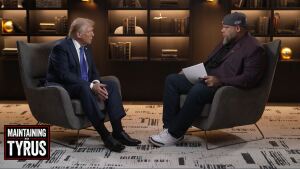
 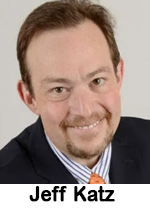 Media analyst, broadcaster, and trade journal publisher Michael Harrison appeared on the popular Jeff Katz afternoon drive show on WRVA, Richmond yesterday (10/29) to discuss comments he made earlier in TALKERS about the historic significance of former President Donald Trump‘s recent three-hour guest spot on the “Joe Rogan Experience” podcast. To listen to the fascinating discussion, please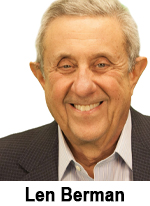
 “When iHeartMedia New York partnered with the New York Road Runners (NYRR) to produce this inaugural radio broadcast of the marathon, it was a no-brainer to put Len at the helm of the broadcast,” said Tom Cuddy, program director for 710 WOR. “His association with New York sports, during his more than 50-year television career, and his ‘second life’ as co-host of the WOR morning show since 2015, ensure that Len will make this a can’t-miss broadcast.” “I’m honored to be hosting WOR’s maiden voyage with the TCS New York City Marathon,” said Berman. “I’ve hosted TV coverage of the event many times and it’s consistently one of the best days of the year in the city. We look forward to conveying that same message to our listeners.”
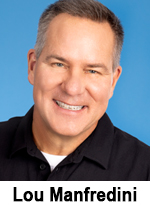 “I have been blessed to call WGN Radio home for the past three decades,” Manfredini tells TALKERS. “But in the end, it’s all about our listeners. I’m excited to continue to help them better understand how their homes work, show them they can have fun, and, of course, remind them to never hold a nail for someone else.” The Chicagoland native will be celebrating his 30th anniversary on WGN Radio in 2025. Mr. Manfredini first appeared on the station as a guest on the Bob Collins Show in 1995 following a letter writing campaign to pitch a call-in home improvement show on WGN.
 “We are delighted that Lou will be with us for his 30th year and beyond,” said WGN Radio VP/GM Mary Sandberg Boyle. “In the nearly 30 years since first appearing on WGN Radio, Lou’s presence across the media world has evolved considerably. Yet, what truly sets him apart is his natural gift of connecting to and interacting with our listeners in the special way that only radio does. Making those listener ‘connections’ has historically been – and will continue to be – the very fabric of WGN 720.” Manfredini can also be heard on weekday segments with John Williams (Mondays), Lisa Dent (Thursdays) and Bob Sirott (Fridays).
  It will be carried by LibertyNewsRadio.com or video stream at TheBigMigShow on Rumble. For additional information or press inquiries, please contact Sam Bushman at 801-756-9133 or LibertyRoundTable@gmail.com.
 One day last winter, Alison Stewart, the host of “All of It” on public station WNYC, New York was alarmed to find herself speaking gibberish.
 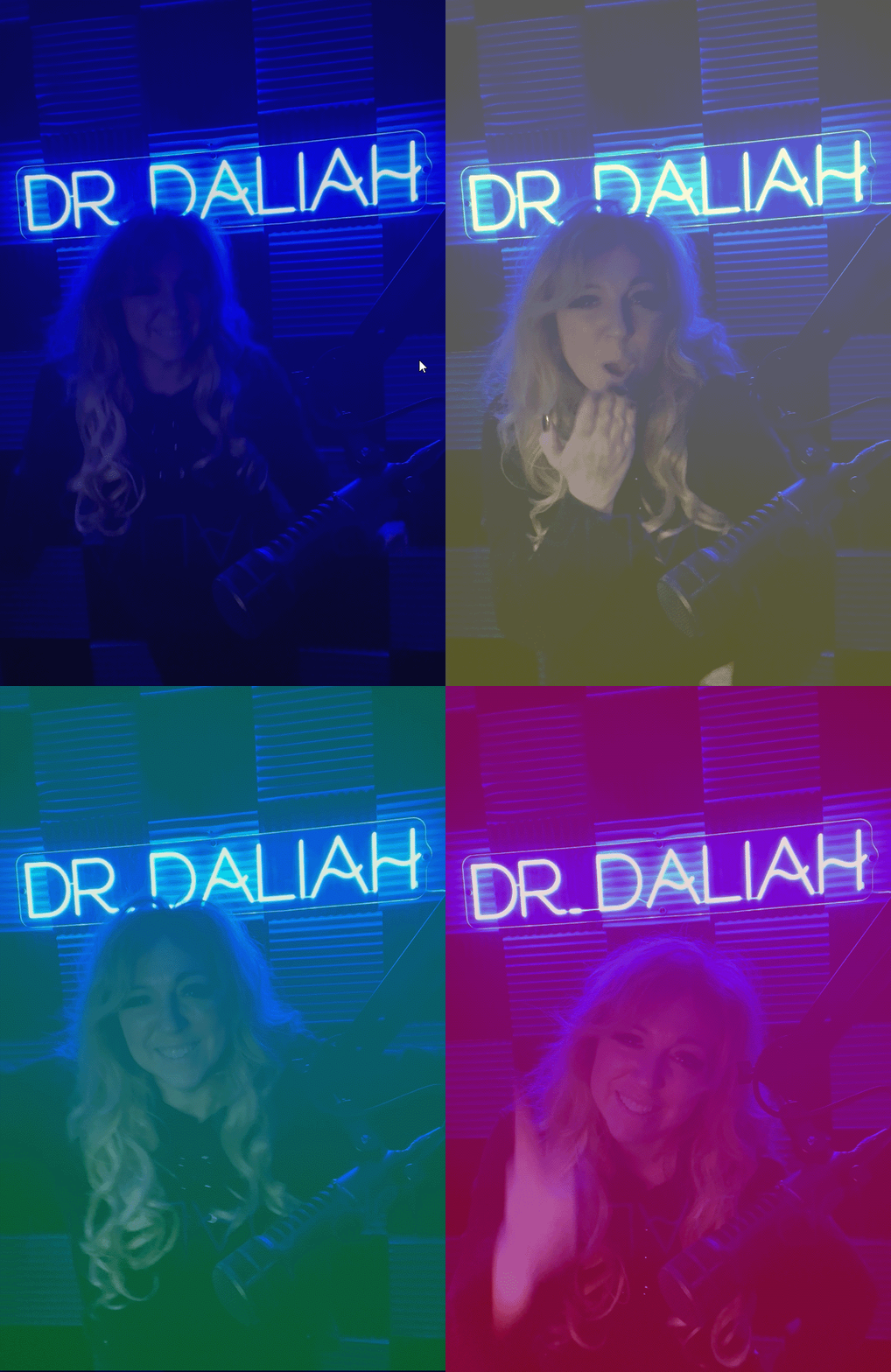 Music Group Gunhill Road Putting Final Touches on Talk Radio Anthem. Gunhill Road, the perennial pop music ensemble that has attracted hundreds of thousands of worldwide followers with its growing repertoire of issue-oriented songs and music videos, is currently in post-production with an anthem celebrating talk radio. Titled “Don’t Stop Talkin’” – the song is an uplifting and infectiously catchy tune about the vital role talk radio plays in serving the cause of American freedom of speech. With lines that include “As long as you’ve got a voice, don’t ever stop!” and “As long as you’ve got the truth, don’t ever stop!” the original composition co-written by band members Steve Goldrich, Paul Reisch, Brian Koonin, and Michael Harrison encourages talk radio practitioners to keep up the good work and great service they provide the nation.TALKERS Heavy Hundred syndicated host Dr. Daliah Wachs pictured above bopping to the music in a scene from the forthcoming video “Don’t Stop Talkin'” by Gunhill Road.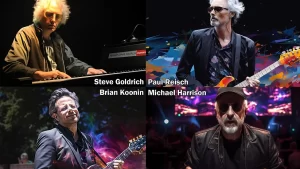
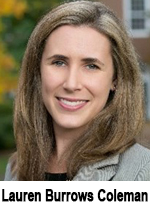 Longtime CFO Marie Tedesco will retire from Beasley after 33 years of what sources describe as “dedicated service to the company.” Before joining Beasley, Burrows Coleman served as Global Head of Strategic Corporate and Commercial Finance at Wayfair, where she led a global team of 50 across Financial Planning & Analysis, Commercial Finance, Capital Markets, Corporate Development, and Global Tax functions. Burrows Coleman’s career also includes leadership positions at WindSail Capital Group and Wind Point Partners, both private equity firms, as well as GE Capital, where she managed equity and debt investments across various industries. She began her career as an investment banker in the Communications & Media group at Lehman Brothers. “We are absolutely thrilled to welcome Lauren into the Beasley family,” said Caroline Beasley, CEO of Beasley Broadcast Group, Inc. “Her extensive and diverse experience, combined with her leadership skills, are exactly what we need to drive the company forward as we evolve into the future.” Burrows Coleman holds an MBA from Harvard Business School and an A.B. cum laude from Dartmouth College. Commenting on Marie Tedesco’s retirement, Beasley said, “Marie has been an integral part of our success, and her contributions have shaped the organization into what it is today,” adding, “It has been a privilege to work alongside her, and we are deeply grateful for her unwavering commitment, hard work, and leadership. We will greatly miss Marie’s wisdom and guidance, and we wish her nothing but the very best!”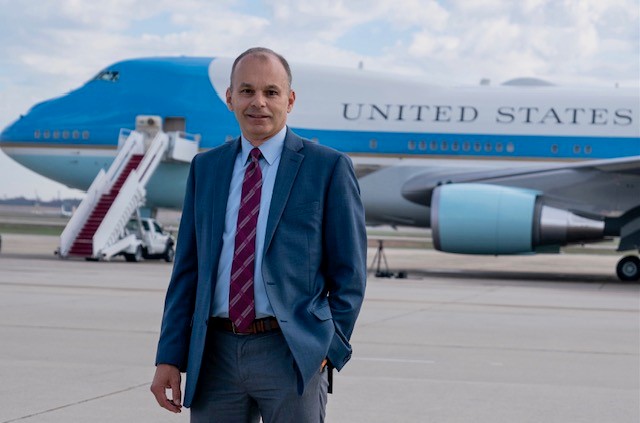
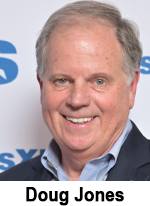 “The CloakRoom with Former Senator Doug Jones” will air live tomorrow from 6:00 pm – 8:00 pm ET on channel 127. According to company sources, with just a few weeks remaining before the November 5 elections, Senator Jones will engage with Progress listeners, taking calls to discuss the pressing news stories of the day. He’ll also leverage his personal political experience to analyze the key senatorial races, as well as the presidential election. In addition, the former senator will be joined by Julie Chavez Rodriguez, VP Kamala Harris’s campaign manager, as well as a surprise guest. “The stakes in this election could not be any higher,” Jones tells TALKERS. “I can’t think of a better way to talk directly with voters nationwide and have real conversations about the issues at the top of their minds as we head into Election Day. As a regular guest on SiriusXM’s Progress channel, I know they have a passionate audience with a lot of important, fresh subjects to discuss, so this should be a lot of fun.” The show will have its first run live during the usual time slot of “The Dean Obeidallah Show.”
  The special will also replay multiple times throughout the week and will be available anytime on demand on the SiriusXM app. Progress is SiriusXM’s channel dedicated to amplifying progressive viewpoints. The channel features a wide range of voices including Zerlina Maxwell, Stephanie Miller, Thom Hartmann, Michelangelo Signorile, Dean Obeidallah, John Fugelsang, and more. Photo by Joy Asico-Smith / AP for SiriusXM.
 According to a report in The Forum, Fieldstone Group, which owns Fargo heritage radio station “The Flag” at AM 1100 / FM 92.3, is planning to purchase WDAY Radio from Forum Communications, owner of WDAY-TV and The Forum. In November 2020, Fargo-based Fieldstone Group began managing WDAY. If the sale is approved by the FCC, Fieldstone will own the 102-year-old AM radio station, its online properties, social media accounts, and transmitter/tower site. Terms of the sale were not immediately disclosed by the buyer or the seller. “We are thrilled to see this day arrive,” said Steve Hallstrom, president and managing partner of Fieldstone Group. “We thank the Marcil family and the leaders and staff of Forum Communications for a great partnership these last four years. WDAY Radio has always had a tradition of serving the community with great news, weather, ag, and sports and we’ve enjoyed the journey of growing those elements with the help of our friends and partners at Forum Communications.” Hallstrom said it’s been important to have WDAY Radio “serve the community with quality local programming from sunrise to sunset, which is becoming a rarity in our business. I also want to thank our listeners for their loyalty and the many local businesses and organizations that have trusted us with their advertising and marketing dollars.” Fieldstone Group also owns KTGO “The Flag” in Tioga, N.D, at AM 1090 and FM 92.7, three stations in Grand Rapids, Minn: KOZY 1320 AM / 93.1 FM, KMFY 96.9 FM and KBAJ 105.5 FM; and The McKenzie County Farmer newspaper based in Watford City, N.D. “WDAY Radio is North Dakota’s longest-serving broadcast operation,” said Scott Hennen, VP/partner of Fieldstone Group and general manager of WDAY Radio from 2001-2009. “It is an honor to take ownership of this iconic community source of information.”
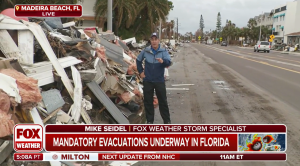 Storm specialist Mike Seidel is currently reporting from Madeira Beach, FL while correspondent Robert Ray is in Fort Myers Beach, FL. On Tuesday, Seidel will report from St. Petersburg, FL with Ray remaining in Fort Myers. FOX Weather will also deploy meteorologists Britta Merwin and Steve Bender to Sarasota, FL, Bob Van Dillen to Tampa Bay and Haley Meier to Daytona Beach, FL while meteorologists Michael Estime, Craig Herrera, Ari Sarsalari, Ian Oliver and Kiyana Lewis will anchor coverage from FOX Weather headquarters in New York. FOX Weather hurricane specialist Bryan Norcross will also provide continuous updates from New York. FOX Weather Digital will provide comprehensive coverage of Hurricane Milton, available 24/7 on FOXWeather.com and in the FOX Weather app, including the exclusive Hurricane HQ tab. FOX Weather Digital will include leading meteorological analysis, exclusive expertise from Norcross, coverage from all FOX Weather field resources and related content of every angle related to US impacts of the storm.
 With its state-of-the-art technology capabilities that includes satellite and IP distribution and live sports production, the company is available to offer additional services to those in need. “At Skyview Networks, our top priority is the safety of our partners and the continuity of their operations,” Aaron Mellis, VP, business services, Skyview Networks tells TALKERS. “With Hurricane Milton approaching, our team is fully prepared and ready to step in with services to support our clients’ needs, ensuring they are met seamlessly.” For inquiries on extended services in preparation of Milton, please contact