


Industry News

Cumulus/Westwood Studies: Audio Listeners are a Rich Source of In-market Financial Consumers

CumulusSeven consumer studies commissioned by the Cumulus Media | Westwood One Audio Active Group® over an eight-year period find audio listeners are a rich source of in-market financial consumers and drive significant top and bottom funnel impact. The key findings from the studies are outlined on this week’s blog.

Key takeaways:

• Compared to TV viewers, audio listeners are far more likely own investment assets, to be in the market for financial services, and be interested in the category.
• Despite massive TV spending by financial service marketers, TV viewers exhibit low brand equity for financial service brands and weak interest in the category due to the older skew of TV audiences.
• MRI-Simmons: Heavy podcast and AM/FM radio listeners are the ideal audiences for financial brands as they are more likely to be premium clients willing to pay for financial services.
• Case study #1: MESH Experience: Among consumers with $500K+ of investable assets, heavy AM/FM radio listeners are three times more likely than heavy TV viewers to be in the market for a new or additional financial services company.
• Case study #2: AM/FM radio drives strong growth in top funnel measures such as awareness, favorability, and consideration.
• Case study #3: A MARU/Matchbox study of consumers with $1M+ of investable assets found over a six-month period, an AM/FM radio campaign generated double-digit lifts in most measures of brand equity.
• Case study #4: Heavy AM/FM radio listeners are more likely to be active investors and more engaged with the financial category versus heavy TV viewers.
• Case study #5: Heavy AM/FM radio listeners are +44% more likely to be financial ‘thrivers,’ those who like taking investing risks and agree that investing is important.
• Case study #6: Compared to TV viewers, audio listeners are much more likely to have investments across a broad array of assets classes and more likely to invest in major financial brands.
• Case study #7: Harris Poll Brand Tracker: A Westwood One NFL AM/FM radio campaign generates significant brand equity impact far stronger than among TV viewers.

Check out today’s blog post.

View a 15-minute video of the key findings here.

Industry News

AUDACY STUDY: Local Radio is the Most Trusted News Source

Local news radio is the most trusted news source, besting TV and social media, according to a new study conducted by Audacy in partnership with Alter Agents – a marketing research firm.  The study – “Local News Radio: Credible, Engaging & Mobilizing” – explores news radio’s powerful connection with news enthusiasts who consider news radio to be a vital part of their day and demonstrates how unbiased journalism and trusted relationships create a safe haven for audiences and brands. The study surveyed 2,542 listeners from seven markets with Audacy news stations, including Chicago, Dallas, Detroit, Los Angeles, New York, Philadelphia and San Francisco. “In an age of information overload, Americans seek credible news sources they can rely upon. Enter local news radio,” said Paul Suchman, chief marketing officer, Audacy. “Local news radio serves as a trusted voice, delivered by brands that are deeply connected to the communities they serve. These environments create exceptional opportunities for advertisers to reach engaged audiences with significant buying power. And the premium content local news stations deliver is unparalleled in its relevance, timeliness, and humanity.”  The study indicates that at all moments throughout the day, millions of listeners turn to their trusted local news radio stations for the latest updates, insights and stories that shape their community and the world. These listeners are deeply engaged with their cities, constantly seeking information and turn to trusted news sources to stay informed. 85% of listeners find local radio news credible – more than any other medium. The study further insinuates this credibility pays immense dividends for advertisers, as 92% of listeners pay attention to advertisements they hear on local radio, with almost 80% of these listeners finding ads on news stations both trustworthy and informative.  To view the “The Power of Local News Radio” please click here.

Industry Views

SABO SEZ: Seek New Story Sources and Surprise Your Listeners

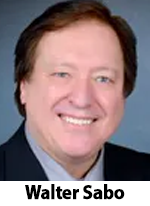
By Walter Sabo
Consultant, Sabo Media Implementers
A.K.A. Walter Sterling
Radio Host, “Sterling On Sunday”
Talk Media Network

imEarlier this week, Michael Harrison published his top 10 list of suggestions for being a successful talker. Item number three really caught my eye:


“Avoid worn out talking points. Be original. Always bring something new to the table. Otherwise you DESERVE to be replaced by AI.”

 When consulting client stations, the PD and I will take the on-air team through a pragmatic brainstorm session to discover completely unused source material.

First the material should be intriguing to you and appealing to your listener (singular.) New sources mean surprises and the fastest and most economical method of generating word of mouth, phone calls and cume is to present surprises all day.

1. Close to home. Pay foreground attention to incidents at home. Your home. Events that you may view as mundane could bond you with your listener. Consider that water in the basement, check engine light, parent/teacher conference, bad bank behavior, in-law interference. If any of those experiences has happened to you, you honestly know that they are a bigger deal than speeches in Congress.

2. Search the names of locations that you never discuss. Those searches have revealed to me and my listener that the number one fear in Siberia is the vast forest fires and that as the permafrost melts, it could expose million-year-old deadly viruses. One “Siberia news” search. Try this, search “Keith Fons North Pole Alaska” You will discover a bizarre Christmas story.

3. Local morning TV shows have unique fun stories that you don’t see because you’re listening to the radio. Go to their websites and you will see all of their topics, with audio, dated. 

Take a different approach to proven topics. A trait of successful hosts is that they discuss common topics but take a very different tact. Some examples: When TV legend Ann Bishop of WPLG Miami died, fellow broadcaster Neil Rogers mourned Bishop by saying, “She did nothing for me, sir.”

On crime in Cleveland, the late Mike Trivisonno on WTAM declared, “the best thing that could happen is for the Mafia to come back to Cleveland.”

Howard Stern surprises you every time he opens his mouth. It’s the fresh topics combined with surprising POV=Star. 

Walter Sabo has an outstanding track record advising media companies wishing to increase their share of revenue. His weekly syndicated show Sterling On Sunday aims to provide three hours of completely unique topics.  Contact him at walter@sabomedia.com or 646.678.1110

Advice

Monday Memo: The Resourceful Podcaster, Parked

By Holland Cooke
Consultant


BLOCK ISLAND, RI — The pandemic shutdown changed the standard for remote broadcasting.

  • Cable news talking heads – previously on-set or in a professional studio elsewhere – began appearing at home. And TV’s aesthetic is forever changed. Webcam video is the good-enough new-normal, and “Zoom” has become a verb. On Twitter, witty @RoomRater does just that, critiquing screen shots from various shows. On my TV show, TALKERS publisher Michael Harrison predicted that the new generation of TV news/talk sets will resemble “Frasier’s living room,” the at-home look IN-studio, rather than the Lucite desk and garish casino-looking graphics that have been the norm. And shows are saving a bundle NOT-paying as much as a thousand dollars for remote studio time + to Uber guests who may only appear for several minutes. A local station interviewed my state rep sitting in his truck talking into his phone cam.’ It was “authentic.”

(more…)

Industry News

Cumulus Partners with The Media Audit and TOMA.Solutions for Consumer Insights

Cumulus Media says that it is “accelerating its commitment to data-driven sales by partnering with The Media Audit and TOMA.Solutions to bring sophisticated market and consumer intelligence to Cumulus stations across a growing number of U.S. markets, providing a level of local clarity that goes far beyond traditional audience metrics.” The company says that The Media Audit provides granular local market data imgon consumer lifestyles, purchasing behavior and cross-platform media usage while TOMA.Solutions adds a powerful layer of competitive insight by measuring “Top-of-Mind Awareness,” revealing which local brands own the first-to-mind position in their categories. Cumulus president of operations Dave Milner says, “Today’s advertisers want more than audience delivery. They want insight, clarity, and a stronger connection between marketing decisions and business results. By integrating specialized resources like The Media Audit and TOMA.Solutions into our broader research suite, our teams in these markets provide an even deeper level of local intelligence, helping our clients build more precise and effective campaigns.”

Industry Views

TALKERS Books Announces Publication of Playing the Clip: The Digital Media Creator’s Legal Guide to Fair Use

TALKERS Books announces the release of, Playing the Clip: The Digital Media Creator’s Legal Guide to Fair Use, by media attorney (and imgTALKERS magazine associate publisher) Matthew B. Harrison, a work designed for today’s news/talk media environment where audio, video, screenshots, and quotes are not just supporting elements – but serve as the actual content itself. This technique has become particularly prevalent on YouTube and even cable news/talk TV but increasingly appears in audio form as what used to be called “actualities” – sound from another source.

The book introduces and defines what TALKERS identifies as the “Play the Clip” technique: the now-standard practice across broadcasting, podcasting, streaming, and social platforms of presenting the source material rather than merely describing it. Although this practice has become ubiquitous, it leaves content creators and providers vulnerable to legal ambiguity, uncertainty, and consequences.

At a time when creators increasingly rely on third-party media to inform, critique, and engage audiences, Playing the Clip addresses a persistent gap between how content is created and how the law evaluates it. Theimg book explains the legal concept of fair use not as a permission structure, but as a legal defense raised after copying has already occurred – an uncomfortable but essential distinction that underpins the entire analysis.

Rather than offering abstract theory or checklist-style guidance, the book focuses on how courts actually evaluate real-world uses. It examines the operational realities creators face: platform incentives, inconsistent enforcement, monetization pressures, and the false sense of security created by what “everyone else is doing.”

The central premise is straightforward: infringement is the starting point, not the conclusion- and fair use, when it applies, is the justification that must be built from there.

Playing the Clip is now available:

  • Print Edition (Amazon): $24.95
  • Kindle Edition (Amazon): Limited-time promotional price of $1.00

Free to TALKERS subscribers

In addition, TALKERS is making the book available at no cost to its readership for a limited time.

Below is a form just for TALKERS readers. Just submit your email address to receive access to a free digital copy, available in either EPUB or PDF format, depending on preference. This offer is intended to ensure that working media creators -regardless of platform or budget – can access the material during its initial release window. To receive a free book, please click here.

Industry News

Mike McVay to Receive MIW Honor

Mentoring and Inspiring Women in Radio, Inc announces that McVay Media president Mike McVay is the recipient of the 3rd Annual MIW Erica Farber Impact Award that recognizes individuals “who drive meaningful change by actively engaging with impactful organizations and generously imgcontributing their time, expertise, and resources. Honorees are true champions of service, demonstrating an unwavering commitment to fostering growth and progress within the industry.” McVay was presented with the award by Erica Farber on April 20, at the MIW Lipstick & Lobster Dinner at Maggiano’s. MIW board president Sheila Kirby states, “Mike McVay has been a consistent and powerful advocate for both the radio industry and the advancement of women within it. His willingness to share his time, expertise, and influence has made a lasting impact on MIW and the broader community we serve. Mike doesn’t just support the mission, he actively helps move it forward, and that kind of leadership is exactly what the Erica Farber Impact Award represents.”

Industry News

WWO: Guidelines for Using AI to Build Your Media Plans

Today’s blog post from Cumulus Media | Westwood One’s Audio Active Group addresses the use of AI by local advertisers to inform their media plans. Cumulus president of operations Bob Walker says that use of AI is fine but there are “some watchouts and best practices to consider.” Heimg offers these tips: 1) Be exact: The more specific the language used, the more accurate the response; State a desired outcome like “grow awareness”, “increase sales”, or “expand my customer base”; 2) Use reputable sources within search queries to get accurate information; 3) Take careful note of sourcing and dates: Don’t take data at face value without checking it; 4) Understand that AI platforms are different: Results will vary depending on the platform; and 5) Expect responses will change: Lots of factors impact the AI answers so read them carefully. See the full blog post here.

Industry Views

Monday Memo: The 2026 Case for Weekend Talk Radio

By Holland Cooke
Consultant

imgTime Spent Listening to podcasts has now surpassed TSL with spoken word radio. And both are fraught.

Anyone can do a podcast, and everyone seems to be. How to get found/subscribed-to/shared?

  • And in this listen-when-ever-you-want culture, basing Return On Investment in a brokered-time weekend ask-the-expert radio show that only reaches real-time listeners is increasingly dubious.

So, I’m helping podcasters I work with to do both. To amplify the impact of all the work you put into a podcast, make radio your content engine.

Yes, radio, for two big reasons:

  • Credibility, because? Anyone can do a podcast. But being on broadcast radio makes you seem “real.” The station delivers you an existing audience that trusts its information, supports its advertisers, and listens habitually. You are live, interactive, and “car radio.” And interview guests will be easier to attract to your on-air show than to a podcast.
  • As a podcaster, you are already an audio publisher – but you’re doing all the work yourself, reckoning what’s relevant to your listeners – a slow, lonely way to build an audience. Host a call-in radio show, and everything changes. Your callers and guests become the content pipeline that makes your podcast more than just you-talking. Their questions position you as an authority and offer proof of what your audience wants. No guesswork. No blind spots. Just nonstop relevance that keeps listeners leaning-in, coming back, and sharing your podcast with friends.

This 1 + 1 can = lots more than 2, when your show and podcast promote each other; and as this process repurposes content to social media, E-newsletters, video, and other online resources. Here’s the schematic: http://getonthenet.com/workflow.png

Holland Cooke (HollandCooke.com) is a consultant working the intersection of broadcasting and the Internet. Follow HC on Twitter @HollandCooke and connect on LinkedIn

Industry News

Dr. Murray Sabrin Launches Weekly Podcast

img

Noted “public intellectual” and longtime talk media guest Dr. Murray Sabrin has launched a weekly video podcast titled, “Health, Wealth, and the Pursuit of Happiness.”  In it, he interviews experts and colorful figures from the worlds of health care, finance, and politics in addition to sharing his own commentaries. A prolific author, Substack columnist, and public speaker, Sabrin has been one of the most sought-after guests in news/talk media for the past three decades. He is one of America’s most visible experts on libertarianism and free market economics – ideologies that have strong followings within the influential arena of talk radio. Sabrin is emeritus professor of finance at Ramapo College of New Jersey, an associate scholar at the Mises Institute, and a former Libertarian Party standard bearer for governor in the Garden State. He is the founder of a grassroots movement, “Make Americans Financially Independent (MAFI)” – a counterpoint to the present tendency toward runaway, unconstitutional government spending that has led the U.S. to take on trillions of dollars in stifling debt. Sabrin’s guest on the debut installment of the podcast is psychotherapist Joe Sansone. To view the podcast, please click here. To book Dr. Sabrin as a guest, please call Victoria Jones at 917-865-3991 or email: victoria@dcradiocompany.com.

Industry News

Edison: Radio Still Dominates In-Car Listening

Citing data from its Q1 2026 Share of Ear, Edison Research says that even though consumers have more audio options than ever before in their cars, AM/FM radio takes up the majority of time spent listening toimg audio in the car among Americans 13+. Edison adds, “As of Q1 2026, 55% of in-car audio time is spent listening to AM/FM radio. The next closest platform in the car is streaming audio. Time with streaming audio has grown over the 12-year history of Share of Ear but remains a distant competitor to AM/FM radio among the total population ages 13+, with 16% of in-car audio time going to streaming platforms… Among Americans 13-34, 46% of their in-car audio time is spent listening to AM/FM radio and 30% with streaming audio sources.”

Industry News

Beasley Brings Sontag Aboard as VP of HR

Beasley Media Group names Bill Sontag vice president of human resources. Sontag has served for the past 30 years with Procter &img Gamble. Beasley says in his new role, he’ll oversee all human resources and benefits functions across Beasley Media Group. His responsibilities include employee relations, benefits administration, compliance, and the development of programs designed to support the well-being and professional growth of employees across the organization. He will also oversee the company’s business insurance programs.

Industry News

Connoisseur Media to Acquire Five Nebraska Signals from NRG Media; Will Sell Four Topeka Stations to MSC Radio Group

Connoisseur Media is both a buyer and a seller in news today. First, the company announces it is acquiring five radio signals in Nebraska from NRG Media. Those include news/talk KLIN-AM, Lincoln and its FM translator K257GN-FX and four music stations – three in Lincoln and one licensed to Milford, Nebraska.  Connoisseur says the transaction isimg pending regulatory approval by the FCC and is expected to close in summer of this year. Connoisseur CEO Jeff Warshaw states, “We are over the moon to be able to add these phenomenal properties and team to our company. This marriage will allow us to even better serve the community and our clients.” NRG Media CEO Mary Quass adds, “The Lincoln stations have been a very important part of our story, and we are pleased to pass them to Jeff and his team. Jeff is a broadcaster who shares our commitment to great local service, quality programming, and deep community connections!” At the same time, Connoisseur is entering into a deal with MSC Radio Group to sell its Topeka cluster that includes news/talk WIBW-AM and three music brands. About this sale, Jeff Warshaw says, “We’re incredibly proud of the impact these stations have had in Topeka and the connections they’ve built with listeners. As we continue to refine our portfolio, this agreement allows us to focus our resources on key growth markets while ensuring these stations are well-positioned for the future with KNZA. We’re confident they will continue their legacy of serving the community with a strong emphasis on local engagement, news, and partnerships.”

Industry News

Scarborough and Brzezinski Re-Up with MS Now

Variety reports that Joe Scarborough and Mika Brzezinski have signed a new deal to remain with MS NOW. The new contract keeps the duo with the network through 2029. Recently, thte program was cut from four hours to three to make room for a new program hosted by Stephanie Ruhle. Scarborough comments, “Mika and I are excited to be staying with our ‘Morning Joe’ family and friends who have been watching regularly for almost 20 years.” See the Variety story here.

Industry Views

Take Back the Airwaves: Why Radio’s Future Belongs to Main Street, Not Wall Street

By John Caracciolo
President/CEO
JVC Broadcasting

imgThe recent shutdown of CBS News Radio isn’t just another media headline – it’s a wake-up call. A clear example of what happens when decisions about our information, our communities, and our voices are made in corporate boardrooms disconnected from real life.

This wasn’t a programming failure. It wasn’t a lack of audience. It was an accounting decision – made by people who don’t live in the communities radio serves, don’t rely on it, and don’t understand its true value. And that’s exactly why they got it wrong.

Radio has never been more important. In an era flooded with misinformation, algorithm-driven content, and faceless digital noise, radio remains immediate, local, and – most importantly – trusted. It’s the one medium that still shows up live, every day, in real time, for real people.

Radio isn’t dying. It’s being stripped down by people who don’t know how to grow it. But here’s the truth: this moment isn’t just a loss – it’s an opening. A rare and powerful opportunity to rebuild something better. Because what’s missing right now isn’t demand. It’s leadership. This is the moment to create a new kind of radio network – one built not for Wall Street, but for Main Street. A network designed to empower local stations, not replace them. One that helps stations monetize their greatest strength: localism. Local voices. Local news. Local advertisers. Local trust.

Let’s be clear about something: consolidation itself isn’t the enemy. When done right, consolidation can be a powerful tool – one that strengthens local newsrooms, provides resources, and creates the scale needed to compete in a modern media landscape. But there’s a line. When consolidation is used purely for profit – when it strips stations of their local identity, cuts talent, and replaces service with spreadsheets – that’s when it fails. Profit must be our servant, not our master. The future of radio depends on getting that balance right. We need smart, strategic growth that invests in journalism, expands local reporting, and gives stations the tools to thrive – not survive. We need leadership that understands scale should support localism, not suffocate it. That’s where the opportunity is right now.

The future is a network that works differently – a network that partners with local stations to amplify their voices, not drown them out. One that provides national scale where it matters – news gathering, distribution, sales infrastructure – while keeping content authentic and rooted in the community. A network that helps local stations win. Because local radio doesn’t need to be replaced – it needs to be reinforced.

Imagine a network that:

  • Delivers credible, trusted national news while allowing stations to localize and own the story • Builds shared revenue models that actually benefit local operators.
  • Gives advertisers access to both national reach and local impact.
  • Invests in talent, not cuts it.
  • Uses modern tools – digital, streaming, social – to extend radio’s reach without losing its soul.

That’s not just possible – it’s necessary. This is how we make radio competitive again. Not by shrinking it, but by strengthening what made it great in the first place. And let’s be honest – no one is better positioned to build this than the people who actually believe in radio. We have the tools. We have the experience. We have the relationships. And most importantly, we understand the audience because we’re part of it.

This is the time to act. The vacuum left by corporate retreat is real, and it won’t stay empty for long. Either Main Street steps in to rebuild radio with purpose, or something else will fill that space – and it won’t have the same commitment to trust, community, or truth.

So, let’s not waste this moment. Let’s take back the airwaves from bureaucratic investors who see radio as a line item instead of a lifeline. Let’s build a network that works for stations, communities, and listeners. Let’s make radio great again – not by looking backward, but by building forward. This isn’t the end of radio. It’s the beginning of its next chapter. And this time, we’re writing it. Let the revolution begin my friends, who’s with me?

John Caracciolo is the president and CEO of JVC Broadcasting.  He can be emailed at johnc@jvcbroadcasting.com or phoned at 631-648-2525.  

Industry News

Warshaw Argues Against Soros Fund Management’s Motion to Strike

In a court filing submitted on Monday (3/2), Connoisseur Media CEO Jeffrey Warshaw presented the Connecticut Superior Court with his reasons why the court should not grant Soros Fund Management’s motion to strike in his suit against the company for breach of contract, unfair trade practices and more. In the original complaint filed in May of 2025, Warshaw alleges that he had a deal with Soros Fundimg Management’s Michael Del Nin in 2022 and began working together “to try to acquiring Cox Radio, with Del Nin agreeing that Warshaw would manage the business as CEO upon successful acquisition.” While both parties were doing due diligence on the CMG deal, Warshaw learned that an Audacy majority stake holder was willing to sell its stake in the company. Warshaw says he steered SFM and Del Nin to the deal that made SFM a majority stake holder of the new Audacy in early 2024. Warshaw alleges he was promised he’d be the next CEO of Audacy or that he would get 5% of SFM’s profits from the Audacy acquisition. Later, SFM filed a motion to strike arguing that talks between Del Nin and Warshaw did not rise to the level of an employment offer. In his recent filing with the court, Warshaw says SFM reads “the Complaint in the light least favorable to Plaintiff. And they introduce new facts and make factual arguments that must be left for resolution by a jury at trial. Even so, based on the Complaint’s detailed allegations, Defendants’ arguments fall apart. Defendants ask the Court to believe that Jeffrey Warshaw, a veteran executive and dealmaker in radio, attempted to ‘cozy up’ to Defendants, newcomers to radio. But why did they seek an introduction to Warshaw in the first place? Why did they need Warshaw to source the Audacy transaction, and quickly ask him to introduce them to Audacy’s controlling debtholder? Why did Michael Del Nin call Warshaw 107 times between October 2023 and October 2024? On breach of contract, Defendants argue that the Complaint does not plead definite and certain terms of the contract between Warshaw and SFM. That ignores the definiteness of the contract terms alleged, as well as controlling precedent holding that an oral agreement is enforceable so long as missing terms can be ascertained by fair implication or industry custom. Defendants also downplay the value of Warshaw’s sourcing of the Audacy deal and his introduction of Defendants to the firm holding a controlling interest in Audacy debt.”

Industry Views

Reckless Disregard in the Age of AI: What Verification Now Requires

By Matthew B. Harrison
TALKERS, VP/Associate Publisher
Harrison Media Law, Senior Partner
Goodphone Communications, Executive Producer

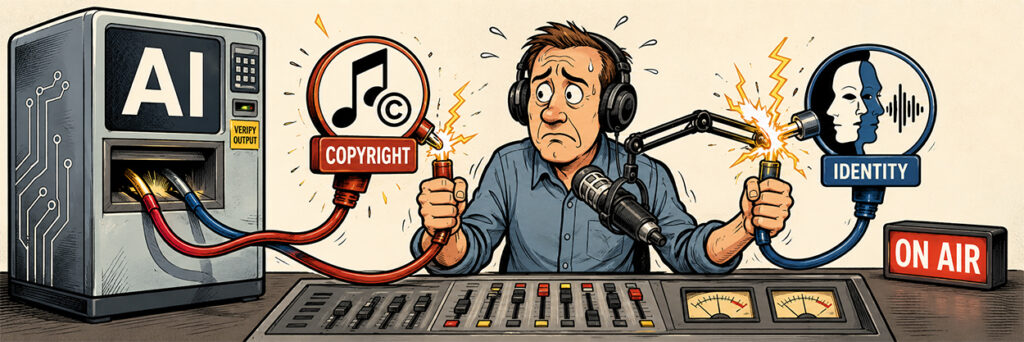
imgAI is now embedded in the modern newsroom. Not as a headline, not as a novelty, but as infrastructure. It drafts outlines, summarizes complex reporting, surfaces background details, and accelerates prep for live conversations. For media creators operating under relentless deadlines, that efficiency is not theoretical. It is practical and daily.

That reality raises a quiet but consequential legal question. When AI contributes to your research, what does verification now require?

Professional hosts are not reading raw chatbot answers on air and calling it journalism. That caricature misses the real issue. What is actually happening is subtler and far more common.

AI now sits inside research workflows. Producers use it for background. Hosts use it to summarize reporting. Teams use it to outline controversies or draft rundowns. Most of the time, it works. Sometimes, however, it invents.

When that invention involves a real person and a serious allegation, the legal analysis looks familiar.

For public figures, defamation requires proof of actual malice – knowledge of falsity or reckless disregard for truth. For private figures, negligence is usually enough. In both cases, the focus is not on the tool. It is on the content creator’s conduct.

AI does not change the elements. It changes the context in which reasonableness is judged.

Courts have long held that repeating a defamatory statement can create liability, even if someone else said it first. If you rely on a blog, and that blog relied on AI, and the allegation is false, the question becomes whether your reliance was reasonable.

Was the source reputable? Was the claim inherently improbable? Were there obvious red flags?  Was contradictory information readily available?

AI’s reputation for “hallucinating” facts now forms part of that backdrop. Widespread awareness that these systems can fabricate citations, merge identities, or invent accusations becomes relevant when a court evaluates your verification choices.

This does not mean using AI indicates reckless disregard. It means using AI does not excuse skipping verification when the stakes are high.

The more specific and damaging the claim, the greater the duty to confirm it through independent, reliable sources. Not another prompt. Not a circular reference to the same unverified blog. Rather, a primary record, official statement, or established reporting.

Documentation matters. If challenged, being able to show that you checked multiple sources before broadcast can be decisive.

None of this is new doctrine. What is new is how seamlessly AI blends into ordinary research habits. That integration makes it easier to forget that the legal question is still about human judgment.

The law will not ask whether your workflow was efficient. It will ask whether your conduct was reasonable under the circumstances.

In the age of AI, verification is not a courtesy. It is risk management.

Matthew B. Harrison is a media and intellectual property attorney who advises radio hosts, content creators, and creative entrepreneurs. He has written extensively on fair use, AI law, and the future of digital rights. Reach him at Matthew@HarrisonMediaLaw.com or read more at TALKERS.com.

Industry Views

Progressive Talk Media Star Thom Hartmann Interviewed

UFCO Hartmann copy

WYD Media nationally syndicated progressive talk show host, Thom Hartmann is Michael Harrison‘s guest this week on Up Close Far Out – a YouTube video presentation of broadcast industry trade publication TALKERS magazine.  Hartmann is one of – if not THE – most influential and longest running progressive radio and talk media commentators on the scene today.  His daily program is heard on several hundred radio stations as well as the SiriusXM Progress 127 channel, Free Speech TV, Substack, YouTube, and Facebook. He is a prolific best-selling author and publishes a widely read daily newsletter, the Hartmann Report. Hartmann is currently ranked number 8 on the prestigious TALKERS Heavy Hundred list of the 100 Most Important Radio Talk Show Hosts in America.  Harrison and Hartmann discuss the state of news/talk media, the challenge of covering the Trump presidency, and both commentators’ concern about the administration’s escalating infringement on First Amendment rights. To experience the video in its entirety please click HERE.

Industry News

Edison: Podcasting Overtakes AM/FM Spoken-Word Listening

According to data from Edison Research, podcasts have overtaken AM/FM in consumption of spoken-word audio. Edison says, “In 2015, AM/FM radio accounted for 75% of the time Americans spent with spoken-word audio sources. AM/FM radio was not only the mostimg dominant spoken-word audio listening platform, but it was fully sixty-five percentage points higher than podcasts, which accounted for 10% of listening time back then. Quarter by quarter and year over year, time spent using AM/FM radio to listen to spoken-word audio has declined significantly and shifted to time spent with podcasts. As of Q4 2025, 40% of time spent listening to spoken-word is now spent with podcasts and 39% of time is spent with AM/FM radio. Not only does radio not beat podcasts by a significant margin, it now trails the on-demand platform for spoken-word audio listening.”

Industry News

SAG-AFTRA Criticizes Nexstar News Cuts

SAG-AFTRA is condemning Nexstar Media Group’s decision to eliminate SAG-AFTRA positions at WGN-TV in Chicago and lay off multiple journalists at KTLA in Los Angeles and at stations across the country. SAG-AFTRA says, “These cuts strike a serious blow to a trusted source of news and information on which these communities depend.” SAG-AFTRA president Sean Astin comments, “By laying off journalists across the country, Nexstar is eroding the resources and talent that local communities rely on for trusted news. These actions highlight the risks of media consolidation and underscore the urgent need for regulators and the company to prioritize the public interest and the professionals who serve it.”

Industry Views

If the Bot Lies, Who Pays?

By Matthew B. Harrison
TALKERS, VP/Associate Publisher
Harrison Media Law, Senior Partner
Goodphone Communications, Executive Producer 

img

A reporter recently asked a clean question with sharp edges: “Who is responsible when an AI defames someone?”
It sounds futuristic. It isn’t. It’s a standard defamation analysis dressed in new technology.
The most publicized early test involved radio host Mark Walters, who sued OpenAI after ChatGPT falsely stated he had been accused of embezzlement. The case was dismissed in federal court in Georgia in 2024. The court concluded the complaint did not plausibly allege the required level of fault. No federal appellate court has yet imposed defamation liability on an AI developer for a hallucinated statement alone.
That matters.
Defamation still requires a false statement of fact, publication to a third party, fault, and damages. An AI system cannot form intent. It cannot know falsity. It is not a legal person. But an AI output can absolutely contain a false statement about a real individual.
Courts will not ask whether “the AI defamed.” They will ask who published the statement.
Publication is broader than many assume. It does not require a broadcast tower. It requires communication to at least one third party. If a chatbot produces a false statement visible only to the person who prompted it and that person is the subject of the statement, there is typically no publication. The moment that output is emailed, posted, quoted, aired, or incorporated into a script, publication is satisfied.
The AI session itself is not the problem. Distribution is.
That is where fault enters the picture.
For public figures, plaintiffs must prove actual malice: knowledge of falsity or reckless disregard for truth. “The computer said it” is not a defense. If a host repeats a serious allegation generated by a system widely known to hallucinate and fails to verify it, a plaintiff will argue reckless disregard. For private figures, negligence is usually enough. Failing to check an AI-generated accusation against readily available sources may meet that standard.
The technology does not lower the bar. Nor does it create a new type of immunity. It simply changes the source of the words.
The unsettled frontier is developer exposure under Section 230 and product liability theories. Courts have not yet produced a controlling appellate decision holding a model developer liable in defamation solely because a model generated a false statement. That question remains open, but it is not yet answered in plaintiffs’ favor.
Here is the practical reality for media professionals.
An AI can generate the sentence.
You are the one who makes it public.
That’s where liability is found.
Matthew B. Harrison is a media and intellectual property attorney who advises radio hosts, content creators, and creative entrepreneurs. He has written extensively on fair use, AI law, and the future of digital rights. Reach him at Matthew@HarrisonMediaLaw.com or read more at TALKERS.com.
Industry News

New Public Media Infrastructure Organization Announces Board of Directors

In November of last year, Public Media Infrastructure was created with one of the final grants from the Corporation for Public Broadcasting and was designed to help meet the infrastructure needs of all public media stations in the modern era. It was founded by American Public Media Group, PRX, New York Public Radio, Station Resource Group, and the National Federation of Community Broadcasters. Now, that organization announces its new new board leadership and five new members who join representatives from PMI’s co-founding organizations. New York Public Radio executive chair LaFontaine Oliver is named Chair of the Board. The Board’s new members are Anni Caporuscio, general manager of KKCR Community Radio; Mariana Robertson, general manager of KCAW Raven Radio; José Martínez-Saldaña, co-executive director of Radio Bilingüe; Vijay Singh, CEO of Vermont Public; and Kenya Young, president and CEO of Louisville Public Media.

Industry News

“105.7 The Fan” in Baltimore Promotes Joe LaCroix

Audacy’s Baltimore sports talk outlet WJZ-FM “105.7 The Fan” promotes Joe LaCroix to assistant brand manager. WJZ brand manager Scott Jameson says, “Joe has been an incredible resource and tremendousimg help to the entire team throughout the past year, stepping in without hesitation and taking on added responsibility. His work ethic, commitment to the station, and focus on fostering a collaborative environment have not gone unnoticed, making him the ideal candidate for this elevated role.” LaCroix, who’s been with the station since 2017 and has served as executive producer of the morning show since 2021, says, “I’m delighted to accept this role and grateful for the opportunity. I’m excited to continue working with this team and to help drive the continued growth and success of ‘The Fan.’”

Industry News

Federal News Network Contracts with Leadership Connect

Hubbard Radio’s Federal News Network (including WFED-AM, Washington, DC) announces a strategic partnership with Leadership Connect, a provider of government, policy, and contracting intelligence.img Hubbard says the collaboration brings together Federal News Network’s trusted reporting with Leadership Connect’s proprietary data and analysis to deliver deeper context and insight across the federal marketplace. Federal News Network publisher Jeffrey Wolinsky states, “Our mission has always been to support federal executives with the insights they need to lead effectively. This partnership with Leadership Connect allows us to enrich our reporting with deeper data, ensuring our audience receives more impactful content than ever before. We are thrilled to integrate these resources to better serve the federal community.”

Industry News

Manhattan Borough President Attempting to Censor Newsmax

News outlet Newsmax is fighting an attempt by New York City Manhattan borough president Brad Hoylman-Sigal who is petitioning New York City Mayor Zohran Mamdani to remove Newsmax content from the city’s taxi TV screens. New York’s taxis are private entities that operate via a city license known as a medallion. Last year, Newsmax signed with Curb aimg deal to provide a one-minute news update hosted by one of the network’s anchors to over 15,000 taxis across the country, including in New York City. In a January 21 letter to Mamdani and Taxi and Limousine Commissioner Midori Valdivia, Hoylman-Sigal stated the cabs should not carry Newsmax because of its “politically charged content.” The letter went further, stating Newsmax “is not a credible news source for New Yorkers. I urge you to summarily suspend the NYC Taxi and Limousine Commission’s partnership with Curb… and demand that Curb cease its collaboration with Newsmax as a condition of licensure given the platform’s history of misinformation and disingenuous reporting.” Newsmax says, “This is a pure act of censorship targeting a news organization reaching over 50 million Americans regularly. Newsmax plays it straight and that drives the far left crazy.” See the Newsmax story here.

Industry Views

Monday Memo: TV Wants In – Welcome Them

By Holland Cooke
Consultant

imgLinear broadcast media have never been more challenged. Internet video now commands far more viewing time than over-the-air TV. And their own networks are hijacking viewers! Your local NBC station tells you to watch Peacock. ABC points you to Disney+. CBS pushes Paramount+. Affiliates are effectively forced to promote their own competition.

Music radio is – at best – holding the line against streaming. News/talk radio’s information staples are more-available on smartphones and smart speakers, and its monologue‑heavy style feels less inviting than social media dialogue. 

Radio has what TV envies. We’re in-car, and still #1 there.  

TV has what radio needs. With more local news HR, they’re in more places. 

Both need more promotion than they can afford.

  • Radio still delivers the most cost-efficient reach and frequency in the local market. When I programmed WTOP, Washington, we and what’s now WUSA9 (the former WTOP-TV) had a handshake deal to grab whatever we wanted from each other, with on-air credit. True story: The news director from NBC4 offered that “you can use OUR stuff and not even SAY it’s ours. Just STOP saying that so-and-so ‘told Channel 9…’”
  • And radio-using-local-TV-meteorologists is a win-win. Weather is the #1 reason people watch local news, so TV stations promote it heavily. Radio using their weather people underlines – and stands on the broad shoulders of – the TV station’s weather image and delivers radio habit-forming content with a pedigree.

Local TV and radio are the last two mass-reach media in town, with neither medium losing to the other. Resourceful collaboration makes all the sense in the world. Brainstorm.

Holland Cooke (HollandCooke.com) is a consultant working the intersection of broadcasting and the Internet. Follow HC on Twitter @HollandCooke and connect on LinkedIn

Industry Views

WPHT, Philly Star Dom Giordano Guests on TALKERS Media Channel’s “Up Close Far Out”

img

Don’t miss this deep-dive analysis of the “dumbing down of America” as WPHT, Philadelphia midday host (12:00 noon – 3:00 pm) Dom Giordano joins Michael Harrison as this week’s guest on the YouTube TALKERS Media Channel’s “Up Close Far Out.” Recognized as one of the most important radio talk show hosts in America for almost four decades,img Giordano is a political commentator, social generalist and seasoned expert on education. He is a former Pennsylvania-based schoolteacher whose keen insights, innovative ideas, and communication skills were discovered by talk radio in Philadelphia in 1987 when, after serving as a dependable “go-to” source on education, he became a fulltime host on WWDB-FM. In 2000, he moved over to powerhouse WPHT 1210 am in Philly where he has been broadcasting ever since. In addition to his enduring radio presence, Giordano hosts several podcasts including the groundbreaking “Old School, New School, Next School” which takes a critical-but-constructive view of America’s education crisis and is must-listening for parents who care about their kids and the future of America. Get ready for a no-holds-barred view of such hot topics as school choice, the tyranny of social media, the distraction of smart phones, short term attention spans, bullying, the threat of guns and violence, responsible parenting, media complacency, and a whole lot more. View the conversation in its entirety here.

Industry Views

You Are the Asset: Why Protecting Your Voice and Likeness Is No Longer Optional

img

By Matthew B. Harrison
TALKERS, VP/Associate Publisher
Harrison Media Law, Senior Partner
Goodphone Communications, Executive Producer

imgFor years, “protect your name and likeness” sounded like lawyer advice in search of a problem. Abstract. Defensive. Easy to ignore. That worked when misuse required effort, intent, and a human decision-maker willing to cross a line.

AI changed that.

When Matthew McConaughey began trademarking his name and persona-linked phrases (“alright, alright, alright”), it was not celebrity vanity. It was an acknowledgment that identity has become a transferable commodity, whether the person attached to it consents or not.

A voice is no longer just expressive. It is functional. It can be sampled, trained, replicated, and redeployed at scale. Not as a parody. Not as commentary. As a substitute. When a synthetic version of you can narrate ads, read copy, or deliver endorsements you never approved, the injury is not hypothetical. It is economic.

We have already seen this play out. In the past two years, synthetic versions of well-known voices have been used to sell products the real person never endorsed, often through social media ad networks. These were not deep-fake jokes or parody videos. They were commercial voice reads. The pitch was simple: if it sounds credible, it converts. By the time the real speaker objected, the ad had already run, the money had moved, and responsibility had dissolved into a stack of platform disclaimers.

This is where many creators misunderstand trademark law. They think it is about logos and merchandise. It is not. Trademarks protect source identification. Meaning, if the public associates a name, phrase, or expression with you as the origin, that association has legal weight. McConaughey’s filings reflect that reality. Certain phrases signal him instantly. That signaling function has value, and trademark law is designed to prevent identity capture before confusion spreads.

Right of publicity laws still matter. They protect against unauthorized commercial use of name, image, and often voice. But they are largely reactive. Trademarks allow creators to draw boundaries in advance, before identity becomes unmoored from its source.

This is not a celebrity problem. Local radio hosts, podcasters, commentators, and long-form interviewers trade on recognition and trust every day. AI does not care about fame tiers. It cares about recognizable signals.

You do not need to trademark everything. You do need to know what actually signifies you, and decide whether to protect it, because in an AI-driven media economy, failing to define your identity does not preserve flexibility. It invites identity capture.

Matthew B. Harrison is a media and intellectual property attorney who advises radio hosts, content creators, and creative entrepreneurs. He has written extensively on fair use, AI law, and the future of digital rights. Reach him at Matthew@HarrisonMediaLaw.com or read more at TALKERS.com.

Industry News

NAB Goes to Bat for Removal of Ownership Caps

The National Association of Broadcasters is testifying on behalf of over-the-air broadcasters who would like to see the Federal Communications Commission’s radio and television station ownership caps eliminated. In lengthy testimony regarding the 2022 Quadrennial Regulatory Review – Review of the Commission’s Broadcast Ownership Rules and Other Rules Adopted  Pursuant to Section 202 of the Telecommunications Act of 1996, NAB says that, unlike those arguing to keep or even strengthen ownership caps, those asking for their removal are providing real-world testimony. The NAB writes, “They documented in detail the vastimg competition local radio stations today face for audiences and vital advertising revenues from online and satellite content providers and digital ad platforms not subject to any comparable restrictions on their scale and scope; the dire negative effects that consumer and advertiser substitution of competing digital audio content and advertising for traditional radio has had on the listenership and advertising revenues garnered by local radio stations, including in mid-sized and small markets; and how the retention of asymmetric ownership restrictions has prevented radio broadcasters from gaining local scale to take advantage of important economic efficiencies, obtain investment capital, and better compete for audiences and advertising revenues, and thus enhance – or even maintain – their provision of news, emergency information, and valued entertainment and sports programming in local communities across the country at no cost to the public.”  Responding to testimony from musicFirst Coalition and the Future of Music Coalition – referred to as the Coalitions – NAB writes, “First, the fact that the Coalitions continue to hold themselves out as protectors of small, local independent broadcasters not just borders on the absurd but crosses over into full-blown absurdity. The Coalitions represent the interests of the music industry, which is dominated by three consolidated international record labels. Compared to even the largest radio station groups, the giant record labels are the 800-pound gorillas of the music world. Those three labels earn billions more in revenue than the approximately 11,000 full-power commercial AM/FM stations combined. As NAB earlier reported, the three major music companies jointly generated about $2.9 million per hour in 2023. In remarkable contrast, in 2023 and 2024 the vast majority of radio stations garnered less – and often much less – than $2.9 million per year in advertising revenues. Needless to say, the Coalitions have never explained how local radio stations earning such low levels of revenue (and even lower, if any, profits) are supposed to keep talented employees and provide high quality programming, including popular music, sports, and informational programming, such as weather updates and emergency information, OTA and free to the public without achieving increased local scale, greater economic efficiencies, and more robust ad revenues. See the NAB’s complete testimony here.

Industry News

Audacy Partners with Next Net for AI Search Discoverability Optimization

Next Net — a company that specializes in search discoverability and AI optimization — partners with Audacy to launch NextNet AI – AI Search Discoverability Optimization for local and regional businesses nationwide. Then two companies say this partnership brings “enterprise-grade AIimg discoverability capabilities to small and mid-sized businesses that are being excluded from emerging search and discovery channels due to cost, complexity, and technical barriers.” Audacy SVP of digital Jenny Sutton says, “Local advertisers can be overwhelmed by the pace of change in digital marketing and discovery. By partnering with Next Net, we’re giving our clients a future-ready solution that integrates AI discoverability directly into the media and marketing strategies they already know and trust, without requiring technical resources or additional burden on the business owner.” 

Industry Views

LOOKING AHEAD to the Second Half of the Third Decade of the 21st Century

By Michael Harrison
TALKERS
Publisher

imgWith the conclusion of 2025 at hand, we are entering the second half of the third decade of the 21st century.  It will be a remarkably transitional period for the talk radio industry and its closely associated fields in talk media, as well as media-in-general.

Here’s what’s going to happen:

The age old “radio station” paradigm as a brick-and-mortar business/cultural/communications center will disappear.  After more than a century, it will be financially and physically impractical to operate the process of “radio” as a federally licensed production company tethered to a broadcast tower that houses programming, sales, and a roster of creative practitioners under one roof on an employee-based payroll. Radio “stations” will be more of an esthetic meme than an actual physical place on a dial coming from a specific business space with desks and “departments.” Programming and sales – local, regional, and national – will be provided by “outside” sources.  Most “talent” will operate as either independent contractors or employees (or “partners”) of these outside companies.  Local-ness and/or national-ness will not depend upon actual location of sources but rather focus of content.  The biggest challenge facing radio station owner/operators will be to transition their “media station” brands from being licensed entities to effectively competing in the “dark jungle” or “high seas” of unlicensed platforms… without going broke.

In the wider world of media:

AI is going to put “Hollywood” out of business.  Oh, there will still be a nebulously geographic place in Southern California called “Hollywood” but it will no longer be mythically based on big studios, production companies, and star talent.

And lovers of freedom will come to recognize the communications arm of “Big Tech” as the greatest threat to liberty facing humanity since World War II.

More on the above in 2026.

Happy holidays!

Michael Harrison is the publisher of TALKERS.  He can be contacted at michael@talkers.com.

Industry News

iHeartMedia Opens Video Podcast Platform to Creators & Publishers

iHeartMedia announced the extension of its ‘Creators First’ mission by expanding its podcast platform offerings to support both audio and video distribution within both the app and web versions of iHeartRadio – at no cost to creators. The company says that inn 2026 it will “give creators the ability to distribute full-length video directly into iHeartRadio – for free – inimg addition to their existing audio distribution. When this video feature launches, creators will be able to upload their podcast episodes, including full-length video versions, through their standard RSS feeds for seamless distribution in iHeartRadio.” The company goes on to say that this feature will 1) allow podcasters to control how their content is presented; 2) allow creators control over their monetization, with no revenue share required to iHeart; and 3) give them the freedom to have their videos hosted and served from wherever they want and not be tied to an iHeart-owned hosting provider. iHeartMedia chairman and CEO Bob Pittman explains, “While audio remains the backbone of the podcast medium, as well as its primary source of audience connection and the reason for the industry’s explosive growth, video podcasting is now emerging as a completely separate and incremental form to audio, in the same way that podcasting evolved as a new layer on top of broadcast radio. At iHeartMedia creators come first. Providing this new video distribution capability for free to our creators is an additional testament to our continuing focus on creators’ success and is consistent with how and why the podcast industry was built to begin with.”