

Industry Views

The Annual (Radio Station) Physical

By Jonathan Little
TroyResearch
President

imgAn annual physical is a wise idea. Doc asks, “How are you doing?”. Then he or she asks some detailed questions based on your medical history. Then “how have you been feeling? Any issues?” Doc always orders blood draws to see what might be lurking. Is the statin drug keeping your cholesterol in check? Are you getting plenty of exercise, plenty of sleep? How’s your diet? Over the years, I’ve visited about my health with at least a dozen different doctors. I’m convinced that the good ones always ask good questions and then listen carefully. Good questioner – good listener. That’s the doc I can respect and put my trust in. 

If you operate a radio station, your station could benefit from an annual physical. You already know how it’s doing based on ratings, revenue, and profit. Your listeners know how you’re doing for them personally because they’re the users of your radio product. Is it pleasing, challenging, inspiring or annoying, irritating, and easily ignored with a click? If you ask them, they’ll tell you. You should ask them at least once a year. 

TroyResearch has been in the business of asking listeners what they think for 27 years. We recently teamed up with Midwest Communications, Inc., in Green Bay to conduct an exploratory research project with their news/talk station WTAQ. TroyResearch’s association with MCI goes back nearly 27 years, doing music and perceptual research for the Duke Wright music stations. The WTAQ project was something new. Our goal was to discover what actionable data the opinions of loyal listeners might produce. TroyResearch worked with VP Programming Jeff McCarthy and Operations Manager Jason Hillery to develop a 25-question study. 

Survey respondents were recruited over the air and were encouraged to go to the WTAQ website to take a brief survey. Clearly, we wanted to hear from P1’s, those listeners who produce 60%+ of reported listening. Their answers provided a clear picture of WTAQ loyalists – what they like, what they don’t like, their political affiliation, their listening behaviors (radio, podcasts, TV news, cable news, etc.), favorite news outlets, trustworthiness of news outlets, their thoughts about protests becoming riots, and their favorite podcasts to mention a few. 

More than 200 respondents, Persons 18+, completed the WTAQ perceptual study. (32% 18-54, 68% 55+). With Jeff’s and Jason’s permission, we share some results. 

Political Affiliation

1% Democrat
78% Republican
15% Independent
6% Other, like Libertarian, Socialist

In car listening

80% Local radio
10% Satellite radio
6% Streaming services like Spotify
3% Podcasts
1% Other like personal playlists 

Listening to WTAQ, which simulcasts

76% FM
9% AM
8% Streaming from WTAQ app
6% Streaming from a smart device
1% Streaming from WTAQ.com

Where do you get your news? (Select all that apply)

93% Radio
46% Broadcast TV (local channels)
41% Cable news like Fox, CNN, MSNBC
29% Social Media like X, Facebook, Tiktok
16% Internet news like NY Post, Washington Post
10% Newspaper
12% Other 

Your primary news source

58% Radio
15% Cable news like Fox, CNN, MSNBC
8% Broadcast TV (local channels)
7% Internet news like NY Post, Washington Post
7% Social Media like X, Facebook, Tiktok
3% Other
1% Newspaper

When does a protest/demonstration become a riot? (Select all that apply)

85%+ When protesters strike police, throw projectiles, set fires, do property damage
75% When protesters spit on police officers
60% When protesters burn the American flag
37% When protesters curse at police officers

Do you listen to podcasts?

23% Frequently
29% Occasionally
35% Rarely
13% Never

What podcast platform do you use? (Select all that apply)

32% YouTube
25% Spotify
19% iHeart
19% Apple
10% Amazon
2% Rumble
1% The Blaze
1% Daily Wire 

As a broadcaster that reports news and information, WTAQ is interested in knowing how trustworthy you consider the reporting presented by these companies. (1 = very untrustworthy, 5 = very trustworthy)

4.43 WTAQ Radio, Green Bay
3.78 Fox News
3.59 Fox 11, Green Bay
2.92 WBAY, Channel 2, Green Bay
2.83 WFRV, Channel 5, Green Bay
2.77 WHBY Radio, Appleton
2.71 NBC 26, Green Bay
2.22 Green Bay Press Gazette
2.01 Wisconsin State Journal
1.99 Milwaukee Journal Sentinel
1.46 MSNBC
1.37 CNN 

WTAQ asked the 0-10 Customer Endorsement Score question – “On a scale of 0-10 how likely would you be to recommend WTAQ to a friend or colleague?” Those scores reflect the listeners’ opinions of how the station is doing and it’s a forecast of WTAQ’s future. As a rule, a CES of 50 or higher indicates a healthy and sustainable product. WTAQ scored a strong 73 Customer Endorsement Score. 

VP Jeff McCarthy and OM Jason Hillery are pleased with the results of this exploratory study. The WTAQ Sales Team is delighted with the data. 

Good questioner … Good listener! WTAQ asked good questions. And now their leadership team is “listening” to the answers and determining what adjustments, if any, may result in improved ratings, revenue, and profit, on the way to an 80 Customer Endorsement Score with the next WTAQ study. 

Jonathan Little is president of TroyResearch. He can be phoned at 608-219-1077 or emailed via: jlittle@troyresearch.net

Industry News

Newsmax Settles with Dominion Voting; Claims a Fair Trial Was Impossible

Newsmax Media, Inc announces it has reached a settlement agreement with Dominion Voting Systems in which it will pay $67 million over three years to resolve the suit. The suit revolved around Newsmax’s coverage of the 2020 presidential election in which Dominion claimed certain statements made byimg Newsmax were defamatory. However, Newsmax is not admitting guilt; just the opposite. “Newsmax believed it was critically important for the American people to hear both sides of the election disputes that arose in 2020. We stand by our coverage as fair, balanced, and conducted within professional standards of journalism.” The company says Delaware Court Judge Eric Davis would not provide a fair trial wherein the company could present standard libel defenses to a jury. Newsmax CEO Christopher Ruddy says, “The Delaware Court under Judge Davis effectively enforced a confiscation of our property because our reporting was not always sympathetic to Joe Biden. The actions taken against Newsmax, and earlier against FOX News, represent a direct attack on free speech and a free press.”

Industry News

New Research: The Most Avid NFL Fans Live on Sports Audio

audacy logo horiz color rgb

New research from Audacy and Vision Insights reveals that the most passionate NFL fans aren’t just watching games – they’re living the NFL lifestyle through sports audio. Over 80% of NFL fans listening to sports talk radio, play-by-play, and sports podcasts identify as avid fans – outpacing TV viewers and social media followers. These listeners are also a marketer’s dream: higher incomes, more spending power, and deeper emotional connections to brands that support their teams. Audacy’s sports network claims to reach more monthly listeners than the next three competitors combined, making it the largest home for NFL diehards.

Please click here for full survey results.

Industry News

Ed Herman Joins Big Toe Media, LLC as Partner in Ownership of KLIS Radio, St. Louis

KLIS
 

St. Louis-based Big Toe Media, LLC, the recently launched media company behind The Lou Information Station (KLIS 590 AM), has announced that Ed Herman, managing partner of Brown & Crouppen Law Firm, has officially joined the company as a partner (8/12).  The company tells TALKERS that Herman, a prominent voice in the St. Louis legal and media communities, brings with him a wealth of experience in brand development, audience engagement, and community impact. Herman’s investment in Big Toe Media signals a bold step forward in the company’s mission to reshape local talk radio and digital content.  “Ed has been part of building one of the most recognizable brands in St. Louis through innovation and an unwavering focus on connecting with people,” says Dave Greene, cofounder of Big Toe Media. “His belief in our vision—and his decision to invest in it—gives us the momentum and credibility to take KLIS to the next level.”  KLIS 590 AM, now branded as The Lou Information Station, is being reimagined as a locally driven platform for talk radio, live video streaming, podcasts, and real-time digital engagement. Programming focuses on the people and stories that matter most to the St. Louis region. “I’ve always believed in using media to empower and inform,” says Herman. “While I’ll continue serving as managing partner at Brown & Crouppen, joining Big Toe Media gives me the chance to be part of something that’s not just entertaining – but truly meaningful. This is local media done right.”  With Herman on board, Big Toe Media plans to continue expanding original programming, investing in local talent, and creating new advertising and sponsorship opportunities that serve both listeners and the region’s business community.

Industry News

FCC Commissioner Gomez Issues Scathing Statement on Paramount-Skydance Merger

FCC Commissioner Anna M. Gomez has made no secret of the fact that she’s horrified not by the merger itself but with Paramount’s acquiescence to the Trump Administration in seeking approval to merge with Skydance. Here is her statement in full: “Today marks the final chapter of a dark moment in our nation’s history. After months of cowardly capitulation, including an unprecedented payout to settle a meritless lawsuit in exchange for regulatory approval, Paramount and Skydance have completed their merger, and ‘New Paramount’ will be created.

“This will be a new company, born in shame after trading away fundamental First Amendment principles inimg pursuit of pure profit. It embraced this Administration’s radical notion that discriminatory behavior should be tolerated and even embraced, while efforts to expand opportunity for everyone should be rejected.

“More alarmingly, the company agreed to never-before-seen forms of government control over newsroom decisions and editorial judgment – actions that violate both the First Amendment and the law. A government-sanctioned ‘truth arbiter’ will soon arrive at CBS. Their role will be to ensure that journalists at CBS do not criticize this Administration or express views that conflict with its agenda. That should alarm anyone who values the core democratic principle of a free and independent press.

“All of this is being carried out under the guise of combating so-called ‘media bias,’ a term which, in practice, appears to encompass anything or anyone who disagrees with this Administration. Never mind that those now feigning concern over media bias are the same individuals who have spent the past decade attacking the press and sowing public distrust in journalism. And even if such bias did exist to the extent they claim, the last entity the American people should entrust with defining or policing it is the federal government.

“Sadly, this will not be the end of this Administration’s campaign of intervention in media to silence critics, gain favorable coverage, and impose ideological conformity on newsrooms that should remain independent. With longstanding institutions like CBS compromised in this way, it will be up to us – as citizens – to hold this Administration accountable for its abuses.

“I urge others to take notice and find their courage. And I will continue to call out cowardly corporate capitulation for what it is: a betrayal – not just of journalistic independence, but of the public trust.

“Because if the First Amendment is to mean anything at all, it must mean that no government –regardless of party – gets to decide what is true, who gets heard, or which voices are silenced.”

Industry News

Audacy Flips WSFS, Miramar to Sports

Audacy flips alternative WSFS-FM, Miramar, Florida – between Miami and Fort Lauderdale – to a simulcast of its Miami sports talker WQAM and is petitioning the FCC to change the calls to WQAM-FM.img The station is at 104.3 FM and boasts a 100,000-watt signal. Audacy regional president Claudia Menegus says, “Miami’s sports fans have an unrivaled passion, and they deserve a destination that matches their energy. By adding this powerful FM signal, we’re not just expanding our reach – we’re solidifying WQAM’s position as the undisputed leader in South Florida sports radio.” The weekday lineup consists of “The Joe Rose Show with Hollywood” (6:00 am to 10:00 am), “Tobin & Leroy” (10:00 am to 2:00 pm) and “Hochman, Crowder & Solana” (2:00 pm to 6:00 pm).

Industry News

WGN’s Dave Eanet to Retire; Andy Masur Named AM Sports Anchor

WGN Radio morning drive sports anchor Dave Eanet is retiring from his role on the Bob Sirott morning show. The station announces that Andy Masur will assume the sports anchor position effective August 28. Eanet is not retiring from broadcasting as he’ll continue as play-by-play voice for Northwestern Wildcatimg football and men’s basketball games broadcast on WGN and he’ll also serve as a fill-in anchor on the WGN-TV sports desk. Eanet says, “Can’t believe it’s been 41 years since I first set foot in the WGN studios. As I close this chapter of my career, imgthe word that comes to mind is ‘grateful.’ I’m so thankful to the entire WGN family for their friendship and support over the years. It’s not just the names you know, but the entire crew on and off the air. I’m forever indebted to the managers, engineers, producers, newspeople, sales team, and all the others who have made WGN such a special place to work. Most of all, I’m thankful to the listeners who have a special relationship with this station.” WGN Radio VP and general manager Mary Sandberg Boyle says, “I am thrilled to share that our own Andy Masur will assume morning show sports duties going forward. Andy is a talented broadcaster who has built a rapport with the WGN Radio audience as a regular fill-in for Dave and as our weekend sports anchor. We are lucky to have him.”

Industry News

NewsTalkSTL Hosts to Broadcast from Israel

NewsTalkSTL hosts Tim Jones and Chris Arps will be broadcasting their program from Israel on Tuesday and Wednesday of next week. The station (KNBS-FM, Bowling Green; K270BW, Bellefontaine; and KLJY-HD3, Clayton in Missouri) says the duo will be in Israel all next week providing special coverage as part ofimg a partnership between NewsTalkSTL and Newsmax. NewsTalkSTL says this will be Chris Arps’s second visit to Israel in the past month. His previous trip, which took place during Iranian airstrikes, was a sightseeing tour. This time, he returns as part of a diplomatic delegation organized by Newsmax in coordination with the Israeli government. Tim Jones says, “Traveling to Israel, especially during this consequential time, will be a life changing trip. Experiencing the Holy Land, visiting with top Israeli officials, all while literally walking in the footsteps of Jesus, will be an incredible experience for all of us in NewsTalkSTL nation.” NewsTalkSTL president of programming Jeff Allen says, “It should be an incredible week of content from Tim and Chris. They won’t just be sharing their impressions; they’ll have stories you can only get by being there on the ground.”

Industry News

Townsquare Media Q2 Net Revenue Down 2.3% as Income Rises

Townsquare Media reports net revenue of $115.5 million in the second quarter of 2025, a decline of 2.3% from the same period in 2024. However, the company posts net income of just over $2 million afterimg reporting a net loss of $48.8 million in the same quarter a year ago. Townsquare reports revenue in segments and the broadcast advertising segment saw net revenue of $48.7 million, a decrease of 9.2% from the same quarter in 2024. The company’s digital advertising segment’s net revenue was $42.5 million, an increase of 2.4% over Q2 of 2024.

Industry News

Bonneville Rebrands KTTH as “Seattle Red”

Bonneville announces that news/talk KTTH-AM, Seattle is underscoring its conservative content as it rebrands the station as “Seattle Red.” Bonneville says, “Seattle Red’s identity reflects fresh conservative voices and growing influence in the Pacific Northwest. This transformation marks more than just a nameimg change; it’s the launch of a dynamic new digital platform delivering hard-hitting conservative news, thought provoking opinions, and exclusive investigative reports headlined by Jason Rantz. ‘Seattle Red’ will be the definitive home for conservative content, expanding our reach, sharpening our brand, and doubling down on our mission to challenge the status quo.” It adds, “At the heart of ‘Seattle Red’ is Jason Rantz, whose live and local content brings a distinctly Seattle perspective to issues that matter most.” KTTH program director Jason Antebi says, “Our new identity as Seattle Red introduces a thriving community and home for conservatives in the Pacific Northwest. We’re building a media platform that amplifies bold voices, breaks real news, and isn’t afraid to challenge the narrative.”

Industry Views

TV Trend is Radio Wake-Up Call

By Holland Cooke
Consultant

imgSouth Florida viewers are confused. WPLG, which brands as “Local 10,” was an ABC-TV affiliate for 69 years… until yesterday. Now it’s more local than ever, after divorcing its network, whose programming moved to the FOX affiliate’s digital channels 18.1 and 7.2, now branded “ABC Miami.” Among courteous FAQs about this change on WPLG’s web site: “How do I rescan my TV?” to find ABC programming.

FAQ #1: Why is this happening? 

WPLG GM Bert Medina explains, “We made a generous offer to ABC, but it became clear the two sides were not going to agree to a new deal.”

Citing the FCC’s “interest in and the authority to promote the public interest and to ensure that local broadcast TV stations retain the economic and operational independence necessary to meet their public interest obligations,” Chairman Brendan Carr is investigating what he calls networks’ “attempt to extract onerous financial and operational concessions from local broadcast TV stations.” His recent letter to Comcast CEO Brian Roberts announced an inquiry into NBC practices that will also scrutinize other networks’ affiliation agreements. He reckons that networks threatening long-held affiliations “could result in blackouts and other harms to local consumers of broadcast news and content.”

“That’s why we have an FCC license.”

WPLG’s GM explains that “our job is to serve this community with news and local programming.” He – and his Berkshire Hathaway ownership – determined that “if we agreed to the ABC terms, that mission would have suffered.” The last straw? “Exclusivity, which is the core to our relationship, is disappearing. Even when ABC airs high-quality programming, like the Oscars, ABC airs that same programming on other platforms. We no longer feel we are getting what we pay for.”

Proud that “a majority of our staff grew up here,” Medina announced that WPLG is staffing up. “Instead of sending our money to New York, we will keep it in our community and use that money to finance a massive expansion in local news and other local programming. We are excited for the future of Local 10. Just watch us. We are about to serve this community in an even bigger and better way.”

Music has been commoditized 

It’s all over the other platforms and devices increasingly siphoning-off radio listening time and ad revenue. And unlike six-spot (or longer) stopsets now common on FM, streams’ spots are shorter and fewer. And there are NO commercials for paid subscribers who’ve had-it-up-to-here with broadcast music radio.

TV networks aren’t shy about hijacking affiliates’ viewers. ABC offers Disney+, CBS lures us to Paramount+, NBC touts Peacock. And network radio spots are plugging iHeart podcasts.

So, yuh. Make your station as smartphone friendly as possible. But when I jump in the car, and my phone pops-up on the dashboard radio once owned, what comes out the speaker still has to compete. And what is the ONE thing that streams that your robotic FM competitors don’t offer? “Local.”

Holland Cooke (HollandCooke.com) is a media consultant working at the intersection of broadcasting and the Internet. Follow HC on Twitter @HollandCooke

Industry News

CRN Digital Talk Radio’s Michael Letts Expands to LA and Portland

CRN Digital Talk Radio says that “The Michael Letts Show” is expanding syndication on two West Coast stations. The program is now being broadcast on KMET-AM, Los Angeles and KBNP, Portland. CRN saysimg the program “continues to build a powerful platform that champions American values, highlights critical national security issues, and gives voice to law enforcement, veterans, and grassroots advocates.” Letts adds, “I’m honored to bring our message to listeners in Los Angeles and Portland. Now more than ever, we need open, honest dialogue on the challenges facing our country – and we’re doing just that, one conversation at a time.”

Industry Views

Monday Memo: How You Tune Them Out?

By Holland Cooke
Consultant

imgUnintentionally, your poorly phrased comment, dated reference, weary cliché, or offhand remark can at least subtly distance you from your listener and could undercut your credibility, offend, or even spark backlash.

Whether you’re a broadcaster, podcaster, newscaster, or you are crafting commercial or promo copy, take a fresh look at these often-overlooked pitfalls.

Dated references: Nothing can disrupt your listener’s day quicker than quickly changing weather. Being thought of as a weather source can advantage any station in any format. But you risk that currency by calling tomorrow “…a carbon copy of today.” Few under 50 have ever used carbon paper. And with weather more erratic lately, implying otherwise can make your forecast sound – forgive me – “like a broken record.” Also antique: “Rolodex,” now that listeners’ smartphones have “Contacts.” So, purge old-speak from “the radio dial.” Listeners (and advertisers) notice when we keep-up… or don’t.

Stereotyping: 

— “Soccer mom in a SUV” sure is the retail super-consumer advertisers want to see pull-into the parking lot. Visualize her in programming and promotion planning and sales prospecting… OFF-air stuff. But reinforcing gender roles and class assumptions ON-air paints a narrow picture of parenting and lifestyle, potentially alienating women.
— “You know how Millennials are.” Yes – like “Generation X” – they dislike being typecast, and you sound out-of-touch and judgmental.
— Calling someone “a Karen” can alienate listeners who have felt ridiculed suffering a situation similar to whatever you’re describing. And there are millions in the potential ratings sample named… Karen.
— “Probably some college kid with no clue how to drive in the snow” implies incompetence based on age and background. This kind of dig can undermine younger listeners or newcomers to your market.

Stereotypes are lazy, often a shortcut to humor or imagery. Ask yourself: “Is this something I’d say to someone’s face?”

im

Insensitive Humor: “Looks like someone forgot their meds today!” can offend those quietly dealing with anxiety, or depression. Pandemic silver lining: Mental health is no longer a laughing matter. You may have seen TV PSAs by Howie Mandel, sharing how ADHD has impacted his life and asking that it not be a punchline.

“Potty-mouth:” Mom and Dad’s just-the-two-of-them vocabulary is different than the way they speak with kids in the car, and what they want to hear their children repeat after hearing on radio.

— “Pissed-off” has become unnecessarily familiar, particularly with recent inflation…with which we are “annoyed,” “fed-up,” and “frustrated.”
— Even if something sounds commonplace, origins or implications may make it unsuitable for all-audience radio. “Scumbag” began as a term for condom. “Sucks” and “screwed” also have sexual roots some consider vulgar.

Taboo red flags:

— “No offense, but…” or “I’m just saying…” often precede something offensive.
— “It’s just a joke!” often follows a crack at the expense of marginalized groups.
— “Everyone thinks that…” overgeneralizes and can alienate those who disagree.
— Mocking accents or speech patterns can come across as disrespectful rather than entertaining.
— “Real [men/women] do…” Gendered assumptions can feel exclusionary or outdated.
— “This [group] is always…” Sweeping characterizations often reinforce stereotypes.

Words have weight. In a medium where tone, timing, and trust matter, what we say – and how we say it – can either strengthen listener connection or erode it.

NEXT WEEK: Topics to Tune-IN the listeners you want most.

Holland Cooke (HollandCooke.com) is a media consultant working at the intersection of broadcasting and the Internet. Follow HC on Twitter @HollandCooke

Industry News

TALKERS News Notes

Edison Releasing Top Podcast Badges. Edison Research announces the release of an official Top Podcast badge for shows to use that designate them as having achieved a spot within the top rankings of weekly podcast listeners, based on Edison Podcast Metrics. The Top Podcast badge is available for shows in the Top 10, Top 25, and Top 50 rankings from Edison Podcast Metrics in both the U.S. and the UK.

Compass Enters Deal with Deja Vu. Radio personality and ABC Television contributor Déjà Vu is working with Compass Media Networks to manage all aspects of marketing, distribution, and advertising sales for “The Deja Vu Show.” She says, “I love radio, and it is my mission to continue to do whatever it takes to grow our presence on the radio in every possible market in the country.”

Audacy Partners with C-Word Podcast. Audacy Podcasts partners with award-winning writer, director, actor, and producer Lena Dunham and writer, historian, and curator Alissa Bennett to handle sales and distribution for their podcast, “The C-Word,” bringing the previously paywalled podcast to all major podcast platforms for free for the first time. The two creators say, “We loved making ‘The C-Word,’ and now we’re thrilled to bring her out of the vault and into the hearts of listeners everywhere. These stories are just as resonant today as when we first told them, and partnering with Audacy allows us to reach a broader audience.”

Industry News

Date and Details Set for 10th Annual Music Industry Reunion in SoCal

img

Many readers and subscribers of TALKERS trace their radio industry roots back to the golden days when the radio programming and record promotion businesses were so symbiotic that the major trade publication serving this two-headed conglomeration was actually called Radio & Records: “The Industry’s Newspaper.”

On September 10, 2025, music and radio industry veterans from across the USA will come together at the 10th Annual Music Industry Reunion. The event will again take place at the Sagebrush Cantina in Calabasas, CA. Doors open at 6:30 pm. The Music Industry Reunion prides itself on bringing together the best of the music business from around the world for this special evening of memories, laughter, and hugs. Past reunions in New York and Los Angeles have reunited over 500 industry influencers, industry legends and icons as well as the brightest radio, music, management, publicity, and marketing professionals in the business. Attendees can enjoy hot hors d’oeuvres as well as chips and salsa, along with $5 tequila shots. Additionally, the Sagebrush Cantina’s full menu will be available to purchase.

According to TALKERS publisher Michael Harrison, “For those of us who were lucky enough to be a part of that wild and crazy chapter of pop culture biz history – especially as it played out in Southern California – this is one of the greatest, most beloved industry events of the year… pure history, nostalgia, and fun!”

Advance tickets are $35 (+Eventbrite service processing fee) and available at this link: https://tinyurl.com/mir10th

The luxurious Anza Hotel has King Suites available at a special Music Industry Reunion rate of $118, which includes access to the hotel’s bar, pool, gym, and free parking. It’s just a few minutes’ walk to the event. Use Code: 250911LA10 at 818.222.5300 or follow this link: https://tinyurl.com/mir10hotel

Connect with The Music Industry Reunion: https://www.facebook.com/groups/MusicBusinessReunion The 10th Annual Music Industry Reunion is coordinated by legendary music biz promoters Jon Scott and Kenny Ryback. Jon Scott 818.601.1283 jonpaulscott@gmail.com Kenny Ryback 747.666.5465 kenny.ryback@gmail.com

Industry Views

Monday Memo: News/Talk’s New Fall Season

By Holland Cooke
Consultant

imgWhy we’re already seeing TV tout its coming attractions: They understand how, after Labor Day, routines settle in. Viewers will be ready to re-engage.

Radio stations that treat September as just another month are missing an opportunity to reintroduce our relevance, refresh our programming, and remind listeners why we matter. After a summer of disrupted routines, school vacation, and scattered attention, commutes return, and schedules normalize. And we want to be the soundtrack. How?

1. Make listeners feel like they’re rejoining a conversation they care about. “Back to the grind? We’re back with what matters.”
2. Freshen your lineup or formatics. It’s a great time to introduce new contributors – analysts, columnists, or rotating guests with fresh perspectives. Debut a new segment: deeper dives, listener town halls, daily fact-checks, etc.
3. Update Imaging.Listeners tune to news/talk for clarity. At client stations, we’re refreshing IDs, show opens, transitions. Convey momentum and immediacy, and that you’ve got your listener’s back. Adjust clocks to improve flow and appointment tune-in. Even subtle changes, well-explained and promoted, can feel significant.

im

4. TV has premieres. Radio can, too. Launch a limited-run podcast series and promote it on-air?
5. Promote like you’re running for election. Off-air marketing money may be scarce, but you have other arrows in your quiver: Daily topical on-air promos explain how listening will be helpful. Use social media to tease what’s upcoming, and to post ICYMI “Feature the Moments that Matter.” Ditto e-newsletters and station app alerts and, and partner mentions via local media or civic groups.
6. Sales! Help advertisers freshen their messages similarly.

Any station, any format, should reassert its role. And – as each day’s events impact everyday life – no other format can command more attention than news/talk. So, welcome back.

Holland Cooke (HollandCooke.com) is a media consultant working at the intersection of broadcasting and the Internet. Follow HC on Twitter @HollandCooke

Industry News

Thomas Adds Saturday Show to TMN Offering

img

Talk radio host Joe Thomas says his Talk Media Network-syndicated program “First Thing Today” is launching a live Saturday morning edition beginning August 2. Thomas says, “The workplace paradigm has changed. Most Americans work just as much on Saturday as they do Monday-Friday, so they need to be up on the news and need a chance to talk about it just as much then.” He notes that his first affiliate for this Saturday edition is JVC Broadcasting’s WRCN, Riverhead, New York (Long Island). Thomas says, “WRCN is where my career really took off. I learned so much there, met my wife there, had our first child while I was there so it was a thrill to hear that John Caracciolo and JVC were bringing me back to 103.9 FM on Long Island for the first time since 1995!” Stations interested in the show can inquire via: willis@talkmedianetwork.com.

Industry Views

In the Age of Blogs, Podcasts, and Substack, Defamation Law is Asking: How Public is Too Public?

By Matthew B. Harrison
TALKERS, VP/Associate Publisher
Harrison Media Law, Senior Partner
Goodphone Communications, Executive Producer

imgMark Walters didn’t expect to lose private-figure legal protections over something he never talked about – especially since the thing he never talked about never even happened. A nationally syndicated radio host and outspoken Second Amendment advocate, Walters is publicly known, but in a specific lane. He never discussed nonprofits, financial misconduct, or legal ethics. Yet when ChatGPT hallucinated a claim that he had embezzled from a charity, a Georgia court ruled he was a public figure – and dismissed his defamation suit. 

The logic? Walters had a platform, a following, and a history of public commentary. That was enough. The court held that his general media presence elevated him to public-figure status, even though the allegedly defamatory statement had nothing to do with the subject matter of his actual work. wasn’t defamed about what he’s known for—but his visibility was used against him anyway.

The case didn’t just shut down a complaint. It opened a wider question: who qualifies as a public figure in the modern media era – and when does that designation apply to topics you never touched?

Mark Walters Inspired editorial cartoon for exclusive use by TALKERS


Why Public Figure Status Matters

Defamation law protects people from false, reputation-harming statements – but not equally. A private figure needs only to show that the speaker was negligent. A public figure, by contrast, must prove actual malice – that the speaker knew the statement was false or recklessly disregarded the truth.

This high standard, first articulated in New York Times v. Sullivan, was intended to protect freedom of speech and the press. But in the age of digital publishing and algorithmic reach, it’s increasingly used to deny protection to people who never thought they were stepping into the spotlight.

What Makes Someone a Public Figure?

Courts recognize two main categories:

– General-purpose public figures are household names – people famous across all topics and platforms.

– Limited-purpose public figures are individuals who have voluntarily entered public controversy or engaged in widespread public commentary on specific issues.

Here’s where the modern problem begins.

Thanks to blogs, newsletters, podcasts, and social media, it’s easier than ever to participate in public dialogue – and harder than ever to keep that participation confined to just one topic.

Post a viral thread on immigration?

Host a weekly podcast about school choice?

Weigh in on TikTok about local politics?

You may have just stepped into “limited-purpose public figure” territory – whether you intended to or not.

The Walters v. OpenAI Case – Now the Law

In Walters v. OpenAI, the court didn’t question whether the claim was false – only whether Walters could meet the public figure burden of proof. The court held that he could not. Despite the fact that he had never discussed the subject matter in question, his general visibility was enough to require that he prove actual malice. And he couldn’t.

The decision came with no trial, no settlement – just a dismissal. It now stands as legal precedent: having a public voice on one issue may cost you private-figure protections on others.

Microphone, Meet Microscope

This shift affects:

Independent journalists

– Podcast hosts

– Niche content creators

– Local activists with modest but vocal platforms

They may not feel “public,” but courts increasingly view them that way. And once that threshold is crossed, the burden in a defamation case becomes dramatically harder to meet.

he more you speak publicly—even on one topic—the more legally exposed you are everywhere else.

That wasn’t the intent of Sullivan. But in today’s fragmented, always-on media culture, visibility leaks- and so do legal thresholds.

Final Takeaway

You don’t need to be famous to be “public.” You just need to be findable.

Whether you’re behind a mic, a blog, or a camera, your platform may elevate you into public figure status – and bring defamation law’s toughest burdens with it. If you’re defamed, you’ll have to prove the speaker acted with knowing falsehood. If you’re doing the speaking, your target’s legal classification could determine how costly a misstep becomes.

In 2025, every microphone is also a microscope. Know what the law sees before you go live.

Matthew B. Harrison is a media and intellectual property attorney who advises radio hosts, content creators, and creative entrepreneurs. He has written extensively on fair use, AI law, and the future of digital rights. Reach him at Matthew@HarrisonMediaLaw.com or read more at TALKERS.com.

Industry News

“The Big 89” Returns (for Two Hours): WLS, Chicago to Pay Tribute to its Music Radio Glory Days

Graphic

Tomorrow night 7/26) listeners can hear “WLS Unwound: Personalities of the MusicRadio Years.” A gathering of air talent from the legendary days of top 40 radio will get-together in the WLS, Chicago lakefront studios to talk about the glory days of when WLS was the Midwest powerhouse for hits and known as “The Rock of Chicago!”  Scheduled to appear: Tommy Edwards, Chuck Knapp, Catherine Johns, Chuck Buell, Jim Kerr and others who may just happen to drop by. This exciting radio event will be hosted by WLS historian Scott Childers, who literally wrote the book on the legendary radio station, now a major talk outlet. Art Vuolo will be archiving the show on video, while Ted Gorden Smucker, Bill Shannon, Tim Larson, Travis Bravo, and Kipper McGee make it all work in harmony. The broadcast will take place Saturday night (tomorrow) on WLS-AM 890 at 10:00 pm CDT

WLS is also available online at wlsam.com.

Lots of great audio clips will also be included. Click below to hear one of the many great promos that WLS is featuring this week. https://app.box.com/s/zyu3elud2u11zrlqy8gxdq3zyy5g80du

Industry News

Rich Eisen Returns to ESPN

Sports talk media personality Rich Eisen is returning to the ESPN radio fold, effective September 2. ESPN says “The Rich Eisen Show” will be available nationally on ESPN Radio, in addition to Disney+ and ESPN+img live in the 12:00 noon to 3:00 pm daypart. The show will be simulcast live on Disney+ every day and on ESPN+ during select weeks in the year. In addition to his weekday show, Eisen brings his full podcast lineup from The Rich Eisen Podcast Network to ESPN platforms. Eisen says, “Once we struck a deal with Disney for the video version of The Rich Eisen Show, it made complete sense to migrate the audio version to ESPN Radio, where I got started in the terrestrial radio world almost 30 years ago. It’s just another way to return to my roots with my old and now new friends at ESPN and GKB. I couldn’t be more excited about our future together on multiple platforms.”

Industry News

SABO SEZ: Star Search – They’re Out There!

By Walter Sabo
a.k.a. Walter Sterling, Host
WPHT, Philadelphia, “Walter Sterling Every Damn Night”
and TMN syndicated, “Sterling on Sunday”

imgConventional industry wisdom: “If our morning star leaves, we’re dead. How could we replace them?”

First, loosen up the criteria. There are actual conversations taking place right now at an AC station between executives afraid to hire a great country jock because she has never “done AC.” Let that nonsense go and pay attention to the qualities of a star.

Consulting work brought regular demands to find star talent. Disruptive. Audience builders. Talent can be found anywhere, everywhere when we put down the notion of an ideal resume.

FAVORITE STORY: I was on the 23rd Street bus a few years ago. It was packed. There was a woman on her cell phone giving advice to a caller about living with a man prior to marriage. She had a big personality, easy to hear. New Yorker after New Yorker listened to this intriguing conversation and then… passenger after passenger started to express their opinions to this passenger, on a New York City bus, at rush hour. By the time she had to get off, half the bus was participating with her in her private conversation.

I wrote her a note on my card and asked her to please get in touch with me.

She did. We had coffee for one hour. It seemed like five minutes. Her life story was intriguing, overwhelming, timeless.

Anna Smith. “Anna on the Bus.” I had her in the production room at Audacy in New York and tough big city radio people gathered around the studio and whispered to me, “She should have her own show.”

Anna tells compelling stories: Her father was an 18-wheeler. He would arrive first with his deliveries. Dispatchers usually sent him to the back of the line because he was Black. After waiting for hours to dock, he was fined for late deliveries.

Anna lost several of her seven children to disease and shootings. No anger. Just “the way of the world.” Stories like that. She’s been on my show many times. She’s a radio star.

“Anna on the Bus.”

Walter Sabo has been a C Suite action partner for companies such as SiriusXM, Hearst, Press Broadcasting, Gannett, RKO General and many other leading media outlets. His company HITVIEWS, in 2007, was the first to identify and monetize video influencers.. His nightly show “Walter Sterling Every Damn Night” is heard on WPHT, Philadelphia. His syndicated show, “Sterling On Sunday,” from Talk Media Network, airs 10:00 pm-1:00 am ET, and is now in its 10th year of success. He can be reached by email at sabowalter@gmail.com.

Industry News

FCC’s Trusty Comments on CPB Funding Recission

Newly confirmed FCC commissioner Olivia Trusty issues a statement about the recent recission of funding for the Corporation for Public Broadcasting. She states, “I am mindful of the long-standing role that the Corporation for Public Broadcasting has played in supporting educational and cultural programming acrossimg the country, particularly in rural and underserved areas. However, Americans are increasingly skeptical of media institutions, with trust in media at historic lows. That reality cannot be ignored. It is not unreasonable for taxpayers to expect transparency, accountability, and balance from any outlet receiving federal support. Nor is it unreasonable for Congress to reassess whether public funding models established in a different media era remain justified today, especially when Americans have more access to more content from more sources than ever before. This action does not signal the end of public media.  Instead, it presents an opportunity for innovation, partnerships, and more localized decision-making. As a regulator, I will continue to support policies that promote access and competition in media, without presupposing that one model of funding or content creation should be immune from public scrutiny or reform.”

Industry Views

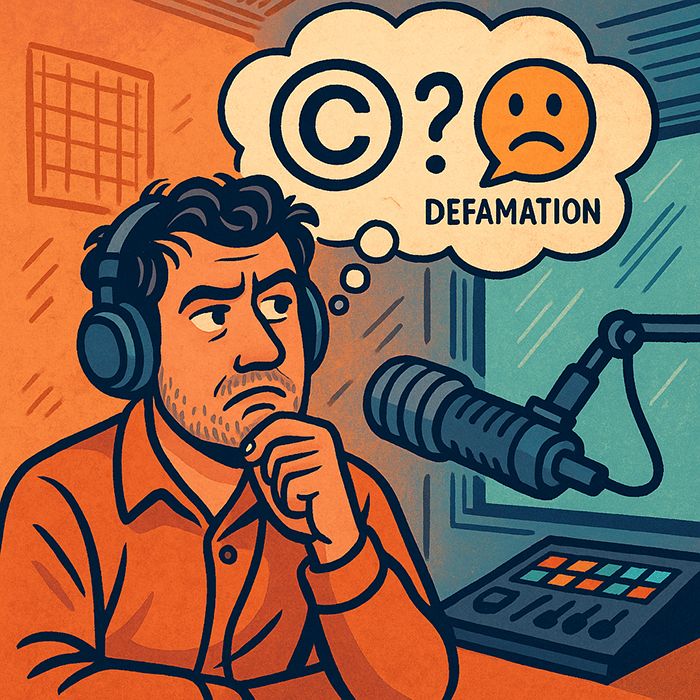
When One Clip Cuts Two Ways: How Copyright and Defamation Risks Collide

img

By Matthew B. Harrison
TALKERS, VP/Associate Publisher
Harrison Media Law, Senior Partner
Goodphone Communications, Executive Producer

imgA radio (or video podcast) host grabs a viral clip, tosses in some sharp commentary, and shares it online. The goal? Make some noise. The result? A takedown notice for copyright infringement – and then a letter threatening a defamation suit.

Sound far-fetched? It’s not. In today’s media world, copyright misuse and defamation risks often run on parallel tracks – and sometimes crash into each other. They come from different areas of law, but creators are finding themselves tangled up in both over the same piece of content.

Copyright Protects Ownership. Defamation Protects Reputation

It’s easy to think of copyright and defamation as two separate beasts. One guards creative work. The other shields reputation. But when creators use or edit someone else’s content – especially for commentary, parody, or critique – both risks can hit at once.

Take Smith v. Summit Entertainment LLC (2007). Smith wrote an original song. Summit Entertainment slapped him with a false DMCA takedown notice, claiming copyright they didn’t actually own. Smith fought back, suing not just for the bogus takedown but also for defamation, arguing that Summit’s public accusations hurt his reputation. The court said both claims could go forward.

That case shows just how easily copyright claims and defamation threats can pile up when bad information meets bad behavior.

Murphy v. Millennium Radio: A Close Call with a Clear Message

In Murphy v. Millennium Radio Group LLC, a New Jersey radio station scanned a photographer’s work – with his credit – and posted it online without permission. That alone triggered a copyright claim. But the hosts didn’t stop there. They mocked the photographer on-air, which sparked a defamation lawsuit.

Even though the copyright and defamation claims came from different actions – using the photo without permission and trash-talking the photographer – they landed in the same legal fight. It’s a reminder that separate problems can quickly become one big headache.

Why This Double Threat Matters

Fair Use Isn’t a Free Pass on Defamation. Even if you have a solid fair use argument, that won’t protect you if your edits or commentary twist facts or attack someone unfairly.
Public Comments Can Double Your Trouble. The second you speak publicly about how you’re using content – whether you’re bragging about rights you don’t have or taking a shot at someone – you risk adding a defamation claim on top of an IP dispute.
Smart Lawyers Play Both Angles. Plaintiffs know the playbook. They’ll use copyright claims for takedown leverage and defamation claims for reputational damage – sometimes in the same demand letter.
FCC Rules Don’t Cover This. It doesn’t matter if you’re FCC-regulated or a podcaster on your own. These risks come from civil law – and they’re coming for everyone.

The Takeaway

The overlap between copyright and defamation isn’t just a legal footnote – it’s a growing reality. In a world of viral clips, reaction videos, and borrowed content, creators need to watch how they frame and comment on what they use, just as much as whether they have permission to use it in the first place.

Because when one clip cuts two ways, you could take a hit from both directions.

Matthew B. Harrison is a media and intellectual property attorney who advises radio hosts, content creators, and creative entrepreneurs. He has written extensively on fair use, AI law, and the future of digital rights. Reach him at Matthew@HarrisonMediaLaw.com or read more at TALKERS.com.

Industry Views

The Soundbite Trap: How Editing in Radio and Podcasting Creates Legal Risk

By Matthew B. Harrison
TALKERS, VP/Associate Publisher
Harrison Media Law, Senior Partner
Goodphone Communications, Executive Producer

imgIn radio and podcasting, editing isn’t just technical – it shapes narratives and influences audiences. Whether trimming dead air, tightening a guest’s comment, or pulling a clip for social media, every cut leaves an impression.

But here’s the legal reality: editing also creates risk.

For FCC-regulated broadcasters, that risk isn’t about content violations. The FCC polices indecency, licensing, and political fairness – not whether your edit changes a guest’s meaning.

For podcasters and online creators, the misconception is even riskier. Just because you’re not on terrestrial radio doesn’t mean you’re free from scrutiny. Defamation, false light, and misrepresentation laws apply to everyone — whether you broadcast on a 50,000-watt signal or a free podcast platform.

At the end of the day, it’s not the FCC that will hold you accountable for your edits. It’s a judge.

1. Alex Jones and the $1 Billion Lesson

Alex Jones became infamous for promoting conspiracy theories on Infowars, especially his repeated claim that the Sandy Hook shooting was a hoax – supported by selectively aired clips and distorted facts.

The result? Nearly $1 billion in defamation verdicts after lawsuits from victims’ families.

Takeaway: You can’t hide behind “just asking questions” or “it was my guest’s opinion.” If your platform publishes it – over the airwaves or online – you’re legally responsible for the content, including how it’s edited or framed. 

2. Katie Couric and the Gun Rights Group Edit

In “Under the Gun,” filmmakers inserted an eight-second pause after Katie Couric asked a tough question, making it seem like a gun rights group was stumped. In reality, they had answered immediately.

The group sued for defamation. The case was dismissed, but reputations took a hit.

Takeaway: Even subtle edits – like manufactured pauses – can distort meaning and expose creators to risk. 

3. FOX News and the Dominion Settlement

FOX News paid $787 million to Dominion Voting Systems after airing content suggesting election fraud – often based on selectively edited interviews and unsupported claims.

Though FOX is (among other things) a cable network, the impact shook the media world. Broadcasters reassessed risks, host contracts, and editorial practices. 

Takeaway: Major networks aren’t the only ones at risk. Radio hosts and podcasters who echo misleading narratives may face similar legal consequences. 

4. The Serial Podcast and the Power of Editing

“Serial” captivated millions by exploring Adnan Syed’s murder conviction. While no lawsuit followed, critics argued the producers presented facts selectively to build a certain narrative. 

Takeaway: Even without a lawsuit, editing shapes public perception. Misleading edits may not land you in court but can damage trust and invite scrutiny.

Whether you’re behind a radio microphone or a podcast mic, your editing decisions carry weight – and legal consequence.

The FCC might care if you drop an indecent word on air, but they won’t be the ones suing you when a guest claims you twisted their words. That’s civil law, where defamation, false light, and misrepresentation have no broadcast exemption.

There’s one set of rules for editing that every content creator lives by – and they’re written in the civil courts, not the FCC code.

Edit with care. 

Matthew B. Harrison is a media and intellectual property attorney who advises radio hosts, content creators, and creative entrepreneurs. He has written extensively on fair use, AI law, and the future of digital rights. Reach him at Matthew@HarrisonMediaLaw.com or read more at TALKERS.com.

Industry News

Monday Memo: We’re There, Too

By Holland Cooke
Consultant

imgHow obsolete does this sound? “Newsweek magazine.” News, gathered during most-of the week, had to be frozen by week’s-end, on deadline, to roll the presses in time for hard copy to be delivered in Monday’s snail mail. Back then – picture people dressed like “Mad Men” characters – enough subscribers felt informed-enough to deliver Return On Investment for the magazine’s advertisers. Seems antique. Now, news is reported moment-to-moment, on any device. And newsweek.com is there… along with everyone else competing for attention.

Also quaint: that “clock radio” on the nightstand, which accomplished two-of-many functions now on smartphones. And the “transistor radios” heard all along the beach this time of year in the 1960s? In Providence, the capital city here in The Ocean State, an AM 630 signal superior to its AM 1290 Top 40 competitor led WPRO to brand itself as “The Station That Reaches the Beaches.” Now, there are smart speakers on those beach blankets. I live at the beach and hear them playing Pandora and Spotify.

Good news, but…

Radio is still the #1 in-car audio; increasingly ported there via smartphone app, if stations have explained theirs well. And there’s plenty of other audio on those phones, and on the smart speakers that brought radio back in-home… unless we ask Alexa to instead “play hotel poolside music” or ask her for the weather or some other heretofore radio content.

im

Repetition builds habit, and to best explain that we’re there too, you should audit the user’s experience consuming your stream. Does “Just say ‘Alexa, play 102.3 WXXX’” or “Hey Siri, play KXXX on TuneIn” get you there? Does the smartphone app instantly play your on-air programming, or are multiple clicks required?

More important than Where and How to listen: Why?

Radio’s real-time nature is still its superpower, and if your station has earned a news reputation, listeners will find you – however they listen – when the fit hits the shan. And between bombshells, diligent stations whose real-time audio seems helpful and relevant and uniquely local will be habit-forming and keep ‘em comin’ back for more. Adding push notifications, breaking news alerts, and other direct engagement can bridge the gap, prompting more live listening.

Beyond that “linear” delivery, our on-demand culture favors predictable utility. Smart stations repurpose their best moments into snackable content: a daily local news roundup, your morning show’s funniest bit, or the weather and event calendar for the weekend; all sponsorable. ICYMI, my recent TALKERS column: Feature The Moments That Matter.

Your over-the-air signal is still the beating heart of your operation. Your call letters are a family surname, these new platforms are siblings. They’re extensions, not threats; extra doors into your house. Make sure they’re open wide, easy to find, and lead to something welcoming. Ideally something they can’t hear anywhere else.

Holland Cooke (HollandCooke.com) is a media consultant working at the intersection of broadcasting and the Internet. Follow HC on Twitter @HollandCooke

Industry News

SABO SEZ: Cash Comes from Ideas, Not Budgets

By Walter Sabo
a.k.a. Walter Sterling, Host
WPHT, Philadelphia, “Walter Sterling Every Damn Night”
and TMN syndicated, “Sterling on Sunday”

imgThere are two broad categories of thought: Task. Creative. When in creative mode, a person innovates, imagines, plans, and solves problems. An idea bank is a bank! Money grows from the results of imagination: new products, new music, new formats, new sales strategies. Business growth depends on new!

Task mode is focused on the past. Accounting, legal, sorting, painting, mowing, eating, surviving. Tasks are essential activities but financially break even, at best.

Your colleagues probably suffer from thoughts of radio industry consolidation and cutbacks. Personally, there was a moment in my career that still haunts me at this writing. A moment more profound than consolidation or repeal of FCC ownership financial requirements.

The crash moment in the history of radio was when a program director uttered these words:

It’s not in the budget.”

The words were less shocking than the source. Owners and general managers had said, we don’t have the money, but never the program director. Program directors, in my experience, lived in a charged creative fantasy. They imagined better shows, contests, DJ patter, bigger, better, fun-er radio for bigger ratings. Programmers thrived in an environment of creative challenges rather than tasks. PDs were often not even shown their budgets.

Creative-mode results in breathtaking promotions (win a house, win your rent, win a six pack of Corvettes.) Audience-daring formats such as album-oriented rock and all sports. Exciting air talent: Howard SternNeil RogersJake FogelnestJohn Kobylt.

Programmers heard general managers say, “A good salesman is one with a good product.” Or, “If you deliver ratings, the sales department will sell it.” Intuitively, general managers and owners knew that if they kept their programmers and talent on the creative side of their brains, the station could succeed.

There were conversations between general managers and program directors when the PD would have “suggestions” about sales and the GMs would say, “That’s the sales manager’s job” and shut down the PD! Therefore, PDs were kept on the creative side of their brains, the idea bank.

Driving a new idea, a new format, promotion, or on-air technique demands a programmer’s knowledge and passion. Without passion, few new strategies are launched. Birthing a new idea in radio is way too difficult to achieve with just logic. New ideas come to exist by fighting for budgets, fighting to win acceptance from staff.

New ideas are worth the fight because they can bring audience growth and fresh cash.

As the industry puzzles over declining sales, declining youth listening, and declining buzz, don’t blame consolidation and streaming. Blame owners that have given programmers the ultimate excuse to not try new ideas, not push new promotions, not embrace fresh talent, not take risks that lead to growth. “It’s not in the budget.” 

Shut the door on your way out. 

Walter Sabo has been a C Suite action partner for companies such as SiriusXM, Hearst, Press Broadcasting, Gannett, RKO General and many other leading media outlets. His company HITVIEWS, in 2007, was the first to identify and monetize video influencers.. His nightly show “Walter Sterling Every Damn Night” is heard on WPHT, Philadelphia. His syndicated show, “Sterling On Sunday,” from Talk Media Network, airs 10:00 pm-1:00 am ET, and is now in its 10th year of success. He can be reached by email at sabowalter@gmail.com.

Industry News

FCC Continues Deregulation Campaign

The Federal Communications Commission announces its latest effort to remove outdated and unnecessary rules and regulations as part of its “Delete, Delete, Delete” initiative. Specifically, the action will remove from its regulations approximately 2,991 words and 41 rules or requirements concerning utility-style burdens on theimg Internet adopted under the Biden Administration and network interconnection. FCC chairman Brendan Carr says, “We’re continuing to clean house at the FCC, working to identify and eliminate rules that no longer serve a purpose, have been on our books for decades, and have no place in the current Code of Federal Regulations. Today’s action is just the latest step the FCC is taking to follow the Trump Administration’s effort to usher in prosperity through deregulation.  And it’s just one of many, with more on the horizon, so stay tuned.”

Industry Views

You Cut for Time. They Cut You a Lawsuit.

By Matthew B. Harrison
TALKERS, VP/Associate Publisher
Harrison Media Law, Senior Partner
Goodphone Communications, Executive Producer

imgLet’s discuss how CBS’s $16 million settlement became a warning shot for every talk host, editor, and content creator with a mic.
When CBS settled a lawsuit with Donald Trump for $16 million over a selectively edited “60 Minutes” interview with Kamala Harris, it wasn’t about guilt. It was about leverage. The lawsuit happened to coincide with Paramount’s FCC merger review – coincidentally, right when regulatory pressure was needed the most.

For broadcasters and digital creators alike, the message is clear: even lawful edits can become political weapons. If you shape content, you’re a target. And the courts aren’t the only battleground. Public outrage, regulatory scrutiny, and advertiser anxiety all shape the cost of controversy.

For Broadcasters: Every Cut Counts

Editing always alters reality. That doesn’t make it wrong – but it makes it risky. Even good-faith trims for time or tone can be reframed as distortion. What matters isn’t just what you cut, but whether you can defend it.

Case in Point: “60 Minutes” vs. DeSantis

CBS was accused of misleading edits in a 2021 vaccine rollout story. They published full transcripts and stood their ground. No apology, no payout.

Takeaways:

— Archive raw footage.
— Log your editorial decisions.
— Be ready to explain your process with clarity and conviction.

For Digital Creators: You’re Not as Untouchable as You Think

Section 230 might protect platforms, but it doesn’t shield you from smear campaigns, takedowns, or frivolous lawsuits. Editing with commentary or critique is often fair use – but that doesn’t stop bad-faith actors from flipping the narrative.

Case in Point: “Decoding Fox News”

Jules Terpak’s critique series survived coordinated attacks thanks to clear sourcing, transparency, and credibility built ahead of time.

Takeaways:

— Know your rights, but also your vulnerabilities.
— Keep receipts.
— Build audience trust before someone tries to burn it down.

The Real Risk Isn’t the Edit – It’s the Optics

Trump didn’t need to win the lawsuit. He just needed the headlines – and CBS needed their merger. Settlements aren’t always about truth. They’re about timing.

So protect yourself:

— Document your work.
— Develop internal standards.
— Don’t panic under pressure – prepare for it.

Because in an era where outrage spreads faster than facts, defending the integrity of your edit isn’t optional. It’s essential.

Matthew B. Harrison is a media and intellectual property attorney who advises radio hosts, content creators, and creative entrepreneurs. He has written extensively on fair use, AI law, and the future of digital rights. Reach him at Matthew@HarrisonMediaLaw.com or read more at TALKERS.com.

Industry News

KXNO, Des Moines Unveils New Lineup

iHeartMedia’s sports talk KXNO, Des Moines is debuting its new program lineup after the departure of a number of local hosts over the past six months or so. Last year, the “Murph and Andy Show” starring Keith Murphy and Andy Fales exited for a podcast initiative. Also exiting were Ross Peterson in late 2024 andimg morning drive personality Travis Justice in January of this year. New in morning drive are Heather Burnside (who moves from the PM drive show) and Alec Busse hosting “The 1st Quarter.” Ken Miller and Trent Condon continue in the 12:00 noon to 2:00 pm slot, and program director and personality Sean Roberts partners with Lucas Strain for the afternoon drive “Off the Bench” show. Overtime Iowa – a “best of the day” program – airs from 5:00 pm to 6:00 pm.

Industry News

WJR, Detroit Names Ryan Ermanni Afternoon Host

Cumulus Media’s news/talk WJR, Detroit appoints Ryan Ermanni host of the 2:00 pm to 4:00 pm show, effective today (7/7). Ermanni is well known in the Detroit market as co-host of  “The Nine” on WJBK-TV FOX 2 Detroit where he served for more than 20 years. Cumulus Detroit/Ann Arbor regional VP and marketimg manager Steve Finateri says, “Ryan Ermanni is not only a seasoned broadcaster with deep roots in Detroit media, he’s also a longtime fan of WJR. His passion for Detroit, his engaging on-air presence, and his respect for what WJR represents make him a perfect fit for our team.” Ermanni comments, “I am so honored to be a part of the WJR daily lineup. I’ve always considered myself just a regular guy from the neighborhood who happens to have a really cool job. The WJR call letters mean something to me, as they do for many people who have grown up in our city and our state. I hope to build the same trust and connection here on WJR as I did at FOX 2. I’m not your typical newsman. I wear my personality on my sleeve, and I react to stories the way someone might if they were sitting at home or in their car. We joke that I’m a “man of the people” — and honestly, I take that as the highest compliment. What you see is what you get. So, if you spot me around town, don’t be shy – come say hello.”
Industry News

FCC Commissioner Gomez Criticizes Paramount-Trump Settlement

FCC Commissioner Anna M. Gomez is calling out Paramount for its settlement with Donald Trump over what she calls “a meritless lawsuit regarding a CBS News interview last year.” Gomez says, “This moment marks a dangerous precedent for the First Amendment, and it should alarm anyone who values a free and independent press. Despite repeated attempts to deny the obvious, this Paramount Payout is a desperateimg move to appease the Administration and secure regulatory approval of a major transaction currently pending before the FCC. For months, it has been clear that this lawsuit was entirely meritless, just like the complaint now before the Commission. The transcript and video of the 60 Minutes interview with Vice President Harris show no evidence of wrongdoing, only the standard editorial judgments used across the news industry to ensure clarity and brevity. Had Paramount chosen to fight this in court, they would have prevailed on the facts and the law. But instead of standing on principle, Paramount opted for a payout. That decision now casts a long shadow over the integrity of the transaction pending before the FCC. Given the extraordinary public interest in this deal, the novel legal questions raised by the lawsuit and its resolution, and the repeated calls from lawmakers for transparency, I once again urge the FCC to bring this matter before the full Commission for a vote. Approving this transaction behind closed doors and under the cover of bureaucratic process would be a shameful outcome that denies the American people the transparency and accountability they deserve, especially when press freedom is at stake.”

Industry News

FCC Chairman Carr Promotes Build Agenda in Sioux Falls

FCC Chairman Brendan Carr was in Sioux Falls, South Dakota yesterday (7/2) to promote the FCC’s “Build America Agenda.” Carr said, “Our ‘Build America Agenda’ will focus on delivering on a number of core objectives. We will unleash high-speed infrastructure builds. We will restore America’s leadership in wireless. We will boost the U.S. space economy. We will advance our national security. And we willimg strengthen America’s tower and telecom workforce.  We will deliver on all of this by implementing smart policies while carrying out a massive and comprehensive deregulatory agenda. As we do so, we will be guided at the agency by a few simple ideas. For one, we will keep the Gretzky test front and center. We want to keep our eye on where the proverbial puck is going, not where it has been. For another, we are going to take a first principles approach. Just because a regulation has been on the books for 30 years, we are not going to keep it there simply out of a sense of inertia. For still another, we will focus on competition as it exists today. The old regulatory silos have been breaking down for quite some time, so the agency must move forward with a keen understanding of today’s converged markets.  We are going to focus on outcomes, rather than process to nowhere. We are going to have a bias towards action. After all, delay has an unappreciated economic and social cost. We are going to push for simple, clear rules, rather than complex and bespoke frameworks. And we are going to support U.S. businesses and domestic onshoring.”