By Matthew B. Harrison
TALKERS, VP/Associate Publisher
Harrison Media Law, Senior Partner
Goodphone Communications, Executive Producer
 When Georgia-based nationally syndicated radio personality, and Second Amendment advocate Mark Walters (longtime host of “Armed American Radio”) learned that ChatGPT had falsely claimed he was involved in a criminal embezzlement scheme, he did what few in the media world have dared to do. Walters stood up when others were silent, and took on an incredibly powerful tech company, one of the biggest in the world, in a court of law.
Taking the Fight to Big Tech
Walters, by filing suit against OpenAI, the creator of ChatGPT, become the first person in the United States to test the boundaries of defamation law in the age of generative artificial intelligence.
His case was not simply about clearing his name. It was about drawing a line. Can artificial intelligence generate and distribute false and damaging information about a real person without any legal accountability?
While the court ultimately ruled in OpenAI’s favor on specific legal procedure concerns, the impact of this case is far from finished. Walters’ lawsuit broke new ground in several important ways:
— It was the first known defamation lawsuit filed against an AI developer based on content generated by an AI system.
— It brought into the open critical questions about responsibility, accuracy, and liability when AI systems are used to produce statements that sound human but carry no editorial oversight.
— It continued to add fuel to the conversation of the effectiveness of “use at your own risk” disclaimers when there is real world reputational damage hanging in the balance.
Implications for the Radio and Podcasting Community
For those spoken-word creators, regardless of platform on terrestrial, satellite, or the open internet, this case is a wake-up call, your canary in a coal mine. Many shows rely on AI tools for research, summaries, voice generation, or even show scripts. But what happens when those tools get it wrong? (Other than being embarrassed, and in some cases fined or terminated) And worse, what happens when those errors affect real people?
The legal system, as has been often written about, is still playing catch-up. Although the court ruled that the fabricated ChatGPT statement lacked the necessary elements of defamation under Georgia law, including provable harm and demonstrable fault, the decision highlighted how unprepared current frameworks are for this fast-moving, voice-driven digital landscape.
Where the Industry Goes from Here
Walters’ experience points to the urgent need for new protection and clearer guidelines:
— Creators deserve assurance that the tools they use are built with accountability in mind. This would extend to copyright infringement and to defamation.
— Developers must be more transparent about how their systems operate and the risks they create. This would identify bias and attempt to counteract it.
— Policymakers need to bring clarity to who bears responsibility when software, not a person, becomes the speaker.
A Case That Signals a Larger Reckoning
Mark Walters may not have won this round in court, but his decision to take on a tech giant helped illuminate how quickly generative AI can create legal, ethical, and reputational risks for anyone with a public presence. For those of us working in media, especially in formats built on trust, voice, and credibility, his case should not be ignored.
“This wasn’t about money. This was about the truth,” Walters tells TALKERS. “If we don’t draw a line now, there may not be one left to draw.”
To listen to a longform interview with Mark Walters conducted by TALKERS publisher Michael Harrison, please click here
Media attorney, Matthew B. Harrison is VP/Associate Publisher at TALKERS; Senior Partner at Harrison Media Law; and Executive Producer at Goodphone Communications. He is available for private consultation and media industry contract representation. He can be reached by phone at 724-484-3529 or email at matthew@harrisonmedialaw.com. He teaches “Legal Issues in Digital Media” and serves as a regular contributor to industry discussions on fair use, AI, and free expression.
Share this with your network



 The weekend program – hosted by Mark Walters – “Armed American Radio” is added to the program lineup at four stations including WZGM-AM, Asheville, North Carolina and WXZQ-FM, Columbus, Ohio. The “AAR Daily Defense Hour” adds three new affiliates including WNWS-FM, Jackson, Tennessee.
 the Corporation” because it was established to be a private non-profit corporation independent from governmental control or influence. This comes after the Trump administration attempted to remove three of the CPB’s board of directors – Laura G. Ross, Thomas E. Rothman, and Diane Kaplan – earlier this year. CPB CEO Patricia Harrison says, “We are very pleased that the Court recognized CPB is an independent, non-profit corporation, free from governmental control or influence, and CPB, board and management, looks forward to continuing our work with policymakers and other stakeholders to ensure accurate, unbiased and nonpartisan public media is available for all Americans.”
 end of this week. It has been the greatest honor of my professional life to serve the American people as a Commissioner. I am deeply honored to have been entrusted with this responsibility by President Donald J. Trump during his first term.
 “Fewer than half of Americans plan to travel this Summer,” according to a
 driving brand preference is ‘mental availability’: how well known a brand is, and how easily it comes to mind. Brands with low mental availability tend to struggle, rejected in favor of more familiar rivals. Or not considered in the first place. Brands with high mental availability don’t have to push so hard to sell, so tend to have higher market shares and better margins.” The authors also advise, “Always aim to get more customers from all segments of the market. It’s the main way brands grow.” The blog post concludes that AM/FM radio makes your media plan better by increasing reach. One example is illustrated as follows: Edison’s “Share of Ear” study of ad-supported audio reveals the combined persons 18+ daily reach of Pandora and Spotify is only 12% of Americans. Adding podcasts causes reach to surge to 29%. The introduction of AM/FM radio lifts daily reach to 74%.
  School with Dom Giordano” – a phrase inspired by the recent TALKERS conference “Generations 2025” held earlier this year in conjunction with IBS NY 2025. The podcast will be carried on the industry’s major platforms.
 Dozens of brand-new audio hardware and software companies have been launched during the past 20 years. These start-ups are usually funded by venture capital money. VC money is not invested to return a profit, it’s poured in to – pour it in. Their money is “different” than the cashflow that fuels your business. Start-up money buys time to profit.
 In a ruling that should catch the attention of every talk host and media creator dabbling in AI, a Georgia court has dismissed “Armed American Radio” syndicated host Mark Walters’ defamation lawsuit against OpenAI. The case revolved around a disturbing but increasingly common glitch: a chatbot “hallucinating” canonically false but believable information.
 TALKERS publisher Michael Harrison introduced the term in the 1990s, inviting us to think-beyond the real-time audio we were sending up those towers. What he described seemed conceptual, even futuristic, back then, when we were still logging-onto AOL via dial-up (screech).
 and public television have enjoyed bipartisan support since 1967. The system has a profound impact on Americans in all 50 states and in every type of community—urban, suburban, rural, and remote. This indispensable service costs the American taxpayer about $1.60 a year, and it is one that the majority of Americans want to maintain. Recent polling from the Pew Research Center shows that only 24 percent of Americans support cutting federal funding. The budget request and executive order are only part of the administration’s ongoing effort to dismantle the American public broadcasting system as we know it. We expect even more to come. If successful, the effort will exacerbate existing news deserts and create new ones, as public radio has become the main (or only) remaining source for fact-based local news, educational and cultural programming, and critical emergency broadcast services in many communities across the country.” He encourages them to contact their legislators and to either donate or increase one’s current contribution to the public broadcasting organization.
 “ArtsBeat,” “Athenaeum Spotlight,” and “On The Mark” for WCPC, Channel 15 and WSKB-FM 89.5, both in Westfield, MA. He was a regular contributor to Berkshire Onstage and a member of the Berkshire Theatre Critics Association. His weekly column “Arts Beat” appeared in The Westfield News. In his youth, Auerbach studied theater at American University and the Yale School of Drama. During his multimedia career his impact was felt nationwide, and he was an indefatigable fundraiser for public broadcasting. As a publicist, he was a devoted supporter of the Springfield Symphony Orchestra and numerous other not-for-profit artistic organizations. TALKERS publisher and local Western Mass resident Michael Harrison states, “I am proud to have been able to call Mark Auerbach a friend for the past 39 years, during which time I have come to respect and admire him as one of the finest media practitioners with whom I have had the pleasure of working. He was a champion of the arts and all that celebrates the humanities in our modern multimedia environment. He was a local giant on a multitude of levels and leaves an irreplaceable void in this part of America’s grassroots media community.” Auerbach requested no funeral services but said if people wish to do something in his memory they can make a gift to either Springfield Chamber Players MOSSO) (
 Global, the parent company of CBS, have begun charging what’s known as ‘reverse’ retransmission fees to broadcasters. The networks demand a share of broadcasters’ revenue for the right to use their content. This practice was once unheard of, but some networks now regularly require more than 100% of broadcasters’ retransmission fees as ‘reverse’ fees, leaving broadcasters to sustain themselves solely on whatever ad sales they can make with their limited inventory (also capped by the networks, and often amounts to only a few minutes of airtime per hour). This funnels more and more money out of local markets and local journalism and into the hands of mega media corporations, who threaten broadcasters with content blackouts if they don’t get sky-high payouts.” They go on to argue that the “problem gets even worse with providers like YouTube TV and Hulu Live. Under their affiliate agreements with the networks, local affiliates can’t even negotiate for online providers to carry the content. The networks do it for them and pay the affiliates whatever they deem reasonable (sometimes, nothing). This gives the networks total control over streaming distribution while robbing local stations of revenue and autonomy in the rapidly growing online video space. What was once a mechanism to support hometown news is now a corporate racket. Instead of investing in local reporters, meteorologists, and producers, local broadcasters’ funds are siphoned to bloated national newsrooms that churn out anti-Trump propaganda and woke talking points. Meanwhile, higher cable bills pass the cost to everyday Americans.”
 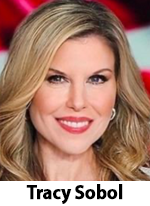 is “bringing America the headlines that matter – fast, accurate, and in-depth. Anchor Tracy Sobol covers politics, economy, culture, and global affairs with trusted analysis and real-time reporting from coast to coast and around the world.” Sobol comes to Newsmax from EWTN where she anchored “EWTN News Nightly.” Sobol comments, “I am thrilled and honored to be joining Newsmax. I could not be more excited to be a part of one of the fastest-growing news organizations, bringing real news to Americans. There is no place that I would rather be.”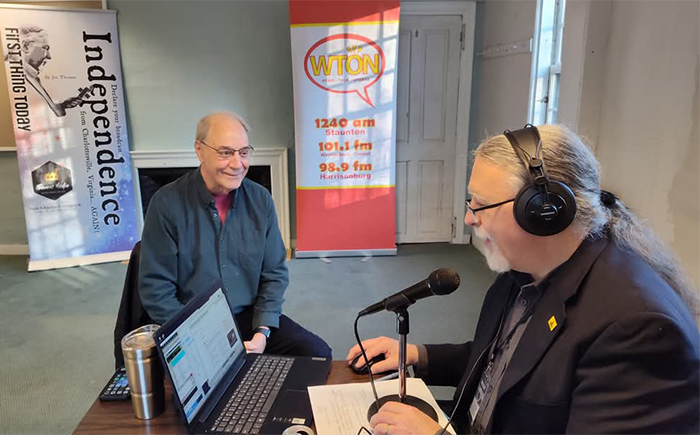
 agreement under which Trump Jr. and Salem will work together to develop a series of high-impact promotional and growth initiatives. At the same time, Salem enters into a strategic agreement with Lara Trump to collaborate on business growth in the digital podcast space, advertiser partnerships, and content innovation. Both Trumps become significant stakeholders in Salem Media. Salem CEO David Santrella states, “These aren’t just partnerships, they’re power moves. Donald Trump Jr. and Lara Trump bring credibility, energy, and the kind of megaphone that moves markets and shapes public opinion. Their alignment with Salem signals a massive leap forward in our ability to lead the next era of conservative media. Donald Trump Jr. and Lara Trump aren’t just becoming business partners with Salem, they now also have significant ownership stakes in the company with a major incentive to grow shareholder value which in turn will drive the stock price. It’s definitely an exciting time to be a Salem shareholder.”
 AURN’s programming operations and traffic initiatives. Tracey Lee is also promoted to senior director of program operations, traffic and affiliations. AURN AVP of program operations and affiliations Lenore Williams says, “Both Carrie and Tracey exemplify the leadership, dedication and passion that drive our success. Their deep experience and dedication to AURN’s mission have made them invaluable assets to the team. These promotions are not only well deserved, but also pivotal as we expand our impact and continue to lead the industry in service to our affiliates and advertisers.”
 YouTube with ads, SiriusXM talk channels, free versions of streaming audio sources, and podcasts. Breaking it down demographically, time spent with ad-supported sources is highest among Americans age 55+, with 75% of their audio time spent with ad-supported audio. While the 18-34 demographic spends the majority of its audio time with ad-supported audio sources, 46% of its listening time is spent with ad-free audio. Edison says, “The strength of ad-free audio with this age group is not surprising considering that younger Americans spend more time on platforms that make removing advertisements easy and not terribly expensive, such as Spotify and YouTube.”
 Radio sells advertisers our listeners’ attention. For a hundred years, our inventory has largely been commercials. Now, as our wandering audience leads us to more revenue channels, are we hooked on spots?
 representative survey of over 4,000 people “identifies a significant identity crisis driven by the convergence of audio-only content and video formats popularized by platforms like YouTube and Spotify.” It shows: 1) 72% of Americans 12+ consider recordings of people discussing any topic on YouTube that are also available as audio-only shows elsewhere to be a podcast; 2) Advertisers face significant barriers to investment due to inconsistent standards, fragmented reporting, and unclear attribution; and 3) A clear, shared definition and interoperable measurement are urgently needed to realize podcasting’s full economic potential. Regarding defining podcasts, they propose new working definitions as follows: Podcast (noun): “An on-demand audio-driven program featuring episodic content across wide-ranging themes and formats. Traditionally delivered via open RSS and conversational in nature, it can include platform-based distribution and is commonly supplemented by video.” And Video Podcast (noun): “An episodic, on-demand program centered on spoken-word content, where synchronized visuals meaningfully shape the experience.”
  Exchange under the ticker symbol NMAX. CNBC reports that the rise brought the company’s market capitalization to “nearly $30 billion – surpassing the market cap of legacy media companies like Warner Bros. Discovery and Fox Corp.” Newsmax CEO Christopher Ruddy told CNBC, “Americans for a long time have been voting with their remote controls, downloads, apps to say they want Newsmax. Now investors powerfully are buying Newsmax shares because they like us, they value us and they want us to keep growing.”
 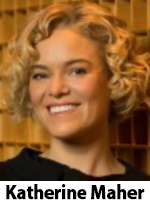 election, its reporting on the origins of the coronavirus in China, and the investigation into Trump’s ties to Russia during his first term. U.S. Rep. Jim Jordan (R-OH) told Maher, “You guys were 0-for-3 on three of the biggest stories in the country.” Maher was also pressed by U.S. Rep. William Timmons (R-SC) about comments she made before she was CEO of NPR in which she called Donald Trump a sociopath, a racist and deranged and asked how she could helm a news organization with that kind of inherent bias. She replied, “There is strong firewall between me and the newsroom,” and said her political thinking and personal worldview have changed in recent years, adding, “I regret those tweets; I would not tweet them again today.” The story notes that Maher said she “respected” the lawmakers’ concerns and promised NPR is doing more under her watch to “beef up our editorial standards” and “make sure we have more points of view reflected in every story.”
  Broadcasting’s budget in its sights. NPR.org reports Maher says of the hearing, “This could be a perfect storm. That’s why this moment does feel different. It feels as if this is a time that we really do need to step up and make as clear a case as possible.” U.S. Rep. Marjorie Taylor Greene chairs the Subcommittee on Delivering On Government Efficiency and she’s quoted saying, “I want to hear why NPR and PBS think they should ever again receive a single cent from the American taxpayer. These partisan, so-called ‘media’ stations dropped the ball on Hunter Biden’s laptop, downplayed COVID-19 origins, and failed to properly report the Russian collusion hoax. Now, it is time for their CEOs to publicly explain this biased coverage.”
  Podcasting is no longer a niche platform lacking scale. Podcasts deserve a larger role in media plans as opposed to “test and learn” experimental buys. 158 million Americans, 55% of persons 12+, are reached monthly. Among persons 18-34, 18-49, and 25-54, monthly reach is now 65% to 73%; 2) It is feasible to consider shifting TV budgets to podcasting given that podcast 18-34 weekly reach (52%) is as big as TV’s (52%); 3) Brands targeting women should give podcasts a starring role in media plans: Podcast female audiences have hit record highs in habituation and reach; 4) Among male demographics, monthly reach is now in the low 70% range; and 5) Adopt agency media legend Arnie Semsky’s “5% solution” to podcasts: Allocate 5% of digital ad budgets to podcasts.
  key findings of this edition of the study include that podcast consumption has reached an all-time high with 70% of Americans age 12+ having listened to a podcast; 51% of those Americans age 12+ having watched a podcast; 73% of Americans age 12+ having consumed a podcast in either audio or video format, representing an estimated 210 million people; and 55% of Americans age 12+ now being monthly consumers. The study also looked at in-car audio use and finds that among americans age 18+ who have driven or ridden in a car in the past month (88%), 40% have Apple CarPlay or Android Auto, and 33% actively use one of these systems.
 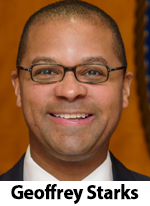 commissioner on the Federal Communications Commission has been the honor of my life. With my extraordinary fellow commissioners and the incredible career staff at the agency, we have worked hard to connect all Americans, promote innovation, protect consumers, and ensure national security. I have learned so much from my time in this position, particularly when I have heard directly from Americans on the issues that matter to them. I have been inspired by the passion, engagement and commitment I have seen from colleagues, advocates, and industry. Over the next few weeks, I look forward to working with the chairman and my fellow commissioners, and all FCC staff, to further the mission of the agency.” Starks is one of two Democrats currently serving on the Commission.