 Incorporating copyrighted material, such as video clips or actualities, can enhance your content, but understanding fair use is critical to avoid legal trouble. Fair use permits limited use of copyrighted material for purposes like criticism, commentary, news reporting, or parody without needing permission. Courts assess fair use based on four factors: purpose and character of the use (is it transformative?), nature of the work (factual vs. creative), amount used, and the effect on the market. Learn practical tips on safely navigating fair use, including using brief excerpts, transforming content, and considering market impact.
This is the second in a series of articles addressing the broader topic of fair use for media creators. Click here for the first installment.
Understanding Fair Use: Purpose and Character of the Use. When using copyrighted material belonging to others in the creation of your own media content, it is important to understanding the concept of fair use. Fair use allows copyrighted material to be used without permission for purposes like criticism, commentary, news reporting, education, or parody. It’s not an absolute right but rather a defense you can claim if challenged. Courts assess fair use based on four key factors, all which broadcasters should carefully consider.
The first factor of fair use that courts consider is the purpose and character of the use. Specifically, is the use of the material transformative? Transformative use is a key concept that can often determine whether your content qualifies as fair use or not – and really is the heart of the inquiry.
What Does Transformative Mean? In legal terms, a use is considered transformative when it adds new expression, meaning, or message to the original work. This is different from merely copying the work or using it for the same purpose as the original creator. By transforming the material, you’re creating something that serves a different purpose or offers new insights, rather than simply replicating the original content.
Example: Auto-Tune the News. One of the most famous examples of transformative use is the Gregory Brothers’ viral “Auto-Tune the News” series, which turned news clips into catchy, auto-tuned songs. In 2010, they took an interview clip with Antoine Dodson, who was describing an attempted home invasion, and turned it into the widely popular “Bed Intruder Song.” In this case, the original news segment was purely factual—a straightforward broadcast of a local news report. However, by remixing the clip with auto-tuned vocals and adding music, the Gregory Brothers transformed the clip into a piece of entertainment and social commentary. This new purpose—entertainment and humor—was distinct from the original intent of simply delivering news, making it a classic example of transformative use. Although the raw news footage was copyrighted, the remix was so different in tone, presentation, and purpose that it was protected under fair use. The transformation added new creative elements and reframed the original material as a humorous, catchy song.
How Does This Apply to Radio? Let’s take this concept and apply it to radio, a medium that often uses clips from other sources. Imagine you’re running a talk show, and you want to use excerpts from a political speech to make a satirical point about current events. If you simply play the speech on air without any changes, it may not qualify as fair use because you haven’t transformed the original material – you’re just rebroadcasting it. However, if you take portions of the speech and then critique, analyze, or poke fun at it, you’re more likely to be in the clear. For example, if your show involves playing clips of political speeches interspersed with humorous commentary or parody, you’re repurposing the original work in a new and transformative way—much like “Auto-Tune the News.”
Another example could be a radio show that plays clips from popular songs but recontextualizes them within a larger discussion of musical trends or cultural history. If the song clips are used to illustrate a point and not simply for entertainment value, the new purpose—educational or critical analysis—can qualify the use as fair. In cases involving parody or political commentary on radio, the fair use defense has sometimes been successful. For instance, radio shows that use short clips from speeches, interviews, or news broadcasts for commentary, satire, or criticism can invoke fair use if the content is transformed for a new purpose.
One example is when talk radio shows play brief excerpts of copyrighted works (e.g., speeches, news clips) to critique or analyze them. If the use is transformative and doesn’t replace the original work in the marketplace (i.e., people wouldn’t listen to the radio show as a substitute for the original), courts have shown a willingness to accept fair use in such contexts. However, detailed legal battles involving radio stations using copyrighted material for parody or commentary are less common than those involving music licensing.
Example: Rogers v. Koons (Rebroadcast of News Content). While not as widely reported as music-related cases, one example of a copyright infringement suit involving the rebroadcast of talk content was a case where a news organization sued a radio station for replaying portions of its copyrighted interviews and reports without permission. In cases like this, radio stations or broadcasters may try to claim fair use based on the purpose of the rebroadcast, such as using a portion of an interview for commentary, satire, or news reporting. However, if the content is used purely to replay the original, as opposed to being transformed into a new, critical, or educational piece, the fair use defense may not succeed. For example, news stations may license their talk content (like interviews or original reporting) through syndication deals. If a radio station broadcasts this content without securing the necessary licensing agreement, they may face a copyright lawsuit.
Example: Talk Show Hosts and Syndicated Content. A real-world scenario can involve syndicated talk shows or podcasts that are copyrighted. Radio stations can face lawsuits if they replay this content without proper authorization. An example would be stations rebroadcasting popular talk radio shows or political commentaries (such as those by syndicated hosts like Rush Limbaugh or Howard Stern) without purchasing broadcast rights. This unauthorized use can lead to legal action from the copyright holders. For example, if a station replays clips of an interview conducted by NPR or a news network for entertainment or even news purposes, and it doesn’t transform the content for criticism or commentary, it may be violating copyright law. Radio companies might try to claim fair use, but the courts will look closely at whether the replay served a new, transformative purpose or was simply a verbatim rebroadcast.
Key Considerations for Broadcasters. To better understand whether your use of copyrighted content is transformative, ask yourself:
• Are you adding new meaning or message? The more your work transforms the original content – such as using it for commentary, criticism, or satire – the more likely it qualifies as fair use.
• Does your use serve a different purpose? If you’re using the content for a new purpose, like entertainment, education, or social commentary, rather than simply duplicating the original, it can be seen as transformative.
• Are you just using the original for its own sake? If the copyrighted material is used in a way that does not add new expression or meaning, it’s less likely to fall under fair use. Transformative use is a powerful defense in fair use claims, but it’s not a guarantee. Always make sure your purpose and character are different from the original intent of the work, and when in doubt, seek legal counsel.
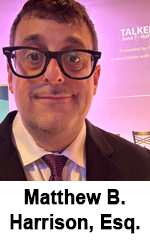
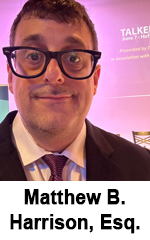
Media attorney, Matthew B. Harrison is VP/associate publisher, TALKERS; Senior Partner, Harrison Media Law; and executive producer, Goodphone Communications. He is available for private consultation and media industry contract representation. He can be reached by phone at 724.484.3529 or email at matthew@harrisonmedialaw.com



 Let’s continue our ongoing series of articles about fair use. A recent case highlights fair use considerations in audio media and podcasting, particularly concerning music and short audio clips used in intros, where some creators assume that brief snippets automatically qualify as “fair use.” Legal experts clarify that using a song clip, even if brief, doesn’t inherently meet fair use criteria. Courts have emphasized that fair use hinges not just on brevity but also on factors like purpose, nature, and market impact on the original work. Music clips, even short ones, are often seen as significant portions of the original content, carrying substantial value, making unauthorized use in podcasts or similar formats legally risky.
 The Broadcasters Foundation of America has launched its annual Year-End Giving Campaign, which seeks to raise donations from tax-deductible personal contributions to the Guardian Fund and corporate contributions to the Angel Initiative. The Broadcasters Foundation, a 501c3 charity, is the only charity devoted exclusively to helping colleagues who are in dire need of monthly or emergency financial assistance due to life-altering illness or a disaster. “We are devoted exclusively to providing aid to colleagues in broadcasting who are suffering from extreme illness, or hardship from a devastating disaster,” stated Tim McCarthy, president of the Broadcasters Foundation. “We also take care of colleagues who have retired. Grants are supported solely by contributions from individuals and companies within our industry and offer a ‘hand-up’ to our colleagues during trying times. We’re asking everyone in broadcasting to please consider including the Broadcasters Foundation in your 2024 charitable giving.” Over the past 20 years, the Broadcasters Foundation has distributed over $15 million in aid to colleagues nationwide, across all states and territories, who need it most. “Requests for aid continue to grow exponentially as more of our peers and their families are affected by severe illness or disasters, such as the recent flurry of destructive hurricanes,” explained Scott Herman, chairman of the Broadcasters Foundation. “Whether it’s a monthly grant or one-time aid in response to an emergency, the Broadcasters Foundation is often a refuge and beacon of hope for colleagues whose lives have been upended by unforeseen and tragic circumstances. Please consider a donation. Donations go directly to helping our colleagues who are in desperate need.” For more information about the Broadcasters Foundation, including how to apply for aid or make a donation, visit
 These episodes feature Chachi’s special guests Al Roker, longtime weatherman on NBC’s The Today Show and co-anchor of the iconic morning show’s third hour, and Patsy Smullin, owner/president of California Oregon Broadcasting, and host of the successful television interview series, Up Close and Personal. Roker and Smullin will be among those honored next week as Giants of Broadcasting by the Library of American Broadcasting Foundation at the 2024 Giants of Broadcasting & Electronic Arts luncheon and awards ceremony. The event will be held on Tuesday, November 12th at Gotham Hall in New York City. To listen to these new “Chachi Loves Everybody” podcast episodes, please
 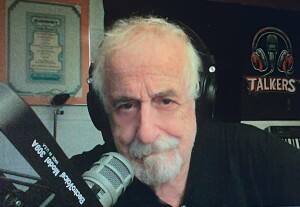 Today is Election Day in America. Finally! Now the talk media industry is about to learn what’s next? No matter which way the presidential race goes, the results will have a measurable impact on news/talk media’s positioning and strategy going forward for years to come. According to TALKERS publisher Michael Harrison, “That’s what happens when the news media operates within the paradigm of primarily ‘targeting’ audiences based on their pre-existing biases, opinions, and passions. The only objective seeking of truth that takes place within the formulation of media strategy, in this transactional environment, focuses on one basic concern – where does the audience, that we so zealously covet, stand on this?” During an editorial conference this morning, Harrison stated, “The two major media-base ‘camps’ that have emerged in the past decade on talk radio, news/talk TV, YouTube and podcasting, fall under the basic headings of the pro-Trump media industry and the anti-Trump media industry. Yes, both have grown into full-fledged industries – and their interests are deeply entangled. As cynical as this might sound, the deck is about to be reshuffled to one degree or another and talk media industry practitioners are going to have to pull off some fancy steps to avoid sinking into the quicksand of inevitable changes in public opinion – regardless of what shape these movements take.” Harrison adds, “If you’ll pardon the ancient reference, no one wants to be left playing Frankie Avalon and Bobby Rydell records the day after the Beatles’ and their British buddies invaded our pop culture.”
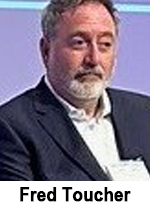 Toucher, who now co-hosts “Toucher & Hardy“ on 98.5 The Sports Hub, WBZ-FM, Boston took some time on this morning’s show (11/5) to address ”the elephant in the room.” Shertenlieb‘s new show on local classic rock outlet WZLX had been canceled after five months, and Toucher didn’t seem to have any sympathy for his former partner. In a story by reporter Nick O’ Malley posted on the news site MassLive.com, “I hate him,” Toucher said. “So, I was happy yesterday when I heard about this. But I was a little disheartened that he still carries none of the responsibility and takes none of the blame and still just can’t be honest.” Toucher and Shertenlieb co-hosted the “Toucher & Rich” show from 2009-2023, working together to produce one of Boston’s most popular morning shows. However, the show ran into issues in 2023. Toucher missed time due to personal and physical issues, including a stretch of time at an alcohol detox facility. In November, parent company Beasley Media said in a statement that Shertenlieb declined to accept a new contract. On Monday, Shertenlieb announced that he was “disappointed” that his show was being canceled after just five months. The radio host complained that management forced him to “alter the format” of the show by adding music. However, Toucher noted Tuesday that Shertenlieb’s show was a “ratings disaster.” “He not only did not bring in a new audience to that show, he alienated – based on ratings – their entire existing audience,” Toucher said. “He had like a third of the ratings that they got jockless in the morning … Yeah, management might have been a little concerned.” Toucher said that critics can paint the picture of his reaction however they like. But he did note that he and co-host Jon Wallach say they weren’t alone in celebrating the demise of Shertenlieb’s show. To see the complete article in MassLive.com, please
 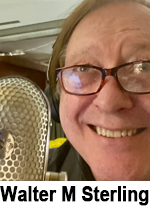 Take advantage of the new media order. Initially, TiVo was a hit because you could pause live TV and go to the bathroom whenever you wanted. Bathroom breaks while watching live TV was a revelation. As you were going to the bathroom, your relationship with media was being re-wired in your brain. In a matter of months, you were able to watch what you wanted, whenever you wanted. DECADES of TV scheduling strategies became anachronistic. It’s November. Do you know when your favorite shows are airing on TV? No! No need you’ll watch them whenever you want!
 WURD Radio Endorses Kamala Harris for President. For the first time in its 20+ year history, Philadelphia’s only Black-owned radio station, WURD Radio has endorsed a political candidate — Kamala Harris for President of the United States. Prompted in part by the decision from owners of the Los Angeles Times and The Washington Post to overrule planned endorsements by their editorial boards, sources at the station tell TALKERS, this decision underscores the importance of independent media ownership. From the endorsement: “Our founder, Walter P. Lomax Jr., M.D., understood that the media has the power to shape perceptions, images, narratives and, most importantly in this election, to tell the truth. He understood that the media can demonize or humanize, destroy or exalt, diminish or elevate. Dr. Lomax knew that mainstream media often marginalizes, caricatures and maligns Black people. WURD is in a unique position to speak honestly and emphatically about what matters most to our community because we are independently owned.” To read the entire text of the endorsement, please
  SiriusXM Tips Off College Basketball Coverage with 74 Games on Opening Night, November 4. SiriusXM will deliver college basketball fans an extensive schedule of live games throughout the 2023-24 college basketball season, starting with a slate of 74 women’s and men’s matchups to choose from when the season tips off this Monday (11/4). The men’s schedule includes all 19 teams from the Associated Press Top 25 that are in action on Monday night, including the season’s first matchup of Top 25 ranked teams – #8 Baylor @ #6 Gonzaga (11:30 pm ET). The opening day schedule of women’s games on SiriusXM includes 12 teams from the Associated Press Top 25 and features a couple of Top 25 matchups – #20 Ole Miss @ #3 USC (noon ET) and #5 UCLA @ #17 Louisville (2:30 pm ET). Throughout the season SiriusXM listeners will get access to dozens of game broadcasts each week involving teams from the SEC, Big Ten, Big 12, ACC, Pac-12, Big East and more.
 Newsmax Launches in France on Molotov. Newsmax TV, one of America’s most popular news channels, just launched on Molotov, one of France’s leading TV platforms, as U.S. voters go to the polls to pick their next president. The Newsmax channel went live on Molotov’s platform on October 24, 2024, expanding its global footprint with 19 million Molotov users in France and French-speaking territories. Molotov is one of France’s main TV services offering streaming television to internet users across the nation and its territories. Molotov subscribers can tune to Newsmax via the platform’s free tier.
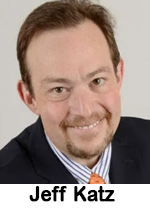 Media analyst, broadcaster, and trade journal publisher Michael Harrison appeared on the popular Jeff Katz afternoon drive show on WRVA, Richmond yesterday (10/29) to discuss comments he made earlier in TALKERS about the historic significance of former President Donald Trump‘s recent three-hour guest spot on the “Joe Rogan Experience” podcast. To listen to the fascinating discussion, please
 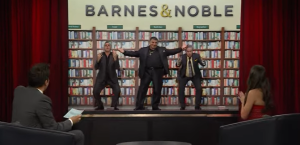 Proving There’s More to Life in America this Week than Just Presidential Politics. Pictured above is Salem Radio Networks (SRN) East Coast affiliate relations manager Jim Bligh – a frequent “player” in NYC-based skits on “Saturday Night Live“ in addition to appearing in theatrical feature films – joined NBC’s “The Tonight Show with Jimmy Fallon” on Tuesday 10/29). Fallon and Grammy-winning guest Olivia Rodrigo played “What’s Behind Me?”…a charade style game with Fallon describing action happening as her back was turned. Blight – far right – acted out a scene of Three Mobsters doing Yoga at a Barnes & Noble. See Bligh’s skit by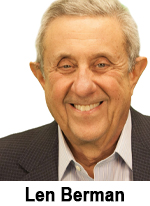
 “When iHeartMedia New York partnered with the New York Road Runners (NYRR) to produce this inaugural radio broadcast of the marathon, it was a no-brainer to put Len at the helm of the broadcast,” said Tom Cuddy, program director for 710 WOR. “His association with New York sports, during his more than 50-year television career, and his ‘second life’ as co-host of the WOR morning show since 2015, ensure that Len will make this a can’t-miss broadcast.” “I’m honored to be hosting WOR’s maiden voyage with the TCS New York City Marathon,” said Berman. “I’ve hosted TV coverage of the event many times and it’s consistently one of the best days of the year in the city. We look forward to conveying that same message to our listeners.”
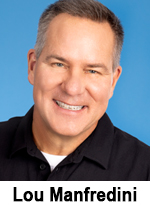 “I have been blessed to call WGN Radio home for the past three decades,” Manfredini tells TALKERS. “But in the end, it’s all about our listeners. I’m excited to continue to help them better understand how their homes work, show them they can have fun, and, of course, remind them to never hold a nail for someone else.” The Chicagoland native will be celebrating his 30th anniversary on WGN Radio in 2025. Mr. Manfredini first appeared on the station as a guest on the Bob Collins Show in 1995 following a letter writing campaign to pitch a call-in home improvement show on WGN.
 “We are delighted that Lou will be with us for his 30th year and beyond,” said WGN Radio VP/GM Mary Sandberg Boyle. “In the nearly 30 years since first appearing on WGN Radio, Lou’s presence across the media world has evolved considerably. Yet, what truly sets him apart is his natural gift of connecting to and interacting with our listeners in the special way that only radio does. Making those listener ‘connections’ has historically been – and will continue to be – the very fabric of WGN 720.” Manfredini can also be heard on weekday segments with John Williams (Mondays), Lisa Dent (Thursdays) and Bob Sirott (Fridays).
  It will be carried by LibertyNewsRadio.com or video stream at TheBigMigShow on Rumble. For additional information or press inquiries, please contact Sam Bushman at 801-756-9133 or LibertyRoundTable@gmail.com.
 One day last winter, Alison Stewart, the host of “All of It” on public station WNYC, New York was alarmed to find herself speaking gibberish.
 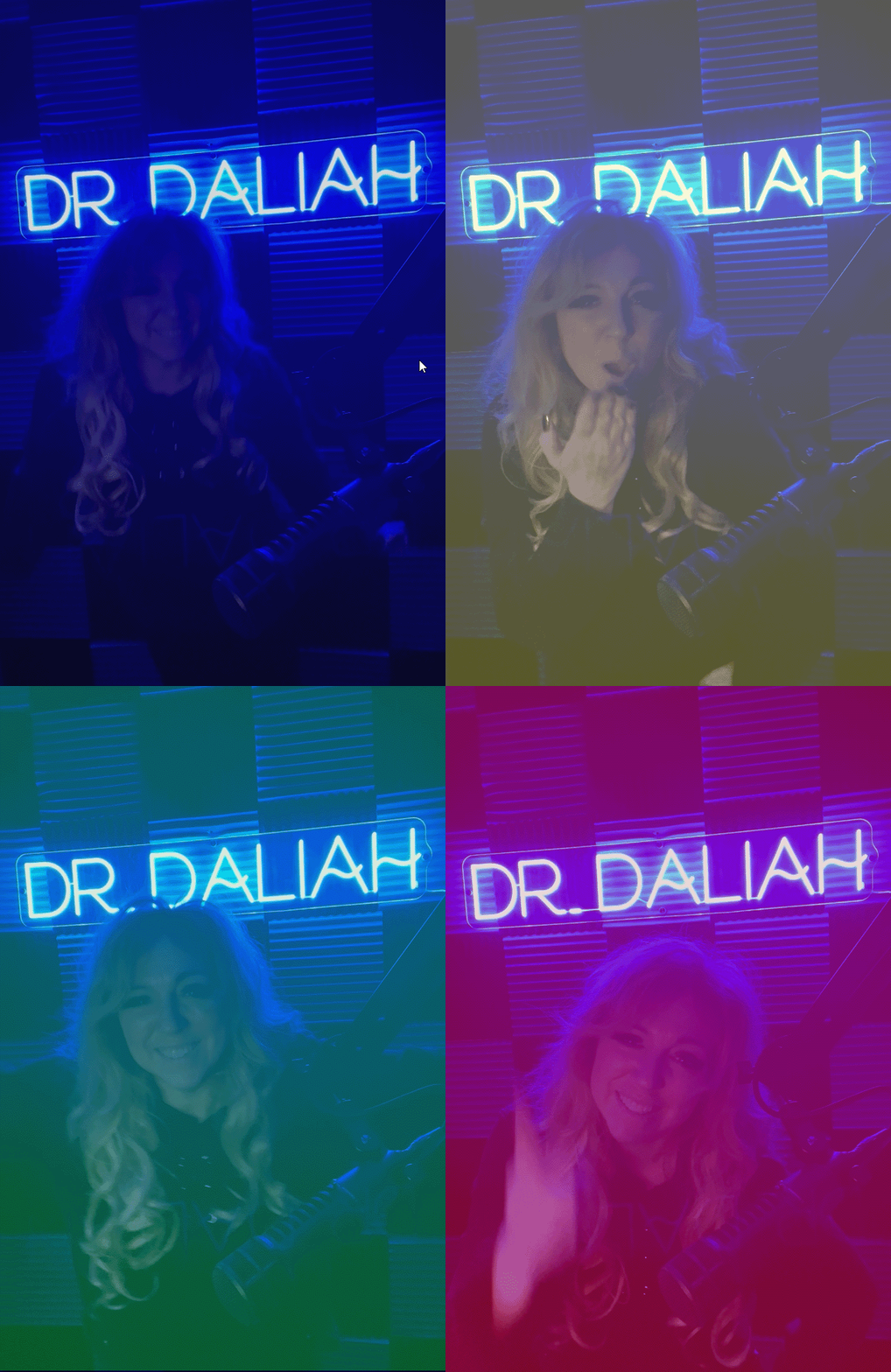 Music Group Gunhill Road Putting Final Touches on Talk Radio Anthem. Gunhill Road, the perennial pop music ensemble that has attracted hundreds of thousands of worldwide followers with its growing repertoire of issue-oriented songs and music videos, is currently in post-production with an anthem celebrating talk radio. Titled “Don’t Stop Talkin’” – the song is an uplifting and infectiously catchy tune about the vital role talk radio plays in serving the cause of American freedom of speech. With lines that include “As long as you’ve got a voice, don’t ever stop!” and “As long as you’ve got the truth, don’t ever stop!” the original composition co-written by band members Steve Goldrich, Paul Reisch, Brian Koonin, and Michael Harrison encourages talk radio practitioners to keep up the good work and great service they provide the nation.TALKERS Heavy Hundred syndicated host Dr. Daliah Wachs pictured above bopping to the music in a scene from the forthcoming video “Don’t Stop Talkin'” by Gunhill Road.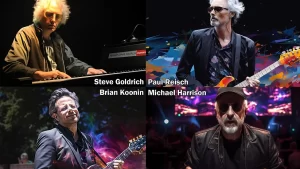


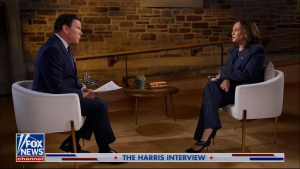 Ideology and, as Michael Harrison calls it, “the daily dance of affirmation” aside – perhaps there’s something to be said about booking “opposition” political luminaries as guests on our industry’s highly “targeted” venues. FOX News Channel’s (FNC) “Special Report with Bret Baier” delivered 7.8 million viewers and 1,126,000 in the 25-54 demo during anchor Bret Baier’s exclusive interview with VP Kamala Harris from 6:00 pm – 6:30 pm ET this past Wednesday (10/6), according to Nielsen Media Research. The interview marked the highest rating of the Harris-Trump political season, outrating Harris’s individual appearances on “60 Minutes,” “The View,” “The Late Show with Stephen Colbert,” CNN and MSNBC. For the full 6:00 pm ET hour, “Special Report” drew 6.7 million viewers and 901,000 in the 25-54 demo. Combined with the show’s midnight airing 12:00 midnight -12:30 am ET, the interview with VP Harris nabbed 9.2 million viewers and 1.4 million in the 25-54 demo, beating ABC’s interview with President Joe Biden before he dropped out of the race (8.5 million viewers).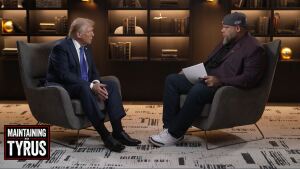
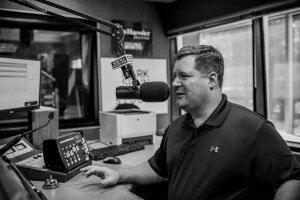
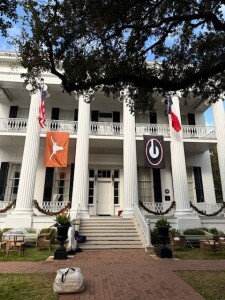 95.5 WSB, Atlanta (and nationally syndicated) TALKERS Heavy Hundred star, Erick Erickson is giving both sides an airing today (10/18) in his midday show that he’s broadcasting from the parlor in the Texas Governor’s Mansion (see pic at left) before UGA battles University of Texas tomorrow. He tells TALKERS, he’ll have on both Governors Gregg Abbott (R-TX) and Brian Kemp (R-GA) to talk about the border, the election, and football.