

When the Library Talks Back

By Matthew B. Harrison
TALKERS, VP/Associate Publisher
Harrison Legal Group, Senior Partner
Goodphone Communications, Executive Producer
 Imagine SiriusXM acquires the complete Howard Stern archive – every show, interview, and on-air moment. Months later, it debuts “Howard Stern: The AI Sessions,” a series of new segments created with artificial intelligence trained on that archive. The programming is labeled AI-generated, yet the voice, timing, and style sound like Stern himself.
Owning the recordings might suggest the right to create new works from them. In reality, the answer is more complicated – and the music industry offers a useful comparison.
Music Industry Precedent
Sony, Universal, and others have spent hundreds of millions buying music catalogs from artists such as Bob Dylan, Bruce Springsteen, Paul Simon, and Queen. These deals often include both composition rights and master recordings, giving the buyer broad control over licensing and derivative works.
In music, the song and the recording are the assets. In talk content, the defining element is the host’s persona – voice, cadence, and delivery – which changes the legal analysis when creating new material.
Copyright and Persona Rights
Buying a talk archive usually transfers copyright in the recordings and any scripts. That permits rebroadcast, excerpts, and repackaging of original programs.
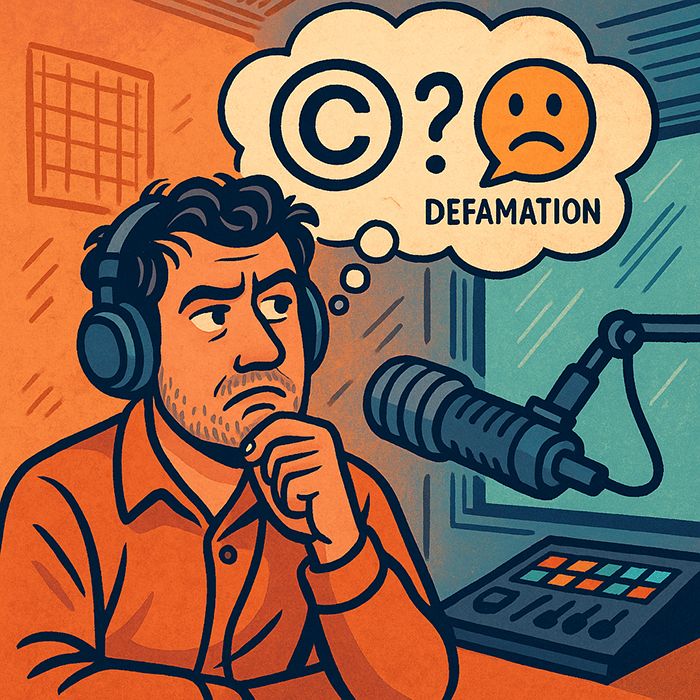
It does not automatically transfer the host’s right of publicity – control over commercial use of their name, likeness, and in many states, their distinctive voice. In Midler v. Ford Motor Co. (1988), the court ruled that imitating Bette Midler’s voice in a commercial without consent was an unauthorized use of her identity.
This means a company can own the shows without having the right to make new performances in the host’s voice unless the contract clearly grants that right.
The AI Factor
AI technology can replicate a host’s voice, tone, and style with high accuracy, producing entirely new programming.
Outside broadcasting, a recent AI-generated George Carlin special – written by humans but performed by a voice model trained on decades of his work – sparked debate about rights and legacy.
In talk radio, similar AI use could create “new” episodes featuring well-known hosts. Even with clear labeling, right-of-publicity claims may arise if the host or their estate never authorized it. Disclaimers may address consumer confusion but do not remove identity-rights issues.
Why It Matters
This applies to more than national figures. Any broadcaster or podcaster with a substantial archive could face it. Selling or licensing a library could give the buyer the tools to replicate your voice without your participation.
For buyers, the ability to produce new content from archived material has commercial appeal. But without the right to use the host’s voice for new works, it carries significant legal and reputational risk.
Contracts Decide
The key is in the contract:
— Did the talent assign rights to their name, likeness, and voice for future works?
— Is use limited to original recordings or extended to derivative works?
— Does it address future technologies, including AI?
Older agreements often omit these points, leaving courts to decide. Future contracts will likely address AI directly.
Takeaways
For talent: Know what you are transferring. Copyright ownership does not necessarily include your future voice.
For buyers: Owning an archive does not automatically give you the right to create AI-generated new material in the original host’s voice.
For everyone: As AI advances, control over archives will depend on the contracts that govern them.
Matthew B. Harrison is a media and intellectual property attorney who advises radio hosts, content creators, and creative entrepreneurs. He has written extensively on fair use, AI law, and the future of digital rights. Reach him at Matthew@HarrisonLegalGroup.com or read more at TALKERS.com.
 You did everything right – or so you thought. You used a short clip, added commentary, or reshared something everyone else was already posting. Then one day, a notice shows up in your inbox. A takedown. A demand. A legal-sounding, nasty-toned email claiming copyright infringement, and asking for payment.
 South Florida viewers are confused. WPLG, which brands as “Local 10,” was an ABC-TV affiliate for 69 years… until yesterday. Now it’s more local than ever, after divorcing its network, whose programming moved to the FOX affiliate’s digital channels 18.1 and 7.2, now branded “ABC Miami.” Among courteous FAQs about this change on WPLG’s web site: “How do I rescan my TV?” to find ABC programming.
 Reviewing radio’s challenges:
 Why we’re already seeing TV tout its coming attractions: They understand how, after Labor Day, routines settle in. Viewers will be ready to re-engage.
 Mark Walters

 Ask any dog: The humans’ greatest invention EVER? Ice cream. Share summer’s sweetest treat with them, and listeners, during National Ice Cream Month.
 In radio and podcasting, editing isn’t just technical – it shapes narratives and influences audiences. Whether trimming dead air, tightening a guest’s comment, or pulling a clip for social media, every cut leaves an impression.
 Let’s look into the crystal ball. Humor me if you will.
 Let’s discuss how CBS’s $16 million settlement became a warning shot for every talk host, editor, and content creator with a mic.
 Music on the weekend provides multiple positive strategic weapons for talk stations. From launch, “New Jersey 101.5” (1,000,000+ cumer); WTKS-FM “Real Radio,” Orlando; WABC, New York; WPHT, Philadelphia; and other major market winners air music all weekend or on dayparted shows.
 Are archived shows – whole hours – your station’s only on-demand offering? It’s an easy checkbox: post the aircheck, call it a podcast.
 If you saved back issues from when TALKERS was a print tabloid, dig-down about 20 years into the stack. A couple times a year beginning then, I was reporting from conferences then called The Podcast and New Media Expo, which later evolved into NMX and BlogWorld and other incarnations.
 The drive to stream video of radio shows has always been risky. Remember your shock when you first saw one of your radio heroes? Video streaming can present a constant disconnect between the show in the listener’s head and the show on the stream. Many stations make the disconnect worse by streaming terrible video images. Combine the trauma of how a host really looks with a dreary TV show and the package cannot benefit the relationship between station and listener/viewer.
 right, two shows… one on the radio, one on the stream. Seamless and fun.
 With so many of us taking vacation time soon, guest hosts are often local somebodies who are not career broadcasters and don’t share our second-nature performance routines. For their benefit, these tips, based on my experience on both sides of the mic:
 At first, I thought it was a joke. When I realized there were serious people having serious meetings about the joke, it became both horrific and symptomatic
 In the golden age of broadcasting, the rules were clear. If you edited the message, you owned the consequences. That was the tradeoff for editorial control. But today’s digital platforms – YouTube, X, TikTok, Instagram – have rewritten that deal. Broadcasters and those who operate within the FCC regulatory framework are paying the price.
 This coming Sunday, June 15, is Father’s Day. For that day – and the Friday before (hint-hint) – you might have already readied Harry Chapin’s “