By Walter Sabo
A.K.A. Walter M Sterling
WPHT, Philadelphia
Sterling Every Damn Night
Sterling on Sunday Syndicated, TMN
Another Side of Midnight, WABC, New York
 In 1952, the success formula for today’s radio was discovered and put into practice by two hungry entrepreneurs: Todd Storz and Gordon McLendon. Both men owned dying radio stations in medium and major markets. The industry was suffering from a lack of purpose or solutions due to the advent of television which drove the migration of hit network radio shows to television. Lucille Ball, Bob Hope, and Gertrude Berg were on radio first.
Storz and McLendon developed “Top 40” with their own brains and money. Top 40 was research and focus group based, as well as. Storz tried it first in Omaha, then Kansas City and Miami. McLendon in Dallas, Houston, Minneapolis, and New Orleans. The formula was simple but not obvious. Their common-sense solution worked in all formats: music and talk.
Ruth Meyer was Storz’s PD in Kansas City and I worked with her at ABC. She was very clear when outlining the Storz history, “It was all Todd.”
Success ingredients
The formula: Target one demographic. Play their hits – often. Call out the names of as many people in the audience as possible – make the listener a star. Present with enthusiasm. Promote at every local crowd event possible. Repeat.
All of the McLendon and Storz stations grew instantly, usually to number one.
That ingredient list works repeatedly for station after station for decades. But, and here’s the but, all of those ingredients have to be in the recipe. Leave out promotion, for example, or research, and it doesn’t work. But the full ingredient list does work for every single format.
I asked Mickey Luckoff, who ran talker KGO as the number one station in San Francisco for most of our lives, how he selected his on air talk hosts to which he replied, “They all come from top 40 because I can teach them talk but I can’t teach them radio.” His promotions were non-stop and smart, TV campaigns were non-stop and research, yes, research – non-stop!
When Adult Contemporary was evolving, my team was responsible for the NBC FM properties. Corporate finance people who went to Wharton urged me to go slow, layer in expenses when launching this odd new format. I knew layering was a recipe – for failure!!! All the ingredients had to be rolled out at once. In 1981, WYNY in New York had a $2 million dollar cash and a $2 million barter promotion budget. Result, a $3 million profit and a 5 share. Thanks to PD Pete Salant and GM Al Brady Law. We used the Storz/McLendon recipe with AC music and Dr. Ruth, it obviously works.
WGMS-FM was a classical station in Washington, DC. When it was owned by RKO and run by visionary Jerry Lyman, it applied the Storz/McLendon recipe to classical music. Their promos announced that WGMS played “Real Oldies – Your favorites from the 1600s, 1700s and 1800s!” WGMS aired a tight playlist of hits. Special weekends were popular, such as a “Beethoven Weekend” with t-shirt giveaways. The station was a profit monster, top 10 in Washington DC.
Five years ago, WABC-AM was about 28th in NYC as a result of cutting costs, by god the cost cutting was epic and so was the failure. Today, John Catsimatidis, the owner, and Chad Lopez, the president, have grown the station to a 4 share and number eight in New York. An AM talk station, number eight and growing. What? How? They put in all the ingredients. The station is data driven. The talent is live. External paid ads run for WABC almost every single day. The air team goes to local events to meet the crowds. WABC airs live listener music requests and dedications on the weekend with Cousin Bruce Morrow and Joe Piscopo – live. Did I mention live?
Today not history
The team is happy. They are making radio. This isn’t nostalgia. Mr. Cats is a very current based businessman who expects results. Like Storz and McLendon he is an entrepreneur, a private owner deploying common sense. He’s doing what is proven, what works. Bravo.
Conclusion: There is nothing wrong with radio. Just stop. Include every ingredient in the proven recipe; expect stunning results.
Walter Sabo has been a C-Suite action partner for companies such as SiriusXM, Hearst, Press Broadcasting, Gannett, RKO General, and many others. His nightly show “Walter Sterling Every Damn Night” is heard on WPHT, Philadelphia. His syndicated show, “Sterling On Sunday,” from Talk Media Network, airs 10:00 pm-1:00 am ET, and is now in its 10th year of success. He recently began hosting “Another Side of Midnight” weekends on WABC, New York. He can be reached by email at sabowalter@gmail.com or phoned at 646-678-1110.





 When in doubt, I recall smart quotes from people in our business who are successful, well paid, kind, and future oriented. I have always focused on what’s next rather than what’s been. These observations drive good results:
 By Walter Sabo
 “It’s all media,” declared accomplished media executive Jack Griffin when confronted with brand new definitions of content and content distribution. Jack, for years, was president of Meredith Publishing, Time Inc., and The Tribune Company. I met Jack when he was publisher of PARADE magazine. Jack is pragmatic, won’t waste your time and spots BS faster than most humans. We were listening to discussions of the impact of online media versus traditional media, and his line was running out. Jack declared “It’s all media” and the meeting blessedly ended. The phrase haunts me and it is being proven true every second of every day.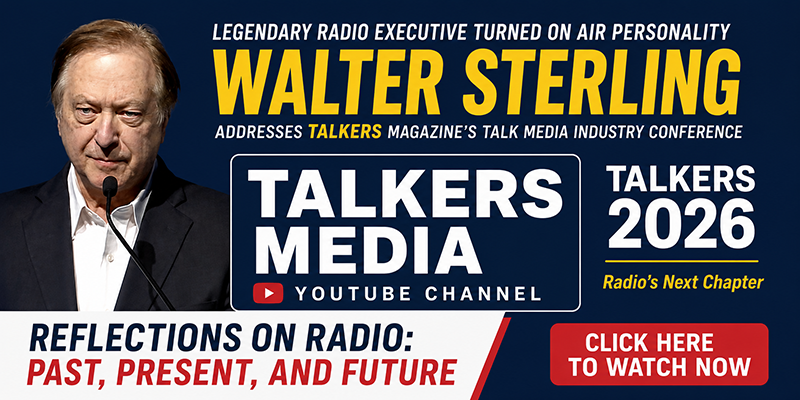
 Billionaires make predominantly good investments, which is why they are billionaires.
 Jay Clark was the first program director of WABC as a talk station. He set the tone and path for modern talk radio. This week I had Jay on as a special guest on the Red Apple Audio Networks all night show, “The Other Side of Midnight.” We celebrated the anniversary, May 10, (1982) of WABC’s switch from music to talk on the giant signal at 770 AM.
 format in America. KGO was the killer biller in San Francisco. The execs who ran them were mighty proud: Ben Hoberman, Ed McLaughlin, Al Racco, Chuck Debere. Yes, they ran those stations, but they also invented the caller-driven talk format. There were other winning talk stations, but they were guest centric rather than listener centric (i.e. WOR, WGN). At the time, there were 43 stations listed as “talk” stations. 43. Not many models.
 Talk radio has a long incredibly successful run of shows about sex.
 I am pleased to be speaking this weekend at the IBS New York 2026 conference in New York City. Thank you, TALKERS magazine, for being the presenting sponsor of this important, timely annual event along with the Intercollegiate Broadcasting System (IBS).
 “Darn, if we were on FM everything would get better.” Not true. This writer launched many of the successful talk formats on FM stations in the early 1990s. The ones that worked, such as KLSX, Los Angeles; WTKS, Orlando; and New Jersey 101.5 in Trenton, were produced for the unique demands of FM. Then and today, the FM band cume utilized the radio in a completely different manner than AM audiences. The competition on FM isn’t another talk show. It’s Chapelle Roan and Taylor Swift. Ya know, billion-dollar Taylor Swift. The production values of FM music stations set the expectations of “the sound.” “Let’s pay some bills…” Followed by bumper music! Followed by eight minutes of commercials for Med Alert is just not what FMers are used to hearing on Elvis Duran. (Elvis is doing a talk show.)
 The plague of pessimism about the future of radio is fueled internally by radio employees. Doomsayers are logically found in the sales department. All day, salespeople meet with buyers. A buyer’s job is to negotiate a lower price by arguing radio’s negatives. The wall of negativity thrives within the work environment of a seller. Tough. But there is little or no reason for pessimism.
 Talk show hosts are not motivated or driven like disk jockeys or salespeople. Most general managers have never managed talk show hosts. Few program directors have managed talk show hosts. My career has been blessed with daily exchanges with the best talk show hosts in history. Here are some suggestions I would like to share on how to have a superior relationship with talk stars.
 Advice columns blanketing sites like LinkedIn, the Skimm, and Forbes 2.0 – aimed at recent graduates – encourage their readers to seek and bond with an at-work mentor. After years of skimming “5 bullet” articles, I have reached the tipping point and I’m not going to take it anymore: Seeking a mentor as a career strategy is horrible advice. Just horrible.
 Andy Economos, the founder of Radio Computing Systems (RCS), was a leader in bringing digital tech into the radio industry. In 1980, he was leaving his position as head of technology for NBC Inc. to start his own company. I was EVP of the NBC FM stations. Andy and I were walking to lunch, crossing Sixth Avenue at 49th street and he asked me, “Is there any software your radio stations could use?”
 Finally. Not by Facebook, TikTok, Instagram, nope; I was banned from a WBIR anchor’s video live stream.
 One of my first jobs out of college was working in the marketing department of WNBC-AM, New York. Yes, “Imus In The Morning” (Don Imus – not nice), Cousin Brucie (Bruce Morrow – nicest star who ever lived). One of my tasks was to pull ratings numbers from the computer for the sales department. I was fascinated by TIME SPENT LISTENING (TSL) and CUME numbers. I’d rank them, compare, trend them every way imaginable.
 The groaning and moaning that “radio is losing younger demos and will die tomorrow” misses the point. What attracts younger audiences? What has always attracted younger audiences? NEW STUFF. New clothes, shows, slang, ideas… NEW. When you “found” radio, you found a top 40 station that was saturated in the latest music, events and ATTITUDE. Radio remains vital by presenting and celebrating new, shocking, contest prizes, revolutionary ideas, hosts, jocks… NEW.
 The world of blogs and vlogs has been loaded with largely erroneous news of MTV closing. New owner, Paramount Global, is searching for divisions showing no growth. If MTV is now a liability, it may be a target for a shutdown.
 of the Gods has powered thousands of hours of programming fun. Recently, I saw the latest edition of his book.
 Like many of you, I love “Ancient Aliens” on the History Channel narrated by the formidable Robert Clotworthy. Robert is a great guest on my show, “Sterling Every Damn Night” and he puts up with whatever nonsense that gets tossed at him. Thank you, Robert.
 As a media consultant, my team has had the privilege of being engaged extensively by members of the C-Suite. Becoming a member of the C-Suite is a common goal. To get into any group, acceptance often depends on acting and appearing like established members. Here are some of the actions observed of business masters whom we consulted:
 Have you noticed a profile pattern for the mass shooters and political assassins? 20-30 years old. Living at home or close.
 Amazon learned that there are high volume sales for specific categories of products. High demand equals high value to the seller. Items such as diapers, printer ink, staplers, batteries, etc. Being brilliant, Amazon created “Amazon Basics.” Same products, white labeled. Amazon doesn’t manufacture batteries; they just slap their logos on what America needs most. That’s why Mr. Bezos has a bigger boat than you.
 The risk is real. Suggesting that a technique used with great success in the recent past might be beneficial to the present is a perilous course. Is the idea out of touch with today’s reality? Is the author ignoring current trends?