Surprisingly, that iconic summertime feel-good song almost never made it to vinyl…
By Mark Wainwright
 Consider the following song titles:
“There Goes My Baby”
“Save the Last Dance For Me”
“On Broadway”
“Up On the Roof”
“Dance With Me”
“This Magic Moment”
You don’t have to be a battle-scarred radio veteran like me, or an older music fan who remembers hearing those songs as a youngster to immediately recognize these as hits recorded by The Drifters. These songs, and all their other successful releases, were constantly played on the air back in the glory days of AM Top-40 radio, and they are still widely heard and enjoyed today, sometimes in surprising settings; “This Magic Moment” recently turned up in a TV commercial for Heinz ketchup. It is scarcely possible to imagine the history of American popular music without these songs.
Now try this little experiment:
Pull YouTube up on your browser, type the words “Under the Boardwalk” in the search box, and see what pops up. You could spend days (seriously) going through all the uploads from folks who posted that favorite Drifters tune, not to mention all the subsequent recordings made over the years. Some of the names will surprise you. Did the Rolling Stones, of all people, actually record “Under the Boardwalk”? Indeed they did, along with folks like Bruce Springsteen (yo, he’s a Jersey Shore guy, why not?). The song has became a standard, a staple of oldies bands and doo-wop vocal groups who continue to perform the song today. And yet, this most iconic of summertime feel-good songs was within hours of never being recorded. The backstory of that episode, along with the odd twists and turns of the group’s history, deserves some attention.
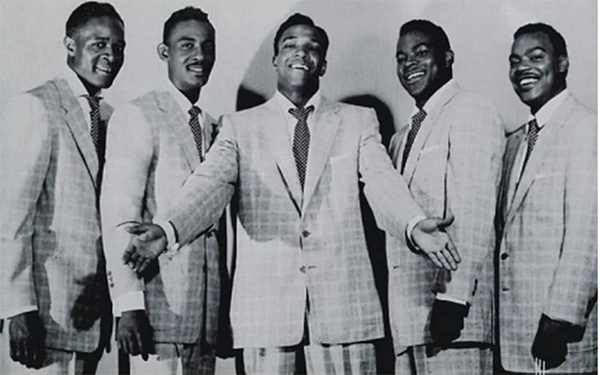
The Drifters (pictured below in an early photo courtesy of YouTube) were a 1950s brainchild of agent and producer George Treadwell, who got his hands on an early version of the group and envisioned them as sort of all-purpose background singers for hire who could be farmed out to provide background vocals for recording sessions, and for featured performers doing live gigs. Treadwell never thought of them as having a set lineup, he figured that vocalists would drift in and out of the group as needed (hence the name). The group became successful in their own right after their 1953 release “Money Honey” (Clyde McPhatter was the lead singer back then), and they never looked back. For more than a decade, hardly a week went by where you wouldn’t see a Drifters tune somewhere on the music charts.
Treadwell’s management of the group could be capricious, to say the least. He once purportedly fired the band and replaced them with another new group of singers who then performed a show scheduled for the following night (he might have done something like this more than once). Somehow, it all managed to work out. Dozens of vocalists were part of the group at various times, although when The Drifters were inducted into the Rock and Roll Hall of Fame in 1988, there were seven performers who were cited as critical to the group’s success. I believe Charlie Thomas was the last of these fine singers, and he died in January this year.
“Under the Boardwalk” was written in 1964 by Kenny Young and Arthur Resnick and they offered it to The Drifters, who immediately saw the potential. A recording session was set for May 21, 1964 (already pushing the calendar for summer release), but the night before the session, lead singer Rudy Lewis died of a suspected heroin overdose. George Treadwell and the folks at Atlantic Records really wanted to get the tune out there, so they finally decided to record the song as scheduled. Johnny Moore was called upon to sing the lead vocal; he was the group’s designated backup lead vocalist who would fill in when needed.
One can hardly imagine what these guys were thinking and feeling under the circumstances, but they got through it, Johnny Moore did a superb job, and the final result was amazing. The group actually cut alternate takes of the song. Some radio stations were hesitant to play a record containing the lyric “making love under the boardwalk” (remember, this was 1964), so other takes were done with the replacement line “falling in love under the boardwalk.” It was released in June and was constantly heard on the great AM Top-40 stations of the day, and played incessantly on jukeboxes nationwide. The song spent three weeks at #1 on the Cashbox magazine R&B chart, and got as high as #4 on the Billboard Hot 100 chart. The song would have almost certainly been a Billboard #1, except for a quartet of young Brits who called themselves “The Beatles.” You might recall they also had some pretty good tunes out there at the time.
And the date of that highest Billboard chart position? August 22, 1964. Fifty-nine years ago today.
So now comes the inevitable YouTube link. I think this one is the original track containing the “naughty” lyrics. Turn up the volume and enjoy! (And remember, you should use lotion that has a minimum rating of SPF 30!)
Under the Boardwalk – The Drifters
Mark Wainwright is a veteran radio performer who spent more than 30 years working as a disc jockey, talk show host, and morning personality at well-known radio stations throughout the United States. He was most recently the morning host at WSYR in Syracuse, New York. (He was even a pretty good AM Top-40 jock back in the day, just ask him!) He can be reached through his LinkedIn page or at markwainwright@earthlink.net



 By Walter Sabo